


11 Aug UP TTZ Industries: 10-Point Survey for New & Existing Units Explained
✎ The Taj Trapezium Zone (TTZ) is a Supreme Court-mandated ecological zone where industrial activities are regulated under the 'precautionary principle' and 'polluter pays' doctrine, with compliance verified through a 10-parameter…
Subject Relevance — Where This Topic Fits
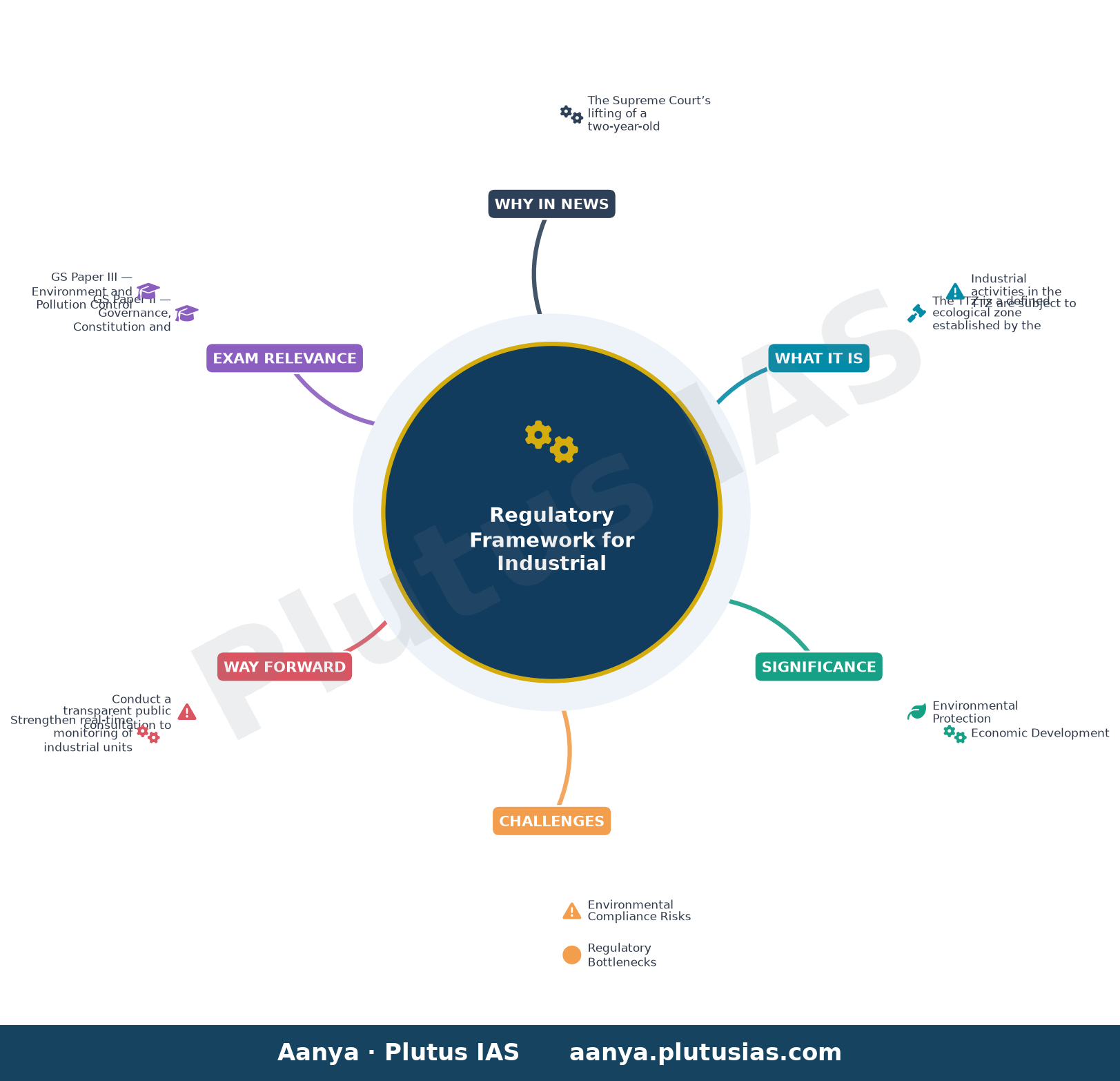
- GS Paper II — Governance, Constitution and Polity | GS Paper III — Environment and Pollution Control | GS Paper III — Industrial Policy and Regulation
- Prelims: Taj Trapezium Zone (TTZ), Supreme Court directives on pollution control, Environmental Impact Assessment (EIA), Micro, Small and Medium Enterprises (MSMEs), Pollution Control Board (PCB), National Environmental Engineering Research Institute (NEERI), Central Empowered Committee (CEC), Industrial expansion regulations
- Essay: Balancing environmental conservation with economic development: The case of the Taj Trapezium Zone, Judicial activism in environmental governance: Ensuring sustainable industrialisation
Quick Revision: The Taj Trapezium Zone (TTZ) is a Supreme Court-mandated ecological zone where industrial activities are regulated under the ‘precautionary principle’ and ‘polluter pays’ doctrine, with compliance verified through a 10-parameter survey including land-use, EIA reports, and air pollution control infrastructure.
Why is this in the news?
The Supreme Court’s lifting of a two-year-old moratorium on new industrial units and expansion of existing ones in the Taj Trapezium Zone (TTZ) has necessitated a structured verification process. A joint survey by the Pollution Control Board, District Industries Centre, and district administration is underway to assess 208 MSME units across 10 critical parameters, including land-use compliance, environmental impact assessments, and air pollution mitigation infrastructure. This development underscores the judicial-executive interface in balancing environmental protection with industrial revival in ecologically sensitive zones.
Background
- The TTZ is governed by the Taj Trapezium Zone Authority (TTZA), chaired by the Divisional Commissioner, with oversight from the Central Empowered Committee (CEC) and technical inputs from the National Environmental Engineering Research Institute (NEERI).
- Air pollution in the TTZ is exacerbated by vehicular emissions, construction activities, and industrial effluents, necessitating stringent compliance with the Air (Prevention and Control of Pollution) Act, 1981.
What is the Taj Trapezium Zone (TTZ) and its regulatory framework?
- The TTZ is a defined ecological zone established by the Supreme Court to protect the Taj Mahal and its environs from environmental degradation, primarily air pollution.
- Industrial activities in the TTZ are subject to prior environmental clearance under the Environment (Protection) Act, 1986, and must comply with the National Ambient Air Quality Standards (NAAQS).
- The TTZ Authority, chaired by the Divisional Commissioner, is the nodal body for implementing pollution control measures, including the establishment of green belts, monitoring of industrial emissions, and enforcement of closure orders against non-compliant units.
- The Central Empowered Committee (CEC) and NEERI provide technical and scientific inputs to the TTZ Authority, particularly for assessing the environmental impact of industrial expansion proposals.
- The verification process for industrial units in the TTZ involves 10 key parameters: land-use compliance, environmental impact assessment reports, air pollution control measures, effluent treatment plants, hazardous waste management, noise pollution levels, solid waste disposal, compliance with the Water (Prevention and Control of Pollution) Act, 1974, compliance with the Environment (Protection) Act, 1986, and adherence to the Supreme Court’s directives.
- The Supreme Court’s role in the TTZ is pivotal, with its directives often superseding executive decisions to ensure environmental justice, as seen in the 2026 order lifting the moratorium on industrial expansion.
- The TTZ model exemplifies the principle of ‘polluter pays’ and ‘precautionary principle’ in environmental governance, where industrial development is permitted only if it does not compromise ecological integrity.
Key Features
| Feature | Significance |
|---|---|
| Survey of existing and new industrial units in TTZ | Ensures compliance with environmental norms and judicial directives for industrial expansion or establishment in the Taj Trapezium Zone. |
| Verification on 10 key parameters | Includes land-use compliance, project feasibility, air pollution control measures, and effluent treatment infrastructure, aligning with environmental safeguards. |
| Mandatory approvals from TTZ Authority, CEC, and NEERI | Ensures multi-layered scrutiny to balance industrial growth with heritage conservation and ecological sustainability. |
| Supreme Court’s conditional relaxation of ban on new industries | Temporary lifting of the 2024 moratorium to facilitate economic activity while maintaining environmental oversight. |
| Role of District Industry Centre (DIC) and Pollution Control Board | Institutional coordination to verify compliance and recommend approvals for industrial units. |
Why it Matters
Environmental Protection
- Preservation of the Taj Mahal and its surrounding ecosystem through strict enforcement of the Taj Trapezium Zone (TTZ) regulations.
- Prevention of irreversible damage to the monument and its buffer zone from industrial pollution, aligning with the Environment Protection Act, 1986.
- Implementation of the Supreme Court’s directives (2024) to balance industrial growth with heritage conservation.
Economic Development
- Facilitation of industrial expansion in MSMEs, particularly in sectors like foundries and manufacturing, to boost local employment and economic activity.
- Potential for increased investment in the Agra region, leveraging its geographical proximity to national highways and logistics hubs.
- Revival of stalled industrial projects due to the moratorium, enabling businesses to scale operations and contribute to state GDP.
Institutional Governance
- Demonstrates inter-departmental coordination among the TTZ Authority, CEC, NEERI, Pollution Control Board, and District Administration.
- Highlights the role of judicial oversight in environmental governance, ensuring adherence to constitutional and statutory mandates.
- Strengthens the regulatory framework for industrial approvals in ecologically sensitive zones.
Judicial Precedent
- Reinforces the principle that economic development must not compromise environmental sustainability, as established in landmark judgments like M.C. Mehta vs. Union of India (1996).
- Illustrates the judiciary’s proactive role in environmental governance, particularly in heritage conservation zones.
Challenges
1. Environmental Compliance Risks
- Risk of industrial units circumventing pollution control measures despite stringent verification processes.
- Potential for air and water pollution in the TTZ if effluent treatment and emission standards are not rigorously enforced.
- Long-term ecological damage to the Yamuna river basin and the Taj Mahal’s microclimate due to unchecked industrial activity.
UPSC Link: Environmental Pollution and Control
2. Regulatory Bottlenecks
- Delays in approval processes due to multi-layered scrutiny by TTZ Authority, CEC, and NEERI, despite the Supreme Court’s conditional relaxation.
- Inconsistencies in land-use verification, particularly in areas with overlapping legal jurisdictions (e.g., forest land, protected monuments).
UPSC Link: Administrative Reforms
3. Economic Viability vs. Conservation
- Balancing the economic benefits of industrial expansion with the long-term costs of environmental degradation in a UNESCO World Heritage Site.
- Potential resistance from local communities and environmental groups if industrial activities are perceived to threaten livelihoods or heritage.
UPSC Link: Sustainable Development
4. Judicial Overreach Concerns
- Criticism of judicial activism in environmental governance, where courts may overstep executive and legislative roles in policy implementation.
- Risk of ad-hoc interventions by courts in industrial approvals, leading to policy uncertainty for businesses.
UPSC Link: Judicial Activism and Separation of Powers
5. Public Participation Gaps
- Limited transparency in the survey and verification process, raising concerns about public accountability and stakeholder engagement.
- Absence of a formal grievance redressal mechanism for affected communities or environmental groups.
UPSC Link: Public Participation in Governance
Challenges — UPSC Perspective
| Issue | Concern |
|---|---|
| Air pollution from industrial emissions | Threat to the structural integrity of the Taj Mahal and respiratory health of local populations. |
| Water pollution from untreated effluents | Contamination of the Yamuna river, affecting biodiversity and downstream communities. |
| Land-use violations in TTZ buffer zones | Encroachment on protected areas, leading to habitat destruction. |
| Delays in approvals due to bureaucratic hurdles | Stalling of industrial projects, impacting economic growth and employment. |
| Lack of real-time monitoring of industrial units | Difficulty in ensuring continuous compliance with environmental norms. |
Way Forward
- Conduct a transparent public consultation to address concerns of local communities and environmental groups regarding industrial expansion.
- Strengthen real-time monitoring of industrial units using IoT-based sensors for air and water quality, integrated with NEERI’s data systems.
- Establish a dedicated grievance redressal mechanism under the TTZ Authority to resolve disputes related to land-use and pollution control.
- Enhance inter-departmental coordination by digitising the approval process for industrial units, reducing bureaucratic delays.
- Implement a phased rollout of industrial expansion, prioritising units with proven compliance records and low environmental impact.
- Conduct periodic environmental impact assessments (EIAs) for all industrial units in the TTZ, with mandatory third-party audits.
- Launch awareness campaigns for MSMEs on sustainable industrial practices, including waste management and energy efficiency.
- Collaborate with UNESCO’s World Heritage Centre to align TTZ regulations with international conservation standards.
UPSC Value Addition
Keywords for Mains Answer-Writing
Taj Trapezium Zone (TTZ) · Taj Mahal conservation · Supreme Court directives on industrial activity · Environmental Impact Assessment (EIA) · Pollution Control Board (PCB) · Industrial units verification · Air pollution control measures · Environmental Engineering Research Institute (NEERI) · Central Empowered Committee (CEC) · MSME (Micro, Small and Medium Enterprises) units
Constitutional & Policy Linkages
- Article 48A (Directive Principles of State Policy) — Protection and improvement of environment and safeguarding of forests and wildlife.
- Article 51A(g) (Fundamental Duties) — Duty of every citizen to protect and improve the natural environment.
- Seventh Schedule (State List, Entry 18) — Land, including land revenue and land improvement.
- Seventh Schedule (Concurrent List, Entry 17) — Prevention of water pollution and air pollution.
Concept Flow
Supreme Court imposes moratorium on new industries in TTZ (2024) → Economic stagnation in MSMEs → Judicial relaxation of ban (conditional) → Survey and verification of industrial units on 10 parameters → Approval process via TTZ Authority, CEC, and NEERI → Industrial expansion or establishment → Environmental monitoring and compliance → Long-term impact on Taj Mahal and local ecosystem.
Prelims Practice Questions
Q1. Consider the following statements regarding the Taj Trapezium Zone (TTZ):
1. TTZ is a defined area around the Taj Mahal designated for environmental protection.
2. The Supreme Court of India has imposed a complete ban on all industrial activities within TTZ.
3. The Central Empowered Committee (CEC) is involved in the regulatory oversight of TTZ.
How many of the above statements are correct?
- Only one
- Only two
- All three
- None
Answer: Only two — Statement 1 is correct as TTZ is a protected area around the Taj Mahal. Statement 2 is incorrect because the Supreme Court has not imposed a complete ban but has regulated industrial activities through specific directives. Statement 3 is correct as the CEC is a body involved in environmental oversight.
Q2. Assertion (A): The National Environmental Engineering Research Institute (NEERI) plays a key role in assessing environmental impacts of industrial units in the Taj Trapezium Zone.
Reason (R): NEERI is a premier research institute under the Council of Scientific and Industrial Research (CSIR) mandated to conduct environmental impact assessments.
Options:
A. Both A and R are true, and R is the correct explanation of A.
B. Both A and R are true, but R is NOT the correct explanation of A.
C. A is true, but R is false.
D. A is false, but R is true.
Answer: ? — Assertion (A) is true as NEERI is involved in environmental assessments in TTZ. Reason (R) is also true and correctly explains the role of NEERI in environmental impact assessments.
Q3. Which of the following parameters is NOT typically verified during the survey of industrial units in the Taj Trapezium Zone (TTZ)?
A. Land-use compliance
B. Project report submission
C. Air pollution control measures
D. Corporate tax compliance
- A
- B
- C
- D
Answer: D — Corporate tax compliance is not a parameter for environmental and industrial regulation in TTZ. The other options (A, B, and C) are explicitly mentioned as key verification points in the survey.
Mains Practice Question
✍ The Supreme Court of India has recently lifted a two-year-old moratorium on new industrial units and expansion of existing ones in the Taj Trapezium Zone (TTZ), subject to stringent environmental safeguards. Critically examine the legal, environmental, and developmental dimensions of this decision. (15 Marks)
Approach: MODEL-ANSWER SKELETON:
1. Context and Legal Framework:
– Brief on TTZ and its significance (Supreme Court orders in M.C. Mehta vs. Union of India).
– Role of the Taj Trapezium Zone Authority and regulatory bodies (PCB, CEC, NEERI).
– Supreme Court’s directives and the lifting of the moratorium.
2. Environmental Safeguards:
– Key parameters for verification (10-point survey: land-use, project reports, air pollution control, effluent treatment plants).
– Role of NEERI and CEC in environmental impact assessments.
– Balance between industrial growth and heritage conservation.
3. Developmental and Economic Dimensions:
– Impact on MSMEs and local economy (e.g., 208 units surveyed in Agra).
– Potential for employment generation and industrial expansion.
– Challenges in ensuring compliance with environmental norms.
4. Critical Analysis:
– Success of past regulatory measures in TTZ.
– Lessons from judicial interventions in environmental governance.
– Role of state agencies (e.g., Uttar Pradesh Pollution Control Board) in enforcement.
5. Conclusion:
– Synthesis of legal, environmental, and developmental trade-offs.
– Recommendations for sustainable industrial growth in heritage zones.
Source: amarujala.com
Generated by AanyaAi for educational purpose.


No Comments