


11 Aug UPSC Exam: Government Initiatives for Menstrual Health & Hygiene in India
✎ The Menstrual Hygiene Scheme (MHS), implemented under the National Health Mission (NHM), is a multi-sectoral initiative that ensures access to safe, affordable, and environmentally sustainable menstrual hygiene products and…
Subject Relevance — Where This Topic Fits
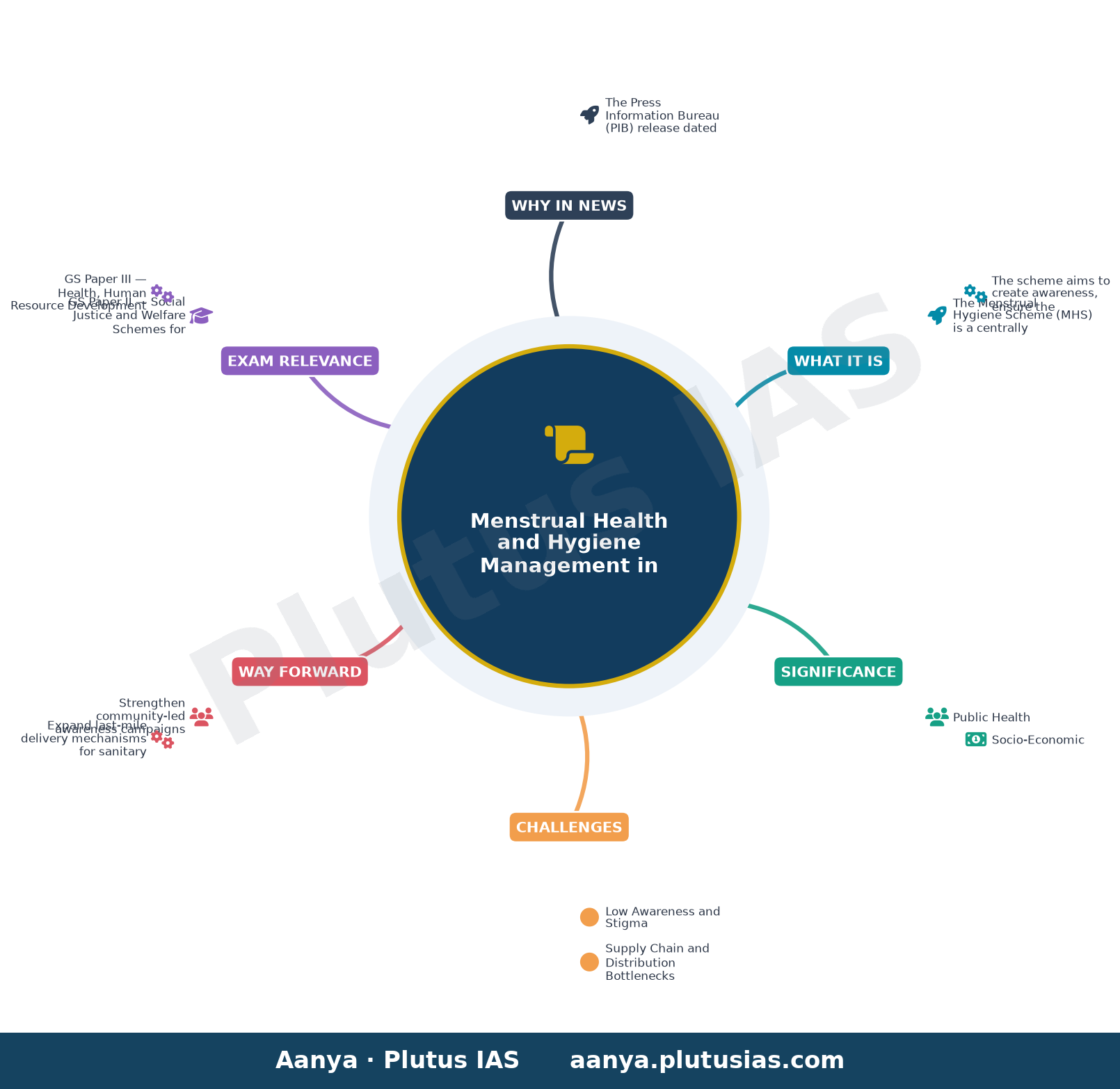
- GS Paper II — Social Justice and Welfare Schemes for Vulnerable Sections | GS Paper III — Health, Human Resource Development and Public Health Infrastructure
- Prelims: Menstrual Hygiene Scheme (MHS), National Health Mission (NHM), Rashtriya Kishor Swasthya Karyakram (RKSK), Swachh Bharat Mission (SBM) 2.0, Sustainable Development Goals (SDG) 3 and 6, Ayushman Bharat Health and Wellness Centres, Frontline Health Workers (ASHAs, ANMs)
- Essay: The Intersection of Public Health, Gender Equity and Sustainable Development: A Case Study of Menstrual Health Management in India, Breaking Barriers: From Policy to Practice in Ensuring Menstrual Health and Dignity
Quick Revision: The Menstrual Hygiene Scheme (MHS), implemented under the National Health Mission (NHM), is a multi-sectoral initiative that ensures access to safe, affordable, and environmentally sustainable menstrual hygiene products and services for adolescent girls, with financial support routed through Annual Programme Implementation Plans (APIPs) and monitored through a robust multi-layered framework.
Why is this in the news?
The Press Information Bureau (PIB) release dated 11 August 2026 highlights the Government of India’s ongoing initiatives under the Menstrual Hygiene Scheme (MHS) as part of the National Health Mission (NHM) to promote menstrual health and hygiene among adolescent girls. The announcement underscores the structured financing, multi-stakeholder coordination, and monitoring mechanisms in place to ensure access to safe, affordable, and environmentally sustainable menstrual hygiene products and services across states and Union Territories.
Background
- Menstrual Health and Hygiene Management (MHM) is recognised as a critical public health and gender equity issue, directly impacting the physical, psychological, and social well-being of adolescent girls and women.
- The scheme operates within the broader framework of the Rashtriya Kishor Swasthya Karyakram (RKSK), which aims to improve the health and nutrition of adolescents through a life-cycle approach.
- The Swachh Bharat Mission (SBM) 2.0 has also integrated menstrual hygiene as a key component, emphasising the need for safe disposal infrastructure in both rural and urban settings.
- The Sustainable Development Goals (SDGs), particularly SDG 3 (Good Health and Well-being) and SDG 6 (Clean Water and Sanitation), mandate universal access to menstrual hygiene products and services as part of global health and sanitation commitments.
- The National Health Policy 2017 and the Ayushman Bharat Health and Wellness Centres (AB-HWCs) framework further reinforce the integration of menstrual health into primary healthcare delivery systems.
What is the Menstrual Hygiene Scheme (MHS)?
- The Menstrual Hygiene Scheme (MHS) is a centrally sponsored scheme implemented by the Ministry of Health and Family Welfare (MoHFW) under the National Health Mission (NHM) to promote menstrual health and hygiene among adolescent girls in India.
- The scheme aims to create awareness, ensure the availability of quality and affordable sanitary napkins, and provide safe and environmentally friendly disposal mechanisms, thereby addressing the multi-dimensional challenges of menstrual hygiene management.
- Under the MHS, states and Union Territories (UTs) receive financial assistance based on their Annual Programme Implementation Plans (APIPs), which are reviewed and approved by the National Programme Coordination Committee (NPCC) for alignment with national priorities.
- Key components of the scheme include the distribution of sanitary napkins, establishment of safe disposal systems, and the conduct of Information, Education, and Communication (IEC) activities to sensitise adolescents, parents, and communities.
- The scheme is aligned with the Rashtriya Kishor Swasthya Karyakram (RKSK), which provides a comprehensive framework for adolescent health, including menstrual hygiene as a critical component.
- Monitoring and evaluation of the MHS are conducted through a robust, multi-layered framework, including state-wise reviews during National Programme Coordination Committee (NPCC) meetings, Annual Common Review Missions (CRM), and independent ground assessments to track progress against approved targets.
- The scheme also emphasises the role of frontline health workers in delivering awareness campaigns and facilitating access to menstrual health services in both rural and urban areas.
Key Features
| Feature | Significance |
|---|---|
| Menstrual Hygiene Scheme (MHS) under NHM | Provides financial and technical support to states/UTs for promoting menstrual hygiene among adolescent girls, including awareness generation and distribution of sanitary napkins. |
| Annual Programme Implementation Plans (PIPs) | States/UTs submit proposals under PIPs to access central funds for menstrual hygiene initiatives, ensuring alignment with national health priorities. |
| Multi-tiered monitoring framework under NHM | Includes reviews during National Programme Coordination Committee (NPCC) meetings to assess state-wise progress against approved targets. |
| Annual Common Review Missions (CRM) | Conducts independent ground-level assessments of programme implementation, health system strengthening, and progress on key indicators. |
| Coordination across ministries/departments | Ensures multi-sectoral collaboration for menstrual health management, involving education, sanitation, and women’s welfare departments. |
Why it Matters
Public Health
- Reduces reproductive tract infections (RTIs) and other health risks associated with poor menstrual hygiene practices.
- Promotes safe disposal of menstrual waste, contributing to environmental sustainability.
- Enhances overall well-being of adolescent girls, supporting their physical and mental health.
Socio-Economic
- Improves school attendance and retention among adolescent girls by addressing menstrual hygiene barriers.
- Reduces out-of-pocket expenditure on menstrual hygiene products, easing financial burdens on low-income households.
- Supports gender equality by ensuring equitable access to hygiene infrastructure and resources.
Governance & Policy
- Demonstrates Centre-State coordination in implementing centrally sponsored schemes under the National Health Mission (NHM).
- Highlights the role of evidence-based monitoring and periodic reviews in public health programme management.
- Showcases the integration of menstrual health into broader health and sanitation policies.
Challenges
1. Low Awareness and Stigma
- Cultural taboos and misconceptions surrounding menstruation impede effective implementation of menstrual hygiene programmes.
- Limited community engagement and sensitization efforts reduce the reach of awareness campaigns.
UPSC Link: GS Paper 1: Social Empowerment
2. Supply Chain and Distribution Bottlenecks
- Inadequate last-mile delivery of sanitary napkins in rural and remote areas hampers equitable access.
- Dependence on state proposals under PIPs may lead to uneven funding distribution across regions.
UPSC Link: GS Paper 2: Governance
3. Monitoring and Evaluation Gaps
- Multi-tiered monitoring frameworks may suffer from data inconsistencies or delayed reporting at the state level.
- Limited use of real-time data for adaptive management of programmes.
UPSC Link: GS Paper 2: Health Governance
4. Environmental Sustainability Concerns
- Disposal of non-biodegradable sanitary waste remains a challenge, particularly in areas lacking waste management infrastructure.
- Over-reliance on single-use products without adequate recycling or composting mechanisms.
UPSC Link: GS Paper 3: Environment
5. Inter-Ministerial Coordination Deficits
- Fragmented implementation across ministries (e.g., Health, Education, Women and Child Development) may lead to duplication or gaps.
- Lack of standardized protocols for cross-sectoral collaboration.
UPSC Link: GS Paper 2: Inter-State Relations
Challenges — UPSC Perspective
| Issue | Concern |
|---|---|
| Cultural taboos | Perpetuation of myths and stigma reduces programme efficacy. |
| Infrastructure gaps | Insufficient WASH facilities in schools and public spaces hinder safe menstrual practices. |
| Funding disparities | Uneven allocation of resources under PIPs may leave marginalized regions underserved. |
| Data underreporting | Lack of disaggregated data on menstrual health outcomes limits evidence-based policymaking. |
| Environmental impact | Non-biodegradable waste from sanitary products contributes to pollution. |
Government Initiatives — Must-Memorise for Prelims
- Menstrual Hygiene Scheme (MHS) under National Health Mission (NHM)
Way Forward
- Strengthen community-led awareness campaigns to dismantle cultural taboos and stigma around menstruation.
- Expand last-mile delivery mechanisms for sanitary napkins, leveraging ASHA workers and local self-help groups.
- Integrate menstrual health education into school curricula to ensure sustained behavioral change.
- Enhance monitoring frameworks with real-time data dashboards and GIS mapping for targeted interventions.
- Promote the use of eco-friendly menstrual products through subsidies and awareness programmes.
- Establish standardized inter-ministerial protocols for cross-sectoral coordination on menstrual health.
- Conduct periodic impact assessments to evaluate programme outcomes and inform policy refinements.
UPSC Value Addition
Keywords for Mains Answer-Writing
Menstrual Health and Hygiene (MHH) · National Health Mission (NHM) · Menstrual Hygiene Scheme (MHS) · Adolescent health · Information, Education and Communication (IEC) activities · Multi-stakeholder coordination · Sustainable Development Goal 3 (SDG 3) · Menstrual Hygiene Management (MHM) · Annual Programme Implementation Plans (PIPs) · National Health Council (NHC) · Community-based interventions · School-based menstrual health policies
Constitutional & Policy Linkages
- Article 21: Right to Health (interpreted to include menstrual health as part of reproductive health).
- Article 47: Duty of the State to improve public health (including sanitation and hygiene).
Concept Flow
Cultural norms and taboos → Low awareness and stigma → Poor menstrual hygiene practices → Increased health risks (RTIs, school absenteeism) → National Health Mission (NHM) framework → Menstrual Hygiene Scheme (MHS) → State/UT proposals under PIPs → Central funding and technical support → Implementation at grassroots level → School-based policies and awareness programmes → Distribution of sanitary napkins and WASH infrastructure → Monitoring via NPCC and CRM → State-wise progress reviews → Adaptive management and course correction → Outcome: Improved menstrual health outcomes → Enhanced school attendance and gender equity → Long-term public health benefits
Prelims Practice Questions
Q1. Consider the following statements regarding the Menstrual Hygiene Scheme (MHS) under the National Health Mission (NHM):
1. The scheme is implemented by the Ministry of Health and Family Welfare to promote menstrual health among adolescent girls.
2. Financial assistance is provided to states/UTs based on their Annual Programme Implementation Plans (PIPs).
3. The scheme exclusively focuses on the distribution of sanitary napkins without any awareness or IEC activities.
4. Monitoring is conducted through a multi-tier framework involving the National Health Council (NHC).
How many of the above statements are correct?
- Only one
- Only two
- Only three
- All
Answer: Only three — Statements 1, 2, and 4 are correct as per the NHM framework. Statement 3 is incorrect because the scheme includes awareness generation, IEC activities, and quality assurance of sanitary napkins alongside distribution.
Q2. Assertion (A): The National Health Mission (NHM) monitors the implementation of the Menstrual Hygiene Scheme (MHS) through a multi-tier framework.
Reason (R): The framework includes reviews during meetings of the National Health Council (NHC) against approved targets.
In the context of the above two statements, which of the following is correct?
- Both A and R are true, and R is the correct explanation of A.
- Both A and R are true, but R is not the correct explanation of A.
- A is true, but R is false.
- A is false, but R is true.
Answer: Both A and R are true, and R is the correct explanation of A. — Both the assertion and reason are true, and the reason correctly explains the assertion as the NHM’s monitoring framework includes NHC reviews against targets.
Q3. Which of the following best describes the primary objective of the Menstrual Hygiene Scheme (MHS) under the National Health Mission (NHM)?
- To provide free sanitary napkins to all women above 18 years of age.
- To promote menstrual health and hygiene among adolescent girls through awareness, access to affordable sanitary products, and safe disposal mechanisms.
- To mandate menstrual leave policies in all educational institutions.
- To subsidize the cost of sanitary napkins for women in rural areas only.
Answer: To promote menstrual health and hygiene among adolescent girls through awareness, access to affordable sanitary products, and safe disposal mechanisms. — The primary objective of the MHS is to promote menstrual health and hygiene among adolescent girls by ensuring awareness, access to affordable sanitary products, and safe disposal mechanisms, as outlined in the NHM framework.
Mains Practice Question
✍ The promotion of menstrual health and hygiene (MHH) is not merely a health issue but a multi-dimensional governance challenge requiring coordinated action across sectors. Critically examine the institutional framework for menstrual health management in India, with reference to the Menstrual Hygiene Scheme (MHS) under the National Health Mission (NHM). Also, analyse the role of Information, Education and Communication (IEC) activities in achieving the objectives of the scheme. (15 Marks)
Approach: MODEL-ANSWER SKELETON:
1. **Introduction (2 marks)**: Define Menstrual Health and Hygiene (MHH) and its significance as a public health and governance challenge, linked to SDG 3 (Good Health and Well-being).
2. **Institutional Framework (6 marks)**:
– **National Health Mission (NHM)**: Role in implementing the Menstrual Hygiene Scheme (MHS) under the Ministry of Health and Family Welfare.
– **Annual Programme Implementation Plans (PIPs)**: How financial assistance is provided to states/UTs based on their proposals.
– **Multi-tier Monitoring**: Role of the National Health Council (NHC) in reviewing state-wise progress against approved targets.
– **Multi-stakeholder Coordination**: Involvement of ministries, departments, and state governments in implementing MHM policies.
– **School-based Policies**: How states/UTs coordinate to ensure access to safe, affordable, and effective menstrual hygiene measures in schools.
3. **IEC Activities (4 marks)**:
– **Role of IEC**: How continuous awareness generation, sensitization, and education campaigns are conducted through health facilities, community platforms, and digital media.
– **Impact**: How IEC activities bridge knowledge gaps and foster behavioral change among adolescent girls and communities.
– **Challenges**: Limitations such as low participation, cultural taboos, and regional disparities in outreach.
4. **Critical Analysis (3 marks)**:
– Evaluate the effectiveness of the institutional framework in addressing MHH challenges.
– Highlight gaps such as uneven implementation across states, lack of standardized monitoring metrics, and sustainability concerns.
– Suggest measures like strengthening grassroots-level monitoring, leveraging technology for real-time data, and integrating MHH into broader adolescent health programs.
Source: PIB (Press Information Bureau)
Generated by AanyaAi for educational purpose.

- डीसीपीसी का विशेष अभियान 6.0: ई-कचरा प्रबंधन और कार्यस्थल दक्षता पर नया फोकस - September 26, 2026
- Special Campaign 6.0: DCP&C to Focus on E-Waste, Cleanliness & Workplace Efficiency - September 26, 2026
- यूपी में हाइब्रिड सोलर सिस्टम: पीएम सूर्यघर योजना में बिजली कटौती से मुक्ति का विकल्प - September 26, 2026

No Comments