


11 Aug UN Steps Up to Aid Colombia After Devastating 7.4 Quake: Key Facts for UPSC
✎ The Sendai Framework (2015–2030) and International Disaster Response Laws, Rules and Principles (IDRL) provide the global and legal frameworks for coordinated international disaster response, exemplified by the UN’s support to…
Subject Relevance — Where This Topic Fits
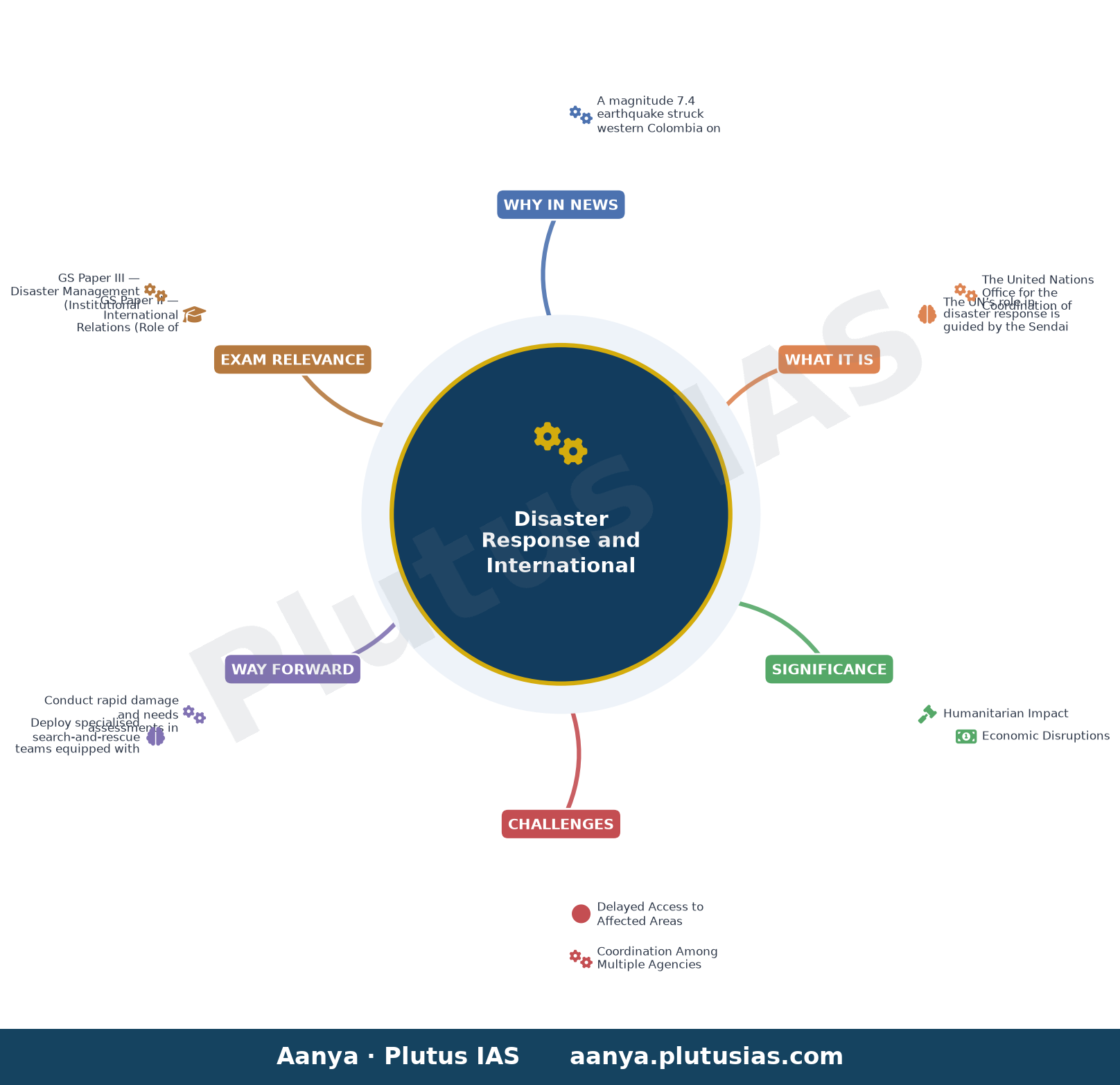
- GS Paper II — International Relations (Role of International Organisations like the UN) | GS Paper III — Disaster Management (Institutional Mechanisms and International Cooperation)
- Prelims: United Nations Office for the Coordination of Humanitarian Affairs (OCHA), Sendai Framework for Disaster Risk Reduction, Disaster Risk Reduction (DRR), Humanitarian Assistance, International Disaster Response Laws, Rules and Principles (IDRL), National Disaster Management Authority (NDMA), Pan American Health Organization (PAHO), World Food Programme (WFP)
- Essay: The Role of International Cooperation in Addressing Global Disasters, Disaster Resilience: Balancing Preparedness and Response
Quick Revision: The Sendai Framework (2015–2030) and International Disaster Response Laws, Rules and Principles (IDRL) provide the global and legal frameworks for coordinated international disaster response, exemplified by the UN’s support to Colombia following the 7.4 magnitude earthquake.
Why is this in the news?
A magnitude 7.4 earthquake struck western Colombia on 10 August 2026, resulting in significant loss of life, structural damage, and humanitarian needs. The United Nations (UN) promptly offered support, highlighting the importance of international disaster response mechanisms and inter-agency coordination in mitigating the impact of such natural disasters. This event underscores the relevance of global frameworks for disaster risk reduction and the role of international organisations in crisis management.
Background
- The Sendai Framework for Disaster Risk Reduction (2015–2030) is a global agreement adopted under the auspices of the United Nations to reduce disaster risks and losses in lives, livelihoods, and health, including economic, physical, social, cultural, and environmental assets of persons, businesses, communities, and countries.
- Colombia is located in a seismically active region due to its proximity to the Nazca Plate and South American Plate boundary, making it prone to earthquakes and volcanic activity.
- The National Disaster Risk Management System (SNGRD) in Colombia is the institutional framework for coordinating disaster preparedness, response, and recovery, aligning with the Sendai Framework’s priorities.
- The Pan American Health Organization (PAHO) and the World Food Programme (WFP) are specialised UN agencies that provide health and food security support in emergencies, respectively.
- International Disaster Response Laws, Rules and Principles (IDRL) guide the legal and operational framework for international assistance during disasters, ensuring coordination and accountability.
- Colombia has faced recurrent seismic events, including the 1999 Armenia earthquake, which resulted in over 1,000 fatalities and widespread destruction.
What is International Disaster Response and the UN’s Role?
- The UN’s role in disaster response is guided by the Sendai Framework (2015–2030), which prioritises understanding disaster risk, strengthening disaster risk governance, investing in disaster risk reduction, and enhancing disaster preparedness for effective response and recovery.
- The United Nations Office for the Coordination of Humanitarian Affairs (OCHA) serves as the central hub for coordinating international humanitarian responses, ensuring that assistance reaches affected populations efficiently.
- The UN Resident Coordinator in Colombia, María José Torres Macho, liaises with national authorities to assess needs and mobilise resources, exemplifying the UN’s on-ground coordination role.
- Specialised UN agencies such as the World Food Programme (WFP) provide food assistance, while the Pan American Health Organization (PAHO) supports health infrastructure and medical response in emergencies.
- International Disaster Response Laws, Rules and Principles (IDRL) provide a legal framework for the entry and effective use of foreign assistance, ensuring that aid is timely, appropriate, and does not disrupt local response efforts.
- The UN’s support in Colombia includes rapid needs assessment, emergency relief coordination, and long-term recovery planning, in alignment with the Government’s disaster management priorities.
- The activation of emergency response mechanisms by the Colombian Government, in collaboration with the UN, demonstrates the importance of national ownership and international solidarity in disaster management.
- The UN’s role is not to replace national efforts but to complement them, ensuring that resources are mobilised efficiently and that gaps in response are addressed.
Key Features
| Feature | Significance |
|---|---|
| Magnitude 7.4 earthquake | High-intensity seismic event causing widespread structural damage and casualties due to ground shaking and secondary hazards like landslides. |
| Epicentre near San José del Palmar, Chocó | Remote and seismically active region, exacerbating challenges in immediate rescue and relief due to terrain and connectivity constraints. |
| Collapse of residential and institutional buildings | Direct threat to life, displacement of populations, and disruption of essential services such as healthcare and education. |
| Landslides and infrastructure damage | Impedes road and air access, delaying emergency response and supply chains to affected areas. |
| Limited rural connectivity | Hinders rapid assessment of damage and coordination of relief efforts, prolonging humanitarian crisis. |
| Activation of national emergency protocols | Demonstrates institutional preparedness in disaster risk management and inter-agency coordination. |
Why it Matters
Humanitarian Impact
- High mortality and injury rates, particularly in urban centres like Pereira and Cali, necessitating immediate medical and search-and-rescue interventions.
- Displacement of populations due to structural collapse and landslides, requiring temporary shelter and relief distribution.
- Vulnerability of children and marginalised groups in affected areas, warranting targeted protection measures.
Economic Disruptions
- Damage to transport infrastructure (airports, roads) disrupts supply chains, trade, and mobility, affecting regional economic activity.
- Destruction of commercial and residential properties imposes financial burdens on households and local governments.
- Potential long-term economic slowdown in affected regions due to reconstruction costs and loss of productive assets.
Institutional Response
- Demonstrates the role of national disaster management agencies in coordinating multi-agency responses under emergency protocols.
- Showcases international solidarity through UN and other agencies offering technical and logistical support to national authorities.
- Highlights the importance of pre-disaster planning, early warning systems, and community preparedness in mitigating impact.
Environmental and Geological Factors
- Seismic activity in the Andean region, influenced by the Nazca Plate subduction beneath the South American Plate, underscores the geological vulnerability of western Colombia.
- Landslides triggered by the earthquake exacerbate damage and complicate rescue operations in hilly and mountainous terrain.
Urban Planning and Resilience
- Exposes weaknesses in building codes and urban infrastructure in high-risk seismic zones, necessitating retrofitting and enforcement of safety standards.
- Raises questions about land-use planning in disaster-prone areas to reduce exposure of populations and critical infrastructure.
Challenges
1. Delayed Access to Affected Areas
- Rugged terrain and landslides restrict road and air access, delaying the arrival of rescue teams and relief supplies.
- Limited rural connectivity impedes real-time damage assessment and coordination of relief efforts.
UPSC Link: GS III: Disaster Management
2. Coordination Among Multiple Agencies
- Need for seamless integration between national disaster management, local authorities, and international aid agencies to avoid duplication or gaps.
- Ensuring that humanitarian aid reaches the most vulnerable groups without delays or mismanagement.
UPSC Link: GS II: International Organisations
3. Provision of Immediate Relief and Medical Care
- High number of casualties requires rapid deployment of medical teams, supplies, and trauma care facilities.
- Risk of disease outbreaks in temporary shelters due to overcrowding and inadequate sanitation.
UPSC Link: GS II: Health
4. Long-Term Reconstruction and Rehabilitation
- Sustainable rebuilding requires robust funding mechanisms, technical expertise, and community participation.
- Addressing housing shortages and restoring livelihoods to prevent long-term socio-economic decline.
UPSC Link: GS III: Economic Development
5. Public Awareness and Preparedness
- Lack of prior awareness about earthquake risks and safety measures may have contributed to higher casualties.
- Need for community-level training in disaster response, including first aid and evacuation drills.
UPSC Link: GS III: Disaster Management
6. Climate Change and Disaster Risk Amplification
- Increasing frequency of extreme weather events may exacerbate the impact of geological hazards like earthquakes.
- Need for integrated risk reduction strategies that account for cascading climate and geological risks.
UPSC Link: GS III: Environment
Challenges — UPSC Perspective
| Issue | Concern |
|---|---|
| Structural collapse in urban areas | High mortality and displacement due to inadequate building codes or enforcement. |
| Landslides in mountainous regions | Impedes rescue operations and causes secondary damage to infrastructure. |
| Limited rural connectivity | Delays assessment of damage and delivery of relief supplies. |
| Overstretched healthcare facilities | Insufficient capacity to handle surge in trauma cases and potential disease outbreaks. |
| Logistical bottlenecks in aid distribution | Risk of unequal access to relief due to terrain and infrastructure damage. |
| Long-term economic recovery | Potential for prolonged socio-economic disruption in affected regions. |
Way Forward
- Conduct rapid damage and needs assessments in collaboration with local authorities to prioritise rescue and relief operations.
- Deploy specialised search-and-rescue teams equipped with advanced technology (e.g., drones, thermal imaging) to locate survivors in collapsed structures.
- Establish temporary medical camps with trauma care facilities to address immediate health needs and prevent disease outbreaks.
- Restore critical transport infrastructure (roads, airports) to enable the movement of relief supplies and personnel.
- Mobilise international humanitarian aid through UN agencies (e.g., WFP, PAHO) and bilateral partners while ensuring alignment with national priorities.
- Enforce temporary building moratoriums in high-risk zones to prevent unsafe reconstruction and prioritise retrofitting of critical infrastructure.
- Launch public awareness campaigns on earthquake preparedness, including evacuation drills and first-aid training for communities.
- Develop a phased reconstruction plan with transparent funding mechanisms and community participation to ensure inclusivity and sustainability.
UPSC Value Addition
Keywords for Mains Answer-Writing
Disaster management · National Disaster Management Authority (NDMA) · Sendai Framework for Disaster Risk Reduction (SFDRR) · International cooperation in disaster response · Earthquake preparedness · Multi-hazard early warning systems · Humanitarian assistance and disaster relief (HADR) · United Nations Office for Disaster Risk Reduction (UNDRR) · Community-based disaster risk reduction · Structural and non-structural measures for disaster mitigation
Concept Flow
Seismic activity along subduction zone (Nazca Plate) → High-magnitude earthquake → Ground shaking and secondary hazards (landslides) → Structural collapse and casualties → Activation of national emergency protocols → Coordination with international agencies → Immediate relief and rescue operations → Assessment of damage and needs → Long-term reconstruction and resilience planning
Prelims Practice Questions
Q1. Consider the following statements regarding the Sendai Framework for Disaster Risk Reduction (2015-2030):
1. It is a voluntary, non-binding agreement adopted by the United Nations member states.
2. It aims to achieve the substantial reduction of disaster risk and losses in lives, livelihoods, and health.
3. The framework prioritizes the integration of disaster risk reduction into national and local development strategies.
4. It mandates the establishment of a global financial mechanism for disaster risk reduction.
How many of the above statements are correct?
- Only one
- Only two
- Only three
- All four
Answer: Only three — Statements 1, 2, and 3 are correct as the Sendai Framework is a voluntary, non-binding agreement adopted by UN member states, aiming to reduce disaster risk and integrate DRR into development strategies. Statement 4 is incorrect as the framework does not mandate a global financial mechanism.
Q2. Assertion (A): The National Disaster Management Authority (NDMA) in India is chaired by the Prime Minister.
Reason (R): The NDMA Act, 2005, vests the authority to chair the NDMA with the Prime Minister to ensure high-level political leadership and coordination in disaster management.
Options:
A. Both A and R are true, and R is the correct explanation of A.
B. Both A and R are true, but R is not the correct explanation of A.
C. A is true, but R is false.
D. A is false, but R is true.
- A
- B
- C
- D
Answer: A — Both Assertion (A) and Reason (R) are true, and the Reason (R) correctly explains the Assertion (A). The NDMA Act, 2005, indeed vests the chairmanship of the NDMA with the Prime Minister.
Q3. Match the following international disaster risk reduction frameworks with their respective focus areas:
Column I
1. Sendai Framework for Disaster Risk Reduction
2. Paris Agreement
3. Hyogo Framework for Action
4. Sustainable Development Goals (SDG 13)
Column II
A. Climate change mitigation and adaptation
B. Reduction of disaster risk and losses
C. Integration of DRR into development strategies
D. Building resilience to climate-related hazards
Select the correct match:
- 1-B, 2-A, 3-C, 4-D
- 1-C, 2-A, 3-B, 4-D
- 1-D, 2-A, 3-B, 4-C
- 1-B, 2-D, 3-A, 4-C
Answer: 1-B, 2-A, 3-C, 4-D — 1-B: The Sendai Framework focuses on reducing disaster risk and losses. 2-A: The Paris Agreement addresses climate change mitigation and adaptation. 3-C: The Hyogo Framework for Action integrates disaster risk reduction into development strategies. 4-D: SDG 13 focuses on taking urgent action to combat climate change and its impacts, including building resilience to climate-related hazards.
Mains Practice Question
✍ The management of disasters such as earthquakes requires a multi-layered, multi-stakeholder approach that integrates preparedness, response, recovery, and mitigation. Critically examine the institutional mechanisms for disaster management in India, with particular reference to the role of the National Disaster Management Authority (NDMA) and the State Disaster Management Authorities (SDMAs). Also, assess how India’s disaster management framework aligns with the Sendai Framework for Disaster Risk Reduction (2015-2030). (15 Marks)
Approach: MODEL-ANSWER SKELETON:
1. **Institutional Framework in India:**
– **Constitutional Basis:** Article 21 (Right to Life) and Directive Principles of State Policy (Article 39, 41, 47, 48A) as the foundational legal basis for disaster management.
– **NDMA Act, 2005:** Establishment of the National Disaster Management Authority (NDMA) chaired by the Prime Minister; National Executive Committee (NEC) headed by the Union Home Secretary; State Disaster Management Authorities (SDMAs) chaired by Chief Ministers; District Disaster Management Authorities (DDMAs) chaired by District Collectors.
– **Institutional Roles:** NDMA’s mandate includes laying down policies, plans, and guidelines for disaster management; SDMAs implement these at the state level; DDMAs operationalize plans at the district level.
– **Example:** The 2015 Nepal earthquake response demonstrated NDMA’s coordination role in evacuating Indian nationals and providing relief.
2. **Sendai Framework Alignment:**
– **Four Priorities:** The Sendai Framework outlines four priorities: understanding disaster risk, strengthening disaster risk governance, investing in disaster risk reduction, and enhancing disaster preparedness for effective response.
– **Alignment with NDMA:** NDMA’s focus on risk assessment, early warning systems, and community-based disaster preparedness aligns with the Sendai Framework’s priorities. For instance, the National Disaster Management Plan (NDMP) 2016 and its updates reflect the Sendai priorities.
– **Gaps:** Limited integration of local governance in disaster risk governance; challenges in inter-state coordination during multi-state disasters (e.g., floods in Assam and Bihar).
3. **Challenges and Criticisms:**
– **Resource Constraints:** Limited funding and technical capacity at the state and district levels.
– **Implementation Gaps:** Delays in approval of State Disaster Management Plans; inadequate training and awareness among local communities.
– **Technology and Innovation:** Need for enhanced use of geospatial technology, artificial intelligence, and community-based early warning systems.
4. **Way Forward:**
– **Strengthening Local Governance:** Empowering DDMAs with greater financial and operational autonomy.
– **Public-Private Partnerships:** Leveraging corporate social responsibility (CSR) funds for disaster resilience projects.
– **Community Engagement:** Promoting participatory disaster risk reduction through awareness campaigns and drills.
Balance of Views:
– **Pro-Institutional View:** NDMA and SDMAs provide a robust institutional framework for disaster management, enabling coordinated national and state-level responses.
– **Critique:** The framework suffers from top-down approach, with limited grassroots participation and accountability mechanisms.
Source: news.un.org
Generated by AanyaAi for educational purpose.

- पेंशन भुगतान में विभाजन से बुजुर्गों को मुश्किल, अधिकार समूहों की चिंता - September 26, 2026
- UPSC Alert: Pension Split Policy Raises Hardship Concerns for Elderly in AP - September 26, 2026
- पीएम स्मृति चिह्न ई-नीलामी 2026: ओडिशा की सांस्कृतिक विरासत का अनूठा प्रदर्शन - September 26, 2026

No Comments