


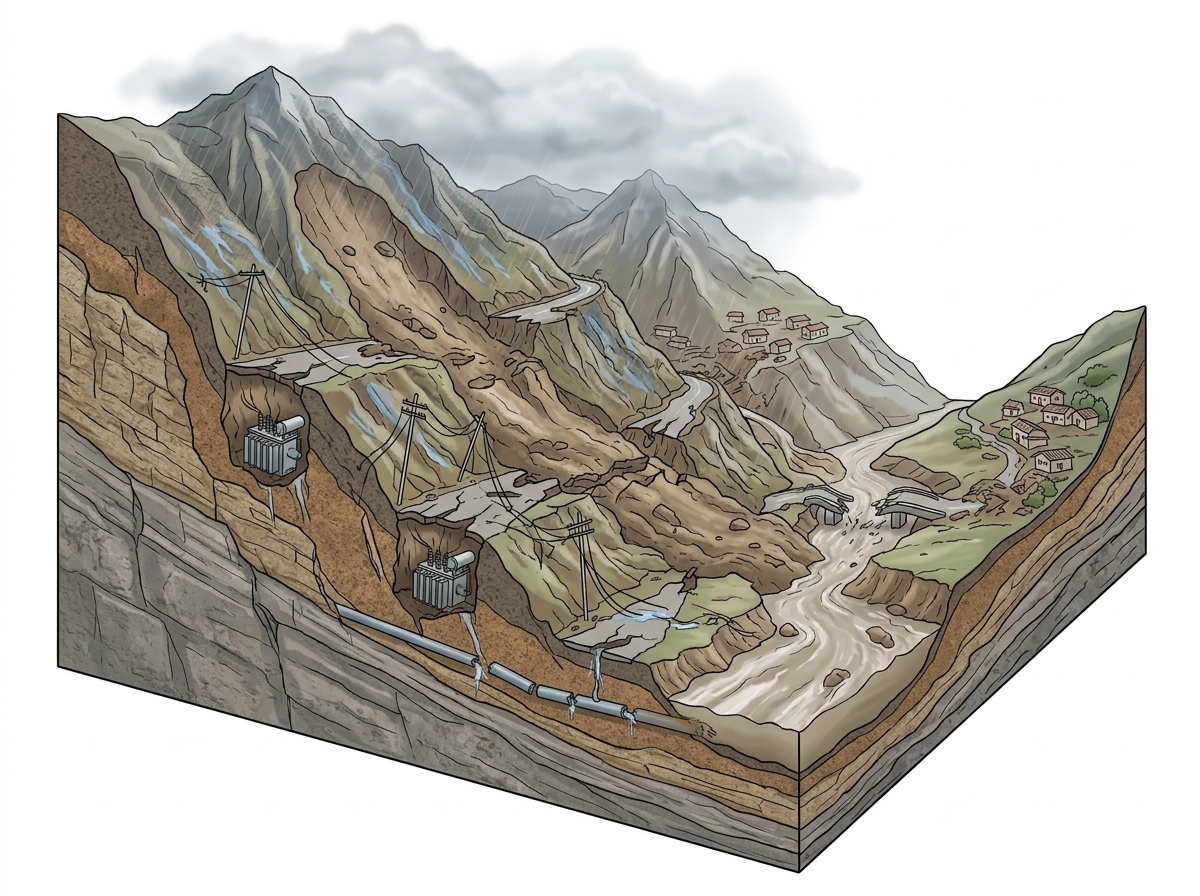
11 Aug Himachal Monsoon 2026: 259 Roads Closed, 161 Transformers & 54 Water Schemes Hit
RoadsTransformersWater supply schemesLandslidesCloudburstsFlash floods✎ Himachal Pradesh’s 2026 monsoon disaster highlights the urgent need for climate-resilient infrastructure, early warning systems, and integrated disaster risk reduction in Himalayan states to mitigate the impacts of extreme…
Subject Relevance — Where This Topic Fits
- GS Paper I — Geography of India and World Geography | GS Paper III — Disaster Management
- Prelims: Cloudburst, Landslide, Flash Flood, Himalayan Ecology, National Disaster Management Authority (NDMA), Disaster Mitigation Fund, Pradhan Mantri Fasal Bima Yojana, National Rural Employment Guarantee Scheme (NREGS), Himalayan States, Western Disturbances, Monsoon Variability, Infrastructure Vulnerability
- Essay: Climate Change and Disaster Resilience: Lessons from the Himalayas, Balancing Development and Environmental Sustainability in Mountainous Regions
Quick Revision: Himachal Pradesh’s 2026 monsoon disaster highlights the urgent need for climate-resilient infrastructure, early warning systems, and integrated disaster risk reduction in Himalayan states to mitigate the impacts of extreme weather events.
Why is this in the news?
The report highlights the severe disruption to critical infrastructure in Himachal Pradesh due to the 2026 monsoon season, with 259 roads, 161 transformers, and 54 water supply schemes affected, alongside 157 fatalities and significant economic losses. This underscores the urgent need for disaster risk reduction, climate-resilient infrastructure, and effective emergency response in ecologically fragile Himalayan states, aligning with India’s broader climate adaptation and disaster management frameworks.
Background
- Himachal Pradesh, a Himalayan state, is highly vulnerable to extreme weather events during the monsoon season due to its steep terrain, fragile geology, and high rainfall variability.
- The state frequently experiences landslides, cloudbursts, and flash floods, which disrupt connectivity, power supply, and water availability, exacerbating socio-economic challenges.
- India’s Disaster Management Act, 2005, mandates the establishment of State Disaster Management Authorities (SDMAs) and District Disaster Management Authorities (DDMAs) to coordinate preparedness and response efforts.
- The National Disaster Management Authority (NDMA) has identified Himalayan states as high-risk zones for climate-induced disasters, emphasizing the need for integrated risk reduction strategies.
- Climate change projections indicate an increase in extreme rainfall events in the Himalayas, necessitating adaptive infrastructure and early warning systems.
What are the key components of disaster resilience in mountainous regions like Himachal Pradesh?
- **Geological Vulnerability**: The Himalayas are tectonically active and composed of young, unstable rock formations, making them prone to landslides and debris flows during heavy rainfall.
- **Infrastructure Resilience**: Critical infrastructure such as roads, bridges, and power transmission lines must be designed to withstand landslides, erosion, and flash floods, incorporating climate-resilient engineering standards.
- **Early Warning Systems**: Real-time monitoring of rainfall, river levels, and landslide-prone zones using satellite data, Doppler radar, and IoT sensors can enable timely evacuations and disaster response.
- **Community Preparedness**: Training local communities in disaster risk reduction, first aid, and evacuation drills enhances resilience and reduces fatalities during extreme events.
- **Ecosystem-Based Adaptation**: Restoring natural buffers such as forests, wetlands, and riverbanks can mitigate the impact of floods and landslides by absorbing excess water and stabilizing slopes.
- **Policy Integration**: The Sendai Framework for Disaster Risk Reduction (2015–2030) and India’s National Action Plan on Climate Change (NAPCC) emphasize multi-hazard risk assessment, adaptive governance, and cross-sectoral coordination for disaster resilience.
- **Financial Mechanisms**: Dedicated funds such as the National Disaster Response Fund (NDRF) and State Disaster Response Fund (SDRF) provide resources for relief, rehabilitation, and reconstruction after disasters.
- **Post-Disaster Recovery**: Systematic damage assessment, compensation mechanisms, and livelihood restoration programs are essential to ensure long-term recovery and reduce vulnerability.
Key Features
| Feature | Significance |
|---|---|
| Prolonged monsoon rainfall | Disruption of surface transport, power distribution, and water supply systems due to landslides and waterlogging. |
| Road closures (259) | Impedes connectivity, emergency response, and economic activities in affected districts. |
| Power transformer disruptions (161) | Leads to electricity outages, impacting households, healthcare, and critical infrastructure. |
| Disrupted water supply schemes (54) | Affects potable water availability, sanitation, and public health in rural and urban areas. |
| Cumulative fatalities (157) | Highlights the human cost of extreme weather events and the need for disaster preparedness. |
Why it Matters
Economic Impact
- Disruption in supply chains due to road closures affects local trade and tourism-dependent economies.
- Power outages reduce industrial and agricultural productivity, particularly in horticulture and hydropower sectors.
- Agricultural losses from waterlogging and landslides threaten food security and farmer livelihoods.
- Rehabilitation and repair costs strain state exchequer and divert funds from developmental projects.
Infrastructural Vulnerability
- Hilly terrain of Himachal Pradesh makes infrastructure highly susceptible to landslides and flash floods.
- Aging and inadequately maintained road networks exacerbate the impact of extreme weather events.
- Reliance on hydroelectric power increases vulnerability to monsoon-related disruptions.
- Urban and rural water supply systems lack resilience to sudden surges in water demand or supply disruptions.
Public Health and Safety
- Disrupted water supply increases risk of waterborne diseases such as cholera and gastroenteritis.
- Electricity outages compromise healthcare services, particularly in critical care and emergency wards.
- Landslides and flash floods pose direct threats to human life, especially in densely populated or remote areas.
- Displacement of populations due to road closures and infrastructure damage raises humanitarian concerns.
Environmental and Ecological
- Increased soil erosion and landslides degrade fragile Himalayan ecosystems.
- Siltation of water bodies and rivers affects aquatic biodiversity and hydropower generation.
- Deforestation and unplanned construction in vulnerable zones exacerbate disaster risks.
Challenges
1. Disaster Risk Reduction and Resilience
- Limited early warning systems for localized landslides and flash floods in hilly regions.
- Inadequate drainage infrastructure in urban and rural areas to handle extreme rainfall.
- Lack of integrated land-use planning to mitigate construction in high-risk zones.
- Insufficient capacity of disaster management authorities to respond to multi-hazard events.
UPSC Link: GS3-Disaster Management
2. Infrastructure Maintenance and Upgradation
- Aging and poorly maintained road networks require systematic retrofitting and reinforcement.
- Power transmission and distribution systems need climate-resilient upgrades to withstand extreme weather.
- Water supply infrastructure requires decentralized systems and redundancy to ensure continuity.
- Bridges and culverts in hilly terrain need structural assessments to prevent collapse during floods.
UPSC Link: GS3-Infrastructure
3. Resource Allocation and Fiscal Constraints
- Limited state resources for simultaneous rehabilitation of multiple infrastructure sectors.
- Competing demands for funds between disaster relief, infrastructure repair, and developmental projects.
- Dependence on central assistance for large-scale disaster recovery and reconstruction.
- Need for innovative financing mechanisms such as climate-resilient infrastructure bonds.
UPSC Link: GS3-Economic Development
4. Inter-Agency Coordination and Governance
- Fragmented roles among state departments (PWD, Irrigation, Power, Health) hinder effective disaster response.
- Lack of real-time data sharing between meteorological agencies and ground-level authorities.
- Inadequate community awareness and participation in disaster preparedness and mitigation.
- Need for a unified command structure for multi-agency disaster management.
UPSC Link: GS2-Governance
5. Climate Change Adaptation
- Increasing frequency and intensity of extreme weather events due to climate change.
- Need for climate-proofing of critical infrastructure and livelihood systems.
- Integration of climate risk assessments in all developmental planning and investment decisions.
- Promotion of nature-based solutions such as afforestation and watershed management.
UPSC Link: GS3-Environment
Challenges — UPSC Perspective
| Issue | Concern |
|---|---|
| Early Warning Systems | Inadequate detection and dissemination of localized weather alerts. |
| Drainage Infrastructure | Insufficient capacity to handle extreme rainfall in urban and rural areas. |
| Land-Use Planning | Unregulated construction in landslide-prone and flood-risk zones. |
| Disaster Response Capacity | Limited resources and manpower for multi-hazard emergency response. |
| Infrastructure Resilience | Aging systems unable to withstand climate-induced stresses. |
| Community Preparedness | Low awareness and participation in disaster risk reduction activities. |
Way Forward
- Strengthen early warning systems with real-time monitoring of rainfall, landslides, and water levels in vulnerable zones.
- Undertake systematic retrofitting and climate-proofing of critical infrastructure such as roads, bridges, and power transmission lines.
- Develop decentralized and redundant water supply systems to ensure continuity during disruptions.
- Enhance inter-agency coordination through a unified disaster management command structure at state and district levels.
- Promote nature-based solutions such as afforestation, watershed management, and riverbank stabilization in high-risk areas.
- Conduct regular structural audits of infrastructure in hilly terrain to identify and mitigate vulnerabilities.
- Invest in community-based disaster preparedness programs to enhance local response capabilities.
- Integrate climate risk assessments into all developmental planning and investment decisions.
UPSC Value Addition
Keywords for Mains Answer-Writing
Disaster Management Act, 2005 · National Disaster Response Force (NDRF) · State Disaster Management Authorities (SDMAs) · Geological Survey of India (GSI) · Cloudbursts · Landslides · Hydro-meteorological hazards · Critical Infrastructure Resilience · Public Health Engineering Department (PHED) · Himachal Pradesh State Disaster Management Authority (HPSDMA) · Climate Change Adaptation · Himalayan Ecosystem Vulnerability · Early Warning Systems · Road Connectivity in Mountainous Regions
Concept Flow
Intense monsoon rainfall → Landslides and waterlogging → Road closures and infrastructure damage → Disruption of transport, power, and water supply → Economic losses, public health risks, and humanitarian challenges → Need for disaster risk reduction, resilient infrastructure, and adaptive governance
Prelims Practice Questions
Q1. Consider the following statements regarding the Disaster Management Act, 2005:
1. It mandates the establishment of National Disaster Management Authority (NDMA) under the Chairmanship of the Prime Minister.
2. The Act provides for the constitution of State Disaster Management Authorities (SDMAs) headed by the Chief Minister of the respective State.
3. The National Disaster Response Force (NDRF) is a statutory body created under this Act.
4. The Act does not cover biological disasters such as pandemics.
How many of the above statements are correct?
- Only one
- Only two
- Only three
- All
Answer: Only three — Statements 1 and 2 are correct as they align with the provisions of the Disaster Management Act, 2005. Statement 3 is incorrect because the NDRF is a force constituted under the Act but is not a statutory body in itself. Statement 4 is incorrect as the Act covers all types of disasters, including biological disasters.
Q2. Assertion (A): Cloudbursts are sudden, intense rainfall events that are common in the Himalayan region during the monsoon season.
Reason (R): The Himalayas, due to their steep topography and fragile geological structure, are highly susceptible to cloudbursts and associated landslides.
- Both A and R are true, and R is the correct explanation of A
- Both A and R are true, but R is not the correct explanation of A
- A is true, but R is false
- A is false, but R is true
Answer: Both A and R are true, and R is the correct explanation of A — Both the Assertion and Reason are true. The Himalayas’ steep topography and fragile geological structure make them highly susceptible to cloudbursts, which are sudden, intense rainfall events. The Reason correctly explains the Assertion.
Q3. Match the following pairs related to disaster management in India:
Column I (Institution) | Column II (Function)
———————|———————-
A. National Disaster Management Authority (NDMA) | 1. Provides immediate response during disasters
B. National Disaster Response Force (NDRF) | 2. Formulates policies and plans for disaster management
C. State Disaster Management Authority (SDMA) | 3. Coordinates disaster response at the state level
D. Geological Survey of India (GSI) | 4. Conducts geological surveys and hazard zonation
- A-2, B-1, C-3, D-4
- A-1, B-2, C-3, D-4
- A-3, B-1, C-2, D-4
- A-4, B-3, C-2, D-1
Answer: A-2, B-1, C-3, D-4 — The correct match is: A-2 (NDMA formulates policies), B-1 (NDRF provides immediate response), C-3 (SDMA coordinates at the state level), and D-4 (GSI conducts geological surveys).
Mains Practice Question
✍ The increasing frequency and intensity of hydro-meteorological hazards in the Himalayan region, such as cloudbursts and landslides, pose significant challenges to infrastructure resilience and public safety. Discuss the institutional and policy frameworks in India that address these challenges, with particular reference to the Disaster Management Act, 2005 and the role of State Disaster Management Authorities (SDMAs). Also, examine the measures required to enhance the resilience of critical infrastructure in such vulnerable regions. (15 Marks)
Approach: MODEL-ANSWER SKELETON:
1. **Institutional Framework under the Disaster Management Act, 2005**:
– Role of the National Disaster Management Authority (NDMA) in policy formulation and coordination.
– Constitution and functions of State Disaster Management Authorities (SDMAs) headed by Chief Ministers.
– Role of District Disaster Management Authorities (DDMAs) at the local level.
– Composition and deployment of the National Disaster Response Force (NDRF) for immediate response.
2. **Policy and Planning Mechanisms**:
– National Disaster Management Plan (NDMP) and its emphasis on preparedness, mitigation, and response.
– Integration of climate change adaptation and early warning systems in disaster management plans.
– Role of the Public Health Engineering Department (PHED) in ensuring water supply resilience during disasters.
3. **Challenges in the Himalayan Region**:
– Fragile geological structure and steep topography increasing vulnerability to landslides and cloudbursts.
– Limited road connectivity and critical infrastructure resilience in mountainous regions.
– Data gaps in hazard zonation and real-time monitoring.
4. **Measures to Enhance Resilience**:
– Strengthening early warning systems with real-time data from agencies like the India Meteorological Department (IMD) and Geological Survey of India (GSI).
– Adoption of green infrastructure and climate-resilient design for roads and bridges.
– Community-based disaster preparedness programs and capacity building.
– Integration of traditional knowledge with modern scientific approaches.
5. **Way Forward**:
– Multi-stakeholder collaboration involving government, civil society, and private sector.
– Regular review and updating of disaster management plans with lessons from recent events.
– Focus on sustainable development practices to reduce anthropogenic pressures on fragile ecosystems.
Source: amarujala.com
Generated by AanyaAi for educational purpose.

- आईआईटी रुड़की में रुटैग 2.0 की तीसरी वार्षिक समीक्षा बैठक: ग्रामीण विकास में तकनीकी बदलाव - September 26, 2026
- UPSC Exam: PM’s Scientific Advisor Reviews RUTAG 2.0 Projects at IIT Roorkee - September 26, 2026
- यूपीएससी के लिए: ‘मेरा स्वास्थ्य, मेरा गौरव’ अभियान से जानें युवाओं में नशामुक्ति का महत्व - September 26, 2026

No Comments