


11 Aug Centre tables Bill to curtail state taxes on minerals: Key UPSC insights
✎ The Mines and Minerals (Development and Regulation) Amendment Bill, 2026 seeks to prohibit state taxation on mineral rights and mineral-bearing lands to centralise regulatory control and ensure commercial viability in the mining…
Subject Relevance — Where This Topic Fits
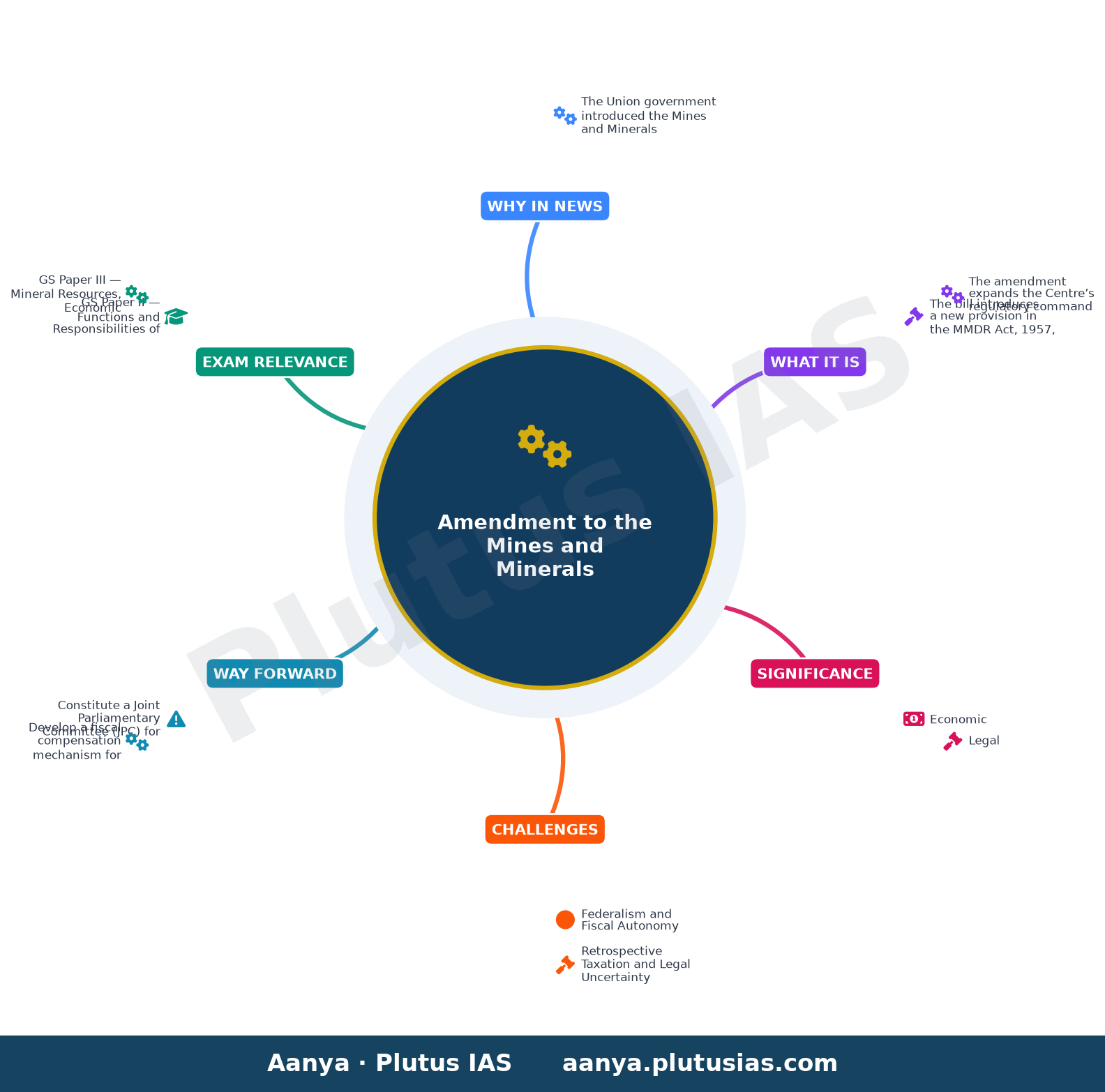
- GS Paper II — Functions and Responsibilities of the Union and the States, Issues and Challenges Pertaining to the Federal Structure | GS Paper III — Mineral Resources, Economic Development, and Regulatory Frameworks
- Prelims: MMDR Act, 1957, Mineral rights, Royalty vs. tax on minerals, Federalism, Supreme Court ruling on mineral taxation, Mineral-bearing lands, Retrospective taxation, Public sector undertakings in mining
- Essay: Federalism and cooperative governance in resource-rich states, Balancing economic viability and fiscal federalism in natural resource management
Quick Revision: The Mines and Minerals (Development and Regulation) Amendment Bill, 2026 seeks to prohibit state taxation on mineral rights and mineral-bearing lands to centralise regulatory control and ensure commercial viability in the mining sector, overriding a 2024 Supreme Court judgment that upheld such state powers.
Why is this in the news?
The Union government introduced the Mines and Minerals (Development and Regulation) Amendment Bill, 2026 in the Lok Sabha to prohibit state governments from imposing taxes, cesses, or levies on mineral rights and mineral-bearing lands. This legislative move follows a July 2024 Supreme Court judgment that upheld the constitutional power of states to levy such taxes, thereby creating a conflict between the Centre’s regulatory objectives and the fiscal autonomy of mineral-rich states. The bill aims to centralise regulatory control over mineral resources while addressing concerns of retrospective taxation and commercial viability in the sector.
Background
- The Mines and Minerals (Development and Regulation) Act, 1957 (MMDR Act) regulates the mining sector in India, including the grant of mineral concessions and the imposition of royalties.
- The MMDR Act does not explicitly bar states from levying taxes on mineral rights or mineral-bearing lands, leading to divergent interpretations and disputes.
- In July 2024, the Supreme Court ruled that royalty under the MMDR Act is not a tax and that states possess the legislative competence to levy taxes on mineral rights and mineral-bearing lands, separate from royalties.
- The Supreme Court’s judgment allowed states to recover past dues from April 1, 2005, subject to certain restrictions, including the exclusion of penalties and additional interest.
- The retrospective nature of the levy and its financial implications—estimated at ₹1.5–2 lakh crore—have raised concerns among industry stakeholders and the Centre.
- The proposed amendment seeks to align the MMDR Act with the Centre’s vision of sustainable and uniform mineral development while addressing the fiscal and regulatory challenges posed by state-level taxation.
What is the Mines and Minerals (Development and Regulation) Amendment Bill, 2026?
- The bill introduces a new provision in the MMDR Act, 1957, explicitly stating that no tax, cess, or levy (by whatever name called) shall be imposed by any state government on mineral rights or mineral-bearing lands.
- The amendment expands the Centre’s regulatory command over mines and mineral-bearing lands to ensure ‘sustainable and uniform development of minerals’, as per the stated objective.
- The bill aims to address the commercial unviability of the mining sector caused by unpredictable and excessive state taxation, which has deterred investment and operational stability.
- The proposed legislation seeks to override the Supreme Court’s 2024 judgment that upheld state powers to levy taxes on mineral rights, thereby centralising control over mineral resource governance.
- The amendment is intended to provide clarity on the distinction between royalty (a statutory payment under the MMDR Act) and state taxes on mineral rights, which have been a subject of prolonged legal and fiscal disputes.
- The bill has been introduced amid broader debates on federalism, with opposition parties arguing that it undermines the fiscal autonomy of states and may violate the constitutional principle of cooperative federalism.
- The proposed changes are expected to impact mineral-rich states such as Jharkhand, Odisha, Chhattisgarh, and Rajasthan, which rely significantly on revenue from mineral taxation.
- The amendment also addresses concerns raised by public sector undertakings (PSUs) and private mining entities regarding retrospective taxation and its financial burden.
Key Features
| Feature | Significance |
|---|---|
| Prohibition of state taxes on mineral rights | Centralises fiscal authority over mineral resources, removing state-level levies to ensure uniform commercial viability of the mining sector. |
| Expansion of Centre’s regulatory command | Extends Union control to mineral-bearing lands, aligning with the constitutional objective of sustainable and uniform mineral development. |
| Supreme Court’s July 2024 ruling | Affirmed state power to levy taxes on mineral rights and lands, creating a legal precedent that the amendment seeks to override. |
| Retrospective taxation relief | Supreme Court permitted states to recover past dues from April 1, 2005, with a 12-year cap starting April 1, 2026, excluding penalties and interest. |
| Industry financial impact | Estimated burden of ₹1.5–2 lakh crore on mining companies, with public sector undertakings facing ₹70,000 crore liability. |
| Federalism and fiscal autonomy debate | Opposition argues the bill undermines state fiscal powers, raising concerns about Centre-state fiscal relations and cooperative federalism. |
Why it Matters
Economic
- Ensures predictability in mineral sector taxation, reducing commercial risks for investors and promoting long-term capital formation.
- Aligns with the goal of ‘Atmanirbhar Bharat’ by stabilising the mining industry, a critical input for manufacturing and infrastructure.
- Potential to reduce litigation over retrospective taxation, improving ease of doing business in the mineral sector.
- May enhance Centre’s revenue share through royalty and auction mechanisms, reducing reliance on state levies.
Legal
- Overrides the Supreme Court’s July 2024 judgment, asserting parliamentary supremacy in regulating mineral taxation.
- Reinforces the principle that royalty under the MMDR Act, 1957 is distinct from state taxes on mineral rights.
- Clarifies the constitutional division of powers between the Union and states in mineral resource governance.
Strategic
- Strengthens Centre’s control over mineral-bearing lands, which are vital for critical mineral security and green energy transitions.
- Supports the National Mineral Policy, 2019’s objective of sustainable and scientific mineral development.
- May facilitate uniform policy implementation across mineral-rich states, reducing inter-state disparities.
Fiscal
- Centralises fiscal authority, potentially reducing tax arbitrage and improving revenue predictability for the Union government.
- States may lose a significant revenue stream, necessitating alternative fiscal measures to compensate for the loss.
- Industry stakeholders may benefit from reduced tax burden, improving competitiveness in global mineral markets.
Challenges
1. Federalism and Fiscal Autonomy
- States argue the bill infringes on their constitutional right to levy taxes under Entry 49 of the State List (Seventh Schedule).
- Potential erosion of cooperative federalism, as the Centre unilaterally restricts state fiscal powers.
- May lead to disputes over compensation for states losing revenue from mineral taxation.
UPSC Link: GS-II: Federalism, Centre-State Relations
2. Retrospective Taxation and Legal Uncertainty
- Industry faces ongoing litigation over past dues, creating uncertainty in investment planning.
- Supreme Court’s partial relief (no penalties/interest) may not fully address the financial strain on mining companies.
- Risk of prolonged legal battles, delaying resolution and impacting sectoral growth.
UPSC Link: GS-II: Judiciary, Judicial Review
3. Sectoral Viability and Investment Climate
- Excessive state taxation had made mining commercially unviable; the bill aims to correct this but may face resistance from states.
- Need for complementary reforms in mining regulations, environmental clearances, and land acquisition to attract investment.
- Risk of regulatory capture or uneven implementation across states.
UPSC Link: GS-III: Investment Models, Ease of Doing Business
4. Revenue Loss for Mineral-Rich States
- States like Jharkhand, Odisha, Chhattisgarh, and Rajasthan stand to lose significant revenue from mineral taxation.
- States may seek alternative revenue sources, potentially leading to new taxes or levies on other sectors.
- Long-term fiscal sustainability of states dependent on mineral resources requires careful planning.
UPSC Link: GS-II: State Finances, Fiscal Federalism
5. Environmental and Sustainability Concerns
- Mineral extraction must align with environmental safeguards under the Environment Protection Act, 1986 and Forest Rights Act, 2006.
- Risk of unregulated mining if fiscal controls are relaxed without robust environmental oversight.
- Need for a balance between economic development and environmental sustainability in mineral governance.
UPSC Link: GS-III: Environmental Governance, Sustainable Development
Challenges — UPSC Perspective
| Issue | Concern |
|---|---|
| Federalism and State Autonomy | Risk of Centre overriding state fiscal powers, leading to disputes over constitutional division of powers. |
| Retrospective Taxation | Ongoing legal disputes over past dues create uncertainty for industry and investors. |
| Sectoral Viability | Mining sector’s commercial unviability due to excessive taxation requires structural reforms beyond fiscal changes. |
| Revenue Loss for States | Mineral-rich states face significant fiscal impact, necessitating alternative revenue strategies. |
| Environmental Governance | Risk of regulatory relaxation in mining may compromise environmental sustainability and local communities’ rights. |
| Investment Climate | Need for holistic reforms in mining regulations, land acquisition, and clearances to attract long-term capital. |
Way Forward
- Constitute a Joint Parliamentary Committee (JPC) for comprehensive review of the bill, ensuring stakeholder consultations with states, industry, and civil society.
- Develop a fiscal compensation mechanism for mineral-rich states to offset revenue losses from the prohibition of state taxes.
- Strengthen environmental safeguards under the MMDR Act, 1957, and allied laws to prevent regulatory relaxation in mining activities.
- Establish a National Mineral Fund to pool revenues from mineral auctions and royalties, ensuring equitable distribution to states and local communities.
- Formulate a National Mineral Policy 2026 to align fiscal, regulatory, and environmental reforms with India’s critical mineral strategy.
- Enhance transparency in mineral auctions and royalty calculations to reduce litigation and improve investor confidence.
- Promote research and development in sustainable mining technologies to balance economic growth with environmental protection.
- Conduct periodic reviews of the amendment’s impact on states, industry, and the environment to ensure policy coherence.
UPSC Value Addition
Keywords for Mains Answer-Writing
Mines and Minerals (Development and Regulation) Amendment Bill, 2026 · federalism and taxation powers · Supreme Court judgment on mineral taxation (July 2024) · MMDR Act, 1957 · royalty vs. tax on mineral rights · retrospective taxation and legal uncertainty · state fiscal autonomy · sustainable mineral development · Centre-state relations in resource governance · mineral-bearing lands and regulatory command
Constitutional & Policy Linkages
- Article 246: Division of Legislative Powers (State List Entry 49 – Taxes on lands and buildings, mineral rights).
- Article 263: Inter-State Council to resolve Centre-state disputes over fiscal and regulatory powers.
- Seventh Schedule: Distribution of legislative subjects between Union and States.
Concept Flow
Supreme Court’s July 2024 ruling upholds state power to tax mineral rights → Industry faces retrospective taxation burden → Centre introduces amendment bill to prohibit state taxes → Opposition raises federalism concerns → Bill seeks to centralise fiscal authority over minerals → States lose revenue stream, industry seeks viability → Need for fiscal compensation and environmental safeguards → Policy reforms must balance economic, legal, and environmental objectives.
Prelims Practice Questions
Q1. Consider the following statements regarding the Mines and Minerals (Development and Regulation) Amendment Bill, 2026:
1. The Bill seeks to bar state governments from imposing any tax, cess, or levy on mineral rights or mineral-bearing lands.
2. The Bill aims to expand the regulatory command of the Centre over mines and mineral-bearing lands for sustainable development.
3. The Bill is a response to a Supreme Court ruling that upheld the power of states to levy taxes on mineral rights.
How many of the above statements are correct?
- Only one
- Only two
- All three
- None
Answer: All three — Statements 1 and 2 are correct as per the Bill’s provisions and objectives. Statement 3 is incorrect because the Supreme Court ruling upheld state power to levy taxes, which the Bill seeks to override.
Q2. Assertion (A): The Supreme Court’s July 2024 judgment held that royalty under the MMDR Act, 1957, is not a tax.
Reason (R): The MMDR Act, 1957, explicitly prohibits states from levying any taxes on mineral rights.
Options:
A. Both A and R are true, and R is the correct explanation of A.
B. Both A and R are true, but R is not the correct explanation of A.
C. A is true, but R is false.
D. A is false, but R is true.
- A
- B
- C
- D
Answer: C — Assertion (A) is true as the Supreme Court ruled that royalty is not a tax. Reason (R) is false because the MMDR Act does not prohibit states from levying taxes on mineral rights; the Court held that such taxation power remains with states.
Q3. Match the following provisions with their correct descriptions:
Column I (Provisions)
1. Section 12A of the MMDR Act, 1957 (as amended)
2. Supreme Court ruling (July 2024)
3. Retrospective taxation
4. Mineral-bearing lands
Column II (Descriptions)
A. Lands containing minerals or associated with mineral deposits
B. Imposition of taxes on mineral rights for past periods
C. Bar on state taxes, cesses, or levies on mineral rights
D. Held that royalty is not a tax and states can levy taxes on mineral rights
- 1-C, 2-D, 3-B, 4-A
- 1-D, 2-C, 3-A, 4-B
- 1-B, 2-A, 3-D, 4-C
- 1-A, 2-B, 3-C, 4-D
Answer: 1-C, 2-D, 3-B, 4-A — 1-C: The amendment bill introduces Section 12A to bar state taxes on mineral rights. 2-D: The Supreme Court held that royalty is not a tax and states can levy taxes. 3-B: Retrospective taxation refers to imposing taxes for past periods. 4-A: Mineral-bearing lands are lands containing minerals or associated with mineral deposits.
Mains Practice Question
✍ The Mines and Minerals (Development and Regulation) Amendment Bill, 2026 seeks to centralise regulatory control over mineral-bearing lands and bar state taxes on mineral rights. Critically analyse the constitutional and federal implications of this Bill. Also, examine how the Bill addresses the concerns arising from the Supreme Court’s July 2024 judgment on mineral taxation. (15 Marks)
Approach: MODEL-ANSWER SKELETON:
1. **Constitutional and Federal Implications**:
– **Article 246 and Seventh Schedule**: Examine the distribution of legislative powers between the Centre and states under the Constitution, particularly Entry 54 (Union List: regulation of mines and mineral development) and Entry 23 (State List: taxes on lands and buildings, including mineral-bearing lands).
– **Doctrine of Federalism**: Discuss the balance between cooperative and competitive federalism, citing landmark judgments (e.g., S.R. Bommai v. Union of India, 1994; State of West Bengal v. Union of India, 1963).
– **State Fiscal Autonomy**: Argue the potential erosion of state fiscal powers and revenue streams, particularly for mineral-rich states like Odisha, Jharkhand, and Chhattisgarh.
2. **Supreme Court’s July 2024 Judgment**:
– **Key Holdings**: Summarise the Court’s ruling that royalty under the MMDR Act is not a tax and that states retain the power to levy taxes on mineral rights and mineral-bearing lands (separate from royalty).
– **Rationale**: Highlight the Court’s emphasis on the legislative competence of states and the absence of any bar in the MMDR Act on state taxation.
3. **Bill’s Provisions and Objectives**:
– **Section 12A**: Explain the proposed amendment to bar state taxes, cesses, or levies on mineral rights and mineral-bearing lands.
– **Regulatory Command**: Discuss the Centre’s expanded regulatory powers over mines and mineral-bearing lands, citing the Bill’s stated objective of ‘sustainable and uniform development of minerals’.
4. **Balancing Views and Concerns**:
– **Pro-Bill Arguments**: Uniformity in mineral governance, prevention of retrospective taxation disputes, and streamlining of regulatory processes.
– **Critiques**: Potential undermining of state autonomy, revenue loss for mineral-rich states, and legal challenges to the Bill’s constitutional validity.
5. **Conclusion**:
– Weigh the competing interests of the Centre and states, and suggest a balanced approach that respects federal principles while addressing the concerns of the mining sector. Highlight the need for consultations with state governments and stakeholders to ensure a harmonious regulatory framework.
Source: Hindustan Times
Generated by AanyaAi for educational purpose.


No Comments