


11 Aug Jharkhand Student Protest: ED Probe & Political Strategy Explained for UPSC
✎ The constitutional right to protest (Article 19(1)(a)) must be balanced with the state’s duty to maintain public order (Article 19(2)), and any restriction imposed under Section 144 CrPC must be reasonable, proportionate, and…
Subject Relevance — Where This Topic Fits
- GS Paper II — Functions and Responsibilities of the Union and the States, Issues and Challenges Pertaining to the Federal Structure | GS Paper III — Role of External State and Non-state Actors in Creating Challenges to Internal Security | GS Paper IV — Ethics in Governance: Challenges of Public Order and Democratic Protest
- Prelims: Jharkhand Public Service Commission (JPSC), Jharkhand Staff Selection Commission (JSSC), Enforcement Directorate (ED), Section 144 of the Criminal Procedure Code (CrPC), Right to Protest under Article 19(1)(a), Federal Structure and State Police Powers, Competitive Examination Reforms
- Essay: Democratic Protests and the State: Balancing Rights and Public Order, Institutional Integrity in Public Examinations: Ensuring Transparency and Accountability
Quick Revision: The constitutional right to protest (Article 19(1)(a)) must be balanced with the state’s duty to maintain public order (Article 19(2)), and any restriction imposed under Section 144 CrPC must be reasonable, proportionate, and time-bound.
Why is this in the news?
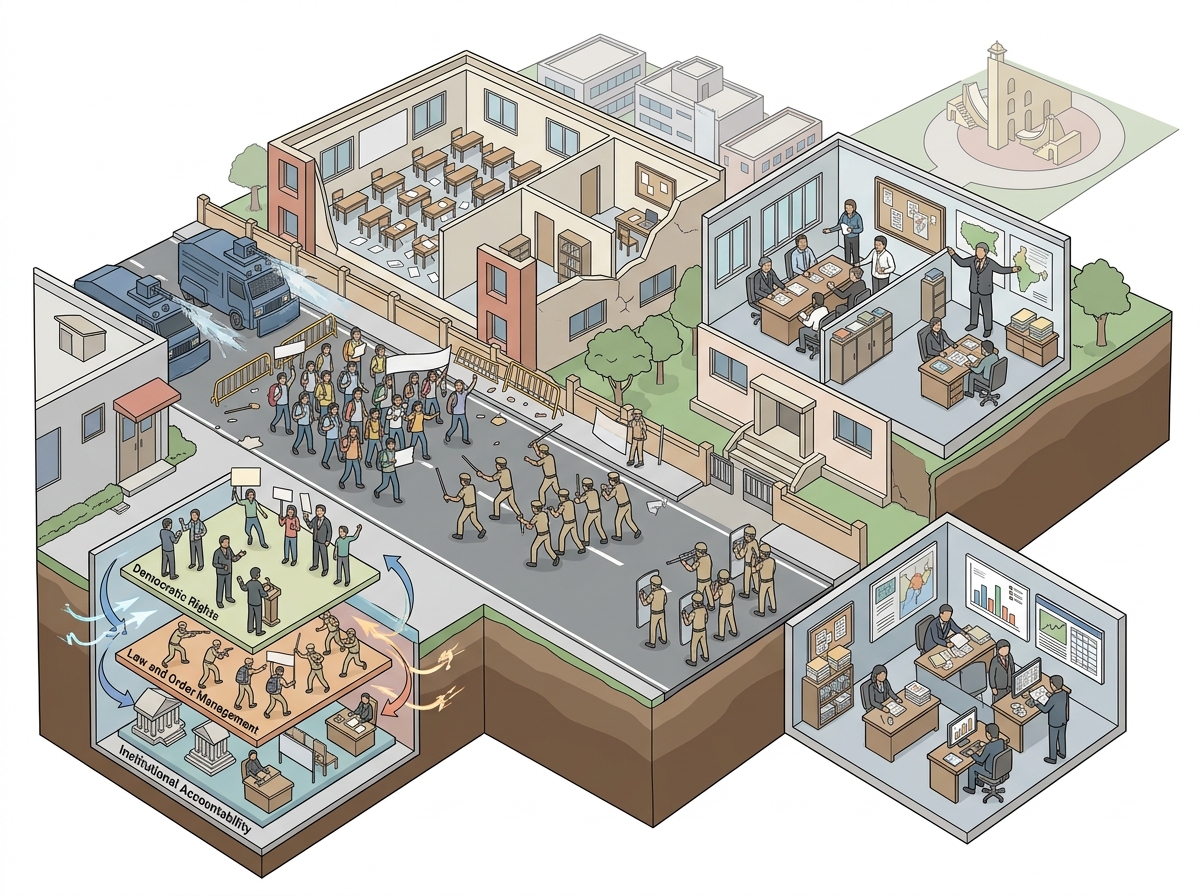
The recent imposition of Section 144 of the Criminal Procedure Code (CrPC) and lathi charge on student protesters in Ranchi, Jharkhand, during a sustained agitation against alleged irregularities in recruitment examinations conducted by the Jharkhand Public Service Commission (JPSC) and Jharkhand Staff Selection Commission (JSSC), has brought into focus the interplay between institutional accountability, democratic rights, and law-and-order management in a federal polity. Concurrently, the initiation of investigations by the Enforcement Directorate (ED) into financial irregularities has added a layer of scrutiny over the governance processes in the state.
Background
- The agitation in Jharkhand follows a pattern of nationwide student protests, notably the NEET paper leak controversy at Jantar Mantar in Delhi, highlighting systemic vulnerabilities in competitive examinations.
- Allegations of irregularities in these examinations have been a recurring issue in several Indian states, leading to judicial interventions and demands for reforms in examination processes.
- The use of Section 144 CrPC to restrict assembly and movement, and the deployment of police forces to manage protests, are governed by the Code of Criminal Procedure, 1973, and framed within the constitutional framework of public order.
- The Enforcement Directorate (ED), a central agency under the Department of Revenue, Ministry of Finance, is mandated to investigate financial crimes under the Prevention of Money Laundering Act (PMLA), 2002, and the Foreign Exchange Management Act (FEMA), 1999.
- The federal structure of India distributes law-and-order powers between the Union and the States, with the latter primarily responsible for maintaining public order, subject to constitutional and statutory safeguards.
What is the Jharkhand Student Agitation and the Enforcement Directorate’s Role?
- The agitation in Jharkhand is primarily led by aspirants of the Jharkhand Public Service Commission (JPSC) and Jharkhand Staff Selection Commission (JSSC) examinations, who allege irregularities in the conduct of these examinations, including paper leaks and unfair practices.
- The protestors have resorted to non-violent methods such as sit-ins, hunger strikes, and assembly outside the State Legislative Assembly, invoking their right to peaceful protest under Article 19(1)(a) of the Constitution of India.
- The state administration invoked Section 144 of the Criminal Procedure Code (CrPC) to prohibit assembly and impose restrictions on movement, citing concerns over public order and potential disruptions.
- The deployment of police forces, including the use of lathi charge to disperse protestors, is a measure of last resort under the law, governed by the principles of proportionality and necessity as enunciated in the Supreme Court’s judgments in *Aruna Roy v. Union of India* (2002) and *Mazdoor Kisan Shakti Sangathan v. Union of India* (2018).
- The Enforcement Directorate (ED) has initiated investigations into alleged financial irregularities connected to the recruitment examinations, which may include kickbacks, embezzlement, or money laundering, under the Prevention of Money Laundering Act (PMLA), 2002.
- The ED’s involvement introduces a central investigative agency into a state-level governance issue, raising questions about the federal balance of powers and the role of central agencies in state-level administrative matters.
- The agitation has also highlighted the broader issue of institutional credibility in public examinations, a concern that has led to judicial interventions such as the Supreme Court’s directions in *Common Cause v. Union of India* (2018) for reforms in examination processes.
- The state government’s response, including the use of police action and the initiation of ED investigations, reflects a dual strategy of maintaining public order while addressing allegations of corruption, though the efficacy and proportionality of these measures remain contested.
Key Features
| Feature | Significance |
|---|---|
| Student-led protest against alleged irregularities in JPSC/JSSC recruitment examinations | Highlights systemic governance failures in competitive examination processes, raising concerns about meritocracy and administrative transparency. |
| Use of police lathi-charge and crowd control measures in Ranchi | Demonstrates the tension between law enforcement and democratic protest rights, with implications for civil liberties and state accountability. |
| Enforcement Directorate (ED) initiating investigation into financial irregularities | Signals potential institutional oversight over alleged malfeasance in public recruitment processes, reflecting federal investigative oversight. |
| Political polarisation between ruling and opposition parties | Exemplifies the intersection of governance failures with electoral politics, influencing public policy discourse and administrative responses. |
Why it Matters
Governance and Accountability
- Reveals systemic vulnerabilities in public recruitment examinations, undermining public trust in institutional integrity.
- Highlights the role of investigative agencies (ED) in scrutinising administrative lapses, reinforcing federal oversight mechanisms.
- Exposes the challenge of balancing law-and-order imperatives with constitutional rights to peaceful protest under Article 19(1)(a).
Public Administration
- Underscores the need for transparent, merit-based recruitment processes to prevent corruption and malpractice in competitive examinations.
- Illustrates the administrative challenges in managing large-scale protests without escalating into violent confrontations.
- Demonstrates the role of district administration in crisis mitigation and maintaining public order during civil unrest.
Legal and Constitutional Framework
- Examines the balance between state authority (police powers) and fundamental rights (freedom of expression and assembly) under the Constitution.
- Evaluates the legal provisions governing investigative agencies (ED) in probing financial irregularities in public institutions.
Challenges
1. Balancing Law-and-Order with Democratic Rights
- Ensuring police actions during protests are proportionate and do not infringe upon constitutional freedoms.
- Preventing escalation of civil unrest into violent confrontations while addressing legitimate grievances of protestors.
- Maintaining public order without suppressing democratic dissent, particularly in sensitive administrative regions.
UPSC Link: GS-II: Fundamental Rights (Part-III)
2. Ensuring Transparency in Public Recruitment Examinations
- Addressing allegations of irregularities in JPSC/JSSC examinations to restore public confidence in merit-based selection.
- Implementing robust mechanisms for auditing and monitoring examination processes to prevent malpractice.
- Strengthening grievance redressal frameworks to address concerns of aggrieved candidates promptly.
UPSC Link: GS-II: Governance and Transparency
3. Institutional Oversight and Investigative Rigor
- Ensuring investigative agencies (ED) conduct impartial and expeditious probes into financial irregularities.
- Avoiding politicisation of investigations while maintaining accountability for administrative lapses.
- Coordinating between state and central agencies to ensure seamless oversight without jurisdictional conflicts.
UPSC Link: GS-II: Role of CBI/ED
4. Crisis Communication and Public Perception Management
- Addressing misinformation and public narratives that may exacerbate tensions during protests.
- Ensuring transparent communication from authorities to build trust and de-escalate tensions.
- Engaging with stakeholders (protestors, opposition, civil society) to address concerns without escalating conflicts.
UPSC Link: GS-II: Role of Media and Civil Society
Challenges — UPSC Perspective
| Issue | Concern |
|---|---|
| Alleged irregularities in JPSC/JSSC examinations | Erosion of public trust in merit-based recruitment processes. |
| Police response to protests (lathi-charge) | Risk of violating constitutional rights to peaceful assembly and expression. |
| Political polarisation over the issue | Potential distortion of policy discourse and administrative responses. |
| ED’s investigation into financial irregularities | Need for impartiality and swift action to restore credibility. |
| Health deterioration of protestors (e.g., Devendra Nath Mahato) | Ethical and legal obligations of state authorities in handling medical emergencies during protests. |
Way Forward
- Constitute an independent judicial commission to investigate allegations of irregularities in JPSC/JSSC examinations.
- Strengthen grievance redressal mechanisms for aggrieved candidates to ensure timely resolution of disputes.
- Implement transparent protocols for competitive examination processes, including third-party audits and real-time monitoring.
- Review and standardise police response protocols during protests to ensure proportionality and adherence to constitutional rights.
- Enhance inter-agency coordination between state police, central investigative agencies (ED), and district administration to address governance failures.
- Promote public awareness campaigns to educate stakeholders about their rights and responsibilities during protests.
- Establish a multi-stakeholder dialogue platform involving protestors, opposition, civil society, and government to address grievances.
- Ensure medical and legal assistance for protestors injured during confrontations, in line with constitutional obligations.
UPSC Value Addition
Keywords for Mains Answer-Writing
Peaceful assembly and protest · Right to Freedom under Article 19(1)(a) · Lathi charge and police action · Enforcement Directorate (ED) and investigative agencies · Recruitment irregularities in JPSC and JSSC · Federal structure and state police powers · Political strategy and opposition response · Public order and reasonable restrictions · Constitutional safeguards for protestors · Role of district administration in law and order
Constitutional & Policy Linkages
- Article 19(1)(a) – Freedom of speech and expression
- Article 21 – Right to life and personal liberty
- Article 32 – Right to constitutional remedies
- Article 38 – Directive Principles of State Policy (DPSP)
Concept Flow
Allegations of irregularities in JPSC/JSSC examinations → Public outrage and protests → Police intervention (lathi-charge) → Escalation of tensions → ED investigation → Political polarisation → Governance and accountability crisis → Need for systemic reforms.
Prelims Practice Questions
Q1. Consider the following statements regarding the right to peaceful assembly in India:
1. The right to assemble peacefully and without arms is guaranteed under Article 19(1)(b) of the Constitution.
2. The state may impose reasonable restrictions on this right in the interest of public order.
3. The Supreme Court has held that the right to assemble is absolute and cannot be restricted by any law.
How many of the above statements are correct?
- Only one
- Only two
- All three
- None
Answer: Only two — Statement 1 is correct as Article 19(1)(b) guarantees the right to assemble peacefully and without arms. Statement 2 is correct as the state may impose reasonable restrictions under Article 19(2) to maintain public order. Statement 3 is incorrect as the Supreme Court has upheld that reasonable restrictions can be imposed on this right.
Q2. Assertion (A): The Enforcement Directorate (ED) is a statutory body under the Prevention of Money Laundering Act, 2002.
Reason (R): The ED conducts investigations into money laundering and foreign exchange violations under the provisions of the PMLA and FEMA.
Options:
A. Both A and R are true, and R is the correct explanation of A.
B. Both A and R are true, but R is not the correct explanation of A.
C. A is true, but R is false.
D. A is false, but R is true.
Answer: ? — Assertion (A) is true as the ED is a statutory body established under the PMLA. Reason (R) is also true and correctly explains the role of the ED under the PMLA and FEMA. Therefore, both A and R are true, and R is the correct explanation of A.
Q3. Match the following constitutional provisions with their respective articles:
Column I
1. Right to freedom of speech and expression
2. Right to assemble peacefully and without arms
3. Right to form associations or unions
4. Right to move freely throughout the territory of India
Column II
A. Article 19(1)(a)
B. Article 19(1)(b)
C. Article 19(1)(c)
D. Article 19(1)(d)
- 1-A, 2-B, 3-C, 4-D
- 1-B, 2-A, 3-D, 4-C
- 1-A, 2-C, 3-B, 4-D
- 1-D, 2-A, 3-C, 4-B
Answer: 1-A, 2-B, 3-C, 4-D — The correct match is: 1-A (Article 19(1)(a)), 2-B (Article 19(1)(b)), 3-C (Article 19(1)(c)), and 4-D (Article 19(1)(d)).
Mains Practice Question
✍ The use of lathi charge by police during peaceful protests raises critical questions about the balance between public order and constitutional rights. Examine the constitutional and legal framework governing the right to peaceful assembly in India, with reference to recent incidents such as those in Ranchi. Also, analyse the role of district administration in ensuring law and order while upholding democratic rights. (15 Marks)
Approach: MODEL-ANSWER SKELETON:
1. Introduction: Define the right to peaceful assembly under Article 19(1)(b) and its significance in a democracy.
2. Constitutional and legal framework:
– Article 19(1)(b) and reasonable restrictions under Article 19(2).
– The Supreme Court’s interpretation in cases such as *Himat Lal K. Shah v. Commissioner of Police* (1973) and *Mazdoor Kisan Shakti Sangathan v. Union of India* (2018).
– Role of state police under the Police Act, 1861, and Code of Criminal Procedure, 1973.
3. Recent incidents in Ranchi:
– Context of JPSC/JSSC recruitment protests and allegations of irregularities.
– Use of lathi charge and its legal justification under Section 129 CrPC.
– Critique of police action vis-à-vis constitutional safeguards for protestors.
4. Role of district administration:
– Responsibilities under the Constitution (Article 246 and Seventh Schedule).
– Guidelines from the Supreme Court in *Common Cause v. Union of India* (2016) on police conduct during protests.
– Need for proportionality and adherence to human rights standards.
5. Conclusion: Emphasise the need for a balanced approach that upholds both public order and democratic rights, with recommendations for reform in police training and protest management.
Source: amarujala.com
Generated by AanyaAi for educational purpose.

- KWML’s Feasibility Reports for Water Metro in 18 Cities: UPSC & PCS Insights - October 3, 2026
- ओडिशा में वन्यजीव अनुसंधान अनुदान कार्यक्रम शुरू, सिमिलिपाल में 300 कैमरे और बढ़ेंगे - October 3, 2026
- India Summons Pakistan High Commission Official Over Violation - October 3, 2026

No Comments