


24 Nov Rising Inflation & External Factors: UPSC Economy Analysis
✎ Inflation, primarily measured by the CPI in India, reflects the erosion of purchasing power and is a key determinant for the RBI's monetary policy decisions, with recent trends indicating a breach of the upper tolerance limit due…
Subject Relevance — Where This Topic Fits
- GS Paper III — Indian Economy and issues relating to Planning, Mobilization of Resources, Growth, Development and Employment; Government Budgeting; Monetary Policy | GS Paper III — Effects of Liberalization on the Economy, Changes in Industrial Policy and their Effects on Industrial Growth
- Prelims: Retail Inflation, Consumer Price Index (CPI), Reserve Bank of India (RBI), Monetary Policy Committee (MPC), Real Wages, Nominal Wages, Food Inflation, Core Inflation, Fiscal Policy, Monetary Policy
- Essay: The interplay of domestic and global factors in shaping India’s economic resilience., Evaluating policy responses to inflation and their impact on inclusive growth and social welfare.
Quick Revision: Inflation, primarily measured by the CPI in India, reflects the erosion of purchasing power and is a key determinant for the RBI’s monetary policy decisions, with recent trends indicating a breach of the upper tolerance limit due to a confluence of domestic and external factors.
Why is this in the news?
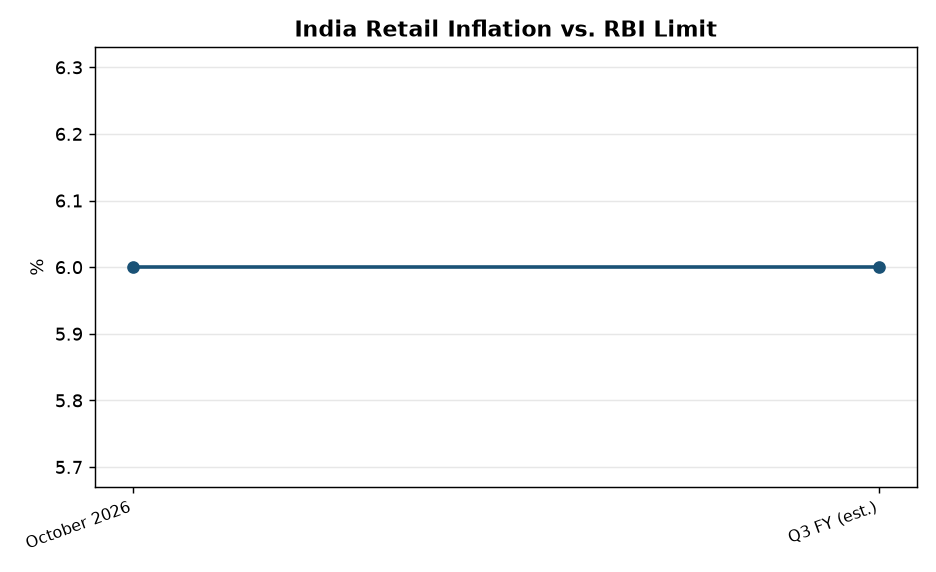
Recent data indicate that India’s retail inflation has surpassed the Reserve Bank of India’s upper tolerance limit of 6% in October 2026, with projections suggesting this trend may persist through the third quarter of the current financial year. This surge is attributed to a combination of external factors and domestic supply-side issues, including agricultural shortfalls due to a deficient monsoon and elevated fuel prices, leading to a broad-based increase across various consumption categories.
Background
- Inflation, as measured by the Consumer Price Index (CPI), is a critical economic indicator reflecting the general increase in prices of goods and services and the corresponding fall in the purchasing value of money.
- The Reserve Bank of India (RBI) is mandated to maintain price stability, with a flexible inflation targeting framework of 4% with a band of +/- 2%, meaning inflation should ideally remain between 2% and 6%.
- Food inflation, a significant component of overall CPI, is highly susceptible to monsoon patterns, agricultural output, and global commodity prices.
- Fuel prices, influenced by international crude oil rates and domestic taxation, have a cascading effect on transportation costs and, consequently, on the prices of most goods and services.
- Real wages, which account for inflation, provide a more accurate picture of purchasing power compared to nominal wages, which are not adjusted for price changes.
- The informal economy, characterized by transactions outside official oversight, can complicate accurate inflation measurement and policy formulation due to its unrecorded nature.
What is Inflation and its Measurement in India?
- Inflation refers to the rate at which the general level of prices for goods and services is rising, and subsequently, the purchasing power of currency is falling.
- In India, the primary measure of inflation for policy purposes is the Consumer Price Index (CPI), specifically the CPI (Combined) for rural and urban areas.
- The CPI measures changes in the price level of a market basket of consumer goods and services purchased by households, including food, fuel, housing, clothing, and services.
- The Ministry of Statistics and Programme Implementation (MoSPI) through the National Statistical Office (NSO) collects and compiles CPI data.
- Food inflation is a sub-component of CPI that specifically tracks price changes in food items, which typically constitute a large portion of household expenditure in India.
- Core inflation excludes volatile components like food and fuel prices from the overall CPI to provide a clearer picture of underlying price trends and demand-side pressures.
- The Monetary Policy Committee (MPC) of the RBI uses CPI data to make decisions regarding the repo rate and other monetary policy tools to manage inflation.
Key Features
| Feature | Significance |
|---|---|
| Retail Inflation Exceeds RBI’s Upper Limit | Indicates a breach of the monetary policy target, necessitating potential intervention to manage price stability. |
| Food Inflation at 8.5% in October 2026 | Highlights the significant impact of agricultural shortfalls and monsoon deficiencies on essential commodity prices, disproportionately affecting lower-income households. |
| Widespread Inflation Across CPI Categories | Demonstrates that inflationary pressures are not confined to specific sectors but are pervasive, affecting a broad spectrum of household expenditures from goods to services. |
| Real Wage Contraction (2012-2024) | Reveals a decline in purchasing power despite nominal wage increases, impacting consumption levels and private investment, particularly among higher wage earners. |
| Discrepancy in Official Inflation Metrics | Suggests that official figures may not fully capture the extent of price increases, potentially underestimating the economic hardship faced by the public. |
Why it Matters
Economic Stability
- Sustained high inflation erodes the purchasing power of consumers, leading to a decline in real incomes and living standards.
- It can distort investment decisions, as businesses face uncertainty regarding future costs and revenues, potentially hindering economic growth.
- High inflation, particularly when driven by external factors, limits the effectiveness of domestic monetary policy tools.
Social Impact
- The disproportionate impact of food and fuel price increases on vulnerable populations exacerbates income inequality and poverty.
- Real wage contraction, especially for higher earners, can lead to reduced consumption, which is a key driver of economic activity.
Monetary Policy Implications
- The breach of the Reserve Bank of India’s (RBI) inflation target mandates a review of monetary policy stance, potentially leading to interest rate adjustments to curb inflationary pressures.
- Challenges in accurately measuring inflation complicate policy formulation, as interventions may be based on incomplete or underestimated data.
Challenges
1. Inflationary Pressures
- Retail inflation exceeding the RBI’s upper comfort limit of 6% indicates a failure to maintain price stability.
- Food inflation at 8.5% in October 2026, driven by agricultural shortfalls and deficient monsoons, significantly impacts household budgets.
- Widespread inflation across 10 of 12 major CPI categories suggests a broad-based increase in prices, making it difficult for households to manage expenses.
UPSC Link: GS-III: Indian Economy and issues relating to planning, mobilization, of resources, growth, development and employment.
2. Real Wage Contraction
- Nominal wages doubled from 2012 to 2024, but real wages fell by 4% after adjusting for inflation, indicating a decline in purchasing power.
- This contraction is sharper for high-skilled and high-earning workers, who are crucial drivers of consumption in the economy.
- Reduced real wages are likely to hit consumption levels and private investment, thereby impeding economic growth.
UPSC Link: GS-III: Indian Economy and issues relating to planning, mobilization, of resources, growth, development and employment.
3. Accuracy of Inflation Metrics
- Evidence from cash with the public and UPI transactions suggests that the official inflation metrics may not be capturing the full extent of rising prices.
- This potential underestimation of inflation can lead to misinformed policy decisions and an inadequate response to economic challenges.
UPSC Link: GS-III: Indian Economy and issues relating to planning, mobilization, of resources, growth, development and employment.
4. External Factors and Policy Control
- Inflation largely driven by external factors, such as global commodity prices or supply chain disruptions, limits the effectiveness of domestic policy interventions.
- The inability to control external variables makes it challenging for the government to implement quick fixes for inflation.
UPSC Link: GS-III: Indian Economy and issues relating to planning, mobilization, of resources, growth, development and employment.
Challenges — UPSC Perspective
| Issue | Concern |
|---|---|
| Retail Inflation Exceeding RBI Limit | Indicates a breach of the mandated price stability target, potentially leading to a loss of confidence in economic management and requiring stringent monetary policy responses. |
| Sharp Rise in Food Inflation | Directly impacts household budgets, particularly for lower-income groups, exacerbating food insecurity and reducing discretionary spending. |
| Pervasive Inflation Across Categories | Signifies a broad-based erosion of purchasing power, affecting various aspects of daily life from essential goods to services, and hindering overall economic activity. |
| Real Wage Contraction | Despite nominal wage increases, a decline in real wages reduces consumer spending capacity, which is critical for driving economic growth through consumption and investment. |
| Potential Underestimation of Inflation | If official metrics do not reflect the true extent of price increases, policy responses may be inadequate, leading to greater economic hardship and misallocation of resources. |
| Dependence on External Factors for Inflation | Reduces the efficacy of domestic policy tools in controlling inflation, making the economy vulnerable to global economic shocks and commodity price fluctuations. |
Way Forward
- Implement targeted supply-side interventions to address sector-specific shortages, particularly in agriculture, to mitigate food inflation.
- Strengthen the agricultural supply chain and storage infrastructure to reduce post-harvest losses and ensure timely availability of produce.
- Monitor global commodity price trends and implement strategic measures to cushion domestic consumers from external price shocks, such as maintaining strategic reserves.
- Enhance the accuracy and coverage of inflation data collection to ensure that official metrics truly reflect the economic reality faced by households.
- Promote policies that support real wage growth through productivity enhancements, skill development, and fair wage practices across sectors.
- Communicate transparently with the public regarding economic challenges and policy responses to manage expectations and build confidence.
- Explore fiscal measures that can provide targeted relief to vulnerable sections of the population affected by high inflation, without exacerbating inflationary pressures.
UPSC Value Addition
Keywords for Mains Answer-Writing
Retail inflation · Consumer Price Index (CPI) · Monetary Policy Committee (MPC) · Food inflation · Fuel prices · Real wages · Nominal wages · Consumption levels · Private investment · Informal economy · Monetary policy tools · Fiscal policy measures
Concept Flow
Patchy and Deficient Monsoon → Agricultural Shortfalls and Elevated Fuel Prices → Rise in Food and Transport Inflation → Widespread Inflation Across CPI Categories → Real Wage Contraction and Reduced Consumption → Economic Pain and Potential Slowdown
Prelims Practice Questions
Q1. Consider the following statements regarding inflation in India:
1. The Reserve Bank of India (RBI) targets retail inflation, measured by the Consumer Price Index (CPI).
2. Food inflation is a component of the Wholesale Price Index (WPI) but not the CPI.
3. A sustained increase in real wages typically leads to a decrease in consumption levels.
- Only one
- Only two
- Only three
- None
Answer: Only one — Statement 1 is correct. The RBI’s Monetary Policy Committee (MPC) uses the CPI as its primary measure for inflation targeting. Statement 2 is incorrect. Food inflation is a significant component of both the CPI and WPI, reflecting price changes at different stages of the supply chain. Statement 3 is incorrect. A sustained increase in real wages, meaning wages adjusted for inflation, generally enhances purchasing power and thus tends to increase consumption levels.
Q2. Which of the following are potential causes of high retail inflation in an economy?
1. Deficient monsoon leading to agricultural shortfalls.
2. Elevated global crude oil prices.
3. Significant increase in real wages across sectors.
4. Expansionary fiscal policy.
- 1, 2 and 3 only
- 1, 2 and 4 only
- 2, 3 and 4 only
- 1, 2, 3 and 4
Answer: 1, 2 and 4 only — Deficient monsoon (1) can lead to supply-side shocks, increasing food prices. Elevated global crude oil prices (2) directly impact fuel and transport costs, contributing to inflation. Expansionary fiscal policy (4) can increase aggregate demand, potentially leading to demand-pull inflation. A significant increase in real wages (3) typically boosts consumption and economic growth, but if not matched by productivity gains, it could contribute to cost-push inflation over time, though it’s not a direct or immediate cause in the same way as supply shocks or demand-side fiscal stimulus.
Mains Practice Question
✍ Examine the multifaceted challenges posed by persistent high retail inflation on household consumption and private investment in an economy. Discuss the limitations of monetary and fiscal policy in addressing inflation primarily driven by external factors. (15 Marks)
Approach: Introduction: Define retail inflation and its current status in India (e.g., exceeding RBI’s comfort limit). Part 1: Challenges on household consumption and private investment. Detail how high inflation erodes real wages, reduces purchasing power, and impacts discretionary spending. Explain how uncertainty due to inflation deters private investment, affecting capital formation and future growth. Part 2: Limitations of monetary and fiscal policy. Discuss how monetary policy (e.g., interest rate hikes) might be less effective against supply-side or external shocks (e.g., global fuel prices, monsoon failures). Explain how fiscal policy (e.g., tax cuts, subsidies) can sometimes exacerbate inflation or face constraints in addressing global price movements. Conclude with the need for a balanced approach, including supply-side interventions and structural reforms.
Source: The Hindu
Generated by AanyaAi for educational purpose.
Related guides on our sites
- Current affairs for upsc 2026
- Best economics optional coaching for upsc
- Best economics optional teacher for upsc
- How to prepare for GS paper 1 for UPSC CSE mains exam

- Rising Inflation & External Factors: UPSC Economy Analysis - November 24, 2026
- पीएलआई योजना: नीति आयोग रिपोर्ट, चुनौतियाँ और आगे की राह - November 24, 2026
- Ganga Water Treaty: India-Bangladesh Renewal & Provisions - November 24, 2026

No Comments