


11 Aug Kerala Launches Certificate & Diploma Courses on Child Rights for UPSC Aspirants
✎ Kerala’s certificate and diploma courses on child rights integrate constitutional protections, POCSO Act, Juvenile Justice Act, and RTE Act to build institutional capacity for child protection and rights-based governance.
Subject Relevance — Where This Topic Fits
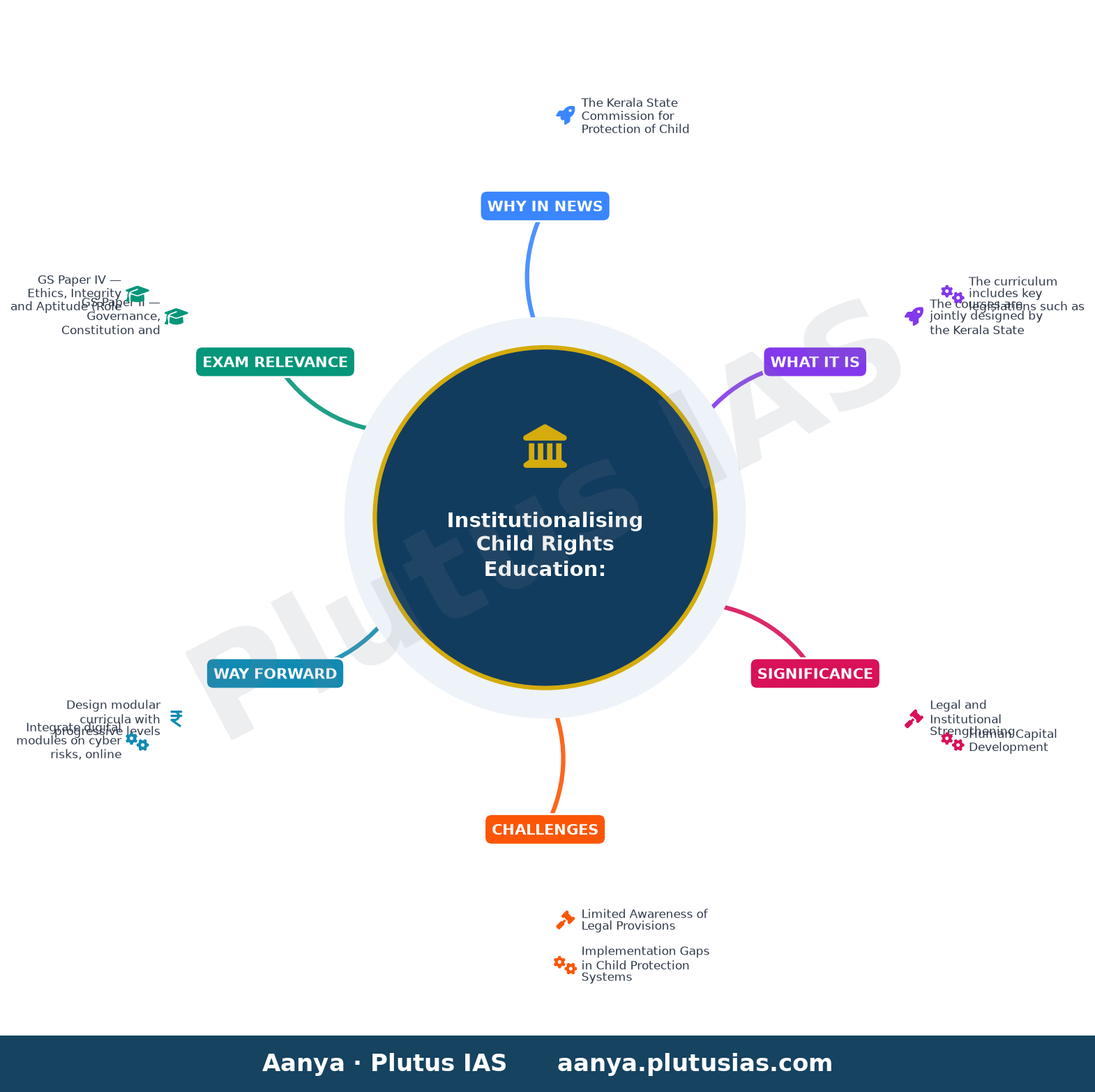
- GS Paper II — Governance, Constitution and Social Justice | GS Paper IV — Ethics, Integrity and Aptitude (Role of Institutions in Child Protection)
- Prelims: Child Rights Commission, POCSO Act, Juvenile Justice Act, Right to Education Act, Kerala State Commission for Protection of Child Rights (KSCPCR), Sree Narayana Guru Open University
- Essay: The Role of Education in Safeguarding Fundamental Rights: A Case Study of Kerala’s Child Rights Curriculum, Institutional Mechanisms for Child Protection: Balancing Rights, Justice, and Welfare
Quick Revision: Kerala’s certificate and diploma courses on child rights integrate constitutional protections, POCSO Act, Juvenile Justice Act, and RTE Act to build institutional capacity for child protection and rights-based governance.
Why is this in the news?
The Kerala State Commission for Protection of Child Rights (KSCPCR) and Sree Narayana Guru Open University have entered into a memorandum of understanding to launch certificate and diploma courses on child rights and protection laws. Scheduled for formal inauguration on 11 August 2026, these courses aim to address the growing vulnerabilities of children to violence, exploitation, neglect, and cyber threats by enhancing the knowledge base of stakeholders through structured academic and practical training.
Background
- The Constitution of India guarantees fundamental rights to all children under Articles 14, 15(3), 21, 21A, and 39(e), which mandate protection from exploitation and access to education and development.
- India has enacted several specialised legislations to protect child rights, including the Protection of Children from Sexual Offences (POCSO) Act, 2012; the Juvenile Justice (Care and Protection of Children) Act, 2015; the Prohibition of Child Marriage Act, 2006; the Prohibition of Child Labour (Prohibition and Regulation) Act, 1986; and the Right of Children to Free and Compulsory Education (RTE) Act, 2009.
- The National Commission for Protection of Child Rights (NCPCR) and State Commissions for Protection of Child Rights (SCPCRs) were established under the Commissions for Protection of Child Rights Act, 2005, to monitor the implementation of child rights instruments and redress grievances.
- Kerala has consistently ranked high in child welfare indices, including the NITI Aayog’s Child Well-being Index (2020), which underscores the state’s proactive approach to child protection and development.
- The proliferation of digital platforms has introduced new risks, including online exploitation, cyberbullying, and exposure to harmful content, necessitating targeted education on child safety in the digital domain.
- The initiative aligns with global commitments under the United Nations Convention on the Rights of the Child (UNCRC), 1989, which India ratified in 1992 and which obliges states to ensure the protection and participation rights of children.
What are the Certificate and Diploma Courses on Child Rights?
- The courses are jointly designed by the Kerala State Commission for Protection of Child Rights (KSCPCR) and Sree Narayana Guru Open University, Kollam, to provide structured academic and practical training on child rights and protection laws.
- The curriculum includes key legislations such as the POCSO Act, Juvenile Justice Act, Prohibition of Child Marriage Act, Prohibition of Child Labour Act, and Right to Education Act, alongside constitutional provisions and child protection systems.
- The certificate course is likely to be of shorter duration (e.g., 3–6 months), while the diploma course will offer a more comprehensive study (e.g., 9–12 months), with provisions for modular learning to accommodate working professionals.
- Target beneficiaries include teachers, students, parents, law enforcement personnel, social workers, and government officials, ensuring a multi-stakeholder approach to child protection.
- The courses aim to bridge the knowledge gap between legal provisions and ground-level implementation, fostering a rights-based culture in communities and institutions.
- Practical components may include case studies, field visits to child protection institutions, and training on reporting mechanisms under the POCSO Act and Juvenile Justice Act.
- The initiative reflects a shift from reactive child protection measures to proactive education and awareness, aligning with the principle of ‘prevention is better than cure’ in safeguarding child rights.
- Upon completion, participants are expected to gain competencies in identifying child rights violations, navigating legal frameworks, and advocating for child-centric policies and practices.
Key Features
| Feature | Significance |
|---|---|
| Certificate and Diploma Courses on Child Rights | Formalises capacity-building in child rights, ensuring systematic dissemination of legal and procedural knowledge to stakeholders. |
| Joint Initiative by KSCPCR and Sree Narayana Guru Open University | Leverages academic infrastructure and statutory authority of a state commission for structured training programmes. |
| Focus on Practical and Academic Knowledge | Bridges theory-practice divide by integrating legal frameworks with real-world child protection mechanisms. |
| Coverage of Key Legislations (POCSO, JJ Act, RTE, etc.) | Ensures alignment with national child protection architecture and legal obligations under multiple statutes. |
| Target Audience: General Public, Teachers, Students, Officials | Expands the base of informed stakeholders beyond traditional enforcement agencies. |
| Addressal of Emerging Threats (Cyber Risks, Exploitation) | Proactively responds to evolving challenges in child safety beyond traditional domains of physical abuse. |
Why it Matters
Legal and Institutional Strengthening
- Enhances compliance with constitutional and statutory provisions on child rights through education and awareness.
- Strengthens the institutional role of the Kerala State Commission for Protection of Child Rights (KSCPCR) as a nodal agency for capacity-building.
- Promotes a rights-based approach in governance by embedding legal literacy in public and professional domains.
Human Capital Development
- Equips teachers, students, and officials with specialised knowledge to identify, report, and address child rights violations.
- Fosters a culture of child-centric governance by integrating rights education into mainstream institutions.
- Supports the Sustainable Development Goal 4 (Quality Education) target on inclusive and equitable learning opportunities.
Preventive and Protective Governance
- Reduces incidents of child exploitation, neglect, and abuse through early education and awareness campaigns.
- Enables proactive intervention by empowering stakeholders to recognise red flags and procedural pathways.
- Complements existing child protection systems by creating a trained cadre of first responders.
Interdisciplinary Impact
- Bridges gaps between law, education, social work, and technology in child protection frameworks.
- Encourages cross-sectoral collaboration among government, academia, and civil society.
Challenges
1. Limited Awareness of Legal Provisions
- General public and even officials often lack familiarity with child rights statutes and reporting mechanisms.
- Low awareness of POCSO Act, JJ Act, and RTE Act hinders effective implementation and reporting of violations.
UPSC Link: GS II: Social Justice – Vulnerable Sections
2. Implementation Gaps in Child Protection Systems
- Underreporting of child rights violations due to lack of trained personnel and systemic inefficiencies.
- Delays in justice delivery and rehabilitation due to procedural bottlenecks in child protection agencies.
UPSC Link: GS II: Governance – Accountability
3. Emerging Threats in Digital Space
- Cyberbullying, online exploitation, and grooming pose new challenges beyond traditional abuse domains.
- Lack of digital literacy among parents, teachers, and children exacerbates vulnerability to online risks.
UPSC Link: GS III: Cyber Security – Challenges
4. Resource Constraints in Training Programmes
- Scaling capacity-building initiatives requires sustained funding, faculty, and infrastructure support.
- Ensuring equitable access across rural and urban regions remains a logistical challenge.
UPSC Link: GS II: Human Resource Development
5. Inter-Agency Coordination Deficits
- Fragmented response mechanisms among schools, police, child welfare committees, and NGOs hinder holistic protection.
- Lack of standardised protocols for data sharing and case management across agencies.
UPSC Link: GS II: Governance – Coordination
Challenges — UPSC Perspective
| Issue | Concern |
|---|---|
| Underreporting of Child Rights Violations | Systemic failure to document and act on violations due to lack of awareness and procedural clarity. |
| Procedural Delays in Justice Delivery | Lengthy legal processes under POCSO and JJ Act deter victims and witnesses from pursuing cases. |
| Digital Vulnerabilities | Inadequate safeguards against cyber threats, including online abuse and exploitation of children. |
| Capacity Gaps in Frontline Workers | Teachers, anganwadi workers, and police lack specialised training to handle child rights cases. |
| Fragmented Implementation of Laws | Overlapping jurisdictions and lack of inter-agency coordination reduce efficacy of child protection mechanisms. |
| Equity in Access to Training | Rural and marginalised communities face barriers in accessing certificate/diploma courses due to infrastructure and language constraints. |
Way Forward
- Design modular curricula with progressive levels (basic, intermediate, advanced) to cater to diverse stakeholders.
- Integrate digital modules on cyber risks, online safety, and reporting mechanisms into the courses.
- Establish a state-level certification framework to ensure recognition and career progression for trained professionals.
- Partner with NGOs, schools, and local bodies to conduct outreach programmes in rural and tribal areas.
- Develop a monitoring and evaluation system to assess the impact of training on reporting and redressal of child rights violations.
- Collaborate with national bodies like NCPCR and NITI Aayog to align state-level initiatives with national child protection strategies.
- Incorporate case studies and simulations to enhance practical application of legal and procedural knowledge.
- Ensure multilingual delivery of courses to accommodate linguistic diversity within the state.
UPSC Value Addition
Keywords for Mains Answer-Writing
Child Rights Commission · Juvenile Justice Act 2015 · Protection of Children from Sexual Offences (POCSO) Act 2012 · Right to Education (RTE) Act 2009 · Prohibition of Child Marriage Act 2006 · Prohibition of Child Labour Act 2016 · Kerala State Commission for Protection of Child Rights (KSCPCR) · Sree Narayana Guru Open University · Child protection mechanisms · Cyber threats against children · Constitutional provisions for child rights · Multi-stakeholder governance of child welfare · Institutional capacity-building for child rights · Academic-practical integration in education
Concept Flow
Rising incidents of child rights violations → Recognition of systemic gaps in awareness and implementation → State initiative to formalise capacity-building → Joint academic-statutory collaboration → Structured certificate/diploma courses → Targeted training for stakeholders → Enhanced reporting and redressal → Strengthened child protection ecosystem → Long-term reduction in violations and improved justice delivery.
Prelims Practice Questions
Q1. Consider the following statements about the Juvenile Justice Act, 2015:
1. It mandates the establishment of Child Protection Committees at the district level.
2. It classifies offences committed by children into heinous, serious, and petty offences.
3. It prohibits the trial of children below the age of 18 years as adults under any circumstances.
4. It empowers the Juvenile Justice Board to dispose of cases within a maximum period of 4 months.
How many of the above statements are correct?
- Only one
- Only two
- Only three
- All four
Answer: All four — Statements 1, 2, and 4 are correct. Statement 3 is incorrect as the Act allows for the possibility of trying children aged 16-18 as adults for heinous offences under specific conditions.
Q2. Assertion (A): The Protection of Children from Sexual Offences (POCSO) Act, 2012, mandates the establishment of Special Courts for the trial of offences under the Act.
Reason (R): The Act aims to ensure speedy trial and reduce the trauma faced by child victims by providing a child-friendly environment.
In the context of the above two statements, which one of the following is correct?
- Both A and R are true, and R is the correct explanation of A
- Both A and R are true, but R is not the correct explanation of A
- A is true, but R is false
- A is false, but R is true
Answer: Both A and R are true, but R is not the correct explanation of A — Both the assertion and reason are correct. The POCSO Act explicitly mandates the establishment of Special Courts (Section 28) to ensure speedy trial and child-friendly procedures, making R the correct explanation of A.
Q3. Match the following Acts with their respective primary objectives:
Column I
A. Right to Education Act, 2009
B. Prohibition of Child Marriage Act, 2006
C. Prohibition of Child Labour Act, 2016
D. Juvenile Justice Act, 2015
Column II
1. Ensuring free and compulsory education for children aged 6-14 years
2. Prohibiting and penalising child marriage
3. Prohibiting the engagement of children in hazardous and non-hazardous labour
4. Providing a legal framework for the care, protection, and rehabilitation of children in conflict with the law
Select the correct match:
- A-1, B-2, C-3, D-4
- A-2, B-1, C-4, D-3
- A-3, B-4, C-1, D-2
- A-4, B-3, C-2, D-1
Answer: A-1, B-2, C-3, D-4 — The correct matches are: A-1 (Right to Education Act), B-2 (Prohibition of Child Marriage Act), C-3 (Prohibition of Child Labour Act), and D-4 (Juvenile Justice Act).
Mains Practice Question
✍ The Kerala State Commission for Protection of Child Rights (KSCPCR) has collaborated with the Sree Narayana Guru Open University to launch certificate and diploma courses on child rights and protection laws. Critically examine the significance of such institutional capacity-building initiatives in addressing contemporary challenges to child rights in India. (15 Marks)
Approach: MODEL-ANSWER SKELETON:
1. **Introduction**: Define child rights and their constitutional underpinnings (Article 15(3), Article 21A, Directive Principles of State Policy).
2. **Contemporary Challenges**: Highlight rising incidents of violence, exploitation, neglect, and cyber threats against children, citing recent data or reports (e.g., NCRB, NCPCR annual reports).
3. **Role of KSCPCR and Sree Narayana Guru Open University**: Explain the objectives of the courses (practical and academic knowledge on POCSO Act, Juvenile Justice Act, RTE Act, etc.) and their target audience (general public, teachers, students, officials).
4. **Institutional Capacity-Building**: Discuss how such initiatives enhance awareness, create a cadre of trained professionals, and strengthen child protection mechanisms. Reference the National Commission for Protection of Child Rights (NCPCR) and state commissions’ role under the Commissions for Protection of Child Rights Act, 2005.
5. **Comparative Perspective**: Compare with similar initiatives in other states (e.g., Tamil Nadu’s Child Rights Protection Units) or national-level programs (e.g., Integrated Child Protection Scheme).
6. **Challenges**: Identify limitations such as low enrolment, lack of awareness, or resource constraints in implementing such programs.
7. **Conclusion**: Emphasise the need for multi-stakeholder collaboration (government, academia, civil society) to ensure the effectiveness of these initiatives. Conclude with a forward-looking statement on the role of education in safeguarding child rights.
Source: The Indian Express
Generated by AanyaAi for educational purpose.

- KWML’s Feasibility Reports for Water Metro in 18 Cities: UPSC & PCS Insights - October 3, 2026
- ओडिशा में वन्यजीव अनुसंधान अनुदान कार्यक्रम शुरू, सिमिलिपाल में 300 कैमरे और बढ़ेंगे - October 3, 2026
- India Summons Pakistan High Commission Official Over Violation - October 3, 2026

No Comments