


11 Aug Supreme Court Seeks Centre’s Response on Netaji’s Ashes Repatriation Plea
✎ The repatriation of Netaji Subhas Chandra Bose’s ashes from Tokyo involves constitutional rights under Article 25, diplomatic protocols with Japan, and the judiciary’s role in ensuring executive accountability for timely…
Subject Relevance — Where This Topic Fits
- GS Paper II — International Relations: Bilateral Relations (India-Japan), Diplomatic and Consular Relations, Cultural and Historical Ties | GS Paper II — Polity and Governance: Role of the Judiciary in Governance, Fundamental Rights and Duties, Constitutional Remedies | GS Paper III — Security: Historical Context of National Security and Freedom Struggle
- Prelims: Subhash Chandra Bose, Indian National Army (INA), Renkō-Ji Temple, Taihoku (Taipei) air crash, Article 26 of the Indian Constitution (Freedom to manage religious affairs), diplomatic immunity, bilateral treaties between India and Japan, Union Ministries of External Affairs and Home Affairs
- Essay: The interplay of historical memory and contemporary governance: Repatriation of national icons as a reflection of national identity, Judicial intervention in matters of national heritage and family sentiment: Balancing constitutional rights with executive discretion
Quick Revision: The repatriation of Netaji Subhas Chandra Bose’s ashes from Tokyo involves constitutional rights under Article 25, diplomatic protocols with Japan, and the judiciary’s role in ensuring executive accountability for timely decision-making.
Why is this in the news?
On August 11, 2026, the Supreme Court of India, led by Chief Justice Surya Kant, issued a notice to the Union Ministries of External Affairs and Home Affairs on a petition filed by Anita Bose Pfaff, daughter of Netaji Subhas Chandra Bose, seeking the repatriation of his mortal remains from Renkō-Ji Temple in Tokyo. The petition underscores the prolonged failure of the Union government to facilitate the repatriation of Netaji’s ashes, which have been preserved in Tokyo for over 80 years, thereby raising critical questions about diplomatic processes, constitutional rights of the family, and the role of the judiciary in matters of national heritage and historical memory.
Background
- Netaji Subhas Chandra Bose, a prominent leader of the Indian independence movement and founder of the Indian National Army (INA), is believed to have died in an air crash at Taihoku (Taipei) in 1945, while en route from Singapore following the Japanese surrender to the Allied Powers.
- His mortal remains were transported to Tokyo in early September 1945 and subsequently interred at Renkō-Ji Temple, where they have remained under the custodianship of successive head priests for over eight decades.
- The preservation of Netaji’s ashes in Tokyo has been a subject of public and familial concern, with successive generations of his family expressing the desire for their repatriation to India for the performance of final rites.
- The Union government has, to date, not taken a final, reasoned, and time-bound decision on the repatriation of Netaji’s ashes, despite multiple representations from family members and public stakeholders.
- The Supreme Court, in its order dated August 11, 2026, directed the Union Ministries of External Affairs and Home Affairs to respond to the petition, emphasizing the need for a reasoned decision within a stipulated timeframe.
- This case follows a prior petition filed by Netaji’s grandnephew, Ashish Ray, which the Supreme Court had declined to entertain, directing the daughter to approach the court directly as the legal heir.
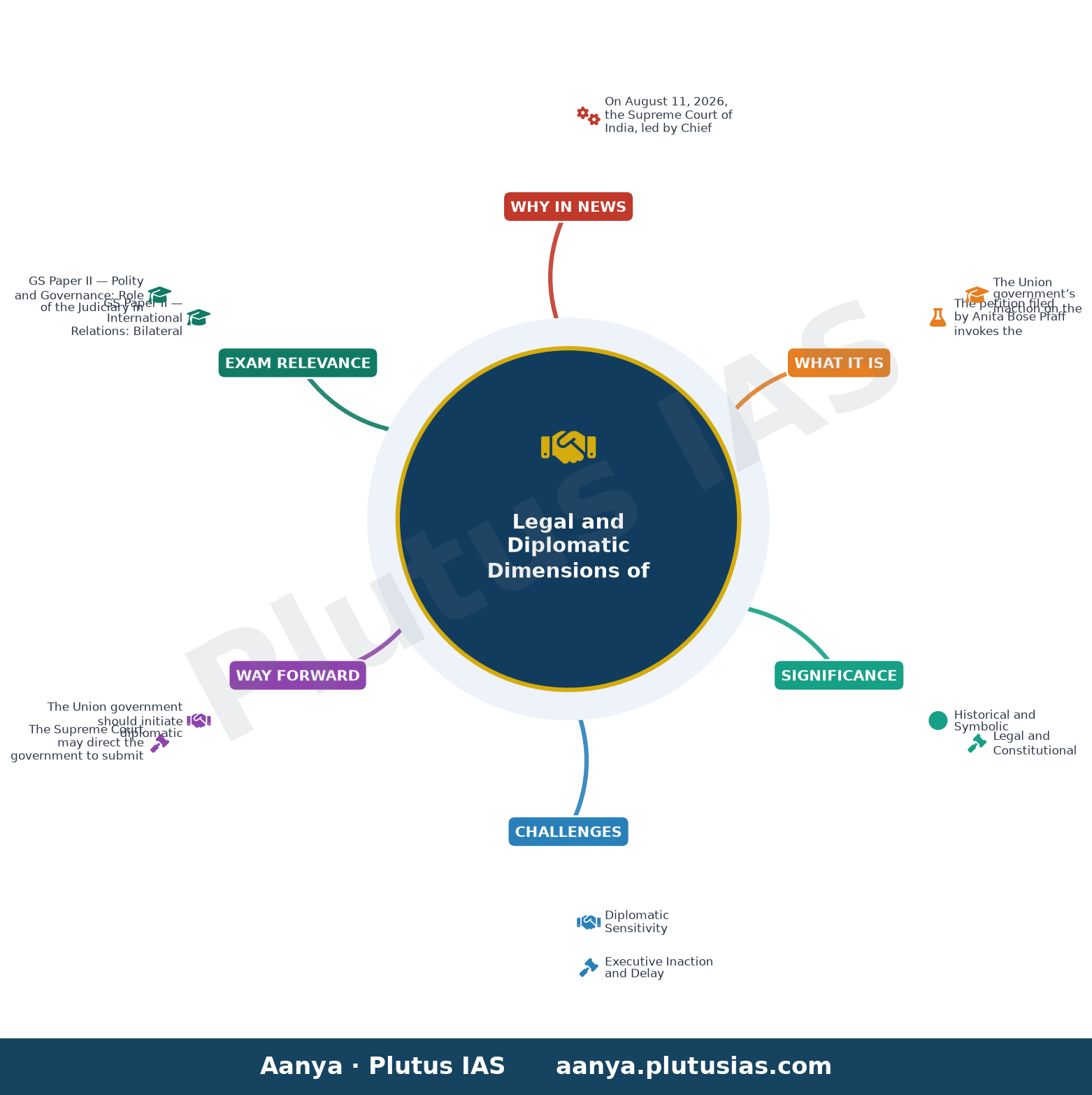
Repatriation of Netaji Subhas Chandra Bose’s Ashes: Legal, Diplomatic, and Constitutional Dimensions
- The petition filed by Anita Bose Pfaff invokes the constitutional right of the family to perform final rites with dignity and closure, as envisaged under Article 25 (Freedom of conscience and free profession, practice, and propagation of religion) of the Indian Constitution.
- The Union government’s inaction on the repatriation of Netaji’s ashes raises questions about the application of diplomatic protocols and bilateral treaties between India and Japan, particularly in matters concerning the repatriation of mortal remains of historical figures.
- The preservation of Netaji’s ashes in Tokyo for over 80 years reflects a historical anomaly, as the ashes were not repatriated despite the end of World War II and the establishment of independent India in 1947.
- The role of the judiciary in this matter highlights the principle of judicial review in governance, particularly in cases where executive inaction impinges upon the rights of citizens or families of national icons.
- The Union Ministries of External Affairs and Home Affairs are constitutionally mandated to formulate and implement policies on international relations and internal security, respectively, which may include facilitating the repatriation of mortal remains.
- The case also intersects with the broader discourse on historical memory and national identity, as Netaji’s legacy continues to be a symbol of India’s struggle for independence and the contributions of the INA.
- The Supreme Court’s directive to the Union government to respond within a stipulated timeframe underscores the judiciary’s role in ensuring accountability and timely decision-making in matters of public importance.
- The preservation of Netaji’s ashes in Tokyo also raises questions about the ethical and cultural dimensions of repatriation, including the sentiments of the family and the symbolic significance of the final rites in India.
Key Features
| Feature | Significance |
|---|---|
| Petition by Netaji’s daughter | Establishes the legal heir’s right to seek repatriation of mortal remains, invoking the principle of dignity in final rites under Article 21 of the Constitution. |
| Supreme Court’s notice to Union Ministries | Triggers a constitutional process requiring the executive to justify its inaction or propose a reasoned decision on repatriation. |
| Historical preservation at Renkō-Ji Temple | Represents an 80-year-old state of affairs where mortal remains are preserved outside India, creating a symbolic and emotional disconnect for the nation. |
| Government’s prolonged inaction | Highlights the executive’s delay in addressing a long-standing public sentiment and familial expectation regarding Netaji’s final resting place. |
| Judicial intervention in humanitarian matters | Demonstrates the judiciary’s role in resolving disputes involving posthumous dignity and closure for families of national figures. |
Why it Matters
Historical and Symbolic
- Netaji Subhash Chandra Bose’s legacy remains a pivotal narrative in India’s freedom struggle, with his presumed death in 1945 shaping post-Independence historical discourse.
- The preservation of his ashes in Tokyo for over eight decades symbolises a persistent unresolved chapter in India’s collective memory, warranting closure through repatriation.
- Repatriation would align with global practices where nations repatriate the mortal remains of their historical leaders to their homeland for dignified preservation and public homage.
Legal and Constitutional
- The petition invokes the right to dignity (Article 21) and the right to perform final rites (Article 25), framing repatriation as a constitutional obligation of the state.
- The Supreme Court’s intervention underscores the judiciary’s role in ensuring that executive inaction does not infringe upon fundamental rights or public sentiment.
- The case tests the balance between executive discretion in foreign policy and judicial oversight in matters affecting national sentiment and familial rights.
Diplomatic and Bilateral
- Repatriation would require diplomatic negotiations with Japan, testing India’s bilateral relations and cultural diplomacy in matters of historical significance.
- The case may set a precedent for future repatriation requests of Indian historical figures’ remains held abroad, influencing diplomatic protocols.
- Japan’s long-standing custodianship of the ashes reflects its respect for Netaji’s role in India’s freedom struggle, necessitating sensitive handling of the request.
Societal and Emotional
- The demand for repatriation resonates with public sentiment, reflecting a desire for closure and a tangible connection to a revered national leader.
- Familial expectations of performing final rites in India underscore the emotional dimension of the issue, transcending political narratives.
- The case highlights the role of memory in nation-building, where historical figures serve as symbols of unity and inspiration across generations.
Challenges
1. Diplomatic Sensitivity
- Repatriation requires delicate negotiations with Japan, which has historically honoured Netaji’s legacy through the preservation of his ashes.
- Any perceived coercion or unilateral demand could strain bilateral relations, particularly given Japan’s historical and cultural ties to the Renkō-Ji Temple.
UPSC Link: GS II: India and its neighbourhood- relations.
2. Executive Inaction and Delay
- The Union government’s prolonged failure to decide on repatriation reflects bureaucratic inertia, raising questions about policy paralysis in matters of national sentiment.
- The judiciary’s intervention may compel the executive to act, but it also risks politicising a humanitarian issue if not handled with sensitivity.
UPSC Link: GS II: Structure, organisation and functioning of the Executive.
3. Legal Precedents and Jurisdiction
- The Supreme Court’s refusal to entertain a similar petition by Netaji’s grandnephew earlier underscores the need for clear legal standing, particularly for familial claims.
- The case may necessitate judicial clarification on the balance between executive foreign policy and judicial oversight in matters of national importance.
UPSC Link: GS II: Judiciary- structure and functioning.
4. Symbolic vs. Practical Considerations
- While repatriation holds symbolic value, practical challenges such as the preservation of ashes and the logistics of a state funeral must be addressed.
- The government must balance public sentiment with the need for a dignified and well-planned repatriation process.
UPSC Link: GS II: Government policies and interventions.
5. Historical Ambiguity and Closure
- The unresolved circumstances of Netaji’s death and the prolonged preservation of his ashes in Tokyo create a lingering ambiguity that repatriation alone may not fully resolve.
- The case raises questions about how nations address historical ambiguities and the role of state institutions in providing closure.
UPSC Link: GS I: Modern Indian history from about the middle of the eighteenth century until the present- significant events, personalities, issues.
Challenges — UPSC Perspective
| Issue | Concern |
|---|---|
| Diplomatic negotiations with Japan | Risk of straining bilateral relations if handled insensitively. |
| Executive’s delay in decision-making | Undermines public trust in the government’s responsiveness to national sentiment. |
| Legal standing of the petitioner | Requires judicial clarity on familial rights versus state prerogative. |
| Logistical challenges in repatriation | Need for a dignified and well-planned process to avoid public backlash. |
| Symbolic vs. practical balance | Ensuring repatriation aligns with public expectations without compromising national interests. |
| Historical ambiguity | Repatriation may not fully resolve the unresolved circumstances of Netaji’s death. |
Way Forward
- The Union government should initiate diplomatic consultations with Japan to explore the feasibility and modalities of repatriation in a phased manner.
- The Supreme Court may direct the government to submit a time-bound action plan for repatriation, ensuring transparency and accountability.
- A high-level inter-ministerial committee should be constituted to address the logistical, legal, and diplomatic aspects of the repatriation process.
- Public consultations or a national committee comprising historians, legal experts, and family representatives should be formed to guide the decision-making process.
- The government should proactively communicate the rationale and progress of repatriation to the public to manage expectations and maintain national unity.
- India should engage with the Renkō-Ji Temple authorities to ensure a dignified handover of the ashes, reflecting mutual respect and cultural sensitivity.
- Post-repatriation, a state funeral or a national memorial should be planned to honour Netaji’s legacy, ensuring closure for the nation and the family.
UPSC Value Addition
Keywords for Mains Answer-Writing
Subhas Chandra Bose · Repatriation of mortal remains · Renkō-Ji Temple, Tokyo · Supreme Court of India · Constitutional remedies · Right to dignity and closure · Union Government and Foreign Policy · Historical memory and national identity · Legal heir and succession rights · Diplomatic negotiations and bilateral relations
Constitutional & Policy Linkages
- Article 21: Right to dignity and posthumous respect (right to perform final rites).
- Article 25: Freedom of religion and the right to perform religious rites.
- Article 51A: Fundamental duties (promotion of harmony and the spirit of common brotherhood).
Concept Flow
Netaji’s presumed death in 1945 and preservation of ashes in Tokyo → 80-year-old state of affairs creating symbolic disconnect → Daughter’s petition invoking Article 21 and 25 → Supreme Court’s notice to Union Ministries → Executive’s inaction and delay → Judicial intervention to ensure closure → Diplomatic negotiations with Japan → Repatriation process and national memorial → Closure for family and nation.
Prelims Practice Questions
Q1. Consider the following statements regarding the repatriation of Netaji Subhas Chandra Bose’s mortal remains from Tokyo:
1. The mortal remains are preserved at Renkō-Ji Temple in Tokyo.
2. The Supreme Court of India has issued notice to the Union Ministries of External Affairs and Home on a petition seeking repatriation.
3. The petition was filed by Netaji’s grandnephew, Ashish Ray, and not by his daughter.
4. The mortal remains have been preserved for over 80 years at the temple.
How many of the above statements are correct?
- Only one
- Only two
- Only three
- All
Answer: All — Statements 1, 2, and 4 are correct. Statement 3 is incorrect as the petition was filed by Netaji’s daughter, Anita Cose Pfaff, not his grandnephew.
Q2. Assertion (A): The Supreme Court of India has the power to direct the Union Government to repatriate the mortal remains of Netaji Subhas Chandra Bose from Tokyo.
Reason (R): The Supreme Court can issue directions under Article 32 of the Constitution for the enforcement of fundamental rights, including the right to dignity and closure.
Options:
A. Both A and R are true, and R is the correct explanation of A.
B. Both A and R are true, but R is not the correct explanation of A.
C. A is true, but R is false.
D. A is false, but R is true.
Answer: ? — Both the assertion and reason are true. Article 32 empowers the Supreme Court to issue directions for the enforcement of fundamental rights, and the right to dignity and closure can be interpreted as part of this.
Mains Practice Question
✍ The preservation of Netaji Subhas Chandra Bose’s mortal remains in a foreign temple for over eight decades has been described as a ‘posthumous exile’ and a denial of closure to his family and the nation. In this context, critically examine the constitutional and diplomatic dimensions of the repatriation of historical remains to India. (15 Marks)
Approach: MODEL-ANSWER SKELETON:
1. **Constitutional Framework and Fundamental Rights**
– Article 21: Right to life and personal liberty, including dignity and closure.
– Article 14: Equality before law and equal protection of laws — ensuring non-discrimination in posthumous matters.
– Article 51A (Fundamental Duties): Duty to uphold the sovereignty and integrity of India, which may extend to honoring national heroes.
2. **Legal and Succession Dimensions**
– Rights of legal heirs (as per the Indian Succession Act, 1925) to perform final rites and seek closure.
– Judicial precedents on repatriation of mortal remains (e.g., cases involving foreign nationals or historical figures).
3. **Diplomatic and Bilateral Relations**
– India-Japan bilateral relations and cultural diplomacy.
– Role of the Ministry of External Affairs in negotiating repatriation agreements.
– Precedents of repatriation of historical remains (e.g., remains of Indian soldiers from foreign soil).
4. **Historical Memory and National Identity**
– Netaji’s legacy in India’s freedom struggle and its symbolic importance.
– Public sentiment and the role of historical memory in nation-building.
5. **Challenges and Counterarguments**
– Religious and cultural sensitivities in Japan regarding the remains.
– Procedural delays and bureaucratic hurdles in repatriation.
– Potential diplomatic implications of repatriation requests for other historical figures.
6. **Conclusion**
– Balance between constitutional rights, diplomatic prudence, and historical justice.
– Need for a time-bound, reasoned decision by the Union Government.
Source: The Hindu
Generated by AanyaAi for educational purpose.

- KWML’s Feasibility Reports for Water Metro in 18 Cities: UPSC & PCS Insights - October 3, 2026
- ओडिशा में वन्यजीव अनुसंधान अनुदान कार्यक्रम शुरू, सिमिलिपाल में 300 कैमरे और बढ़ेंगे - October 3, 2026
- India Summons Pakistan High Commission Official Over Violation - October 3, 2026

No Comments