


11 Aug UN Steps Up Aid for Colombia After Deadly 7.4 Earthquake: Key Facts for UPSC
✎ The Sendai Framework for Disaster Risk Reduction 2015-2030 prioritizes reducing disaster risk through resilient infrastructure, early warning systems, and international cooperation, while the United Nations system coordinates…
Subject Relevance — Where This Topic Fits
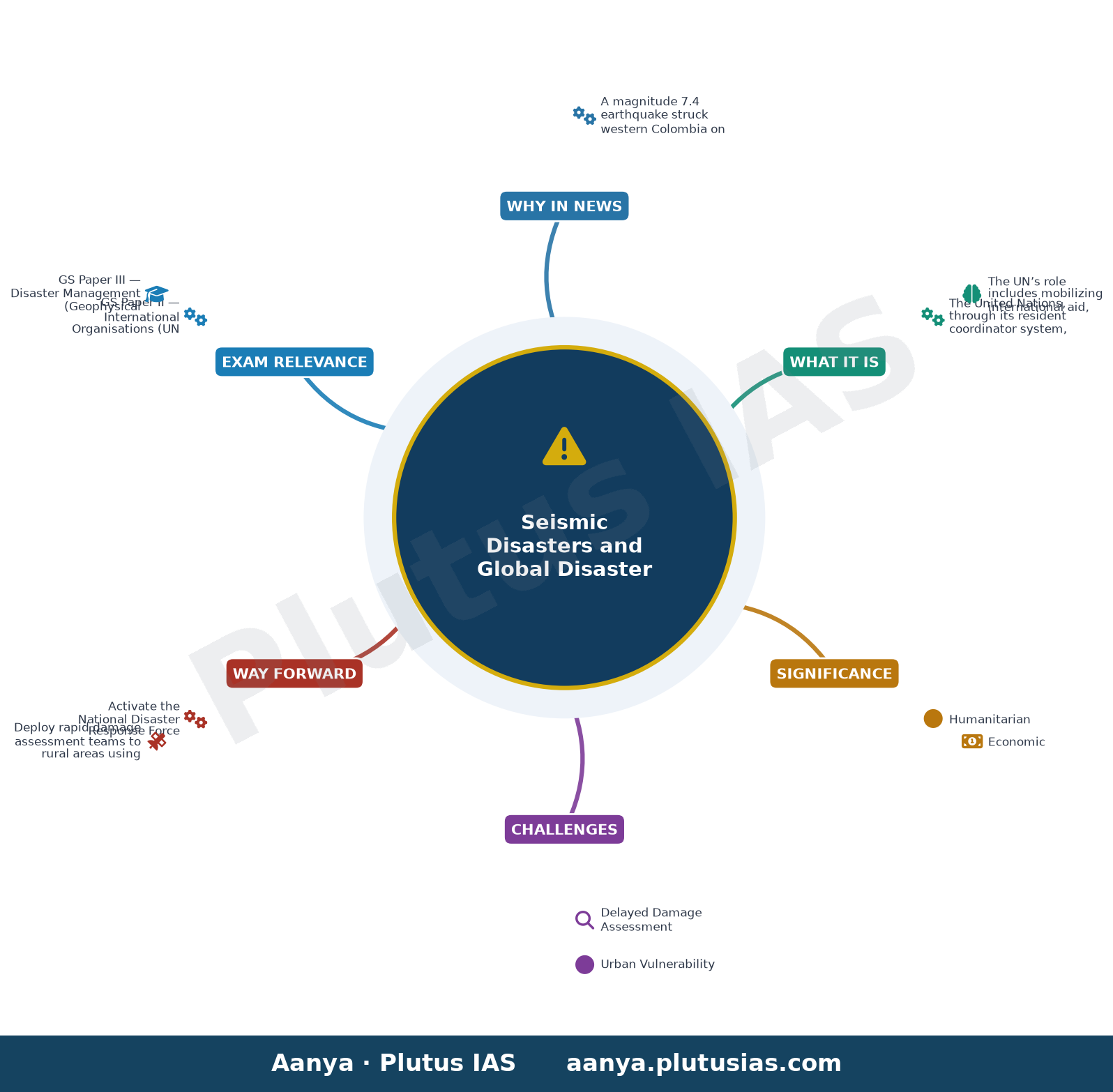
- GS Paper II — International Organisations (UN System and its Agencies) | GS Paper III — Disaster Management (Geophysical Disasters and Mitigation)
- Prelims: Disaster Risk Reduction (DRR), Sendai Framework for Disaster Risk Reduction 2015-2030, UN Office for Disaster Risk Reduction (UNDRR), Pan American Health Organization (PAHO), World Food Programme (WFP), epicentre, seismology, landslides, emergency response mechanisms
- Essay: The interplay between global solidarity and local governance in disaster management, Technological preparedness and human resilience in the face of natural calamities
Quick Revision: The Sendai Framework for Disaster Risk Reduction 2015-2030 prioritizes reducing disaster risk through resilient infrastructure, early warning systems, and international cooperation, while the United Nations system coordinates global disaster response through specialized agencies such as WFP and PAHO.
Why is this in the news?
A magnitude 7.4 earthquake struck western Colombia on 10 August 2026, resulting in significant human casualties, infrastructural damage, and landslides across multiple regions, prompting an immediate international response led by the United Nations. The disaster underscores the critical role of multilateral institutions in disaster risk reduction, emergency response coordination, and humanitarian assistance, while also highlighting the vulnerabilities in infrastructure and connectivity in seismically active zones.
Background
- The Pacific Ring of Fire, a horseshoe-shaped zone encircling the Pacific Ocean, is one of the most seismically active regions globally, accounting for approximately 90% of the world’s earthquakes. Colombia lies along this belt, making it highly susceptible to seismic activity, with historical records of devastating earthquakes such as the 1999 Armenia earthquake (magnitude 6.2) and the 1979 Tumaco earthquake (magnitude 8.2).
- The Sendai Framework for Disaster Risk Reduction 2015-2030, adopted by the United Nations in 2015, is a 15-year, voluntary, non-binding agreement that outlines seven global targets and four priorities for action to reduce disaster risk and losses in lives, livelihoods, and health. It emphasizes the need for international cooperation, early warning systems, and resilient infrastructure.
- The United Nations system plays a pivotal role in disaster response through specialized agencies such as the United Nations Office for Disaster Risk Reduction (UNDRR), the World Food Programme (WFP), and the Pan American Health Organization (PAHO). These agencies provide technical assistance, humanitarian aid, and coordination support to affected countries in the aftermath of disasters.
- Colombia’s National Disaster Risk Management System (SNGRD) is the institutional framework responsible for coordinating disaster preparedness, response, and recovery efforts. It operates under the National Unit for Disaster Risk Management (UNGRD) and aligns with the Sendai Framework’s priorities.
- The 2026 earthquake occurred just three days after the inauguration of Colombian President Abelardo de la Espriella, highlighting the immediate challenges of governance during crises and the need for pre-established emergency protocols.
- Limited connectivity in rural areas, as noted by the UN, exacerbates the challenges of rapid damage assessment and coordination, a common issue in many developing nations with uneven infrastructure development.
The Role of the United Nations in Disaster Response and the Science of Seismic Activity
- The United Nations, through its resident coordinator system, acts as the primary interface between the international community and the affected country’s government in disaster response. The UN Resident Coordinator in Colombia, María José Torres Macho, is coordinating the UN’s assessment and emergency response efforts in collaboration with national authorities.
- The UN’s role includes mobilizing international aid, providing technical expertise, and facilitating the deployment of specialized teams from agencies such as WFP (food security), PAHO (health), and UNDRR (risk reduction). This coordination ensures that assistance is aligned with the needs identified by the affected country.
- The epicentre of an earthquake is the point on the Earth’s surface directly above the hypocentre, where the seismic rupture originates. In this case, the epicentre was near San José del Palmar in Colombia’s Chocó department, a region known for its high seismic risk due to its proximity to the Nazca Plate subduction zone.
- Landslides triggered by earthquakes are a significant secondary hazard, particularly in mountainous or hilly regions. They can block transportation routes, isolate communities, and exacerbate the humanitarian crisis by hindering rescue operations.
- The Sendai Framework for Disaster Risk Reduction 2015-2030 emphasizes the importance of early warning systems, resilient infrastructure, and community preparedness to mitigate the impact of disasters. Colombia’s National Disaster Risk Management System (SNGRD) is designed to implement these priorities.
- The World Food Programme (WFP) and the Pan American Health Organization (PAHO) are critical UN agencies that provide humanitarian assistance in the aftermath of disasters. WFP focuses on food security, while PAHO addresses health emergencies, including the risk of disease outbreaks in displaced populations.
- International solidarity in disaster response is governed by principles of neutrality, impartiality, and humanity, as outlined in the UN Charter and international humanitarian law. These principles ensure that assistance is provided based on need, without discrimination or political influence.
Key Features
| Feature | Significance |
|---|---|
| Magnitude 7.4 earthquake | Classified as a major seismic event, capable of causing widespread structural damage, landslides, and significant loss of life due to its intensity. |
| Epicentre near San José del Palmar, Chocó | Located in a seismically active region, increasing the risk of secondary hazards such as landslides and infrastructure collapse. |
| Collapsed buildings and damaged infrastructure | Disrupts essential services (health, education, transport) and exacerbates humanitarian needs, particularly in urban centres like Pereira and Cali. |
| Cross-border tremors felt in Panama, Ecuador, Venezuela | Demonstrates the regional impact of seismic events, necessitating coordinated disaster response across national boundaries. |
| Limited connectivity in rural areas | Impedes rapid assessment of damage and relief coordination, delaying emergency response and increasing vulnerability of isolated communities. |
Why it Matters
Humanitarian
- The earthquake resulted in over 100 fatalities and significant injuries, with children among the affected, highlighting the vulnerability of civilian populations during natural disasters.
- Collapse of homes and displacement of communities necessitate immediate shelter, food, and medical assistance to prevent secondary crises such as disease outbreaks.
- Damage to 18 health centres and 52 educational facilities disrupts critical social infrastructure, requiring urgent rehabilitation to restore essential services.
Economic
- Destruction of homes and infrastructure imposes substantial economic costs on Colombia, diverting resources from development priorities to emergency relief and reconstruction.
- Disruption of transport networks, including airport closures, hampers trade, logistics, and regional connectivity, particularly in western Colombia.
- The disaster may reduce investor confidence in the affected regions, impacting long-term economic growth and recovery efforts.
Environmental
- Landslides triggered by the earthquake alter local topography, increasing risks of further instability and environmental degradation in the Chocó region.
- Damage to natural habitats and ecosystems may occur, necessitating environmental assessments to mitigate long-term ecological impacts.
Institutional
- The activation of Colombia’s emergency response mechanisms demonstrates the role of national disaster management agencies in coordinating relief efforts.
- International support, including from the UN and its agencies, underscores the importance of multilateral cooperation in managing transnational disasters.
Geopolitical
- The regional tremors highlight the shared vulnerability of Latin American nations to seismic risks, fostering potential for collaborative disaster preparedness and response frameworks.
Challenges
1. Delayed Damage Assessment
- Limited connectivity in rural areas impedes real-time data collection, complicating the prioritization of relief efforts and resource allocation.
- Incomplete assessments may lead to underestimation of needs, leaving vulnerable populations without timely assistance.
UPSC Link: Disaster Management Act, 2005 – Section 35 (Assessment of Disaster Impact)
2. Urban Vulnerability
- High population density in cities like Pereira and Cali exacerbates the impact of structural collapses, overwhelming local emergency services.
- Reinforcement of critical infrastructure (hospitals, schools) is urgently required to prevent secondary hazards and ensure public safety.
UPSC Link: National Disaster Management Plan (NDMP) – Urban Disaster Risk Reduction
3. Cross-Border Coordination
- Seismic tremors affecting multiple countries necessitate synchronized disaster response to prevent duplication of efforts and ensure efficient resource deployment.
- Harmonization of emergency protocols across borders remains a challenge due to varying national capacities and legal frameworks.
UPSC Link: Sendai Framework for Disaster Risk Reduction – Priority 3 (Investing in Disaster Risk Reduction)
4. Health and Sanitation Risks
- Damage to health centres disrupts medical services, increasing the risk of disease outbreaks in displaced populations.
- Contaminated water sources and inadequate sanitation facilities may lead to public health emergencies, requiring immediate intervention.
UPSC Link: International Health Regulations (IHR), 2005 – Core Capacity 8 (Health Emergency Preparedness)
5. Reconstruction and Recovery
- Long-term recovery requires sustained funding and technical expertise, posing challenges for resource-constrained governments.
- Balancing immediate relief with sustainable rebuilding efforts demands strategic planning to avoid protracted displacement.
UPSC Link: National Disaster Response Fund (NDRF) – Guidelines for Reconstruction
Challenges — UPSC Perspective
| Issue | Concern |
|---|---|
| Limited rural connectivity | Impedes rapid damage assessment and coordination of relief operations. |
| Urban infrastructure collapse | Overwhelms emergency services and increases casualties in densely populated areas. |
| Cross-border seismic impact | Requires synchronized regional response to manage transnational disaster risks. |
| Health centre damage | Disrupts medical services, raising risks of disease outbreaks and secondary health crises. |
| Long-term reconstruction funding | Demands sustained financial and technical resources for sustainable recovery. |
Way Forward
- Activate the National Disaster Response Force (NDRF) and specialized urban search-and-rescue teams for immediate relief operations.
- Deploy rapid damage assessment teams to rural areas using satellite imagery and drone technology to overcome connectivity barriers.
- Coordinate with the World Food Programme (WFP) and Pan American Health Organization (PAHO) to mobilize food, medical supplies, and sanitation kits.
- Establish temporary shelters with adequate water, sanitation, and hygiene (WASH) facilities to prevent disease outbreaks.
- Prioritize the reinforcement of critical infrastructure, including hospitals and schools, to restore essential services.
- Facilitate cross-border collaboration with Panama, Ecuador, and Venezuela to share data, resources, and best practices in disaster response.
- Launch a multi-stakeholder fund for reconstruction, leveraging international aid and public-private partnerships to ensure sustainable recovery.
- Conduct post-disaster environmental impact assessments to mitigate risks of landslides and ecosystem degradation.
UPSC Value Addition
Keywords for Mains Answer-Writing
Disaster Management Act, 2005 · National Disaster Response Force (NDRF) · Sendai Framework for Disaster Risk Reduction · International cooperation in disaster relief · United Nations Office for Disaster Risk Reduction (UNDRR) · Constitutional provisions for disaster management in India · Multi-hazard early warning systems · Community-based disaster preparedness · Role of local governments in disaster response · Cross-border disaster management initiatives
Concept Flow
Seismic activity (magnitude 7.4 earthquake) triggers ground shaking → Primary hazards: structural collapse, landslides, and infrastructure damage → Secondary hazards: disruption of health, education, and transport services → Immediate humanitarian impact: casualties, displacement, and loss of shelter → Institutional response: activation of national and international disaster management frameworks → Multilateral support: coordination with UN agencies and regional partners for relief and assessment → Long-term recovery: reconstruction planning and risk reduction strategies
Prelims Practice Questions
Q1. Consider the following statements regarding the Sendai Framework for Disaster Risk Reduction (2015-2030):
1. It is a voluntary, non-binding agreement adopted by UN Member States.
2. The framework prioritizes understanding disaster risk in all its dimensions of vulnerability, capacity, exposure of persons and assets, hazard characteristics, and the environment.
3. It explicitly mandates the establishment of a National Disaster Response Force (NDRF) in every country.
4. The framework sets seven global targets to reduce disaster losses by 2030.
How many of the above statements are correct?
- Only one
- Only two
- Only three
- All four
Answer: Only three — Statements 1, 2, and 4 are correct. Statement 3 is incorrect as the Sendai Framework does not mandate the establishment of NDRF; this is specific to India’s Disaster Management Act, 2005.
Q2. Assertion (A): The National Disaster Response Force (NDRF) is a specialized force constituted under the Disaster Management Act, 2005.
Reason (R): The NDRF operates under the administrative control of the Ministry of Home Affairs, Government of India.
Options:
A. Both A and R are true, and R is the correct explanation of A.
B. Both A and R are true, but R is not the correct explanation of A.
C. A is true, but R is false.
D. A is false, but R is true.
- A
- B
- C
- D
Answer: A — Both Assertion (A) and Reason (R) are true, and R correctly explains A. The NDRF is indeed constituted under the Disaster Management Act, 2005, and operates under the Ministry of Home Affairs.
Q3. Match the following international disaster management frameworks with their respective parent organizations:
Column I (Framework) | Column II (Parent Organization)
1. Sendai Framework for Disaster Risk Reduction | A. United Nations Development Programme (UNDP)
2. Hyogo Framework for Action | B. United Nations Office for Disaster Risk Reduction (UNDRR)
3. International Strategy for Disaster Reduction (ISDR) | C. United Nations General Assembly
4. Sustainable Development Goals (SDG) Target 1.5 | D. United Nations Economic and Social Council (ECOSOC)
Choose the correct match from the options below:
- 1-B, 2-D, 3-A, 4-C
- 1-B, 2-A, 3-D, 4-C
- 1-C, 2-B, 3-A, 4-D
- 1-A, 2-C, 3-B, 4-D
Answer: 1-B, 2-D, 3-A, 4-C — 1-B (Sendai Framework is linked to UNDRR), 2-A (Hyogo Framework was adopted under UNDP), 3-D (ISDR was established by ECOSOC), 4-C (SDG Target 1.5 is a UN General Assembly commitment).
Mains Practice Question
✍ The Sendai Framework for Disaster Risk Reduction (2015-2030) emphasizes a shift from managing disasters to managing risks. In this context, critically examine the role of local governments in disaster risk reduction and response, with reference to India’s legal and institutional framework. Also, discuss the challenges faced by local governments in implementing disaster management plans effectively. (15 Marks)
Approach: MODEL-ANSWER SKELETON:
1. **Introduction (2 marks)**: Define the Sendai Framework’s four priorities for action and its global targets. Highlight the importance of local governments in achieving these targets, citing Article 5 of the Sendai Framework which stresses the role of local authorities.
2. **Legal and Institutional Framework in India (5 marks)**:
– **Constitutional Provisions**: Article 243G (Panchayats) and Article 243W (Municipalities) empower local governments to prepare disaster management plans.
– **Disaster Management Act, 2005**: Sections 35-42 mandate the establishment of District Disaster Management Authorities (DDMAs) and State Disaster Management Authorities (SDMAs), with local governments as key stakeholders.
– **National Disaster Management Plan (NDMP), 2019**: Emphasizes decentralized disaster risk reduction, with roles for Panchayati Raj Institutions (PRIs) and Urban Local Bodies (ULBs).
– **Institutional Mechanisms**: National Disaster Response Force (NDRF), National Disaster Management Authority (NDMA), and State Disaster Management Authorities (SDMAs) work in coordination with local governments.
3. **Role of Local Governments (4 marks)**:
– **Risk Assessment and Planning**: Local governments are best positioned to identify local hazards, vulnerabilities, and capacities (e.g., community-based early warning systems).
– **Preparedness and Mitigation**: Implementation of local-level disaster preparedness plans, training of community volunteers, and maintenance of emergency shelters.
– **Response and Recovery**: Coordination with NDRF, SDRFs, and other agencies during response operations; ensuring access to relief and rehabilitation.
– **Community Engagement**: Mobilizing local communities through awareness campaigns, participatory risk mapping, and inclusive disaster planning (e.g., involving women, children, and marginalized groups).
4. **Challenges Faced by Local Governments (3 marks)**:
– **Resource Constraints**: Limited financial and technical capacity, especially in rural and remote areas.
– **Institutional Weaknesses**: Lack of trained personnel, inadequate infrastructure, and weak inter-agency coordination.
– **Legal and Administrative Gaps**: Overlapping jurisdictions between PRIs, ULBs, and state agencies; delays in fund disbursement under schemes like the National Disaster Mitigation Fund (NDMF).
– **Climate Change and Urbanization**: Increasing frequency of extreme weather events and rapid urbanization exacerbate risks, straining local capacities.
5. **Conclusion (1 mark)**: Summarize the critical role of local governments in achieving the Sendai Framework’s targets and suggest measures to strengthen their capacity, such as capacity-building programs, decentralized funding mechanisms, and technology-driven solutions (e.g., GIS mapping for risk assessment).
Source: news.un.org
Generated by AanyaAi for educational purpose.

- आईआईटी रुड़की में रुटैग 2.0 की तीसरी वार्षिक समीक्षा बैठक: ग्रामीण विकास में तकनीकी बदलाव - September 26, 2026
- UPSC Exam: PM’s Scientific Advisor Reviews RUTAG 2.0 Projects at IIT Roorkee - September 26, 2026
- यूपीएससी के लिए: ‘मेरा स्वास्थ्य, मेरा गौरव’ अभियान से जानें युवाओं में नशामुक्ति का महत्व - September 26, 2026

No Comments