


11 Aug UN Urges Taliban to End Impunity for Security Forces Abuses in Afghanistan
✎ The absence of transparency in accountability mechanisms for human rights violations in Taliban-ruled Afghanistan undermines public trust and contravenes international human rights obligations, necessitating urgent reforms in…
Subject Relevance — Where This Topic Fits
- GS Paper II — International Relations (Human Rights, International Organisations, Regional Security) | GS Paper III — Internal Security (Human Rights Violations, Rule of Law, Accountability Mechanisms)
- Prelims: UNAMA (United Nations Assistance Mission in Afghanistan), Sharia Law in governance, De facto authorities, Supreme Court (Afghanistan), Human Rights Council (UN), Security and Filtration Commission (Afghanistan), Ministry of Propagation of Virtue and Prevention of Vice (Afghanistan), International Covenant on Civil and Political Rights (ICCPR)
- Essay: The role of international organisations in upholding human rights in conflict zones, Balancing sovereignty and accountability: Challenges in post-conflict governance
Quick Revision: The absence of transparency in accountability mechanisms for human rights violations in Taliban-ruled Afghanistan undermines public trust and contravenes international human rights obligations, necessitating urgent reforms in governance and rule of law.
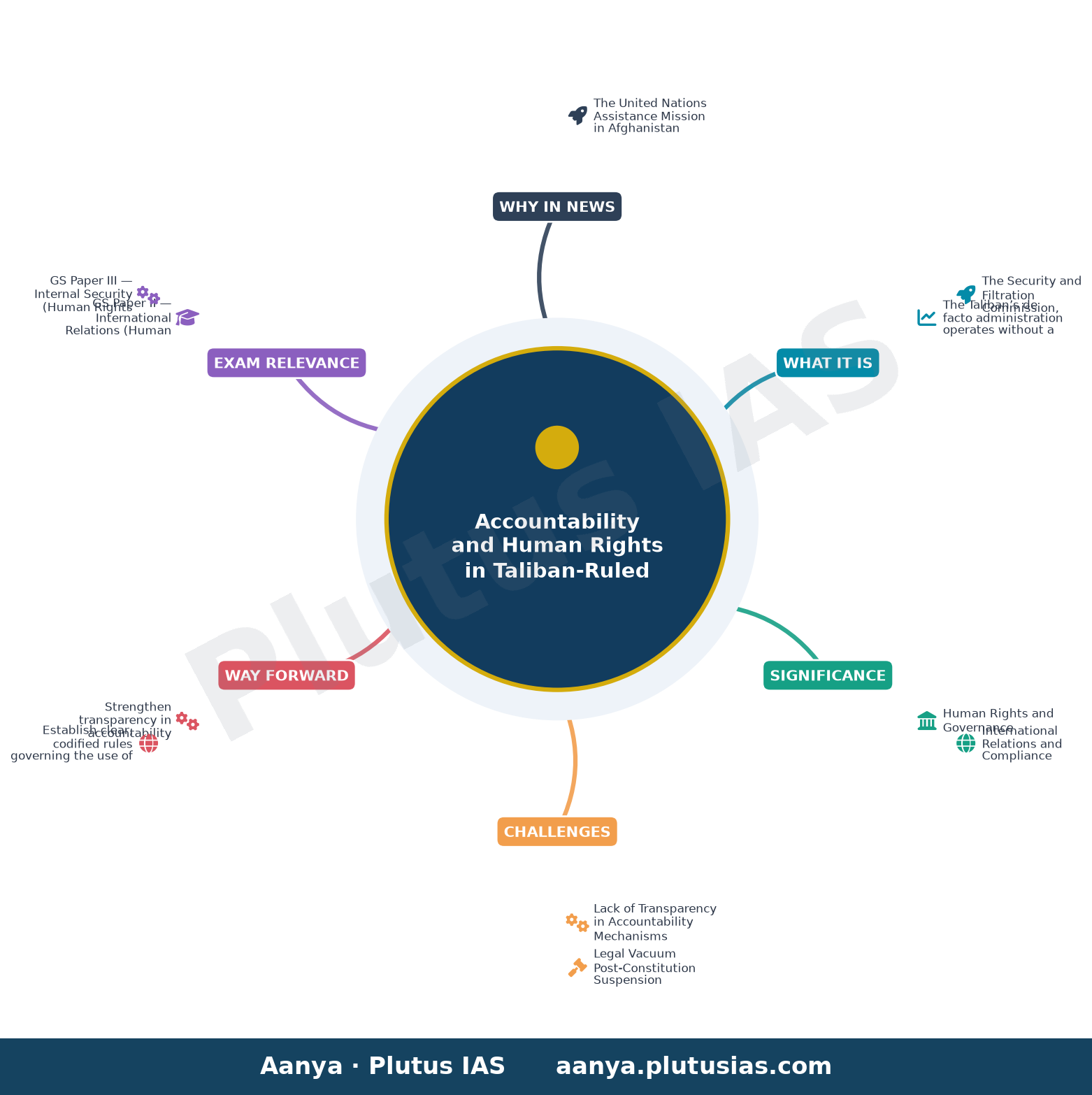
Why is this in the news?
The United Nations Assistance Mission in Afghanistan (UNAMA) has publicly highlighted persistent deficiencies in transparency and accountability within Afghanistan’s de facto governance structures, five years after the Taliban assumed control. The report underscores the absence of public information regarding investigations into alleged human rights abuses by security forces, the suspension of constitutional safeguards, and systemic barriers to justice, particularly for women and girls. This development is significant for UPSC aspirants as it intersects with core themes of international human rights law, governance in non-democratic regimes, and the role of UN peacekeeping missions in post-conflict states.
Background
- The Taliban seized control of Afghanistan in August 2021, marking the end of a two-decade-long democratic experiment and the withdrawal of international forces.
- The Taliban’s governance model is based on a strict interpretation of Sharia law, replacing the former constitutional framework and legal system.
- UNAMA, established by the UN Security Council in 2002, continues to operate in Afghanistan to monitor human rights, governance, and security developments despite the absence of formal diplomatic recognition of the Taliban regime.
- The UN has consistently raised concerns about human rights violations, including arbitrary detentions, discrimination against women and girls, and restrictions on freedom of expression and assembly.
- The suspension of the constitution has resulted in the annulment of existing laws, creating a legal vacuum that complicates accountability for state actors.
- International human rights bodies, including UN Women and the Security Council, have repeatedly called for transparency and accountability in Afghanistan’s governance structures.
What is the governance and accountability framework in Taliban-ruled Afghanistan?
- The Taliban’s de facto administration operates without a formal constitutional framework, relying instead on Sharia-based governance structures such as the Supreme Court and the Ministry of Propagation of Virtue and Prevention of Vice.
- The Security and Filtration Commission, established under Taliban rule, is tasked with overseeing internal security and countering perceived threats, but its operations lack transparency and public accountability.
- The suspension of the former constitution has led to the annulment of laws that previously provided safeguards against human rights abuses, including protections for women’s rights and due process in criminal investigations.
- UNAMA’s mandate includes monitoring governance, rule of law, and human rights, with a focus on documenting violations by state actors, including security forces and morality enforcement bodies.
- Accountability mechanisms, such as military courts and disciplinary tribunals, exist but operate with limited transparency, discouraging public reporting of abuses due to fear of reprisals and lack of trust in institutions.
- The UN has emphasised that visible and consistent accountability measures are essential for restoring public confidence, ensuring equal application of laws, and facilitating Afghanistan’s potential reintegration into the international community.
- The absence of a functioning independent judiciary and the lack of access to justice for victims of human rights violations remain critical challenges in the governance framework.
Key Features
| Feature | Significance |
|---|---|
| UN Assistance Mission in Afghanistan (UNAMA) | Primary UN entity monitoring governance, rule of law, security, and human rights in Afghanistan post-2021, providing impartial oversight and documentation of violations. |
| Supreme Court under Taliban rule | Judicial body operating under de facto authorities, with limited transparency in oversight and accountability mechanisms, raising concerns over due process and rights violations. |
| Security and Filtration Commission | Institution established by Taliban to enforce Sharia-based security measures, with opaque processes for complaints, investigations, and disciplinary actions. |
| Ministry of Propagation of Virtue and Prevention of Vice | De facto authority tasked with enforcing moral codes, whose operations lack transparency and contribute to systemic discrimination, particularly against women and girls. |
| Taliban military courts | Ad hoc judicial bodies handling cases of alleged misconduct by security personnel, with unresolved complaints and limited public accountability. |
Why it Matters
Human Rights and Governance
- The absence of transparent accountability mechanisms undermines public trust in state institutions and erodes the rule of law in Afghanistan.
- Systemic lack of information on investigations or disciplinary actions enables impunity for human rights violations, particularly affecting women and girls.
- The suspension of the former constitution has led to a legal vacuum, complicating efforts to establish credible oversight and judicial processes.
International Relations and Compliance
- Afghanistan’s reintegration into the international community hinges on adherence to international human rights obligations and visible accountability measures.
- UN agencies, including UN Women and the Security Council, have consistently highlighted grave concerns, underscoring the need for structural reforms.
- Failure to address abuses risks prolonged isolation and diminishes Afghanistan’s prospects for diplomatic and economic normalization.
Rule of Law and Institutional Integrity
- The lack of clear rules governing the use of force, arrest, detention, and crowd policing exacerbates arbitrary enforcement and deters public reporting of abuses.
- Institutions like the Security and Filtration Commission and the Ministry of Propagation of Virtue operate with minimal oversight, fostering a culture of unchecked authority.
- Visible accountability is essential to ensure equal application of laws, including for those in positions of power.
Challenges
1. Lack of Transparency in Accountability Mechanisms
- Public information on complaints, investigations, and disciplinary actions is severely limited, weakening deterrence and public confidence.
- Opaque processes in institutions like the Supreme Court and military courts hinder efforts to address human rights violations.
- Fear of reprisals and institutional distrust discourage victims from reporting abuses, particularly among marginalized groups.
UPSC Link: GS II: International Relations – Human Rights
2. Legal Vacuum Post-Constitution Suspension
- The annulment of the former constitution has created a legal void, complicating the establishment of clear legal frameworks for governance and rights protection.
- The absence of a codified legal system undermines the predictability and fairness of judicial processes.
- This vacuum exacerbates systemic discrimination and arbitrary enforcement of Sharia-based codes.
UPSC Link: GS II: Polity – Constitutional Framework
3. Systemic Discrimination Against Women and Girls
- Restrictions imposed by the Ministry of Propagation of Virtue disproportionately affect women and girls, limiting their access to justice and participation in public life.
- The lack of transparency in accountability mechanisms further entrenches gender-based discrimination.
- These systemic barriers undermine Afghanistan’s compliance with international human rights standards.
UPSC Link: GS I: Social Justice – Gender Issues
4. Impunity for Security Forces
- Despite documented instances of misconduct, many complaints remain unresolved, fostering a culture of impunity.
- The referral of cases to Taliban military courts lacks transparency, raising concerns over fair trial guarantees.
- Visible accountability is critical to restore public trust in security institutions.
UPSC Link: GS III: Security – Accountability in Forces
5. International Reintegration and Compliance
- Afghanistan’s reintegration into the global community requires demonstrable progress in human rights and accountability.
- Failure to address abuses risks prolonged diplomatic isolation and economic stagnation.
- Compliance with international obligations is essential for restoring legitimacy and engagement with multilateral institutions.
UPSC Link: GS II: International Relations – Global Governance
Challenges — UPSC Perspective
| Issue | Concern |
|---|---|
| Opaque oversight mechanisms | Undermines public trust and enables impunity for human rights violations. |
| Legal vacuum post-constitution suspension | Creates unpredictability and systemic discrimination in governance. |
| Systemic gender discrimination | Restricts women’s rights and access to justice, violating international standards. |
| Unresolved complaints against security forces | Fosters a culture of impunity and erodes institutional credibility. |
| Lack of clear legal frameworks for force use | Leads to arbitrary enforcement and deters public reporting of abuses. |
Way Forward
- Strengthen transparency in accountability mechanisms by mandating public reporting on complaints, investigations, and disciplinary actions.
- Establish clear, codified rules governing the use of force, arrest, detention, and crowd policing to ensure adherence to international human rights standards.
- Reinstate or reform judicial institutions to ensure independence, fairness, and public accountability, including for women’s rights violations.
- Create accessible complaint mechanisms, particularly for marginalized groups like women and girls, with protections against reprisals.
- Engage with international human rights bodies to align domestic laws with global obligations and facilitate reintegration into the international community.
- Conduct independent audits of security institutions to identify systemic gaps and implement corrective measures.
- Promote public awareness campaigns to educate citizens on their rights and the avenues for reporting abuses.
- Collaborate with UN agencies and civil society to monitor progress and ensure sustained improvements in governance and rights protection.
UPSC Value Addition
Keywords for Mains Answer-Writing
Accountability in governance · Human rights violations · Rule of law · Transparency and oversight · International obligations · De facto authorities · UN Assistance Mission in Afghanistan (UNAMA) · Accountability mechanisms · Human rights institutions · State legitimacy and trust
Concept Flow
Taliban takeover → Suspension of constitution → Legal vacuum → Lack of clear legal frameworks → Arbitrary enforcement by security forces → Human rights violations → Public distrust in institutions → Impunity → Systemic discrimination → International isolation → Need for accountability reforms.
Prelims Practice Questions
Q1. Consider the following statements regarding the United Nations Assistance Mission in Afghanistan (UNAMA):
1. UNAMA is mandated to monitor governance, rule of law, security, and human rights in Afghanistan.
2. UNAMA has the authority to enforce accountability measures against the Taliban.
3. UNAMA reports have highlighted a lack of public information on investigations into human rights violations.
How many of the above statements are correct?
- Only one
- Only two
- All
- None
Answer: All — Statements 1 and 3 are correct as per UNAMA’s mandate and reports. Statement 2 is incorrect because UNAMA does not have enforcement authority; it can only monitor and report.
Q2. Assertion (A): The suspension of the Afghan constitution by the Taliban de facto authorities has resulted in a blanket annulment of all former laws.
Reason (R): The Taliban’s strict interpretation of Sharia law has replaced the democratic constitution, leading to a lack of transparency in legal and judicial processes.
Options:
A. Both A and R are true, and R is the correct explanation of A.
B. Both A and R are true, but R is not the correct explanation of A.
C. A is true, but R is false.
D. A is false, but R is true.
Answer: ? — Both the assertion and reason are correct, and the reason correctly explains the assertion. The Taliban’s suspension of the constitution and imposition of Sharia law have indeed led to a lack of transparency in legal processes.
Q3. Match the following bodies with their respective functions in Afghanistan as reported by UNAMA:
Column I
1. Security and Filtration Commission
2. Ministry of Propagation of Virtue and Prevention of Vice
3. UNAMA
4. Taliban military courts
Column II
A. Monitors governance, rule of law, and human rights
B. Conducts arrests and investigations of reported misconduct by security personnel
C. Promotes discipline and oversight under Taliban rule
D. Enforces strict interpretation of Sharia law
- 1-C, 2-D, 3-A, 4-B
- 1-B, 2-A, 3-D, 4-C
- 1-D, 2-C, 3-A, 4-B
- 1-A, 2-B, 3-D, 4-C
Answer: 1-C, 2-D, 3-A, 4-B — 1 matches with C (Security and Filtration Commission promotes discipline and oversight), 2 matches with D (Ministry of Propagation of Virtue and Prevention of Vice enforces Sharia), 3 matches with A (UNAMA monitors governance and human rights), and 4 matches with B (Taliban military courts conduct investigations).
Mains Practice Question
✍ The absence of transparency and accountability in governance institutions undermines state legitimacy and erodes public trust. Critically examine this proposition with reference to the situation in Afghanistan under Taliban rule. (15 Marks)
Approach: MODEL-ANSWER SKELETON:
1. **Introduction (2 marks)**: Define state legitimacy and its pillars (transparency, accountability, rule of law). Briefly state the Afghan context post-2021 Taliban takeover.
2. **Accountability Mechanisms and Their Absence (4 marks)**:
– Discuss UNAMA’s role in monitoring governance and human rights violations.
– Highlight the suspension of the constitution and its impact on legal frameworks.
– Explain the lack of transparency in institutions like the Security and Filtration Commission and the Ministry of Propagation of Virtue and Prevention of Vice.
3. **Consequences for State Legitimacy and Public Trust (4 marks)**:
– Link absence of accountability to erosion of public trust (e.g., unresolved complaints, fear of reprisals, barriers for women).
– Discuss how this undermines Afghanistan’s compliance with international obligations.
4. **International Obligations and Reintegration (3 marks)**:
– Reference Afghanistan’s obligations under international human rights law.
– Explain how accountability measures are a prerequisite for reintegration into the global community.
5. **Conclusion (2 marks)**: Summarize the critical need for transparency and accountability to restore legitimacy and trust. Offer a balanced view on the challenges faced by de facto authorities.
Source: news.un.org
Generated by AanyaAi for educational purpose.


No Comments