


11 Aug UP TTZ Industries: 10 Key Parameters for New Units Approval
✎ The Taj Trapezium Zone (TTZ) is a Supreme Court-mandated eco-sensitive zone around the Taj Mahal, governed by the Environment (Protection) Act, 1986, and the Air (Prevention and Control of Pollution) Act, 1981, with industrial…
Subject Relevance — Where This Topic Fits
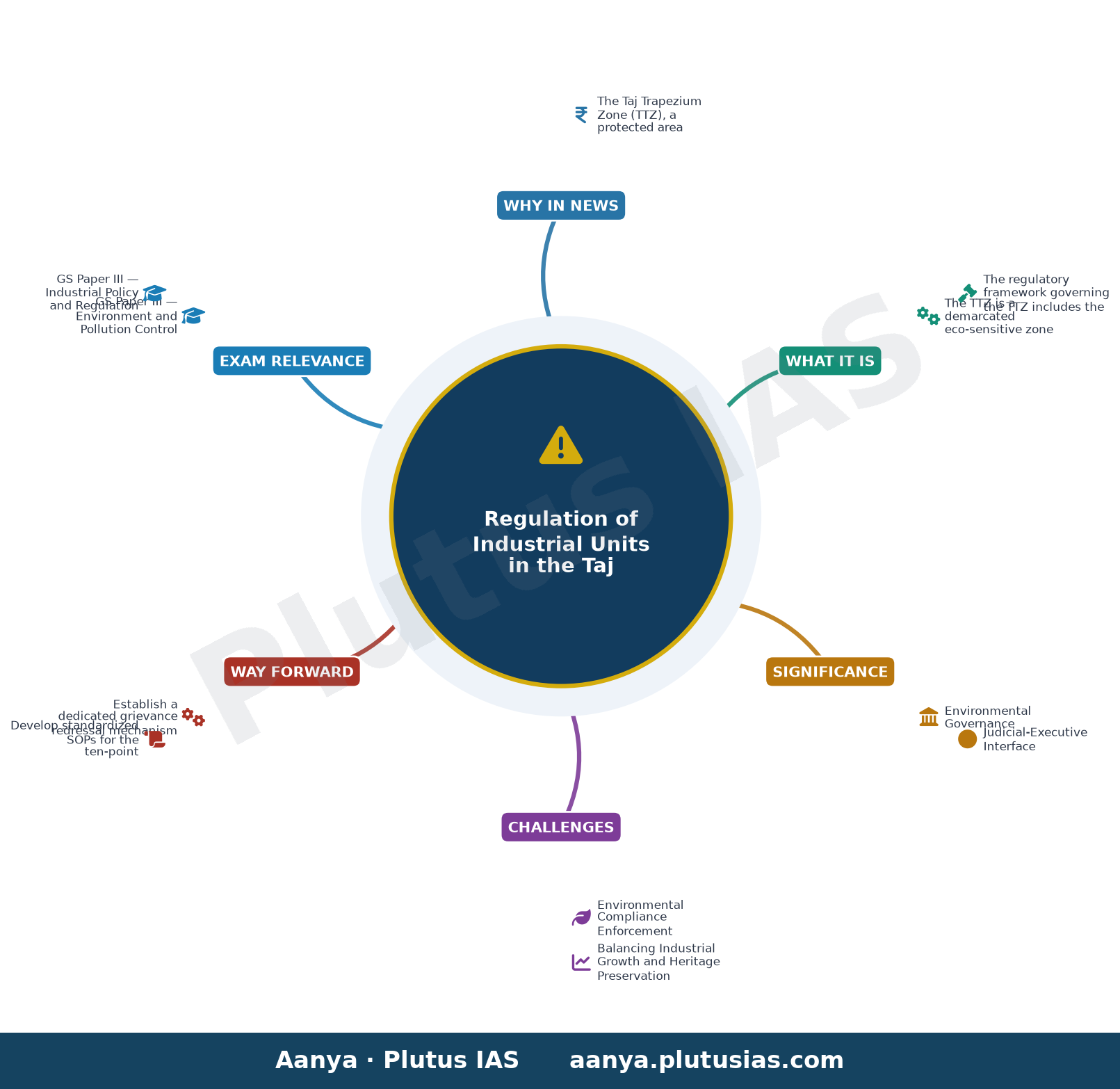
- GS Paper III — Environment and Pollution Control | GS Paper III — Industrial Policy and Regulation | GS Paper II — Constitutional and Legal Framework for Environmental Protection
- Prelims: Taj Trapezium Zone (TTZ), Environmental Impact Assessment (EIA), Supreme Court directives on pollution control, MSME (Micro, Small and Medium Enterprises), Air Pollution Control Board, National Green Tribunal (NGT), Environmental Clearance (EC), Pollution Control Board (PCB)
- Essay: Balancing economic development with environmental conservation: A case study of the Taj Trapezium Zone
Quick Revision: The Taj Trapezium Zone (TTZ) is a Supreme Court-mandated eco-sensitive zone around the Taj Mahal, governed by the Environment (Protection) Act, 1986, and the Air (Prevention and Control of Pollution) Act, 1981, with industrial units required to obtain environmental clearances and comply with ten critical environmental parameters.
Why is this in the news?
The Taj Trapezium Zone (TTZ), a protected area surrounding the Taj Mahal, has initiated a comprehensive survey of industrial units to assess their compliance with environmental norms and legal restrictions. This follows the Supreme Court’s directive to lift a two-year-old moratorium on new industrial establishments and expansions in the zone, subject to stringent verification across ten critical parameters. The move aims to reconcile industrial growth with the preservation of the UNESCO World Heritage Site, while ensuring adherence to pollution control measures.
Background
- The TTZ was established under the Environment (Protection) Act, 1986, and the Air (Prevention and Control of Pollution) Act, 1981, to regulate industrial activities that could degrade air quality and threaten the monument.
- The current survey is being conducted under the supervision of the TTZ Authority, chaired by the Divisional Commissioner of Agra, in collaboration with the Uttar Pradesh Pollution Control Board (UPPCB), District Industry Centers, and other regulatory bodies.
What is the Taj Trapezium Zone (TTZ) and its regulatory framework?
- The TTZ is a demarcated eco-sensitive zone around the Taj Mahal, declared by the Supreme Court to mitigate the impact of industrial pollution on the monument and its ecosystem.
- The regulatory framework governing the TTZ includes the Environment (Protection) Act, 1986; the Air (Prevention and Control of Pollution) Act, 1981; and the Water (Prevention and Control of Pollution) Act, 1974.
- The Supreme Court, through its judgments (e.g., M.C. Mehta vs. Union of India, 1996), has empowered the TTZ Authority to enforce environmental norms, including the closure of non-compliant industries and the imposition of strict pollution control measures.
- The current survey focuses on ten key parameters: land use compliance, project report validity, air pollution levels.
- The survey is being conducted by a joint team comprising officials from the District Industry Center, UPPCB, and the local administration, with oversight from the TTZ Authority and the Central Empowered Committee (CEC).
- The survey aims to identify compliant industrial units that can resume or expand operations, while ensuring that non-compliant units are either shut down or brought into compliance with environmental norms.
Key Features
| Feature | Significance |
|---|---|
| Survey of MSME units in TTZ | Initiates the process for lifting the Supreme Court-imposed moratorium on new industrial units and expansion of existing ones in the Taj Trapezium Zone (TTZ). |
| Ten-point verification framework | Ensures compliance with environmental safeguards, land-use norms, and pollution control measures before granting industrial permissions. |
| Role of TTZ Authority | Chaired by the Divisional Commissioner, it acts as the nodal body for granting consent to industrial units post-verification. |
| Involvement of CEC and NEERI | Central empowered committee and National Environmental Engineering Research Institute provide technical and environmental clearance, respectively. |
| First phase survey of 208 units | Targets MSMEs seeking expansion or new establishment, with 54 units already operational and seeking load augmentation. |
Why it Matters
Environmental Governance
- Reinforces the principle of ‘polluter pays’ by mandating pollution control compliance for industrial activities near heritage sites.
- Ensures adherence to the ‘Precautionary Principle’ under the Environment Protection Act, 1986, to prevent irreversible damage to the Taj Mahal.
- Integrates scientific validation (via NEERI) with administrative oversight to balance industrial growth and ecological preservation.
Judicial-Executive Interface
- Demonstrates the role of the judiciary in environmental governance through the Supreme Court’s intervention in the TTZ case (MC Mehta v. Union of India).
- Highlights the executive’s responsibility to implement judicial directives through structured administrative processes.
- Showcases the use of ‘judicial activism’ as a tool for enforcing environmental laws when legislative or executive measures are inadequate.
Industrial Policy and MSMEs
- Provides a pathway for MSMEs in TTZ to expand operations, addressing their long-standing constraints due to the moratorium.
- Aligns with the ‘Make in India’ initiative by facilitating ease of doing business while ensuring environmental compliance.
- Encourages adoption of cleaner technologies and pollution control measures among MSMEs to meet the ten-point verification criteria.
Institutional Coordination
- Illustrates inter-departmental collaboration between the Pollution Control Board, District Industry Centre, and TTZ Authority for effective implementation.
- Showcases the role of technical institutions (NEERI) in providing evidence-based assessments for environmental clearances.
- Demonstrates the division of powers between central (CEC) and state-level authorities in environmental decision-making.
Challenges
1. Environmental Compliance Enforcement
- Risk of superficial compliance by industries, leading to long-term ecological damage despite formal clearances.
- Challenges in monitoring post-clearance environmental performance, given the limited capacity of regulatory bodies.
- Potential delays in the verification process due to the complexity of the ten-point framework, affecting industrial timelines.
UPSC Link: GS-III: Environmental Pollution & Degradation
2. Balancing Industrial Growth and Heritage Preservation
- Inherent conflict between economic development (industrial expansion) and cultural heritage conservation (Taj Mahal protection).
- Difficulty in quantifying the ‘carrying capacity’ of the TTZ to sustain industrial activities without compromising air quality.
- Need for dynamic policy adjustments to address emerging environmental threats (e.g., air pollution, groundwater depletion).
UPSC Link: GS-I: Indian Heritage & Culture
3. Administrative and Bureaucratic Hurdles
- Delays in inter-departmental coordination, particularly between state and central agencies (e.g., CEC, NEERI).
- Lack of standardized protocols for verifying the ten-point criteria, leading to inconsistent implementation.
- Resource constraints in district-level bodies (e.g., District Industry Centre) to conduct thorough physical verifications.
UPSC Link: GS-II: Governance, Transparency & Accountability
4. Technological and Financial Constraints for MSMEs
- High cost of adopting pollution control technologies, which may be prohibitive for small-scale industries.
- Limited access to green financing for MSMEs to upgrade infrastructure in compliance with TTZ norms.
- Risk of MSMEs resorting to informal or non-compliant practices to circumvent verification processes.
UPSC Link: GS-III: MSMEs & Inclusive Growth
5. Public Participation and Stakeholder Engagement
- Inadequate mechanisms for public consultation during the verification and clearance process, raising transparency concerns.
- Potential resistance from local communities or environmental groups if industrial expansion is perceived as a threat.
- Need for grievance redressal systems to address disputes arising from industrial activities in TTZ.
UPSC Link: GS-II: Role of Civil Society in Governance
Challenges — UPSC Perspective
| Issue | Concern |
|---|---|
| Superficial compliance by industries | Risk of greenwashing and long-term ecological degradation despite formal clearances. |
| Delays in inter-departmental coordination | Prolongs the verification process, affecting industrial timelines and economic growth. |
| High cost of pollution control for MSMEs | May lead to non-compliance or closure of small-scale industries due to financial constraints. |
| Lack of standardized verification protocols | Results in inconsistent implementation across different units and regions. |
| Limited public participation in decision-making | Undermines transparency and raises concerns about accountability in environmental governance. |
| Quantifying TTZ’s carrying capacity | Difficulty in determining the sustainable limit for industrial activities without harming heritage sites. |
Way Forward
- Establish a dedicated grievance redressal mechanism for TTZ stakeholders to report non-compliance or environmental violations.
- Develop standardized SOPs for the ten-point verification framework to ensure uniformity in implementation across units.
- Strengthen the capacity of district-level bodies (e.g., District Industry Centre, Pollution Control Board) through training and resource allocation.
- Promote green financing schemes for MSMEs to facilitate adoption of pollution control technologies and sustainable practices.
- Conduct periodic environmental audits and publish compliance reports to enhance transparency and public trust.
- Collaborate with technical institutions (e.g., NEERI) to develop low-cost, scalable pollution control solutions tailored for MSMEs.
- Initiate public awareness campaigns to educate industries and local communities about TTZ norms and their environmental significance.
- Explore the use of remote sensing and AI-based monitoring for real-time tracking of industrial emissions and compliance.
UPSC Value Addition
Keywords for Mains Answer-Writing
Taj Trapezium Zone · industrial regulation · Supreme Court directives on environment · Taj Mahal conservation · MSME units in TTZ · environmental impact assessment · pollution control in heritage zones · industrial expansion norms · environmental governance · heritage conservation laws · Air (Prevention and Control of Pollution) Act, 1981 · Environment (Protection) Act, 1986 · National Green Tribunal · industrial siting policy · environmental compliance in Uttar Pradesh
Constitutional & Policy Linkages
- Article 48A (DPSP) — Protection and improvement of environment and safeguarding of forests and wildlife.
- Article 51A(g) — Fundamental Duty to protect and improve the natural environment.
Concept Flow
Supreme Court’s moratorium on industrial activities in TTZ (MC Mehta v. Union of India) → Judicial intervention to enforce environmental safeguards. → Supreme Court directives to TTZ Authority for phased resumption of industrial activities → Executive action to comply with judicial orders. → Formation of a joint survey team (Pollution Control Board, District Industry Centre, TTZ Authority) → Inter-departmental coordination for verification. → Ten-point verification framework (environmental, land-use, pollution control norms) → Structured assessment of industrial units. → Consent from TTZ Authority, CEC, and NEERI → Multi-layered clearance process for industrial permissions. → Expansion of MSMEs in TTZ → Economic growth with adherence to environmental governance principles.
Prelims Practice Questions
Q1. Consider the following statements regarding the Taj Trapezium Zone (TTZ):
1. The TTZ is a defined area around the Taj Mahal to protect it from pollution.
2. The Supreme Court of India has imposed a blanket ban on all industrial activities within the TTZ.
3. The TTZ includes parts of the states of Uttar Pradesh, Rajasthan, Haryana, and Delhi.
4. The TTZ was established under the provisions of the Environment (Protection) Act, 1986.
How many of the above statements are correct?
- Only one
- Only two
- Only three
- All four
Answer: Only three — Statement 1 is correct as the TTZ is designated to protect the Taj Mahal from environmental degradation. Statement 2 is incorrect because the Supreme Court has not imposed a blanket ban but has regulated industrial activities based on environmental compliance. Statement 3 is correct as the TTZ includes districts from Uttar Pradesh, Rajasthan, Haryana, and Delhi. Statement 4 is correct as the TTZ was notified under the Environment (Protection) Act, 1986.
Q2. Assertion (A): The National Green Tribunal (NGT) plays a crucial role in enforcing environmental norms in industrial zones like the Taj Trapezium Zone (TTZ).
Reason (R): The NGT has the power to impose penalties and issue directions for compliance with environmental laws, including those governing industrial activities in heritage zones.
Options:
A. Both A and R are true, and R is the correct explanation of A.
B. Both A and R are true, but R is not the correct explanation of A.
C. A is true, but R is false.
D. A is false, but R is true.
Answer: ? — The NGT is empowered under the National Green Tribunal Act, 2010, to enforce environmental laws and issue directions for compliance, including in heritage zones like the TTZ. Thus, both A and R are true, and R correctly explains A.
Q3. Match the following environmental governance mechanisms with their respective legal frameworks:
Column I (Mechanism) | Column II (Legal Framework)
— | —
1. Declaration of Eco-Sensitive Zones | A. Air (Prevention and Control of Pollution) Act, 1981
2. Regulation of industrial emissions | B. Environment (Protection) Act, 1986
3. Notification of heritage conservation zones | C. Wildlife (Protection) Act, 1972
4. Protection of wildlife habitats | D. National Green Tribunal Act, 2010
Options:
A. 1-C, 2-A, 3-B, 4-D
B. 1-B, 2-A, 3-D, 4-C
C. 1-D, 2-A, 3-B, 4-C
D. 1-B, 2-D, 3-A, 4-C
Answer: ? — 1. Declaration of Eco-Sensitive Zones is notified under the Environment (Protection) Act, 1986 (B). 2. Regulation of industrial emissions is governed by the Air (Prevention and Control of Pollution) Act, 1981 (A). 3. Notification of heritage conservation zones, such as the TTZ, is also under the Environment (Protection) Act, 1986 (B), though not listed in the options; closest is B. 4. Protection of wildlife habitats is covered under the Wildlife (Protection) Act, 1972 (C). The correct match is 1-B, 2-A, 3-D (as NGT Act enables enforcement), 4-C.
Mains Practice Question
✍ The Supreme Court of India has, through a series of directives, sought to balance industrial development with the conservation of the Taj Mahal by regulating activities within the Taj Trapezium Zone (TTZ). Critically examine the legal and institutional framework governing industrial activities in the TTZ, with particular reference to recent Supreme Court orders and the role of environmental governance mechanisms. (15 Marks)
Approach: MODEL-ANSWER SKELETON:
1. **Introduction (2 marks)**
– Define the Taj Trapezium Zone (TTZ) as a notified eco-sensitive zone under the Environment (Protection) Act, 1986, encompassing areas around the Taj Mahal to mitigate environmental degradation.
– State the Supreme Court’s role in regulating industrial activities in the TTZ, particularly through its 1996 and subsequent orders, which imposed restrictions on polluting industries.
2. **Legal Framework Governing TTZ (5 marks)**
– **Environment (Protection) Act, 1986**: Basis for notification of eco-sensitive zones, including the TTZ.
– **Air (Prevention and Control of Pollution) Act, 1981**: Regulates industrial emissions and mandates pollution control measures.
– **Water (Prevention and Control of Pollution) Act, 1974**: Ensures compliance with water quality standards.
– **Supreme Court Directives**: Reference to the 1996 judgment (M.C. Mehta v. Union of India) and subsequent orders restricting industrial activities, particularly those emitting sulphur dioxide and suspended particulate matter.
– **National Green Tribunal (NGT)**: Role in adjudicating disputes and enforcing compliance with environmental norms in the TTZ.
3. **Institutional Mechanisms (4 marks)**
– **Taj Trapezium Zone Authority (TTZA)**: Composition, functions, and powers under the Environment (Protection) Act, 1986.
– **State Pollution Control Boards (SPCBs)**: Role in monitoring and enforcing pollution control norms.
– **Central Pollution Control Board (CPCB)**: Provides technical guidance and monitors compliance.
– **Judicial Oversight**: Role of the Supreme Court and NGT in reviewing and modifying industrial regulations.
4. **Recent Developments and Challenges (4 marks)**
– **Supreme Court’s 2026 Order**: Reference to the recent directive allowing certain MSME units to expand subject to compliance with 10 key parameters (e.g., pollution control, land-use norms).
– **Balancing Development and Conservation**: Discuss the tension between industrial growth and heritage conservation, citing examples of industries permitted or restricted in the TTZ.
– **Challenges**: Enforcement gaps, lack of adequate pollution control infrastructure, and the need for sustainable industrial practices.
5. **Conclusion (2 marks)**
– Emphasize the need for a balanced approach that integrates environmental governance with industrial development.
– Highlight the role of multi-stakeholder coordination (judiciary, executive, industry, and civil society) in achieving sustainable outcomes in heritage zones.
Source: amarujala.com
Generated by AanyaAi for educational purpose.

- Rajasthan Panchayati Raj Elections: New Rules, Fines & Disqualification - September 28, 2026
- सेना प्रमुख का बड़ा बयान: जीत जमीन से ही तय होती है, तकनीक नहीं बदल सकती युद्ध की प्रकृति - September 28, 2026
- UPSC Alert: Government Cracks Down on Patwaris for SVAMITVA Scheme Refusals - September 28, 2026

No Comments