


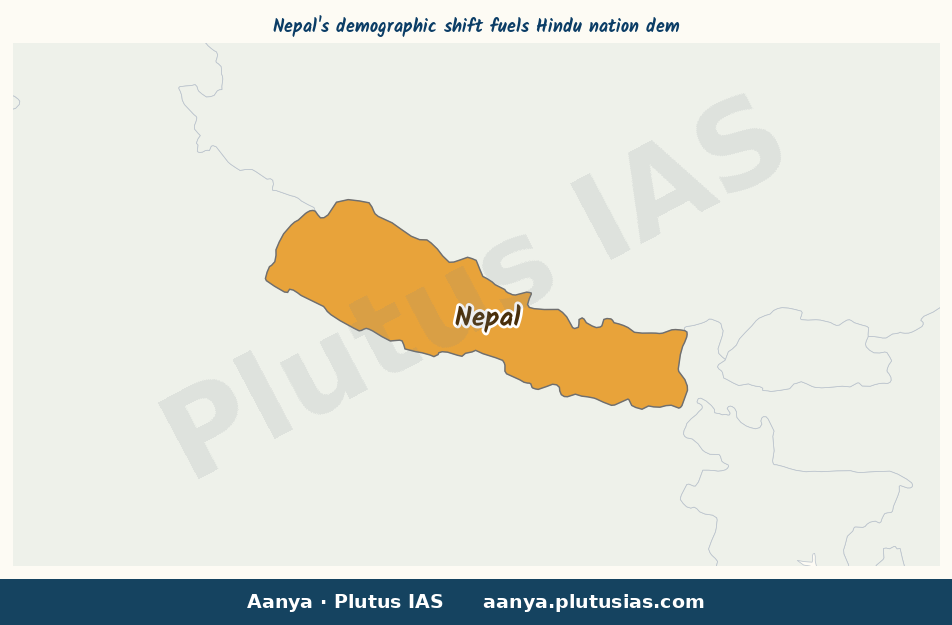
11 Aug Nepal’s Muslim Population Growth Fuels Hindu Nation Demand in UP Exams
✎ Nepal’s 2015 Constitution enshrines secularism (Article 4), and any demand for a Hindu Rashtra would require constitutional amendment via a two-thirds parliamentary majority and a referendum.
Subject Relevance — Where This Topic Fits
- GS Paper II — International Relations: India-Nepal relations, regional security dynamics | GS Paper II — Polity and Governance: Constitutional provisions on secularism and minority rights | GS Paper II — Social Justice: Demographic shifts and communal harmony
- Prelims: Nepal’s 2021 Census, Mithila/Madhesh Province, Hindu Rashtra demand, India-Nepal border districts (Siddharthnagar, Maharajganj, Balrampur), Article 4 of the Nepal Constitution 2015, Secularism in Nepal, Demographic transition theory
- Essay: Demographic changes and their impact on national identity, Secularism vs. majoritarianism in democratic societies
Quick Revision: Nepal’s 2015 Constitution enshrines secularism (Article 4), and any demand for a Hindu Rashtra would require constitutional amendment via a two-thirds parliamentary majority and a referendum.
Why is this in the news?
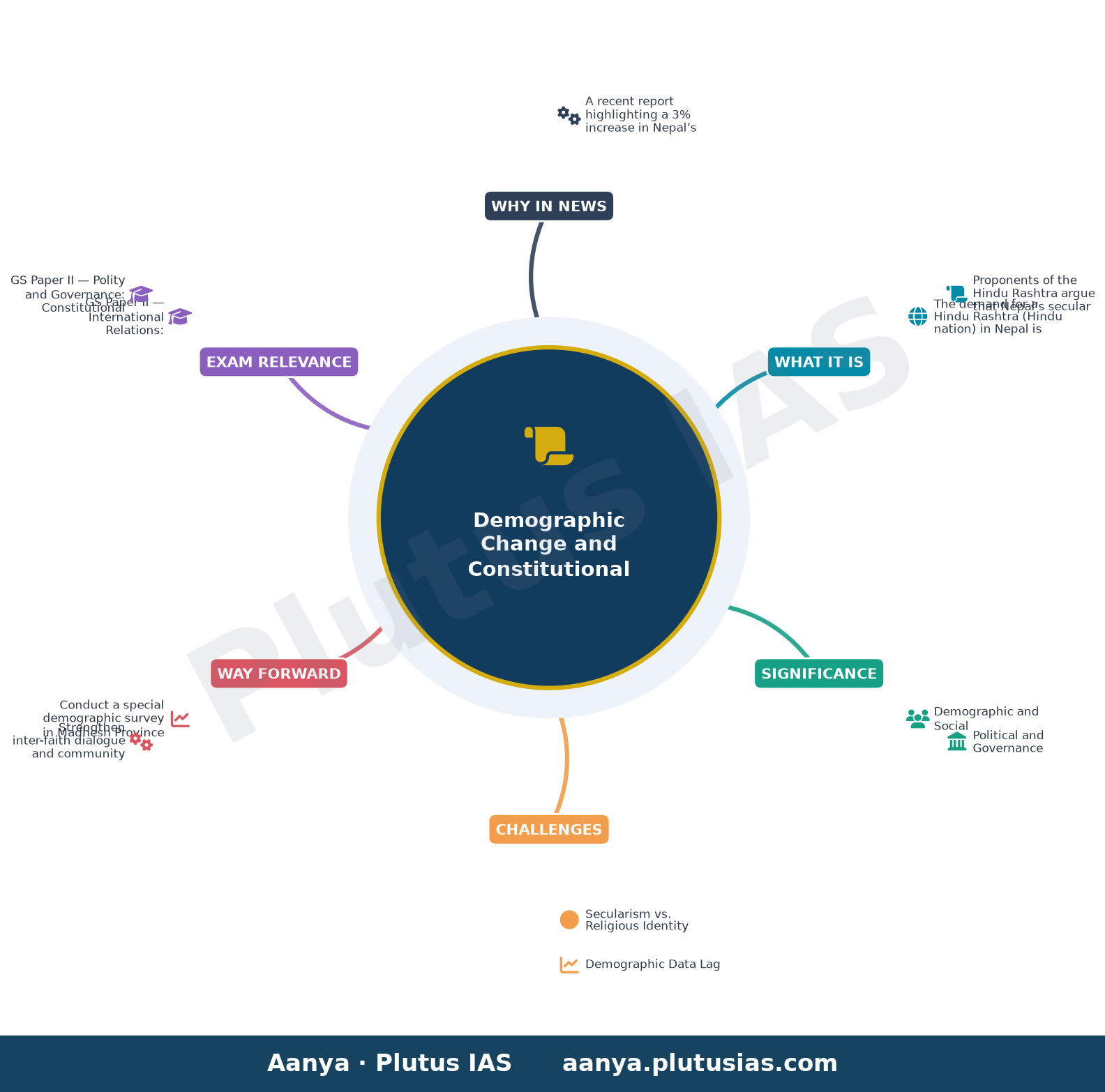
A recent report highlighting a 3% increase in Nepal’s Muslim population over a decade has reignited debates on the country’s secular identity and demands for a Hindu Rashtra. The demographic shift, particularly in the Mithila/Madhesh Province, has triggered socio-political discussions, including concerns over communal harmony and cross-border implications for India’s border districts. This development is significant for UPSC aspirants as it intersects with constitutional governance, India-Nepal relations, and the principles of secularism in a pluralistic society.
Background
- Nepal adopted secularism as a constitutional principle in 2007 (Interim Constitution) and reaffirmed it in the 2015 Constitution, replacing its earlier status as a Hindu kingdom.
- The 2021 Nepal Census reported the Muslim population with the highest concentration in Rautahat district (22.5%) and Madhesh Province (13.3%).
- Historically, Nepal’s population dynamics have been influenced by migration from India, including communities from Uttar Pradesh and Bihar, particularly in the Terai region.
- Communal tensions in districts like Sunsari have underscored the socio-political sensitivities surrounding demographic shifts and their potential to exacerbate inter-community relations.
- India’s border districts such as Siddharthnagar, Maharajganj, and Balrampur share close socio-economic and cultural ties with Nepal’s Terai region, making demographic changes a transboundary concern.
What is the Hindu Rashtra demand in Nepal?
- The demand for a Hindu Rashtra (Hindu nation) in Nepal is rooted in historical and cultural narratives that trace the country’s identity to its former status as the world’s only Hindu kingdom until 2008.
- Proponents of the Hindu Rashtra argue that Nepal’s secular framework has diluted its Hindu majority identity, citing demographic changes as a justification for reverting to a Hindu state.
- Article 4 of the Nepal Constitution 2015 declares Nepal a ‘secular, inclusive, federal, democratic republic,’ a provision that has been contested by groups advocating for a return to Hindu majoritarianism.
- The demand gained traction following reports of demographic shifts, particularly in the Madhesh Province, where Muslim populations have grown significantly over the past decade.
- Religious organisations such as the World Hindu Federation have expressed concerns over what they perceive as an erosion of Nepal’s Hindu cultural heritage due to migration and demographic changes.
- The debate intersects with broader questions of national identity, minority rights, and the balance between cultural preservation and secular governance in a pluralistic society.
- Constitutional experts note that any move to alter Nepal’s secular status would require a two-thirds majority in Parliament and a referendum, making the process politically and legally complex.
- The issue also raises questions about the role of the state in managing demographic changes and ensuring communal harmony in a diverse society.
Key Features
| Feature | Significance |
|---|---|
| Demographic shift in Nepal’s Madhesh Province | A 3% rise in Muslim population over a decade, altering the religious composition of key districts such as Rautahat and Bara. |
| Religious identity politics | The demographic change has intensified demands for Nepal to revert to a Hindu state, reflecting the intersection of religion, governance, and identity. |
| Communal tensions in Sunari district | Violence in July 2026 following a Hindu-Muslim dispute highlights the socio-political friction arising from demographic shifts. |
| Cross-border demographic influence | The proximity of Indian districts like Siddharthnagar and Maharajganj to Nepal’s Terai region raises concerns about spill-over effects on local communities. |
| Data-driven governance challenges | The reliance on decadal census data (e.g., 2021) for policy-making underscores the lag in addressing rapid demographic changes. |
Why it Matters
Demographic and Social
- The rise in Muslim population in Madhesh Province challenges Nepal’s historical religious majority, prompting debates on secularism and state identity.
- Religious polarization risks eroding Nepal’s constitutional commitment to secularism (Article 4 of the 2015 Constitution).
- Social cohesion in multi-ethnic, multi-religious districts like Rautahat and Bara faces strain due to perceived demographic imbalances.
Political and Governance
- Demographic shifts influence electoral politics, with parties potentially mobilizing voters along religious lines to consolidate support.
- The demand for a Hindu state reflects a broader trend of identity-based politics in South Asia, complicating Nepal’s federal and secular governance model.
- Rapid population changes necessitate updated census methodologies to ensure accurate representation and equitable resource allocation.
Regional Stability
- Cross-border demographic movements between India and Nepal may strain bilateral relations if perceived as a security or demographic threat.
- Communal violence in Nepal’s Terai region could spill over into Indian border districts, requiring coordinated law-and-order responses.
Challenges
1. Secularism vs. Religious Identity
- Balancing Nepal’s constitutional secularism with growing demands for a Hindu state poses a governance dilemma.
- Political parties may exploit religious identity for electoral gains, risking polarization and social fragmentation.
UPSC Link: GS-II: Secularism
2. Demographic Data Lag
- Census data (e.g., 2021) does not capture rapid population changes, delaying policy responses to demographic shifts.
- Lack of real-time demographic monitoring hampers evidence-based governance in districts like Rautahat and Bara.
UPSC Link: GS-II: Governance
3. Communal Violence and Law and Order
- Episodic communal violence (e.g., Sunari 2026) threatens social stability and requires robust preventive mechanisms.
- Weak inter-faith dialogue and community policing exacerbate tensions in mixed-population districts.
UPSC Link: GS-III: Internal Security
4. Cross-Border Demographic Spill-Over
- Unregulated migration between India and Nepal may lead to demographic imbalances in border districts.
- Lack of coordinated border management complicates efforts to address demographic pressures on both sides.
UPSC Link: GS-II: Federalism
5. Resource Allocation and Representation
- Rapid demographic changes may distort electoral representation if constituency boundaries are not periodically reviewed.
- Disproportionate growth in certain religious groups could lead to demands for affirmative action or policy adjustments.
UPSC Link: GS-II: Representation
Challenges — UPSC Perspective
| Issue | Concern |
|---|---|
| Religious polarization | Erosion of Nepal’s secular constitutional framework due to identity-based politics. |
| Demographic lag in governance | Outdated census data fails to reflect rapid population changes, delaying policy interventions. |
| Communal violence | Risk of escalation in districts like Sunari, Sunari, and Bara due to socio-religious tensions. |
| Cross-border demographic influence | Potential spill-over of tensions into Indian border districts, straining bilateral relations. |
| Electoral representation imbalance | Unequal growth in religious populations may distort electoral outcomes and representation. |
Way Forward
- Conduct a special demographic survey in Madhesh Province to update census data and inform policy-making.
- Strengthen inter-faith dialogue and community policing mechanisms to prevent communal violence.
- Review and update electoral constituency boundaries periodically to ensure fair representation amid demographic shifts.
- Enhance bilateral cooperation with India to monitor cross-border demographic movements and address security concerns.
- Promote civic education programs to foster social cohesion and counter identity-based polarization.
- Establish a multi-stakeholder task force to assess the socio-economic impacts of demographic changes.
- Develop early warning systems for communal tensions, leveraging local governance and civil society networks.
UPSC Value Addition
Keywords for Mains Answer-Writing
Demographic change and social cohesion · Religious demography in South Asia · Hindu Rashtra debate in Nepal · Secularism and state neutrality · Citizenship and demographic shifts · Minority rights and constitutional provisions · Cross-border demographic dynamics · Social harmony and communal tensions · Census and demographic data · Pluralism and national identity
Constitutional & Policy Linkages
- Article 4 (Nepal’s Constitution, 2015): Secularism as a fundamental principle.
- Article 285 (Nepal’s Constitution): Rights of religious minorities.
- Fundamental Rights (Part 3, Nepal’s Constitution): Equality before law and non-discrimination.
Concept Flow
Demographic shift → Religious identity politics → Demand for Hindu state → Communal tensions → Policy lag → Governance challenges → Rapid Muslim population growth → Perceived demographic imbalance → Identity-based mobilization → Electoral politics → Secularism under strain → Cross-border migration → Spill-over tensions → Bilateral cooperation needs → Law and order challenges → Outdated census data → Delayed policy responses → Resource allocation issues → Representation disparities → Communal violence → Social fragmentation → Governance deficits → Institutional reforms required
Prelims Practice Questions
Q1. Consider the following statements regarding Nepal’s demographic changes as reported in the 2021 Census:
1. Rautahat district has the highest proportion of Muslim population among all districts in Nepal.
2. The Muslim population in Nepal increased by 3% over the last decade.
3. Madhesh Pradesh has the highest proportion of Muslim population among all provinces in Nepal.
4. The Muslim population growth rate in Nepal is uniform across all districts.
How many of the above statements are correct?
- Only one
- Only two
- Only three
- All four
Answer: Only three — Statements 1, 2, and 3 are correct based on the 2021 Census data. Statement 4 is incorrect as the growth rate varies across districts.
Q2. Assertion (A): The demand for declaring Nepal a Hindu Rashtra has intensified due to demographic changes.
Reason (R): The Muslim population in Nepal has grown significantly in the last decade, particularly in Madhesh Pradesh.
Options:
A. Both A and R are true, and R is the correct explanation of A.
B. Both A and R are true, but R is not the correct explanation of A.
C. A is true, but R is false.
D. A is false, but R is true.
Answer: ? — Both the assertion and reason are true, and the reason correctly explains the assertion as demographic changes have fueled debates on Nepal’s national identity.
Q3. Match the following districts of Nepal with their respective Muslim population growth rates (2011-2021) as per the Census data:
Column I (District) Column II (Growth Rate %)
1. Rautahat A. 0.9
2. Bara B. 2.9
3. Banke C. 1.4
4. Kapilvastu D. 0.0
Options:
A. 1-B, 2-C, 3-A, 4-D
B. 1-A, 2-B, 3-C, 4-D
C. 1-D, 2-C, 3-B, 4-A
D. 1-C, 2-A, 3-D, 4-B
Answer: ? — The correct matches are: Rautahat (2.9%), Bara (1.4%), Banke (0.9%), and Kapilvastu (0.0%).
Mains Practice Question
✍ Demographic shifts often intersect with debates on national identity and constitutional secularism. In the context of Nepal’s evolving religious demography, critically examine the implications for social cohesion and the secular character of the state. (15 Marks)
Approach: MODEL-ANSWER SKELETON:
1. **Introduction**: Define demographic shifts and their link to national identity debates. Briefly state Nepal’s secular constitutional framework (Article 4 of the 2015 Constitution).
2. **Demographic Trends**: Present key data from the 2021 Census (e.g., Muslim population growth in Rautahat, Madhesh Pradesh; overall increase of 3% in a decade). Highlight regional variations and external migration factors.
3. **Secularism and State Neutrality**: Discuss Nepal’s constitutional commitment to secularism (Article 4) and its historical context (abolition of Hindu monarchy in 2008). Contrast with debates on Hindu Rashtra.
4. **Social Cohesion Challenges**: Analyze potential threats to social harmony (e.g., communal tensions in Sunari, political mobilisation, media narratives). Reference the 2026 violence in Dewanaganj as a case study.
5. **Comparative Perspective**: Compare Nepal’s model with India’s secularism (Articles 25-28) and challenges faced (e.g., Ayodhya dispute, CAA debates).
6. **Way Forward**: Suggest measures to preserve pluralism: (a) robust census data transparency, (b) inter-faith dialogue, (c) legal safeguards for minority rights, (d) curbing misinformation. Conclude with a balanced view: demographic change need not undermine secularism if institutions remain strong.
Source: amarujala.com
Generated by AanyaAi for educational purpose.

- PM GatiShakti NMP: Integrated Infrastructure Planning for UPSC 2026 - August 11, 2026
- लोकसभा में बिना बहस के पास हुए केरल नाम बदलने और सहकारी बिल, जानें पूरा मामला - August 11, 2026
- Lok Sabha Clears Kerala Renaming to ‘Keralam’ Amid Opposition Deadlock - August 11, 2026

No Comments