


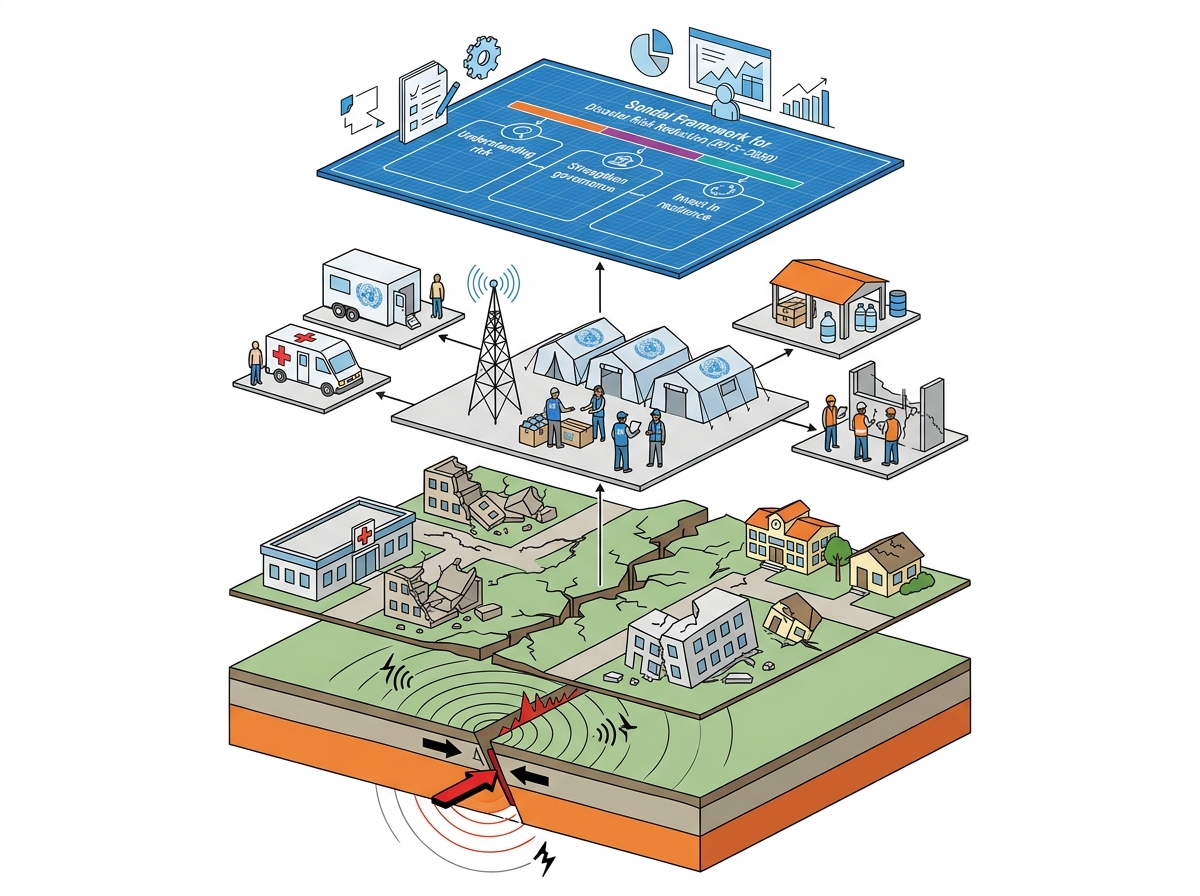
11 Aug UN Steps Up Aid for Colombia After Devastating 7.4 Earthquake
Earthquake epicenterHumanitarian aidHealth centersDisaster responseResilience framework✎ The Sendai Framework for Disaster Risk Reduction (2015–2030) is the global benchmark for reducing disaster losses, with the UN Disaster Assessment and Coordination (UNDAC) system playing a key role in rapid humanitarian response…
Subject Relevance — Where This Topic Fits
- GS Paper II — International Relations — Role of International Organisations in Disaster Response | GS Paper III — Disaster Management — Institutional Mechanisms and Preparedness
- Prelims: Disaster Risk Reduction (DRR), Sendai Framework, United Nations Office for Disaster Risk Reduction (UNDRR), National Disaster Management Authority (NDMA), International Search and Rescue Advisory Group (INSARAG)
- Essay: The Role of International Cooperation in Mitigating Humanitarian Crises, Disaster Resilience as a Pillar of Sustainable Development
Quick Revision: The Sendai Framework for Disaster Risk Reduction (2015–2030) is the global benchmark for reducing disaster losses, with the UN Disaster Assessment and Coordination (UNDAC) system playing a key role in rapid humanitarian response to seismic events such as the 2026 Colombia earthquake.
Why is this in the news?
On 10 August 2026, a magnitude 7.4 earthquake struck western Colombia, resulting in significant human and infrastructural losses, including extensive damage to homes, health centres, and educational facilities. The United Nations (UN) promptly offered coordinated humanitarian support, highlighting the critical role of international disaster response mechanisms and the Sendai Framework for Disaster Risk Reduction (2015–2030) in mitigating such crises.
Background
- The Sendai Framework for Disaster Risk Reduction (2015–2030), adopted by the UN General Assembly, is a 15-year, voluntary, non-binding agreement that outlines priorities for reducing disaster risk and enhancing resilience. It succeeded the Hyogo Framework for Action (2005–2015) and is aligned with the Sustainable Development Goals (SDGs), particularly SDG 11 (Sustainable Cities and Communities) and SDG 13 (Climate Action).
- Colombia is located in a seismically active region due to its position along the Pacific Ring of Fire, making it prone to earthquakes, volcanic activity, and landslides. Historical seismic events, such as the 1999 Armenia earthquake (magnitude 6.2), have demonstrated the country’s vulnerability to such disasters.
- The UN’s role in disaster response is guided by the UN Disaster Assessment and Coordination (UNDAC) system, which deploys teams to assess needs and coordinate international assistance. The UN Resident Coordinator in Colombia, María José Torres Macho, emphasised the importance of inter-agency coordination in the current response.
- The World Food Programme (WFP) and the Pan American Health Organization (PAHO) are key UN agencies that provide humanitarian assistance, including food security and health services, in disaster-affected regions. Their readiness to deploy resources underscores the importance of pre-positioned emergency supplies.
- The Colombian Government’s activation of its emergency response mechanisms, including the National Disaster Risk Management Unit (UNGRD), reflects the implementation of the National Disaster Risk Management Plan, which aligns with the Sendai Framework’s priorities.
- The earthquake’s impact extended beyond Colombia, affecting neighbouring countries such as Panama, Ecuador, and Venezuela, where tremors were felt. This cross-border effect highlights the regional nature of disaster risks and the need for transnational cooperation in disaster management.
What is Seismic Disaster Risk Reduction and Humanitarian Response?
- Seismic Disaster Risk Reduction (DRR) refers to the systematic approach to identifying, assessing, and reducing the risks posed by earthquakes and other seismic hazards. It encompasses structural measures (e.g., earthquake-resistant construction), non-structural measures (e.g., early warning systems), and institutional measures (e.g., emergency preparedness plans).
- The Sendai Framework for Disaster Risk Reduction (2015–2030) is a global blueprint adopted by 187 UN Member States to reduce disaster losses in lives, livelihoods, and health. It outlines seven global targets, including reducing mortality, economic losses, and damage to critical infrastructure.
- The United Nations Disaster Assessment and Coordination (UNDAC) system is a rapid-response mechanism that deploys teams to disaster-stricken areas to assess needs, coordinate international assistance, and support national authorities in response and recovery efforts.
- The International Search and Rescue Advisory Group (INSARAG) is a global network of disaster response teams that provides specialised search and rescue support in collapsed structures. It operates under the UN Office for the Coordination of Humanitarian Affairs (OCHA).
- Humanitarian response to seismic disasters involves immediate actions such as search and rescue operations, medical aid, shelter provision, and food security measures. Agencies like the World Food Programme (WFP) and the Pan American Health Organization (PAHO) play pivotal roles in delivering these services.
- Early warning systems for earthquakes are challenging due to the unpredictability of seismic events. However, regional seismic monitoring networks, such as those operated by the Colombian Geological Service (SGC), provide critical data for rapid assessment and response.
- Disaster risk governance at the national level involves the establishment of institutions like National Disaster Management Authorities (NDMAs), which coordinate preparedness, response, and recovery efforts. In Colombia, the National Disaster Risk Management Unit (UNGRD) serves this function.
- The economic and social impacts of seismic disasters extend beyond immediate losses, including long-term disruptions to education, healthcare, and economic activities. The Sendai Framework emphasises the need for resilient infrastructure to mitigate these impacts.
Key Features
| Feature | Significance |
|---|---|
| Magnitude 7.4 earthquake | High-energy seismic event causing widespread structural damage and loss of life due to ground shaking and secondary hazards. |
| Epicentre near San José del Palmar, Chocó | Geological location in a seismically active zone, amplifying local impact due to proximity to populated areas. |
| Collapse of residential and public infrastructure | Destruction of homes, health centres, and educational facilities disrupting essential services and displacing populations. |
| Landslides and transport disruptions | Secondary geological hazards blocking roads and suspending airport operations, impeding rescue and relief efforts. |
| Limited rural connectivity | Poor communication infrastructure hindering rapid damage assessment and coordination of emergency response in remote areas. |
Why it Matters
Humanitarian Impact
- At least 111 fatalities and 87 injuries reported, with potential for further casualties due to trapped individuals.
- Displacement of populations due to structural collapse and landslides, necessitating temporary shelter and medical aid.
- Vulnerability of children and marginalised groups in affected regions, requiring targeted support.
Geopolitical and Regional Stability
- Cross-border tremors affecting Panama, Ecuador, and Venezuela, highlighting shared seismic risks in the Andean region.
- Potential for regional cooperation in disaster response and risk mitigation strategies among affected nations.
- Impact on Colombia’s socio-economic stability, particularly in western regions, influencing policy priorities.
Institutional Response and Governance
- Activation of Colombia’s national emergency response mechanisms, demonstrating institutional capacity in crisis management.
- Coordination between UN agencies and national authorities to assess needs and mobilise resources.
- Role of local governments (e.g., Pereira, Cali) in leading search-and-rescue operations and damage assessment.
Economic Disruptions
- Damage to transport infrastructure (airports, roads) disrupting supply chains and economic activities in western Colombia.
- Destruction of homes and public facilities imposing financial burdens on rehabilitation and reconstruction efforts.
- Potential short-term decline in economic productivity due to workforce displacement and infrastructure losses.
Environmental and Structural Vulnerabilities
- Seismic activity in a region with high geological instability, necessitating long-term risk reduction strategies.
- Poor construction standards in affected areas exacerbating structural collapse and casualties.
- Need for retrofitting of critical infrastructure to withstand future seismic events.
Challenges
1. Rapid Damage Assessment
- Limited connectivity in rural areas delaying real-time data collection on structural damage and casualties.
- Overwhelmed local authorities struggling to coordinate assessments across dispersed affected zones.
UPSC Link: GS III: Disaster Management
2. Search and Rescue Operations
- Time-sensitive nature of rescue efforts, with trapped individuals at risk of asphyxiation or injury.
- Logistical challenges in accessing remote or landslide-affected areas due to blocked transport routes.
UPSC Link: GS III: Disaster Management
3. Coordination with International Agencies
- Ensuring alignment of UN and other international aid with national priorities to avoid duplication or delays.
- Language and bureaucratic barriers in integrating foreign rescue teams and resources.
UPSC Link: GS II: International Organisations
4. Rehabilitation and Reconstruction
- Long-term financial requirements for rebuilding homes, schools, and healthcare facilities.
- Risk of corruption or mismanagement in fund allocation for relief and reconstruction.
UPSC Link: GS III: Development and Management
5. Public Health Emergencies
- Increased risk of waterborne diseases due to damaged sanitation infrastructure.
- Psychological trauma among survivors, necessitating mental health interventions.
UPSC Link: GS II: Health
6. Policy and Institutional Gaps
- Inadequate enforcement of building codes in seismic zones, leading to preventable structural failures.
- Lack of integrated disaster risk reduction strategies linking local, national, and regional levels.
UPSC Link: GS III: Disaster Management
Challenges — UPSC Perspective
| Issue | Concern |
|---|---|
| Limited rural connectivity | Hampers real-time damage assessment and coordination of rescue operations. |
| Collapsed transport networks | Blocks access to affected areas, delaying relief and evacuation efforts. |
| Damage to public infrastructure | Disrupts essential services (healthcare, education) and increases vulnerability of displaced populations. |
| Secondary hazards (landslides) | Complicates search-and-rescue operations and exacerbates long-term displacement. |
| Overwhelmed local authorities | Strains capacity to manage multi-agency response and resource allocation. |
| Potential for disease outbreaks | Rises due to compromised sanitation and overcrowded temporary shelters. |
Way Forward
- Conduct rapid structural safety audits of remaining buildings to prevent further collapses and ensure safe occupancy.
- Deploy mobile connectivity units to restore communication in rural and remote areas for real-time data sharing.
- Establish clear protocols for integrating international aid with national emergency response to avoid duplication.
- Prioritise search-and-rescue operations in high-risk zones with trapped populations, utilising specialised teams (e.g., NDRF-equivalent units).
- Launch temporary shelters with adequate sanitation, healthcare, and psychological support for displaced families.
- Formulate a multi-year reconstruction plan with transparent fund allocation and anti-corruption safeguards.
- Strengthen enforcement of seismic building codes and retrofitting of critical infrastructure in high-risk regions.
- Enhance regional cooperation with neighbouring countries to share seismic data and best practices in disaster management.
UPSC Value Addition
Keywords for Mains Answer-Writing
Disaster management · International cooperation in emergencies · United Nations humanitarian assistance · Multi-hazard vulnerability · National Disaster Response Framework · Sendai Framework for Disaster Risk Reduction · Cross-border disaster impact · Emergency response coordination · Humanitarian logistics · Sustainable Development Goal 11 (SDG 11) · Infrastructure resilience · Community-based disaster risk reduction
Concept Flow
Seismic activity (magnitude 7.4 earthquake) → Ground shaking and secondary hazards (landslides) → Structural collapse (homes, public buildings) → Immediate humanitarian impact (casualties, displacement) → Activation of emergency response mechanisms → Coordination with international agencies → Assessment of damage and needs → Rehabilitation and reconstruction planning → Policy review for risk reduction.
Prelims Practice Questions
Q1. Consider the following statements regarding the Sendai Framework for Disaster Risk Reduction 2015–2030:
1. It is a non-binding agreement adopted by the UN General Assembly.
2. It aims to substantially reduce disaster damage to critical infrastructure and disruption of basic services.
3. It prioritizes the enhancement of international cooperation for developing countries.
4. It mandates the establishment of a permanent UN Disaster Response Force for rapid deployment.
How many of the above statements are correct?
- Only one
- Only two
- Only three
- All
Answer: Only three — Statements 1, 2, and 3 are correct as the Sendai Framework is a voluntary, non-binding agreement adopted by the UN General Assembly in 2015, focusing on reducing disaster risk and enhancing international cooperation. Statement 4 is incorrect as the framework does not mandate a permanent UN Disaster Response Force.
Q2. Assertion (A): The United Nations Office for the Coordination of Humanitarian Affairs (OCHA) plays a central role in coordinating international humanitarian responses to disasters.
Reason (R): OCHA is mandated by the UN General Assembly to mobilize and coordinate humanitarian assistance in emergencies.
Options:
A. Both A and R are true, and R is the correct explanation of A.
B. Both A and R are true, but R is not the correct explanation of A.
C. A is true, but R is false.
D. A is false, but R is true.
Answer: ? — Both Assertion (A) and Reason (R) are true, and R correctly explains A. OCHA is indeed mandated by the UN General Assembly to coordinate humanitarian assistance globally, including in disaster scenarios.
Q3. Match the following UN agencies with their primary roles in disaster response:
Column I (Agency) Column II (Primary Role)
1. World Food Programme (WFP) A. Coordination of international humanitarian response
2. United Nations Children’s Fund (UNICEF) B. Provision of emergency food assistance
3. Pan American Health Organization (PAHO) C. Delivery of health services and disease control
4. United Nations Office for the Coordination of Humanitarian Affairs (OCHA) D. Protection and welfare of children in emergencies
Options:
1-B, 2-D, 3-C, 4-A
1-A, 2-B, 3-D, 4-C
1-C, 2-A, 3-B, 4-D
1-D, 2-C, 3-A, 4-B
Answer: ? — The correct match is: 1-B (WFP provides emergency food assistance), 2-D (UNICEF focuses on children’s welfare), 3-C (PAHO delivers health services), and 4-A (OCHA coordinates humanitarian response).
Mains Practice Question
✍ Critically examine the role of international cooperation in disaster management, with particular reference to the Sendai Framework for Disaster Risk Reduction 2015–2030. How does such cooperation enhance the resilience of nations to natural disasters? (15 Marks)
Approach: MODEL-ANSWER SKELETON:
1. **Introduction (2 marks)**: Define disaster management and international cooperation in this context. Briefly introduce the Sendai Framework as a global blueprint for disaster risk reduction.
2. **Sendai Framework: Key Provisions (3 marks)**:
– Adopted in 2015 by the UN General Assembly as a voluntary, non-binding agreement.
– Four priorities: understanding disaster risk, strengthening disaster risk governance, investing in disaster risk reduction, and enhancing disaster preparedness.
– Targets include reducing mortality, affected people, economic loss, and damage to critical infrastructure.
3. **Role of International Cooperation (4 marks)**:
– **Knowledge Sharing**: Mechanisms like the UN Office for Disaster Risk Reduction (UNDRR) facilitate exchange of best practices (e.g., early warning systems).
– **Financial and Technical Support**: Developed nations and multilateral agencies (World Bank, UNDP) provide funding and expertise to vulnerable countries.
– **Humanitarian Assistance**: Agencies like OCHA, WFP, and UNICEF coordinate cross-border relief efforts (e.g., post-earthquake operations in Colombia).
– **Capacity Building**: Training programs and drills enhance local preparedness (e.g., National Disaster Response Force in India).
4. **Enhancing Resilience (3 marks)**:
– **Multi-Hazard Approach**: Frameworks like Sendai emphasize addressing multiple hazards (earthquakes, floods, cyclones) to build systemic resilience.
– **Infrastructure Resilience**: International standards (e.g., ISO 31000) guide the construction of resilient infrastructure.
– **Community Engagement**: Local participation ensures culturally appropriate and sustainable risk reduction strategies.
5. **Challenges and Limitations (2 marks)**:
– **Resource Disparities**: Developing nations often lack funds and technology for effective risk reduction.
– **Political Will**: Compliance with international frameworks depends on domestic priorities and governance.
– **Coordination Gaps**: Overlapping mandates among agencies can lead to inefficiencies.
6. **Conclusion (1 mark)**: Summarize the critical role of international cooperation in mitigating disaster impacts and the need for sustained commitment to the Sendai Framework.
Source: news.un.org
Generated by AanyaAi for educational purpose.

- ओडिशा में भगवान जगन्नाथ भूमि के निपटान के लिए ई-पोर्टल विकसित करेगी सरकार - September 26, 2026
- Odisha Launches E-Portal for Lord Jagannath Land Settlement: UPSC Exam Focus - September 26, 2026
- कर्नाटक और कस्तूरीरंगन रिपोर्ट: विकास बनाम पर्यावरण का संतुलन - September 26, 2026

No Comments