


11 Aug Bill to restrict state taxes on minerals: Key points for UPSC & State PCS
✎ The Mines and Minerals (Development and Regulation) Amendment Bill, 2026, proposes to prohibit state taxes on mineral rights to centralise mineral governance and address fiscal unpredictability, following a 2024 Supreme Court…
Subject Relevance — Where This Topic Fits
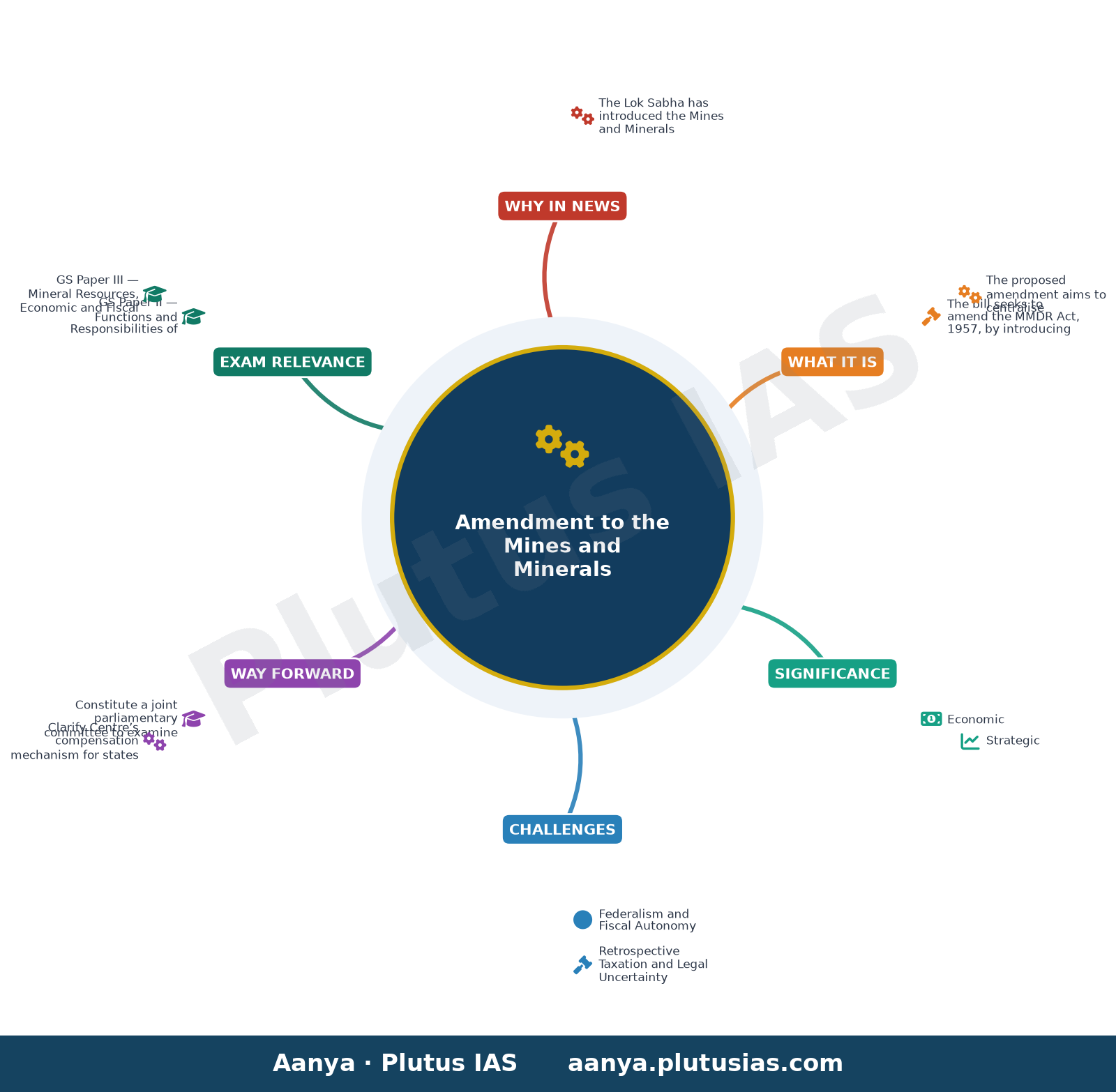
- GS Paper II — Functions and Responsibilities of the Union and the States, Federalism | GS Paper III — Mineral Resources, Economic and Fiscal Policy
- Prelims: MMDR Act, 1957, Article 246 (Union, State, and Concurrent Lists), Mineral royalties, Fiscal federalism, Supreme Court judgment on mineral taxation (2024), Parliamentary procedure for amendment of central laws
- Essay: Federalism in India: Balancing Centre-State Relations, Resource nationalism and economic governance in mineral-rich states
Quick Revision: The Mines and Minerals (Development and Regulation) Amendment Bill, 2026, proposes to prohibit state taxes on mineral rights to centralise mineral governance and address fiscal unpredictability, following a 2024 Supreme Court ruling on state taxation powers.
Why is this in the news?
The Lok Sabha has introduced the Mines and Minerals (Development and Regulation) Amendment Bill, 2026, which seeks to prohibit state governments from imposing taxes, cesses, or levies on mineral rights and mineral-bearing lands. This legislative move follows a July 2024 Supreme Court judgment affirming state powers to tax mineral rights independently of royalties under the MMDR Act, 1957. The bill aims to centralise regulatory control over mineral resources while addressing concerns of retrospective taxation and fiscal unpredictability in the sector.
Background
- The Mines and Minerals (Development and Regulation) Act, 1957 (MMDR Act) governs the regulation and development of mineral resources in India, with royalties as the primary fiscal instrument for mineral extraction.
- In July 2024, the Supreme Court upheld the constitutional validity of state taxes on mineral rights and mineral-bearing lands, distinct from royalties under the MMDR Act, thereby affirming the fiscal federalism framework.
- The judgment permitted states to recover past dues from April 1, 2005, subject to certain conditions, leading to significant financial implications for both public and private sector entities in the mining industry.
- Mineral-rich states such as Jharkhand, Odisha, Chhattisgarh, and Rajasthan have historically relied on mineral revenues to fund local development, making fiscal autonomy in this sector a critical issue.
- The amendment bill is introduced amid broader debates on resource nationalism, ease of doing business, and the balance between central regulatory oversight and state fiscal powers.
What is the Mines and Minerals (Development and Regulation) Amendment Bill, 2026?
- The bill seeks to amend the MMDR Act, 1957, by introducing a new provision that explicitly prohibits state governments from imposing any taxes, cesses, or levies on mineral rights or mineral-bearing lands.
- The proposed amendment aims to centralise regulatory control over mineral resources, expanding the Centre’s command over mines and mineral-bearing lands for the ‘sustainable and uniform development of minerals’.
- The bill addresses concerns raised by the mining industry regarding retrospective taxation, which has been a contentious issue since the Supreme Court’s 2024 judgment.
- By barring state taxes on mineral rights, the bill seeks to create a predictable and stable fiscal environment for investors in the mining sector, potentially enhancing ease of doing business.
- The amendment also reflects a broader policy shift towards greater centralisation of resource governance, aligning with the Centre’s objective of ensuring uniform mineral development policies across states.
- The bill has sparked debates on federalism, with opposition parties arguing that it undermines the fiscal autonomy of states and may lead to unintended economic consequences for mineral-rich regions.
- The proposed changes are part of a broader trend of legislative amendments aimed at streamlining mineral governance, including recent reforms in auction mechanisms and royalty structures under the MMDR Act.
Key Features
| Feature | Significance |
|---|---|
| Prohibition of state taxes on mineral rights | Ensures uniform fiscal regime for mineral-bearing lands, aligning with Centre’s regulatory authority under MMDR Act. |
| Expansion of Centre’s regulatory command | Broadens Union oversight to mineral-bearing lands, beyond existing provisions for mines. |
| Retrospective application of Supreme Court ruling | States may recover past dues from April 1, 2005, subject to court’s 2024 verdict. |
| Exclusion of penalties and additional interest | Provides partial relief to mining entities from retrospective levies. |
| Federalism implications | Raises questions on balance between Union authority and state fiscal autonomy. |
Why it Matters
Economic
- Enhances predictability for investors by removing state-level tax variability on mineral rights.
- Potential reduction in litigation costs for mining companies due to clarified fiscal obligations.
- May influence royalty structures under the MMDR Act, affecting revenue sharing between Centre and states.
Strategic
- Strengthens Centre’s control over mineral resources, critical for sectors like defence, energy and infrastructure.
- Supports uniform national policy for mineral development, reducing inter-state disparities.
- Aligns with India’s critical mineral mission to secure supply chains for green and high-tech industries.
Legal
- Reinterprets the constitutional division of fiscal powers between Union and states under Article 246.
- Clarifies the distinction between royalty (non-tax) and tax on mineral rights, as per Supreme Court’s 2024 ruling.
- Sets a precedent for Centre-state fiscal disputes in resource-rich sectors.
Industry
- Reduces compliance burden for mining firms operating across multiple states.
- May lower cost of capital for mineral exploration and extraction projects.
- Encourages formalisation of the mining sector by reducing tax arbitrage.
Challenges
1. Federalism and Fiscal Autonomy
- States may perceive erosion of fiscal powers, leading to constitutional challenges.
- Risk of inter-state disputes over revenue sharing and regulatory jurisdiction.
- Potential for political backlash in mineral-rich states with high reliance on mineral revenues.
UPSC Link: GS2: Centre-State Relations
2. Retrospective Taxation and Legal Uncertainty
- Mining companies face uncertainty due to retrospective application of levies from 2005.
- Litigation risk persists despite partial relief from penalties and interest.
- Delays in judicial resolution may deter investment in the sector.
UPSC Link: GS3: Judicial Review & Policy Stability
3. Investor Confidence and Sectoral Growth
- Inconsistent fiscal regimes across states may deter long-term investments.
- Uncertainty over tax regimes could delay project clearances and environmental approvals.
- Competitive federalism may suffer if states perceive Centre’s actions as encroaching on their rights.
UPSC Link: GS3: Investment Climate
4. Revenue Implications for States
- Mineral-rich states like Odisha, Jharkhand, and Chhattisgarh may face revenue shortfalls.
- Centre’s compensation mechanism for states remains unspecified in the bill.
- Potential for Centre-state fiscal imbalances in resource allocation.
UPSC Link: GS2: Fiscal Federalism
5. Regulatory Overreach and Implementation
- Expansion of Centre’s regulatory command may lead to bureaucratic delays.
- Risk of overlapping jurisdictions between Union and state authorities.
- Need for robust grievance redressal mechanisms to address industry concerns.
UPSC Link: GS2: Governance & Accountability
Challenges — UPSC Perspective
| Issue | Concern |
|---|---|
| Federalism | Erosion of state fiscal autonomy and potential constitutional conflicts. |
| Retrospective taxation | Legal uncertainty and litigation risks for mining companies. |
| Investor confidence | Inconsistent fiscal regimes may deter long-term capital inflows. |
| State revenue | Mineral-rich states may face fiscal gaps without clear compensation. |
| Regulatory overlap | Risk of duplication in Centre-state regulatory functions. |
| Sectoral growth | Uncertainty may delay critical mineral projects and infrastructure. |
Way Forward
- Constitute a joint parliamentary committee to examine fiscal federalism implications and recommend safeguards for state interests.
- Clarify Centre’s compensation mechanism for states affected by loss of mineral tax revenues.
- Establish a national mineral policy framework to guide Centre-state coordination and reduce regulatory conflicts.
- Strengthen grievance redressal mechanisms for mining companies facing retrospective tax disputes.
- Conduct a comprehensive review of the MMDR Act to align it with the Supreme Court’s 2024 ruling and the proposed amendments.
- Enhance transparency in royalty calculations and revenue sharing to build investor trust.
- Promote inter-state coordination through the Inter-State Council to resolve fiscal and regulatory disputes.
- Initiate capacity-building programs for state officials to ensure smooth implementation of the amended provisions.
UPSC Value Addition
Keywords for Mains Answer-Writing
Mines and Minerals (Development and Regulation) Act, 1957 · Mineral taxation powers of states · Supreme Court judgment on mineral rights taxation (July 2024) · Federalism and fiscal federalism in India · MMDR Amendment Bill, 2026 · Royalty vs. tax on mineral rights · Mineral-bearing lands and regulatory powers · Retrospective taxation in mining sector · Centre-state relations in natural resource governance · Sustainable mineral development policy
Constitutional & Policy Linkages
- {‘Article 246’: ‘Division of legislative powers between Union and states.’}
- {‘Article 282’: ‘Grants-in-aid to states for revenue loss.’}
- {‘Seventh Schedule’: ‘Union vs State List on taxation and mineral development.’}
Concept Flow
Supreme Court 2024 ruling upholds state power to tax mineral rights → Centre introduces MMDR Amendment Bill 2026 to prohibit such taxes → States raise federalism concerns → Industry seeks legal clarity on retrospective levies → Centre proposes uniform fiscal regime → States demand compensation and safeguards → Parliamentary review and judicial scrutiny follow → Potential constitutional amendments or policy refinements emerge.
Prelims Practice Questions
Q1. Consider the following statements regarding the Mines and Minerals (Development and Regulation) Act, 1957:
1. The Act empowers the Centre to levy taxes on mineral-bearing lands.
2. Royalty payable under the Act is treated as a tax by the Supreme Court.
3. The Act does not limit the legislative power of states to tax mineral rights.
How many of the above statements are correct?
- Only one
- Only two
- All three
- None
Answer: Only two — Statement 1 is incorrect as the Act does not empower the Centre to levy taxes on mineral-bearing lands; it regulates mineral development. Statement 2 is incorrect as the Supreme Court held that royalty is not a tax. Statement 3 is correct as the Act does not limit state powers to tax mineral rights.
Q2. Assertion (A): The Supreme Court in its July 2024 judgment upheld the power of states to levy taxes on mineral rights and mineral-bearing lands.
Reason (R): The Mines and Minerals (Development and Regulation) Act, 1957 explicitly prohibits states from imposing such taxes.
- Both A and R are true, and R is the correct explanation of A
- Both A and R are true, but R is not the correct explanation of A
- A is true, but R is false
- A is false, but R is true
Answer: A is true, but R is false — The Supreme Court upheld state powers to levy taxes on mineral rights (A is true). However, the MMDR Act, 1957 does not explicitly prohibit such taxes; rather, it does not limit state legislative powers (R is false).
Q3. Match the following pairs related to mineral taxation and governance:
Column I
1. Royalty under MMDR Act, 1957
2. Tax on mineral rights
3. Mineral-bearing lands
4. Centre’s regulatory command over mines
Column II
A. State legislative power
B. Not a tax (Supreme Court, 2024)
C. Expands to mineral-bearing lands (MMDR Amendment Bill, 2026)
D. Regulated under the Act
- 1-B, 2-A, 3-D, 4-C
- 1-D, 2-A, 3-C, 4-B
- 1-D, 2-B, 3-A, 4-C
- 1-B, 2-D, 3-A, 4-C
Answer: 1-B, 2-A, 3-D, 4-C — Royalty under MMDR Act is not a tax (1-B). Tax on mineral rights is a state legislative power (2-A). Mineral-bearing lands are expanded under the MMDR Amendment Bill (3-C). Centre’s regulatory command over mines is explicitly stated in the Amendment Bill (4-C).
Mains Practice Question
✍ The Supreme Court’s July 2024 judgment affirming state powers to tax mineral rights has necessitated legislative intervention through the Mines and Minerals (Development and Regulation) Amendment Bill, 2026. Critically analyse the constitutional and federal implications of this legislative response. Also, examine the balance between sustainable mineral development and fiscal federalism in this context. (15 Marks)
Approach: MODEL-ANSWER SKELETON:
1. **Constitutional Framework**:
– Article 246 and Seventh Schedule: Distribution of legislative powers between Centre and states.
– Entry 54 (Union List) and Entry 23 (State List) vis-à-vis mineral taxation.
– Federalism as a basic structure (Kesavananda Bharati, 1973).
2. **Supreme Court Judgment (July 2024)**:
– Key findings: Royalty ≠ tax; MMDR Act does not limit state taxation powers.
– Implications for mineral-rich states (e.g., Jharkhand, Odisha, Chhattisgarh).
– Retrospective taxation and its fiscal impact (₹1.5–2 lakh crore estimated burden).
3. **MMDR Amendment Bill, 2026**:
– Provisions: Bar on state taxes/cesses on mineral rights and mineral-bearing lands.
– Expansion of Centre’s regulatory command over mines and mineral-bearing lands.
– Objectives: Sustainable and uniform mineral development; avoiding unpredictable taxation.
4. **Federalism vs. Centre’s Regulatory Command**:
– Tension between Centre’s uniform development mandate and state fiscal autonomy.
– Federalism principles: Cooperative vs. competitive federalism.
– Judicial precedents on Centre-state relations (e.g., State of West Bengal v. Union of India, 1962).
5. **Sustainable Mineral Development**:
– Need for balanced policy: Economic viability vs. environmental and social sustainability.
– Role of National Mineral Policy, 2019 and Sustainable Development Goals.
– Centre’s justification: Avoiding commercial unviability due to excessive taxation.
6. **Balancing Views**:
– States’ argument: Fiscal autonomy and revenue generation for local development.
– Centre/Industry argument: Predictability and competitiveness in mineral sector.
– Possible middle ground: Revenue-sharing mechanisms or capped state levies.
7. **Conclusion**:
– Need for collaborative federalism to reconcile competing interests.
– Role of inter-state coordination councils (e.g., Inter-State Council).
– Future judicial scrutiny on the Amendment Bill’s constitutional validity.
Source: Hindustan Times
Generated by AanyaAi for educational purpose.


No Comments