


11 Aug Kerala Launches Child Rights Courses: UPSC & PCS Exam Guide
✎ The Kerala State Commission for Protection of Child Rights (KSCPCR) is launching certificate and diploma courses in collaboration with Sree Narayana Guru Open University to build capacity on child rights, covering key…
Subject Relevance — Where This Topic Fits
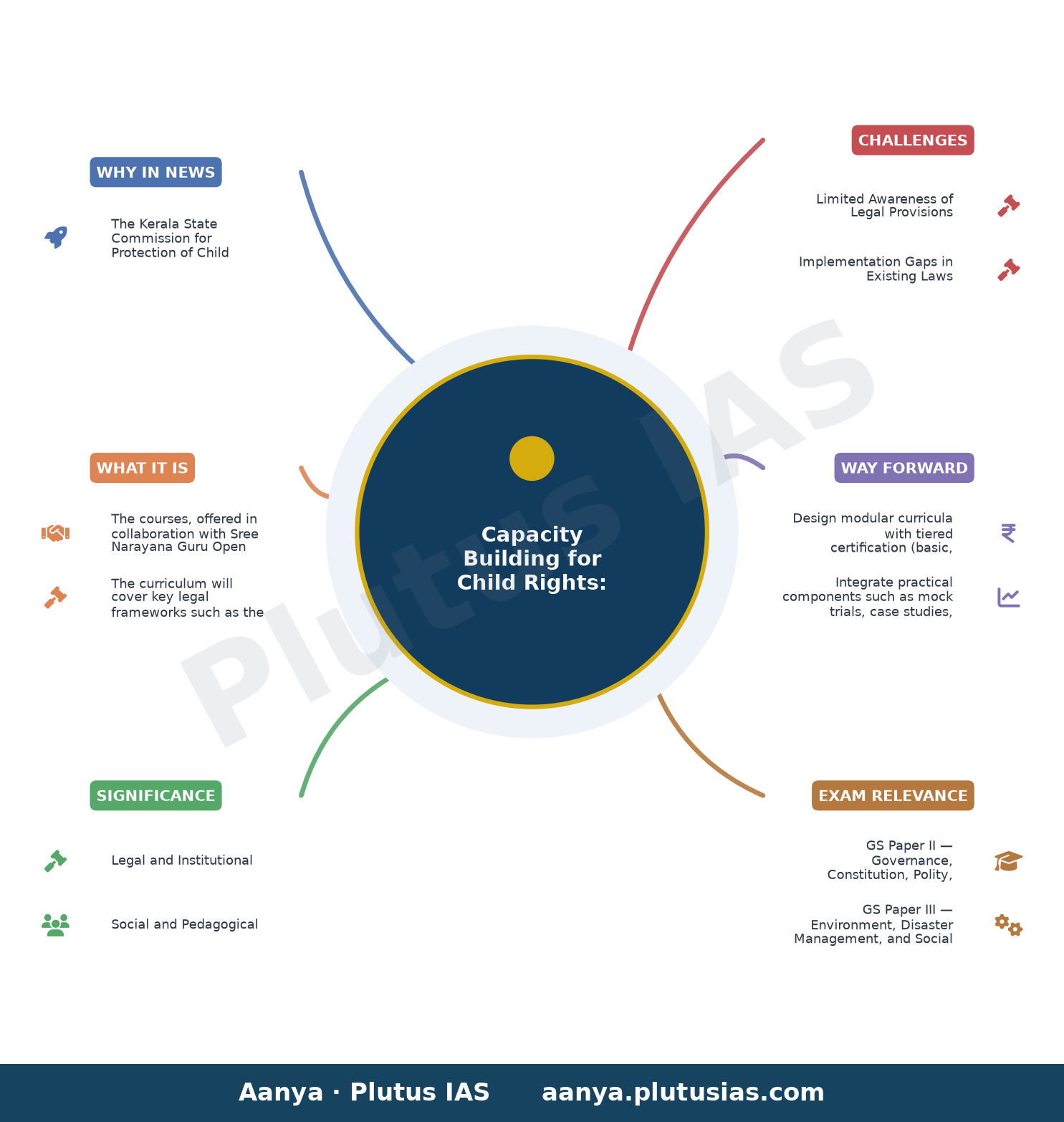
- GS Paper II — Governance, Constitution, Polity, Social Justice and International Relations (Child Rights as part of Fundamental Rights and Directive Principles) | GS Paper III — Environment, Disaster Management, and Social Development (Protection of Vulnerable Groups)
- Prelims: Child Rights Commission, Juvenile Justice Act, 2015, Protection of Children from Sexual Offences (POCSO) Act, 2012, Right to Education (RTE) Act, 2009, Prohibition of Child Marriage Act, 2006, Prohibition of Child Labour Act, 1986, Kerala State Commission for Protection of Child Rights (KSCPCR)
- Essay: The Role of Education in Safeguarding Fundamental Rights, Institutional Mechanisms for Social Justice: Challenges and Opportunities
Quick Revision: The Kerala State Commission for Protection of Child Rights (KSCPCR) is launching certificate and diploma courses in collaboration with Sree Narayana Guru Open University to build capacity on child rights, covering key legislations such as the Juvenile Justice Act, POCSO Act, and Right to Education Act.
Why is this in the news?
The Kerala State Commission for Protection of Child Rights (KSCPCR), in collaboration with Sree Narayana Guru Open University, is set to launch certificate and diploma courses on child rights and protection laws. This initiative is aimed at enhancing the understanding of child rights among the general public, educators, students, and officials, particularly in response to rising concerns over violence, exploitation, neglect, and cyber threats against children.
Background
- The Constitution of India guarantees fundamental rights to children under Articles 15(3), 21, 21A, 24, 39(e), 39(f), and 45, which mandate the state to ensure protection, development, and participation rights for children.
- The Juvenile Justice (Care and Protection of Children) Act, 2015, provides a legal framework for the protection, treatment, and rehabilitation of children in conflict with the law and children in need of care and protection.
- The Protection of Children from Sexual Offences (POCSO) Act, 2012, was enacted to address sexual offences against children and mandates stringent punishments for perpetrators.
- The Right to Education (RTE) Act, 2009, ensures free and compulsory education for children aged 6 to 14 years and emphasizes inclusive and equitable learning environments.
- State Commissions for Protection of Child Rights (SCPCRs) are statutory bodies established under the Commissions for Protection of Child Rights Act, 2005, to monitor the implementation of child rights and address violations.
- Kerala has been a pioneer in child welfare initiatives, including high literacy rates, robust child protection mechanisms, and proactive policy interventions.
What are the Kerala State Commission for Protection of Child Rights (KSCPCR) Courses on Child Rights?
- The courses, offered in collaboration with Sree Narayana Guru Open University, will include certificate and diploma programmes focused on child rights, constitutional protections, and relevant legislation.
- The curriculum will cover key legal frameworks such as the Juvenile Justice Act, 2015; POCSO Act, 2012; Prohibition of Child Marriage Act, 2006; Prohibition of Child Labour Act, 1986; and the Right to Education Act, 2009.
- The courses aim to provide both practical and academic knowledge, equipping participants with the skills to identify, report, and address child rights violations.
- Target beneficiaries include the general public, teachers, students, and government officials, fostering a multi-stakeholder approach to child protection.
- The initiative aligns with the global Sustainable Development Goal (SDG) 16.2, which calls for the end of abuse, exploitation, trafficking, and all forms of violence against and torture of children.
- The courses will incorporate case studies, legal provisions, and institutional mechanisms to ensure a comprehensive understanding of child rights and protection systems.
- The memorandum of understanding (MoU) between KSCPCR and the university formalizes the partnership and sets the stage for long-term capacity-building efforts.
- This programme is expected to enhance the effectiveness of child protection systems in Kerala by creating a cadre of informed stakeholders capable of advocating for and safeguarding child rights.
Key Features
| Feature | Significance |
|---|---|
| Certificate and Diploma Courses on Child Rights | Formalises capacity-building in child rights frameworks, aligning with constitutional obligations under Article 39(f) and the Right to Education Act. |
| Joint Initiative by KSCPCR and SNUOU | Leverages academic rigour of Sree Narayana Guru Open University with the statutory mandate of the Kerala State Commission for Protection of Child Rights. |
| Coverage of Legal Frameworks | Integrates key legislation such as the POCSO Act, Juvenile Justice Act, and Prohibition of Child Labour Act, ensuring practical applicability for stakeholders. |
| Target Audience: General Public, Teachers, Students, and Officials | Expands outreach beyond traditional legal circles, fostering grassroots awareness of child protection mechanisms. |
| Focus on Emerging Threats | Addresses contemporary challenges like cyber threats, exploitation, and neglect, reflecting evolving societal risks to child safety. |
Why it Matters
Legal and Institutional
- Strengthens implementation of child protection laws by enhancing institutional capacity at the state level through structured training programmes.
- Promotes multi-stakeholder collaboration between statutory bodies (KSCPCR) and academic institutions (SNUOU), ensuring evidence-based policy execution.
- Facilitates compliance with constitutional directives (Article 39(f)) and international obligations (UN Convention on the Rights of the Child) through formal education pathways.
Social and Pedagogical
- Empowers educators and parents with legal literacy, enabling early identification and intervention in cases of child rights violations.
- Encourages a rights-based approach in educational institutions, aligning with the Right to Education Act’s emphasis on child-centric governance.
- Reduces systemic gaps in child protection by standardising knowledge dissemination across diverse professional groups.
Policy and Governance
- Demonstrates state-led innovation in child protection, serving as a replicable model for other Indian states under the Integrated Child Protection Scheme (ICPS).
- Enhances inter-departmental coordination by training officials in child rights frameworks, improving service delivery under the Juvenile Justice Act.
Challenges
1. Limited Awareness of Legal Provisions
- General public and even officials often lack familiarity with child protection laws, leading to underreporting of violations.
- Upscaling requires sustained awareness campaigns to bridge knowledge gaps, particularly in rural and marginalised communities.
UPSC Link: GS II: Social Justice
2. Implementation Gaps in Existing Laws
- Despite robust legal frameworks (POCSO, JJ Act), enforcement remains inconsistent due to resource constraints and bureaucratic delays.
- Training programmes must address systemic bottlenecks in investigation, prosecution, and rehabilitation under the ICPS.
UPSC Link: GS II: Governance
3. Cyber Threats and Digital Vulnerabilities
- Rapid digitisation exposes children to online exploitation, grooming, and cyberbullying, outpacing traditional safeguards.
- Courses must incorporate modules on digital literacy, safe internet practices, and reporting mechanisms under the IT Act.
UPSC Link: GS III: Security
4. Intersectional Marginalisation
- Children from Scheduled Castes, Scheduled Tribes, and migrant families face compounded risks of exploitation and neglect.
- Training content should integrate intersectional perspectives to address structural vulnerabilities.
UPSC Link: GS II: Social Justice
5. Resource Allocation and Scalability
- Expanding such courses nationwide requires funding, faculty training, and infrastructure, especially in low-resource states.
- Public-private partnerships and CSR initiatives could supplement government efforts.
UPSC Link: GS II: Governance
Challenges — UPSC Perspective
| Issue | Concern |
|---|---|
| Underreporting of Child Rights Violations | Lack of awareness among victims and stakeholders delays intervention and justice. |
| Inadequate Training for Frontline Workers | Police, teachers, and healthcare workers often lack specialised knowledge of child protection protocols. |
| Digital Divide in Access to Training | Rural and tribal communities may face barriers in accessing online or hybrid course formats. |
| Legal Pluralism and Overlapping Jurisdictions | Conflicts between state laws, central laws, and customary practices can create confusion in enforcement. |
| Monitoring and Evaluation of Training Impact | Absence of standardised metrics to assess the effectiveness of capacity-building programmes. |
Way Forward
- Design modular curricula with tiered certification (basic, intermediate, advanced) to cater to diverse stakeholders.
- Integrate practical components such as mock trials, case studies, and field visits to strengthen experiential learning.
- Establish a state-level digital platform for continuous learning, including webinars, FAQs, and grievance redressal mechanisms.
- Collaborate with NGOs and child rights organisations to pilot the courses in high-risk districts for real-world feedback.
- Develop a monitoring framework with quantifiable indicators (e.g., number of trained officials, reduction in reported violations) to evaluate impact.
- Leverage the National Commission for Protection of Child Rights (NCPCR) to replicate the model across states under the ICPS.
- Incorporate feedback from trained participants into periodic curriculum revisions to ensure relevance and rigour.
- Promote the courses through state education departments to embed child rights education in school and college curricula.
UPSC Value Addition
Keywords for Mains Answer-Writing
Child Rights Protection · Juvenile Justice Act 2015 · Protection of Children from Sexual Offences (POCSO) Act 2012 · Right to Education (RTE) Act 2009 · Child Labour (Prohibition and Regulation) Act 1986 · Prohibition of Child Marriage Act 2006 · State Child Rights Commissions · Child Protection Systems · Sree Narayana Guru Open University · Kerala State Commission for Protection of Child Rights (KSCPCR) · Cyber threats against children · Multi-stakeholder capacity building in child rights · Constitutional provisions for child rights (Article 21A, Article 39(f))
Constitutional & Policy Linkages
- Article 39(f) — Directive Principles of State Policy (childhood protection and education)
- Article 21A — Right to Education (compulsory and free education for children aged 6–14)
- Article 24 — Prohibition of child labour
Concept Flow
Rising incidents of child rights violations → Statutory recognition of gaps in enforcement → Kerala State Commission for Protection of Child Rights (KSCPCR) initiates capacity-building → Collaboration with Sree Narayana Guru Open University (SNUOU) → Design of certificate/diploma courses → Targeted outreach to stakeholders → Practical and academic training on legal frameworks → Enhanced awareness and institutional capacity → Improved reporting and enforcement of child protection laws → Long-term reduction in violations and systemic strengthening of child rights governance.
Prelims Practice Questions
Q1. Consider the following statements regarding the Protection of Children from Sexual Offences (POCSO) Act, 2012:
1. The Act defines a child as any person below the age of 18 years.
2. It mandates the establishment of Special Courts for the trial of offences under the Act.
3. The Act does not provide for the protection of child witnesses.
4. The Act includes provisions for the rehabilitation and social reintegration of child victims.
How many of the above statements are correct?
- Only one
- Only two
- Only three
- All four
Answer: Only three — Statements 1, 2, and 4 are correct as per the POCSO Act, 2012. Statement 3 is incorrect because the Act explicitly provides for the protection of child witnesses under Section 39.
Q2. Assertion (A): The Right to Education (RTE) Act, 2009 guarantees free and compulsory education to all children aged 6 to 14 years.
Reason (R): The RTE Act is a fundamental right enshrined under Article 21A of the Constitution of India.
Options:
A. Both A and R are true, and R is the correct explanation of A.
B. Both A and R are true, but R is not the correct explanation of A.
C. A is true, but R is false.
D. A is false, but R is true.
Answer: ? — Both Assertion (A) and Reason (R) are correct. The RTE Act, 2009 guarantees free and compulsory education to children aged 6 to 14 years, and this right is enshrined as a fundamental right under Article 21A of the Constitution.
Q3. Match the following Acts with their primary objectives:
Column I (Act) | Column II (Objective)
—————————————-|—————————————-
1. Juvenile Justice (Care and Protection) Act, 2015 | A. Prohibition of child labour in hazardous occupations
2. Child Labour (Prohibition and Regulation) Act, 1986 | B. Protection and rehabilitation of children in conflict with law
3. Prohibition of Child Marriage Act, 2006 | C. Ensuring free and compulsory education for children aged 6-14 years
4. Right to Education (RTE) Act, 2009 | D. Prohibition of child marriage and providing punishment for offenders
Options:
A. 1-B, 2-A, 3-D, 4-C
B. 1-A, 2-B, 3-C, 4-D
C. 1-D, 2-C, 3-B, 4-A
D. 1-C, 2-D, 3-A, 4-B
Answer: ? — The correct match is: 1-B (Juvenile Justice Act focuses on protection and rehabilitation of children in conflict with law), 2-A (Child Labour Act prohibits child labour in hazardous occupations), 3-D (Prohibition of Child Marriage Act aims to prohibit child marriage), 4-C (RTE Act ensures free and compulsory education).
Mains Practice Question
✍ Critically examine the institutional mechanisms for child rights protection in India, with particular reference to the role of State Child Rights Commissions. How effective have these commissions been in addressing contemporary challenges such as cyber threats, child labour, and child marriage? (15 Marks)
Approach: MODEL-ANSWER SKELETON:
1. **Constitutional and Legal Framework**:
– Article 39(f) of the Constitution: Directive Principle for child development and protection.
– Article 21A: Fundamental Right to free and compulsory education (RTE Act, 2009).
– Juvenile Justice (Care and Protection) Act, 2015: Framework for child protection and rehabilitation.
– POCSO Act, 2012: Special provisions for sexual offences against children.
– Prohibition of Child Marriage Act, 2006 and Child Labour (Prohibition and Regulation) Act, 1986: Legal prohibitions.
2. **Institutional Mechanisms**:
– **National Commission for Protection of Child Rights (NCPCR)**: Statutory body under the Commissions for Protection of Child Rights Act, 2005; monitors implementation of child rights and examines complaints.
– **State Child Rights Commissions (SCRCs)**: Established under the same Act; state-level bodies with powers to inquire into complaints and recommend measures for child protection.
– **Juvenile Justice Boards and Child Welfare Committees**: Operational arms for implementation at district level.
– **Role of SCRC in Kerala**: Joint initiative with Sree Narayana Guru Open University to launch certificate and diploma courses on child rights; highlights capacity-building and awareness generation.
3. **Contemporary Challenges and Institutional Responses**:
– **Cyber Threats**: Increasing incidents of online exploitation, grooming, and cyberbullying; SCRC can collaborate with cyber cells, schools, and NGOs for awareness and reporting mechanisms.
– **Child Labour**: Persistence in hazardous sectors despite legal prohibitions; SCRC can conduct surveys, recommend policy changes, and monitor enforcement.
– **Child Marriage**: Social and cultural practices persist; SCRC can work with local authorities, conduct awareness campaigns, and support legal interventions.
4. **Effectiveness and Limitations**:
– **Strengths**: SCRC can conduct inquiries, recommend measures, and create awareness; Kerala’s initiative demonstrates proactive institutional engagement.
– **Challenges**: Limited resources, lack of awareness among stakeholders, slow judicial processes, and coordination gaps between institutions.
– **Way Forward**: Strengthening SCRC with adequate funding and staffing, enhancing inter-institutional coordination, leveraging technology for monitoring, and promoting community participation.
5. **Conclusion**:
– SCRC plays a crucial role in child rights protection but requires systemic support to address emerging challenges effectively. Capacity-building initiatives like those in Kerala are steps toward strengthening the ecosystem.
Source: The Indian Express
Generated by AanyaAi for educational purpose.

- KWML’s Feasibility Reports for Water Metro in 18 Cities: UPSC & PCS Insights - October 3, 2026
- ओडिशा में वन्यजीव अनुसंधान अनुदान कार्यक्रम शुरू, सिमिलिपाल में 300 कैमरे और बढ़ेंगे - October 3, 2026
- India Summons Pakistan High Commission Official Over Violation - October 3, 2026

No Comments