


11 Aug DDU-GKY 2.0: Skill Training & Employment for Rural Youth in UPSC 2026
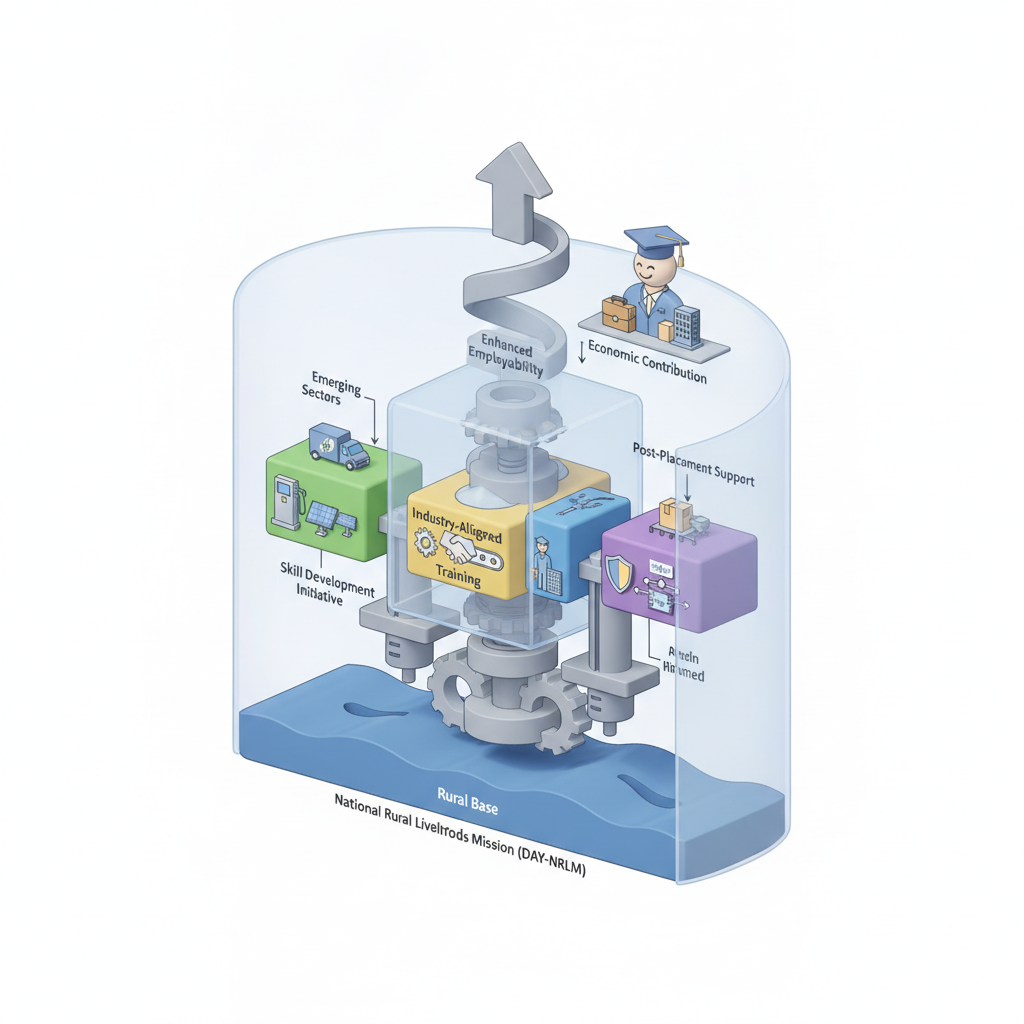
Rural youthVocational trainingIndustry alignmentPlacement supportEmerging sectors✎ DDU-GKY is a placement-linked skill development scheme under DAY-NRLM that trains rural youth in various sectors, ensuring 70% placement, and is implemented via State Rural Livelihood Missions with ₹750 crore allocated for FY…
Subject Relevance — Where This Topic Fits
- GS Paper II — Governance, Transparency and Accountability | GS Paper III — Employment, Skill Development and Human Resource Development
- Prelims: Deendayal Upadhyaya Grameen Kaushalya Yojana (DDU-GKY), Deendayal Antyodaya Yojana – National Rural Livelihoods Mission (DAY-NRLM), Sector Skill Councils, Placement-Linked Skill Training, Gig economy, Renewable energy skills, EV maintenance training, Rural employment guarantee
- Essay: Skill development as a catalyst for inclusive growth, The role of public-private partnerships in employment generation
Quick Revision: DDU-GKY is a placement-linked skill development scheme under DAY-NRLM that trains rural youth in various sectors, ensuring 70% placement, and is implemented via State Rural Livelihood Missions with ₹750 crore allocated for FY 2026-27.
Why is this in the news?
The Deendayal Upadhyaya Grameen Kaushalya Yojana (DDU-GKY) has been highlighted in a recent PIB release dated 11 August 2026, detailing its revised operational guidelines under DDU-GKY 2.0, budgetary allocations for FY 2026-27, and performance metrics up to the current fiscal year. The update underscores the scheme’s strategic pivot toward emerging sectors such as electric vehicle maintenance, renewable energy, and logistics, while reinforcing industry-led placement outcomes and post-placement support mechanisms.
Background
- DDU-GKY is a placement-linked skill development initiative launched under the Deendayal Antyodaya Yojana – National Rural Livelihoods Mission (DAY-NRLM), operational since 2014.
- The scheme is designed to address rural unemployment by enhancing employability through industry-aligned vocational training, thereby contributing to poverty alleviation and livelihood diversification.
- DDU-GKY 2.0, implemented from FY 2025-26, introduces revised guidelines to align with evolving industrial demands and emerging employment opportunities.
- The scheme operates within the constitutional framework of the Directive Principles of State Policy, particularly Article 41 (Right to Work) and Article 46 (Promotion of Educational and Economic Interests of Weaker Sections).
- DDU-GKY is a key component of the government’s broader strategy to achieve Sustainable Development Goal 8 (Decent Work and Economic Growth) and SDG 1 (No Poverty).
- DDU-GKY is implemented through State Rural Livelihood Missions (SRLMs) and Project Implementation Agencies (PIAs), with financial support from the Ministry of Rural Development.
What is the Deendayal Upadhyaya Grameen Kaushalya Yojana (DDU-GKY)?
- Objective: To provide placement-linked skill training to rural youth, with a focus on sustainable livelihoods and poverty reduction.
- Scope: Covers sectors including apparel, automotive, healthcare, IT-ITeS, logistics, renewable energy, and emerging domains such as electric vehicle maintenance and gig economy roles.
- Industry Alignment: Mandates collaboration with Sector Skill Councils (SSCs) and employers to design curricula, conduct assessments, and ensure job placements.
- Placement Framework: Emphasises minimum 70% placement outcomes (including maximum 20% self-employment or gig employment for a minimum of 6 months).
- Financial Architecture: Funded by the Ministry of Rural Development; budgetary allocations for FY 2026-27 include ₹750 crore for training 1.37 lakh beneficiaries and ₹361.96 crore released to states.
- Monitoring and Evaluation: Features include mandatory 6-month post-placement employment period, grievance redressal mechanisms, and alumni engagement for long-term career progression.
- State-Level Execution: Implemented through State Rural Livelihood Missions (e.g., Madhya Pradesh State Rural Livelihood Mission) with district-wise performance tracking.
Key Features
| Feature | Significance |
|---|---|
| Industry-driven training | Ensures alignment with evolving labour market demands and enhances employability in high-growth sectors such as EV maintenance, renewable energy, and healthcare. |
| Post-placement support (12 months) | Improves job sustainability by providing counselling, migration assistance, and upskilling opportunities to prevent early attrition. |
| State-wise employer targeting (20% allocation) | Strengthens local employment ecosystems by mandating partnerships with captive employers in each state/UT. |
| Mandatory 6-month employment period | Reduces short-term placements and ensures long-term career stability for trained candidates. |
| Sector Skill Councils (SSCs) integration | Facilitates standardised curriculum design and certification, bridging skill gaps with industry benchmarks. |
Why it Matters
Economic Empowerment
- Enhances rural livelihood diversification by equipping youth with market-relevant skills, reducing dependency on agriculture.
- Contributes to formalisation of the rural workforce through certified placements in organised sectors.
- Supports India’s demographic dividend by addressing the skill deficit in emerging sectors like logistics and green energy.
Governance & Institutional Framework
- Operationalises the National Rural Livelihood Mission (DAY-NRLM) by integrating skill development with livelihood promotion.
- Demonstrates a results-oriented approach through mandatory post-placement monitoring and employer partnerships.
- Leverages decentralised implementation via State Rural Livelihood Missions (e.g., MPSRLM in Madhya Pradesh).
Social Inclusion
- Targets marginalised rural youth, including women and SC/ST communities, through inclusive training programmes.
- Promotes gender parity in non-traditional sectors (e.g., automotive, IT) via sector-specific skilling initiatives.
- Facilitates upward mobility through career progression pathways in organised employment.
Policy Alignment
- Supports the National Skill Development Mission (NSDM) and Sustainable Development Goals (SDG 8: Decent Work and Economic Growth).
- Complements initiatives like the Skill India Mission by focusing on rural-centric skill ecosystems.
- Advances the ‘Vocal for Local’ agenda by fostering indigenous skill development in high-demand sectors.
Challenges
1. Quality of Training Infrastructure
- Variation in training quality across states due to disparities in institutional capacity and trainer expertise.
- Risk of mismatch between training curricula and industry requirements, particularly in rapidly evolving sectors.
UPSC Link: GS-III: Skill Development
2. Placement Sustainability
- High attrition rates in certain sectors (e.g., hospitality) due to wage disparities or lack of career growth.
- Inadequate post-placement support in remote areas, leading to early exits from formal employment.
UPSC Link: GS-III: Employment
3. Monitoring & Evaluation
- Challenges in real-time tracking of candidates post-placement, especially in gig economy roles.
- Limited transparency in employer compliance with placement guarantees, necessitating stronger grievance redressal.
UPSC Link: GS-II: Governance
4. Geographical Disparities
- Concentration of placements in urban-adjacent districts, leaving remote rural areas underserved.
- Logistical barriers in accessing training centres for candidates in hilly or tribal regions.
UPSC Link: GS-I: Social Justice
5. Gender & Social Barriers
- Cultural constraints limiting female participation in non-traditional sectors (e.g., automotive, construction).
- Low awareness among SC/ST communities about skilling opportunities and benefits.
UPSC Link: GS-II: Welfare Schemes
Challenges — UPSC Perspective
| Issue | Concern |
|---|---|
| Curriculum-Industry Mismatch | Rapid technological changes outpace syllabus updates, reducing employability. |
| Employer Non-Compliance | Failure to honour placement commitments due to cost pressures or labour market shifts. |
| Data Fragmentation | Lack of integrated MIS across states hinders accurate impact assessment. |
| Fund Utilisation Delays | Bureaucratic bottlenecks in state-level disbursement of central funds (e.g., ₹50.89 crore spent out of ₹361.96 crore). |
| Skill Certification Gaps | Non-recognition of certain sector-specific certifications by employers outside the state. |
Government Initiatives — Must-Memorise for Prelims
- Deen Dayal Upadhyaya Grameen Kaushalya Yojana (DDU-GKY)
- Deendayal Antyodaya Yojana – National Rural Livelihoods Mission (DAY-NRLM)
- Skill India Mission
- National Skill Development Mission (NSDM)
Way Forward
- Strengthen State Skill Missions through public-private partnerships to enhance training infrastructure and faculty capacity.
- Expand post-placement support mechanisms, including digital mentorship platforms and mobile counselling units for remote areas.
- Mandate quarterly audits of placement records and employer compliance to ensure transparency and accountability.
- Integrate DDU-GKY with PMKVY and other skilling schemes to avoid duplication and leverage synergies.
- Promote apprenticeship models in collaboration with MSMEs to provide hands-on experience and reduce entry-level skill gaps.
- Establish sector-specific skill hubs in aspirational districts to address geographical disparities.
- Launch gender-sensitive outreach programmes to increase female participation in non-traditional sectors.
- Develop a centralised MIS platform for real-time tracking of candidates, placements, and outcomes.
UPSC Value Addition
Keywords for Mains Answer-Writing
Deen Dayal Upadhyaya Grameen Kaushalya Yojana (DDU-GKY) · National Rural Livelihood Mission (NRLM) · Skill India Mission · Rural youth employability · Industry-driven skilling · Placement-linked skill training · Sector Skill Councils · Gig economy and self-employment · Sustainable livelihoods · Rural transformation · Skill upgradation and reskilling · Placement-linked outcomes
Concept Flow
Identification of rural youth unemployment and skill gaps under DAY-NRLM. → Formulation of DDU-GKY as a demand-driven skilling initiative under the National Rural Livelihood Mission. → Design of industry-aligned training programmes with mandatory post-placement support. → Implementation via State Rural Livelihood Missions with centralised funding and monitoring. → Placement facilitation through employer partnerships and sector skill councils. → Post-placement monitoring to ensure long-term employment sustainability and career progression.
Prelims Practice Questions
Q1. Consider the following statements regarding the Deen Dayal Upadhyaya Grameen Kaushalya Yojana (DDU-GKY):
1. It is a component of the National Rural Livelihood Mission (NRLM).
2. It focuses exclusively on traditional agricultural skills for rural youth.
3. The scheme mandates a minimum 70% placement rate for trained candidates.
4. It provides post-placement support for a duration of one year.
How many of the above statements are correct?
- Only one
- Only two
- Only three
- All four
Answer: All four — Statements 1, 3, and 4 are correct. Statement 2 is incorrect as DDU-GKY prioritizes emerging sectors like electric vehicle maintenance, renewable energy, logistics, healthcare, and IT-ITES, alongside traditional sectors.
Q2. Assertion (A): The Deen Dayal Upadhyaya Grameen Kaushalya Yojana (DDU-GKY) 2.0 emphasizes industry-driven training and post-placement support.
Reason (R): The scheme aims to ensure sustainable livelihoods and long-term employment outcomes for rural youth.
Options:
A. Both A and R are true, and R is the correct explanation of A.
B. Both A and R are true, but R is not the correct explanation of A.
C. A is true, but R is false.
D. A is false, but R is true.
Answer: ? — Both Assertion (A) and Reason (R) are true, and R correctly explains A. DDU-GKY 2.0’s focus on industry-driven training and post-placement support is designed to achieve sustainable livelihoods and long-term employment outcomes.
Q3. Match the following sectors with their corresponding priority areas under the Deen Dayal Upadhyaya Grameen Kaushalya Yojana (DDU-GKY):
Column I (Sector) | Column II (Priority Area)
— | —
A. Electric Vehicle Maintenance | 1. Traditional Crafts
B. Renewable Energy | 2. Emerging Technologies
C. Apparel | 3. Green Energy
D. Agriculture | 4. Traditional Livelihood
Options:
A. A-2, B-3, C-1, D-4
B. A-1, B-2, C-3, D-4
C. A-2, B-1, C-3, D-4
D. A-3, B-2, C-1, D-4
Answer: ? — The correct match is: A (Electric Vehicle Maintenance) – 2 (Emerging Technologies), B (Renewable Energy) – 3 (Green Energy), C (Apparel) – 1 (Traditional Crafts), D (Agriculture) – 4 (Traditional Livelihood).
Mains Practice Question
✍ Critically examine the role of the Deen Dayal Upadhyaya Grameen Kaushalya Yojana (DDU-GKY) in addressing rural youth unemployment and promoting sustainable livelihoods. How far has the scheme succeeded in achieving its objectives of placement-linked outcomes and long-term employment stability? (15 Marks)
Approach: MODEL-ANSWER SKELETON:
1. **Introduction (2 Marks)**
– Brief background: DDU-GKY as a component of DAY-NRLM under the Skill India Mission.
– Objectives: Skill development, employability enhancement, and sustainable livelihoods for rural youth.
2. **Key Features and Institutional Framework (3 Marks)**
– Industry-driven training and Sector Skill Councils (SSCs) for curriculum design.
– Mandate of 70% placement rate and 6-month post-placement support.
– Financial allocation: ₹750 crore for FY 2026-27; ₹361.96 crore released to states.
– State-level implementation: Example of Madhya Pradesh (93,000 trained, 56,000 placed).
3. **Achievements and Data (3 Marks)**
– Cumulative data: 18.45 lakh trained, 12.35 lakh placed since inception.
– Emerging sectors prioritized: EV maintenance, renewable energy, healthcare, logistics.
– Post-placement support: 1-year monitoring, counseling, migration assistance.
4. **Challenges and Criticisms (4 Marks)**
– **Quality vs. Quantity**: Skewed focus on numbers over skill depth; need for continuous upskilling.
– **Sectoral Mismatch**: Limited alignment with local economic needs in some regions.
– **Placement Stability**: Gig economy and self-employment (up to 20%) may not guarantee long-term stability.
– **Monitoring Gaps**: Ensuring effective post-placement support and grievance redressal mechanisms.
5. **Comparative Analysis and Way Forward (3 Marks)**
– Comparison with other skilling schemes: PMKVY (focus on certification), NSDC (broader scope).
– Suggestions: Strengthen industry-academia linkages, enhance vocational training infrastructure, and integrate with rural entrepreneurship programs.
**Balanced Conclusion**: DDU-GKY has made significant strides in skilling rural youth and improving employability, but challenges in placement stability and sectoral alignment persist. The scheme’s success hinges on sustained post-placement support and adaptive industry partnerships.
Source: PIB (Press Information Bureau)
Generated by AanyaAi for educational purpose.

- Exercise Tarang Shakti 2026: India’s Mega Multi-Nation Air Power Showcase - September 27, 2026
- रबी अभियान 2026: राष्ट्रीय सम्मेलन में केंद्र-राज्य तालमेल पर होगा जोर - September 27, 2026
- Himachal CM Sukhu: All Doctor Vacancies to be Filled by March - September 27, 2026

No Comments