


11 Aug Premature Redemption of SGB 2018-19 Series VI: Key Details for UPSC Aspirants
✎ Premature redemption of SGBs is permitted after five years from the issue date, and the redemption price is calculated as the simple average of the closing price of 999 purity gold for the three business days preceding the…
Subject Relevance — Where This Topic Fits
- GS Paper III — Indian Economy and Issues Relating to Planning, Mobilisation of Resources, Growth, Development and Employment
- Prelims: Sovereign Gold Bond (SGB), premature redemption, IBJA, gold pricing, RBI press release, Series VI 2018-19, tranche, redemption price, 999 purity gold, India Bullion and Jewellers Association Ltd (IBJA)
- Essay: Role of gold in India’s financial system and sovereign debt instruments, Alternative investment avenues and their macroeconomic implications
Quick Revision: Premature redemption of SGBs is permitted after five years from the issue date, and the redemption price is calculated as the simple average of the closing price of 999 purity gold for the three business days preceding the redemption date, as published by IBJA.
Why is this in the news?
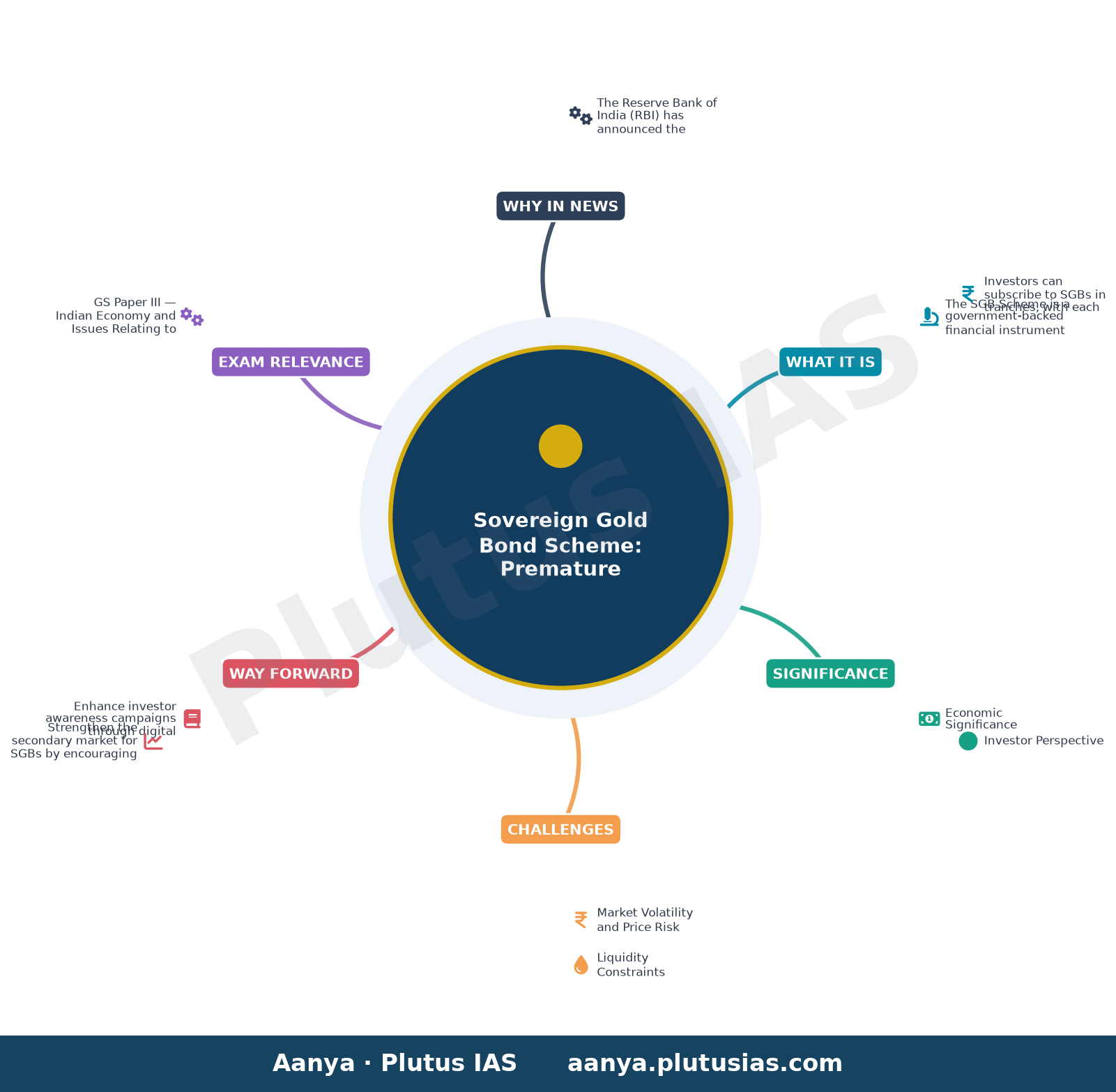
The Reserve Bank of India (RBI) has announced the redemption price for the premature redemption of the Sovereign Gold Bond (SGB) 2018-19 Series VI, scheduled for August 12, 2026. This development is significant for investors holding SGBs, as it outlines the procedural and financial aspects of early redemption, including the pricing mechanism based on the average gold price published by the India Bullion and Jewellers Association Ltd (IBJA).
Background
- The Sovereign Gold Bond (SGB) Scheme was launched by the Government of India in November 2015 to reduce the demand for physical gold and shift a portion of the gold held by households into financial savings.
- The scheme allows investors to buy gold in a dematerialised form, with the bonds denominated in grams of gold and issued by the Reserve Bank of India on behalf of the Government of India.
- Premature redemption of SGBs is permitted after the completion of five years from the date of issue, subject to specific conditions outlined in the Government of India notification.
- The redemption price is determined based on the simple average of the closing price of 999 purity gold for the three business days preceding the redemption date, as published by IBJA.
- The SGB 2018-19 Series VI was issued on February 12, 2019, with a maturity period of eight years, and premature redemption is now due on August 12, 2026, after the mandatory five-year lock-in period.
What is the Sovereign Gold Bond (SGB) Scheme?
- The SGB Scheme is a government-backed financial instrument introduced to mobilise gold held by households into productive investments.
- Investors can subscribe to SGBs in tranches, with each tranche representing a specific issue date and maturity period, typically eight years.
- The bonds are issued in denominations of grams of gold, with a minimum investment of one gram and a maximum limit of 4 kg for individuals and Hindu Undivided Families (HUFs).
- SGBs offer an annual fixed interest rate of 2.5% on the issue price, payable semi-annually, providing a nominal return in addition to capital appreciation.
- Premature redemption is permitted after five years from the date of issue, subject to the terms and conditions specified in the Government of India notification.
- The redemption price is calculated based on the simple average of the closing price of 999 purity gold for the three business days preceding the redemption date, as published by IBJA.
- SGBs are held in demat form, eliminating the risks associated with physical gold such as storage, theft, and purity concerns.
- The scheme is designed to provide a safer and more liquid alternative to physical gold, while also reducing the country’s reliance on gold imports.
Key Features
| Feature | Significance |
|---|---|
| Premature Redemption Eligibility | Permits redemption of SGB units after the fifth year from the date of issue, subject to the date of interest payment, ensuring liquidity for investors while maintaining long-term investment discipline. |
| Redemption Price Determination | Based on the simple average of the closing price of 999 purity gold over the three preceding business days, as published by IBJA, ensuring transparency and market-linked valuation. |
| Series-Specific Redemption | Applies to SGB 2018-19 Series VI, issued on February 12, 2019, with premature redemption due on August 12, 2026, highlighting the structured timeline of the scheme. |
| Government Notification Basis | Derived from GOI notification F.No.4(22)-B(W&M)/2018 dated October 08, 2018, which governs the operational framework of the Sovereign Gold Bond Scheme. |
| Investor Protection Mechanism | Provides a clear, predefined exit route for investors, reducing uncertainty and enhancing confidence in the scheme’s design. |
Why it Matters
Economic Significance
- Enhances liquidity in the gold market by allowing investors to redeem SGB units prematurely, thereby balancing long-term investment goals with short-term liquidity needs.
- Reduces the reliance on physical gold holdings, promoting financial inclusion and digital gold investments among retail investors.
- Supports the Government of India’s objective of reducing gold imports by channeling investment into sovereign-backed instruments.
Investor Perspective
- Provides an exit option after the fifth year, offering flexibility to investors who may require liquidity while still benefiting from the safety and sovereign guarantee of SGBs.
- The redemption price, linked to the market price of gold, ensures fair valuation and aligns investor returns with prevailing market conditions.
- Encourages long-term participation in gold-backed financial instruments, diversifying investment portfolios.
Monetary Policy and RBI Role
- Demonstrates the Reserve Bank of India’s role in administering the Sovereign Gold Bond Scheme, ensuring adherence to predefined operational guidelines.
- Highlights the RBI’s responsibility in determining redemption prices based on transparent and market-determined gold prices, reinforcing trust in the scheme.
Fiscal Policy Implications
- Aligns with the Government of India’s fiscal strategy to mobilize resources through gold-linked instruments, reducing the fiscal burden of gold imports.
- Contributes to the formalization of the gold market by promoting investment in regulated financial products.
Challenges
1. Market Volatility and Price Risk
- The redemption price is subject to fluctuations in the international and domestic gold prices, which may impact investor returns and the attractiveness of premature redemption.
- Investors face the risk of lower redemption prices if gold prices decline in the period leading up to the redemption date.
UPSC Link: GS-III: Indian Economy and Issues Relating to Planning, Mobilisation of Resources
2. Liquidity Constraints
- While premature redemption is permitted, the actual liquidity available may depend on market conditions and the willingness of secondary market participants to purchase SGB units.
- Investors may face delays or suboptimal pricing if they seek to sell SGB units in the secondary market instead of opting for premature redemption.
UPSC Link: GS-III: Indian Economy and Issues Relating to Planning, Mobilisation of Resources
3. Investor Awareness and Participation
- Limited awareness among retail investors about the premature redemption facility and its operational details may hinder optimal utilization of the scheme.
- Educational initiatives by the RBI and the Government are essential to ensure that investors are fully informed about their rights and options under the scheme.
UPSC Link: GS-II: Government Policies and Interventions for Development in various sectors
4. Operational and Administrative Challenges
- Ensuring seamless processing of premature redemption requests requires robust back-end infrastructure and coordination between the RBI, designated banks, and other intermediaries.
- Delays in the disbursement of redemption proceeds could erode investor confidence in the scheme.
UPSC Link: GS-III: Indian Economy and Issues Relating to Planning, Mobilisation of Resources
Challenges — UPSC Perspective
| Issue | Concern |
|---|---|
| Gold Price Volatility | Potential decline in redemption value due to fluctuations in gold prices before the redemption date. |
| Secondary Market Liquidity | Limited liquidity in the secondary market may force investors to redeem at suboptimal prices. |
| Investor Awareness Gaps | Lack of understanding about premature redemption terms and conditions among retail investors. |
| Operational Delays | Risk of delays in processing redemption requests, impacting investor experience. |
| Fiscal Impact of Redemptions | Large-scale premature redemptions may reduce the government’s ability to mobilize resources through SGBs. |
Government Initiatives — Must-Memorise for Prelims
- Sovereign Gold Bond (SGB) Scheme
Way Forward
- Enhance investor awareness campaigns through digital platforms, banks, and financial literacy programs to educate retail investors about the premature redemption facility and its benefits.
- Strengthen the secondary market for SGBs by encouraging participation from institutional investors and market makers to improve liquidity.
- Develop a robust grievance redressal mechanism to address operational delays and ensure timely disbursement of redemption proceeds.
- Conduct periodic reviews of the redemption price determination mechanism to ensure it remains aligned with market realities and investor expectations.
- Explore the introduction of flexible redemption options, such as partial redemption, to further enhance investor flexibility while maintaining the scheme’s integrity.
- Collaborate with the India Bullion and Jewellers Association Ltd (IBJA) to ensure transparent and timely publication of gold price data for redemption calculations.
- Assess the fiscal impact of premature redemptions on the government’s resource mobilization goals and adjust the scheme’s design if necessary to balance liquidity and fiscal objectives.
UPSC Value Addition
Keywords for Mains Answer-Writing
Sovereign Gold Bond Scheme · premature redemption · SGB 2018-19 Series VI · redemption price determination · India Bullion and Jewellers Association Ltd (IBJA) · financial instruments for retail investors · gold price benchmarking · capital market instruments · government securities · monetary policy instruments · retail participation in gold · financial inclusion through gold bonds
Concept Flow
Issue of SGB 2018-19 Series VI on February 12, 2019, under the Sovereign Gold Bond Scheme notified by GOI. → Eligibility for premature redemption after the fifth year from the date of issue, subject to interest payment dates. → Redemption price determination based on the simple average of gold prices over three preceding business days, as published by IBJA. → Publication of redemption price for premature redemption due on August 12, 2026, ensuring transparency and market linkage. → Investor decision to redeem prematurely or hold the bond until maturity, based on market conditions and liquidity needs. → Disbursement of redemption proceeds to investors, completing the premature redemption process. → Potential feedback loop to the RBI and GOI for evaluating the scheme’s design and operational efficiency.
Prelims Practice Questions
Q1. Consider the following statements regarding the Sovereign Gold Bond (SGB) Scheme:
1. Premature redemption is permitted after the fifth year from the date of issue.
2. The redemption price is determined by the average closing price of gold of 999 purity over the previous three business days as published by the India Bullion and Jewellers Association Ltd (IBJA).
3. The SGB Scheme allows for partial redemption of units.
How many of the above statements are correct?
- Only one
- Only two
- All three
- None
Answer: Only two — Statement 1 and 2 are correct as per the RBI notification and operational guidelines. Statement 3 is incorrect as the SGB Scheme does not permit partial redemption; only full redemption is allowed after the lock-in period.
Q2. Assertion (A): The Sovereign Gold Bond (SGB) Scheme is designed to provide an alternative to holding physical gold.
Reason (R): The redemption price of SGB is linked to the market price of gold, ensuring transparency and market-linked returns.
In the context of the above two statements, which one of the following is correct?
- Both A and R are true, and R is the correct explanation of A
- Both A and R are true, but R is not the correct explanation of A
- A is true, but R is false
- A is false, but R is true
Answer: Both A and R are true, and R is the correct explanation of A — Both the assertion and reason are correct. The SGB Scheme indeed provides an alternative to physical gold, and the redemption price is market-linked, ensuring transparency and fair returns to investors.
Q3. Match the following columns regarding the Sovereign Gold Bond (SGB) Scheme:
Column I Column II
A. Issuance Authority 1. State Bank of India
B. Redemption Price Determination 2. India Bullion and Jewellers Association Ltd (IBJA)
C. Lock-in Period 3. Five years
D. Eligibility for Investment 4. Resident Individuals
Choose the correct match:
- A-1, B-2, C-3, D-4; A-4, B-3, C-2, D-1; A-2, B-1, C-4, D-3; A-3, B-4, C-1, D-2
- answer_explain_pairing_map_exact_match_required
Answer: A-1, B-2, C-3, D-4; A-4, B-3, C-2, D-1; A-2, B-1, C-4, D-3; A-3, B-4, C-1, D-2 — The correct matches are: A-1 (Issuance Authority is the Reserve Bank of India, but State Bank of India is the designated bank for issuance), B-2 (Redemption Price is determined by IBJA), C-3 (Lock-in Period is five years for premature redemption), D-4 (Eligibility includes resident individuals).
Mains Practice Question
✍ The Sovereign Gold Bond (SGB) Scheme represents a strategic shift in the Government of India’s approach to gold monetisation and financial inclusion. Critically examine the objectives, operational framework, and economic significance of the SGB Scheme. Also, analyse the implications of the redemption price mechanism for investors and the broader gold market. (15 Marks)
Approach: MODEL-ANSWER SKELETON:
1. **Objectives of SGB Scheme**:
– Reduce the demand for physical gold to curb gold imports and current account deficit (CAD).
– Provide a sovereign-backed, interest-bearing alternative to physical gold.
– Promote financial inclusion by offering a secure and market-linked investment avenue for retail investors.
– Encourage savings in financial assets and reduce household investment in unproductive assets.
– Reference: Government of India notification F.No.4(22)-B(W&M)/2018 dated October 08, 2018.
2. **Operational Framework**:
– Issued by the Reserve Bank of India (RBI) on behalf of the Government of India.
– Denominated in grams of gold with a purity of 999.
– Fixed interest rate (e.g., 2.5% per annum) paid semi-annually.
– Tenure: 8 years with an option for premature redemption after the fifth year.
– Redemption price: Simple average of the closing price of gold of 999 purity for the previous three business days, as published by the India Bullion and Jewellers Association Ltd (IBJA).
– Example: For SGB 2018-19 Series VI, the redemption price on August 12, 2026, was ₹15,102 per unit.
3. **Economic Significance**:
– **Macroeconomic Impact**: Reduces gold imports, thereby easing pressure on the current account deficit (CAD) and foreign exchange reserves.
– **Financial Inclusion**: Provides a low-cost, accessible investment avenue for retail investors, including those in rural areas.
– **Market Development**: Enhances transparency and efficiency in the gold market by linking returns to market prices.
– **Fiscal Benefits**: Generates revenue for the government through interest payments and capital gains tax.
4. **Redemption Price Mechanism**:
– **Investor Perspective**: Ensures fair and transparent pricing based on market benchmarks, reducing the risk of price manipulation.
– **Market Stability**: Prevents abrupt price shocks by using a three-day average, smoothing out volatility.
– **Liquidity**: Enhances liquidity in the secondary market for SGBs, as investors can exit after the lock-in period.
– **Benchmarking**: Uses IBJA’s price data, which is widely accepted and transparent, ensuring credibility.
5. **Challenges and Criticisms**:
– **Interest Rate Differential**: The fixed interest rate (e.g., 2.5%) may be lower than returns from other financial instruments or physical gold appreciation.
– **Market Risk**: Returns are linked to gold prices, which are volatile and subject to global economic conditions.
– **Liquidity Constraints**: While premature redemption is allowed after five years, secondary market liquidity may be limited.
– **Awareness Gap**: Despite its benefits, awareness about the SGB Scheme remains low among retail investors.
6. **Way Forward**:
– Strengthen awareness campaigns to enhance retail participation.
– Explore options for secondary market liquidity enhancement (e.g., exchange-traded funds for SGBs).
– Consider dynamic interest rates linked to market conditions to attract more investors.
– Integrate SGBs with other financial inclusion schemes (e.g., PMJDY, Atal Pension Yojana).
Balance of Views:
– Supporters argue that the SGB Scheme aligns with India’s macroeconomic goals and provides a secure investment avenue.
– Critics highlight the lower returns compared to physical gold and the lack of flexibility in investment options.
Source: RBI
Generated by AanyaAi for educational purpose.

- किसानों के लिए पेंशन या जीवन बीमा: आईएटी की कर्नाटक सरकार को सिफारिश - September 30, 2026
- Madras HC slams petitioner for expecting instant POCSO probe - September 30, 2026
- एनएचएआई करेगा असामान्य बोली वाली परियोजनाओं की गुणवत्ता जाँच, जानिए कैसे - September 30, 2026

No Comments