


11 Aug UPSC Alert: Parliamentary Panel’s 392nd Report on Next-Gen Bus Transport Policy
✎ The 392nd Report of the Parliamentary Standing Committee on Transport, Tourism and Culture recommends replacing state-issued permits with a unified All-India Passenger Permit, establishing a National Bus Terminal Authority on the…
Subject Relevance — Where This Topic Fits
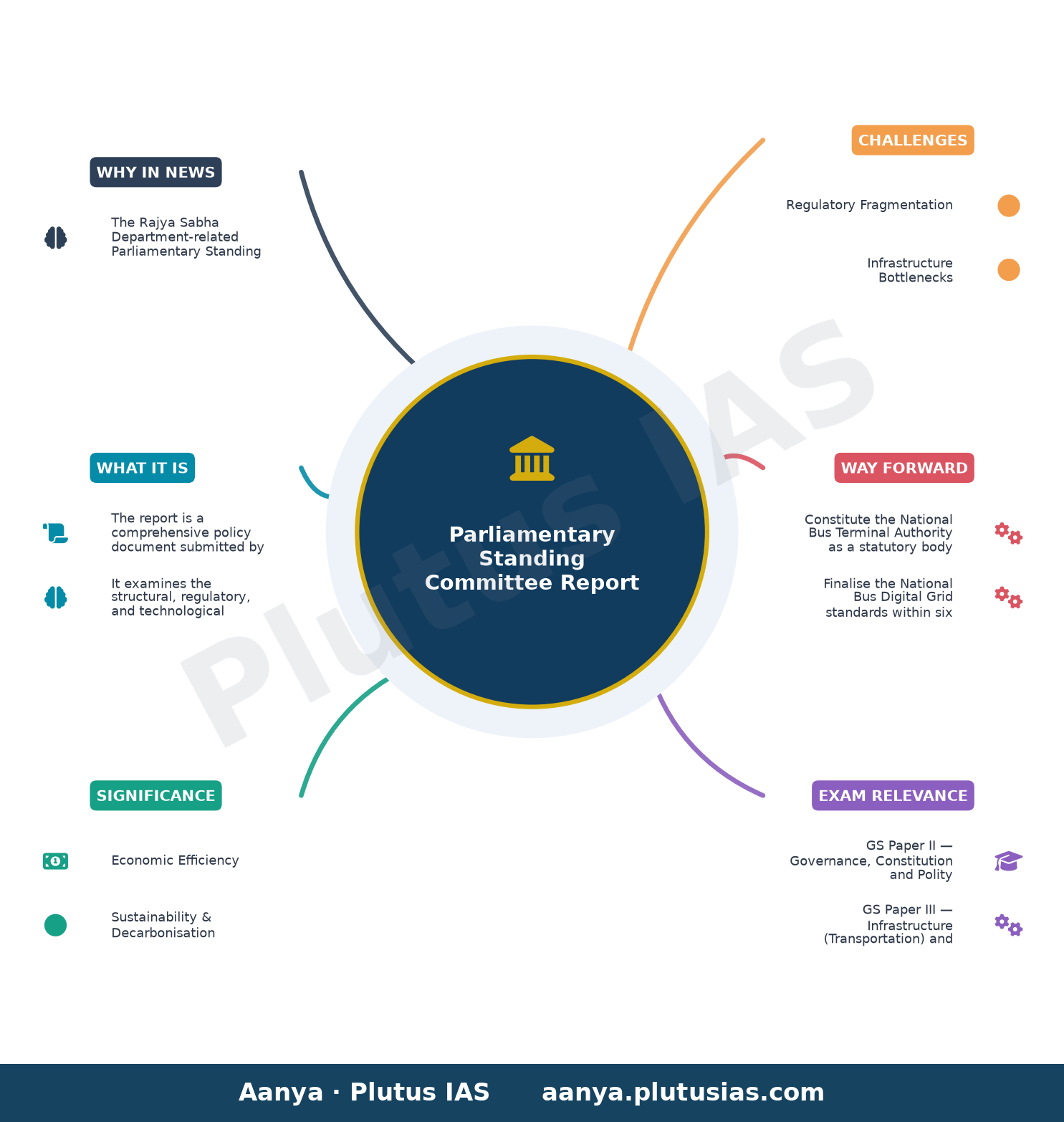
- GS Paper II — Governance, Constitution and Polity (Parliamentary Committees) | GS Paper III — Infrastructure (Transportation) and Economic Development
- Prelims: Parliamentary Standing Committee, Bus Transport Policy, Public-Private Partnership (PPP), Fleet Transition Policy, National Bus Digital Grid, All-India Passenger Permit, National Bus Terminal Authority, Fitment Testing Stations, Retrofitting of Buses, End-of-Life Framework for Electric Buses
- Essay: The Role of Parliamentary Committees in Policy Formulation and Oversight, Sustainable Urban Mobility: Balancing Efficiency, Equity, and Environmental Responsibility
Quick Revision: The 392nd Report of the Parliamentary Standing Committee on Transport, Tourism and Culture recommends replacing state-issued permits with a unified All-India Passenger Permit, establishing a National Bus Terminal Authority on the lines of the Airports Authority of India, and creating a National Bus Digital Grid for real-time tracking and integrated booking systems.
Why is this in the news?
The Rajya Sabha Department-related Parliamentary Standing Committee on Transport, Tourism and Culture, chaired by Member of Parliament Shri Sanjay Kumar Jha, presented its 392nd Report titled ‘Enabling Inclusive, Digital and Sustainable Bus Transport: Policy, Regulation and Public-Private Partnership for Next-Generation Mobility’ on 11 August 2026. The report, adopted by the Committee on 6 August 2026, offers critical recommendations to reform India’s bus transport ecosystem through regulatory, technological, and institutional interventions, aligning with broader national goals of sustainable mobility and digital governance.
Background
- Bus transport remains the primary mode of public transport in India, catering to over 60% of intercity and intracity passenger traffic, particularly in tier-II and tier-III cities.
- The sector faces challenges such as fragmented regulatory frameworks, inadequate infrastructure, safety concerns, and limited integration with digital platforms.
- The COVID-19 pandemic exacerbated operational and financial constraints, necessitating structural reforms for resilience and sustainability.
- The Government of India’s initiatives, such as the FAME-II scheme and the National Electric Mobility Mission Plan (NEMMP), underscore the policy thrust toward green mobility.
- The absence of a unified national framework for bus terminals, permits, and digital tracking has led to inefficiencies, regulatory arbitrage, and suboptimal service delivery.
- Parliamentary Standing Committees play a pivotal role in examining policy gaps, scrutinising executive actions, and recommending legislative or administrative measures to enhance governance.
What is the 392nd Report of the Standing Committee on Transport, Tourism and Culture?
- The report is a comprehensive policy document submitted by the Rajya Sabha’s Department-related Parliamentary Standing Committee on Transport, Tourism and Culture, chaired by Shri Sanjay Kumar Jha.
- It examines the structural, regulatory, and technological deficiencies in India’s bus transport sector and proposes reforms to enhance inclusivity, digitalisation, and sustainability.
- The report is structured around six thematic pillars: All-India Passenger Permits, National Bus Terminal Authority, National Bus Digital Grid, Operator-Centric Safety, and Fleet Transition Compact.
- It advocates for a shift from state-centric to national-level governance, leveraging technology for real-time monitoring, and fostering public-private partnerships (PPPs) for capacity augmentation.
- The report aligns with constitutional provisions such as Article 246 (Subject 24: Transport) and Directive Principles of State Policy (Article 38, 39, 41, 43) that mandate equitable access to transportation and sustainable development.
- It underscores the need for inter-ministerial coordination among the Ministry of Road Transport and Highways (MoRTH), Ministry of Housing and Urban Affairs (MoHUA), and Ministry of Environment, Forest and Climate Change (MoEFCC).
- The recommendations are rooted in global best practices, including the UK’s Bus Service Improvement Plans, Singapore’s Intelligent Transport Systems (ITS), and the EU’s Clean Vehicles Directive.
- The report is a non-binding advisory document but carries significant moral authority, often influencing subsequent legislative or executive actions.
Key Features
| Feature | Significance |
|---|---|
| All-India Passenger Permit | Replaces tourist-specific permits with a unified, electronically verifiable permit system to streamline inter-state bus operations and enhance regulatory oversight. |
| National Bus Terminal Authority | Proposes a dedicated statutory body, modeled on airport authorities, to standardise terminal operations, ownership, and accessibility frameworks across states. |
| National Bus Digital Grid | Aims to integrate bus operations, tracking, and booking systems through interoperable standards, enabling real-time monitoring and data-driven decision-making. |
| Operator-Centric Safety Framework | Introduces mandatory safety audits, retrofitting norms, and emergency alert systems to ensure compliance with life-safety standards for passenger buses. |
| Fleet Transition Compact | Promotes phased adoption of electric buses via bulk procurement, scrappage incentives, and regional manufacturing clusters to accelerate decarbonisation of public transport. |
| Women-Operated Services Initiative | Encourages gender-inclusive employment in bus operations, including driver and staff roles, with infrastructure upgrades like CCTV and alert systems. |
Why it Matters
Economic Efficiency
- Reduces operational redundancies through standardised permits and terminal management, lowering costs for both operators and passengers.
- Enhances asset utilisation via digital tracking and predictive maintenance, improving fleet productivity.
- Facilitates private sector participation through clear regulatory frameworks, attracting investment in bus infrastructure.
Sustainability & Decarbonisation
- Accelerates transition to electric buses through bulk procurement targets and regional manufacturing support.
- Promotes scrappage of older, polluting vehicles via incentive structures linked to fleet modernisation.
- Establishes end-of-life frameworks for electric bus components to ensure environmentally responsible disposal.
Social Inclusion & Equity
- Expands employment opportunities for women in bus operations, addressing gender disparities in the transport sector.
- Standardises accessibility features in buses (e.g., toilets) to cater to diverse passenger needs.
- Ensures uniform service quality across regions through national codes and monitoring mechanisms.
Technological Advancement
- Creates a unified digital ecosystem for bus operations, integrating tracking, booking, and safety systems.
- Leverages GIS-based analytics and crowd-sourced reporting to enhance operational transparency.
- Adopts real-time data sharing to improve route planning, congestion management, and emergency response.
Challenges
1. Regulatory Fragmentation
- Diverse state-level regulations for permits, terminals, and safety standards create operational inefficiencies.
- Lack of inter-state coordination hampers seamless integration of digital and physical infrastructure.
UPSC Link: GS-II: Federalism & Cooperative Governance
2. Infrastructure Bottlenecks
- Inadequate charging infrastructure for electric buses, particularly in rural and semi-urban areas.
- Limited availability of scrap yards and retrofitting facilities for fleet modernisation.
UPSC Link: GS-III: Infrastructure & Logistics
3. Safety & Compliance Gaps
- Inconsistent enforcement of fitness and safety standards across states leads to avoidable accidents.
- Delayed implementation of emergency alert systems and retrofitting norms increases passenger risks.
UPSC Link: GS-III: Transport Safety Regulations
4. Financial Sustainability
- High upfront costs for electric buses and digital infrastructure deter private operators from participation.
- Need for viable revenue models to sustain public-private partnerships in terminal and fleet management.
UPSC Link: GS-III: PPP Models & Fiscal Policies
5. Gender Inclusivity Barriers
- Cultural and systemic biases limit women’s participation in bus operations, particularly as drivers.
- Inadequate infrastructure (e.g., restrooms, safety protocols) at terminals and depots discourages female employment.
UPSC Link: GS-I: Social Justice & Inclusion
Challenges — UPSC Perspective
| Issue | Concern |
|---|---|
| Permit System Fragmentation | Divergent state rules impede seamless inter-state bus operations. |
| Terminal Ownership Conflicts | Mixed models of terminal management lead to inefficiencies and disputes. |
| Electric Bus Adoption Lag | High costs and infrastructure gaps delay transition from fossil-fuel buses. |
| Safety Audit Delays | Protracted compliance checks and retrofitting norms compromise passenger safety. |
| Digital Divide | Uneven access to digital tools among small operators hinders integration with national systems. |
| Gender Representation Gaps | Low female participation in bus operations due to systemic and infrastructural barriers. |
Way Forward
- Constitute the National Bus Terminal Authority as a statutory body within one year, adopting the airport authority model for operational independence.
- Finalise the National Bus Digital Grid standards within six months, ensuring interoperability with existing transport and payment systems.
- Launch a phased scrappage and retrofitting programme for older buses, incentivising operators to adopt electric fleets.
- Establish district-level automated testing stations for periodic safety audits, with mandatory compliance for permit renewals.
- Develop a gender-inclusive employment policy for bus operations, including targeted training programmes for women drivers and staff.
- Create regional manufacturing and maintenance clusters for electric buses to reduce costs and improve local employment.
- Integrate real-time tracking and emergency alert systems across all buses, with penalties for non-compliance.
- Conduct a national audit of terminal infrastructure to identify gaps and prioritise upgrades based on passenger demand.
UPSC Value Addition
Keywords for Mains Answer-Writing
Parliamentary Standing Committee on Transport, Tourism and Culture · Inclusive, Digital and Sustainable Bus Transport · All India Passenger Permit · National Bus Terminal Authority · National Bus Digital Grid · Operator-Centric Safety Framework · Fleet Transition Compact · Women-operated bus services · Public-Private Partnership in Mobility · Interoperability Standards in Transport · Electronic Monitoring of Vehicles · Sustainable Mobility Policy · Bus Terminal National Code · Electric Bus Transition Framework
Constitutional & Policy Linkages
- Article 246: Distribution of Legislative Powers (State List: Transport; Concurrent List: Economic and Social Planning)
Concept Flow
Fragmented state-level regulations → Operational inefficiencies in inter-state bus services → Need for unified permits and terminal standards → Rising urbanisation and mobility demand → Increased pressure on public transport systems → Requirement for digital integration and safety reforms → Climate change commitments → Decarbonisation of transport sector → Transition to electric buses and scrappage incentives → Gender equity imperatives → Inclusion of women in transport workforce → Policy interventions for employment and infrastructure → Technological advancements → Adoption of digital tracking and real-time monitoring → Enhanced service quality and passenger safety → Public-private partnerships → Investment in terminals and fleets → Improved efficiency and sustainability of bus operations
Prelims Practice Questions
Q1. Consider the following statements regarding the Parliamentary Standing Committee on Transport, Tourism and Culture:
1. It is a joint committee of the Parliament.
2. It presented its 392nd report on ‘Inclusive, Digital and Sustainable Bus Transport’.
3. The report recommends the establishment of a National Bus Terminal Authority on the lines of the Airport Authority of India.
How many of the above statements are correct?
- Only one
- Only two
- All three
- None
Answer: All three — Statement 1 is incorrect as it is a standing committee of the Rajya Sabha, not a joint committee. Statements 2 and 3 are correct as per the report’s title and recommendations.
Q2. Assertion (A): The Parliamentary Standing Committee recommends the replacement of All India Tourist Permit with All India Passenger Permit.
Reason (R): The All India Passenger Permit aims to ensure electronic monitoring and dispute-free claims for injured passengers through integration with insurance regulators.
- Both A and R are true, and R is the correct explanation of A.
- Both A and R are true, but R is not the correct explanation of A.
- A is true, but R is false.
- A is false, but R is true.
Answer: Both A and R are true, but R is not the correct explanation of A. — The assertion is true as the report recommends replacing All India Tourist Permit with All India Passenger Permit. The reason is also true and correctly explains the assertion, as the new permit system is designed for electronic monitoring and insurance integration.
Q3. Match the following recommendations of the 392nd report with their respective focus areas:
Column I (Recommendation)
A. National Bus Terminal Authority
B. National Bus Digital Grid
C. Operator-Centric Safety Framework
D. Fleet Transition Compact
Column II (Focus Area)
1. Safety standards for bus operators
2. Transition to electric buses
3. Digital integration and interoperability
4. Terminal management and infrastructure
- A-4, B-3, C-1, D-2
- A-3, B-4, C-1, D-2
- A-4, B-1, C-3, D-2
- A-2, B-3, C-4, D-1
Answer: A-4, B-3, C-1, D-2 — A matches with 4 (Terminal management), B with 3 (Digital integration), C with 1 (Safety standards), and D with 2 (Transition to electric buses).
Mains Practice Question
✍ The Parliamentary Standing Committee on Transport, Tourism and Culture, in its 392nd report, underscores the need for a paradigm shift towards ‘Inclusive, Digital and Sustainable Bus Transport’. Critically examine the key recommendations of the report in the context of India’s evolving mobility landscape. Also, assess the challenges in implementing these recommendations within the federal structure of governance. (15 Marks)
Approach: MODEL-ANSWER SKELETON:
1. **Introduction (2 Marks)**:
– Define the scope of the report and its significance in the context of India’s mobility challenges.
– Highlight the directive of ‘Inclusive, Digital and Sustainable Bus Transport’ and its alignment with SDG 11 (Sustainable Cities and Communities).
2. **Key Recommendations and Their Rationale (6 Marks)**:
– **All India Passenger Permit**: Explain the need for electronic monitoring, dispute resolution for injured passengers, and integration with FASTag and vehicle tracking systems.
– **National Bus Terminal Authority**: Discuss the rationale for separating terminal ownership from bus operations, adopting the Airport Authority of India model, and ensuring non-discriminatory access frameworks.
– **National Bus Digital Grid**: Elaborate on the need for interoperability standards, public live-tracking, integrated booking systems, and GIS-based risk mapping.
– **Operator-Centric Safety Framework**: Highlight the importance of automated testing stations, retrofitting of sleeper and school buses, and mandatory safety ratings for permit renewal.
– **Fleet Transition Compact**: Discuss the phased transition to electric buses, scrap-and-lease models, and regional manufacturing clusters.
– **Women-operated Bus Services**: Emphasise the need for gender-inclusive employment and safety measures like CCTV and alert systems.
3. **Challenges in Implementation (5 Marks)**:
– **Federal Structure**: Discuss the role of state governments in adopting recommendations, particularly for permits, terminal management, and safety standards.
– **Digital Divide**: Highlight infrastructure gaps in rural and semi-urban areas for digital monitoring and electric bus charging.
– **Financial Constraints**: Assess the viability of public-private partnerships (PPPs) and the need for centralised funding mechanisms.
– **Inter-State Coordination**: Explain the challenges in harmonising policies across states, especially for permits and terminal management.
– **Stakeholder Resistance**: Discuss potential resistance from private operators, state transport undertakings, and unions.
4. **Conclusion (2 Marks)**:
– Summarise the transformative potential of the recommendations.
– Emphasise the need for a phased, collaborative approach involving the Centre, states, and private stakeholders to achieve sustainable mobility.
Source: PIB (Press Information Bureau)
Generated by AanyaAi for educational purpose.

- AI आधारित हृदय रोग पूर्वानुमान उपकरण: क्लिनिकल उपयोग के लिए अभी तैयार नहीं – अध्ययन - August 12, 2026
- AI in Heart Disease Prediction: Current Status and UPSC Relevance - August 12, 2026
- लोकसभा में आज पेश होगा यशवंत वर्मा के नकद जांच रिपोर्ट का खुलासा - August 12, 2026

No Comments