


11 Aug UPSC Alert: SC Students Benefit from National Overseas Scholarship Scheme 2025-26
✎ The National Overseas Scholarship (NOS) for Scheduled Castes is a flagship scheme aimed at enhancing equitable access to foreign higher education through digital governance, merit-based selection, and direct benefit transfer…
Subject Relevance — Where This Topic Fits
- GS Paper II — International Relations (Higher Education Abroad) | GS Paper III — Social Justice (Welfare Schemes for Marginalised Sections) | GS Paper IV — Ethics (Inclusive Development and Access to Opportunities)
- Prelims: Scheduled Castes and Scheduled Tribes (Prevention of Atrocities) Act, 1989, National Overseas Scholarship (NOS), Social Justice and Empowerment Ministry, Integrated Portal for Empowerment (SAMARTH), Foreign Education Policy, Digital Governance, Direct Benefit Transfer (DBT), Lok Sabha Questions
- Essay: Inclusive growth and equitable access to opportunities: The role of targeted welfare schemes, Digital governance as a tool for social empowerment and administrative efficiency
Quick Revision: The National Overseas Scholarship (NOS) for Scheduled Castes is a flagship scheme aimed at enhancing equitable access to foreign higher education through digital governance, merit-based selection, and direct benefit transfer mechanisms.
Why is this in the news?
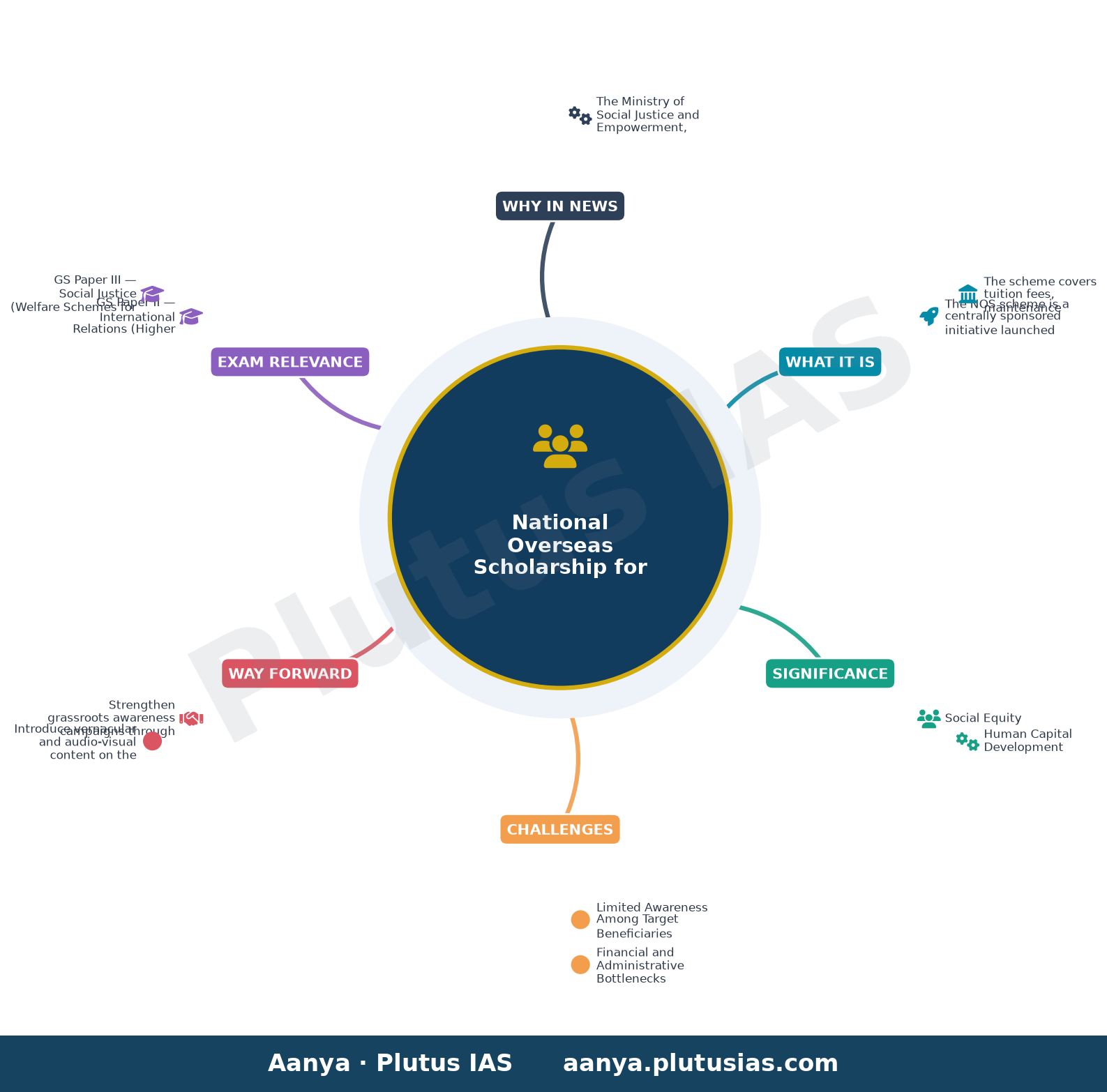
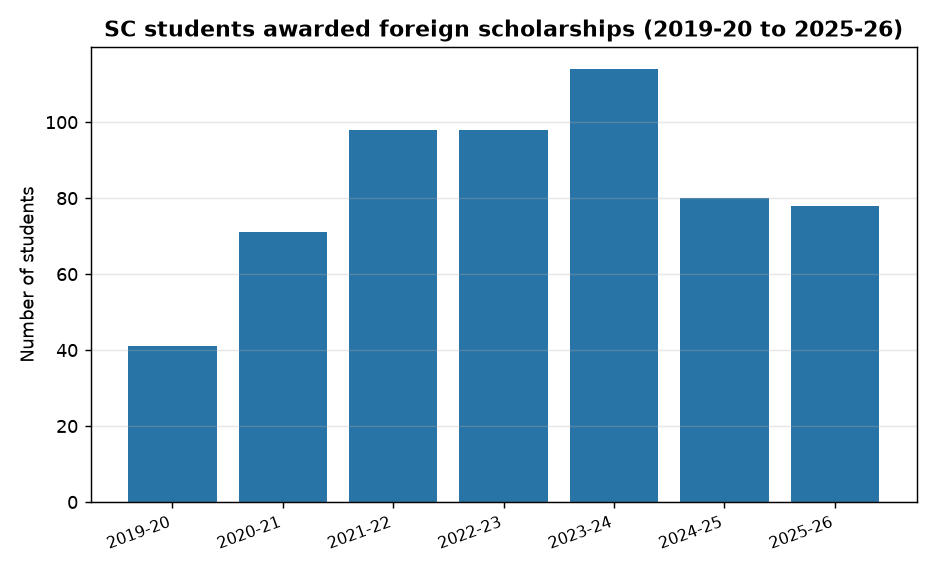
The Ministry of Social Justice and Empowerment, Government of India, has highlighted the expansion and strengthening of the National Overseas Scholarship (NOS) scheme for Scheduled Caste (SC) students, with 580 beneficiaries admitted to foreign universities between 2019-20 and 2025-26. This development underscores the government’s commitment to enhancing access to higher education abroad for marginalised sections, while also reflecting on the administrative reforms, digital integration, and outreach measures implemented to streamline the scheme’s delivery.
Background
- The National Overseas Scholarship (NOS) scheme was introduced to provide financial assistance to meritorious SC students for pursuing master’s and PhD programmes in foreign universities, aligning with the constitutional mandate of promoting educational equity under Articles 15(4) and 46 of the Indian Constitution.
- The scheme is administered by the Ministry of Social Justice and Empowerment, which works in collaboration with Indian Missions abroad for the disbursement of funds and facilitation of admissions.
- The NOS scheme operates within the broader framework of India’s foreign education policy, which encourages international exposure while ensuring that financial constraints do not hinder the academic aspirations of underprivileged sections.
- The scheme’s implementation has evolved over time, with a notable shift towards digital governance, including the integration of the NOS portal with the Integrated Inclusion portal to streamline application, verification, and fund disbursement processes.
- Awareness campaigns, including newspaper advertisements and coordination with state governments, have been intensified to ensure wider reach and participation among eligible SC students.
- The scheme’s performance data indicates a steady increase in the number of beneficiaries, reflecting growing awareness and administrative efficiency, though challenges such as regional disparities in participation persist.
What is the National Overseas Scholarship (NOS) Scheme for Scheduled Castes?
- The NOS scheme is a centrally sponsored initiative launched to provide financial assistance to meritorious Scheduled Caste students for pursuing higher education (master’s and PhD programmes) in top-ranked foreign universities.
- The scheme covers tuition fees, maintenance allowance, contingency allowance, and airfare for the selected students, subject to the ceiling limits prescribed by the Ministry.
- The selection process is merit-based, as per government norms.
- The scheme is implemented through a digital platform, with applications invited online, and the Integrated Inclusion portal serving as a single-window interface for application, document verification, and fund disbursement.
- Funds are released in advance to Indian Missions/Embassies abroad via Letter of Authority (LOA), which are then disbursed to universities and students upon receipt of claims, ensuring timely financial support.
Key Features
| Feature | Significance |
|---|---|
| Digital Integration with e-Samarth Portal | Streamlines application, verification, and fund disbursement processes, reducing bureaucratic delays and enhancing transparency. |
| Proactive Outreach Mechanisms | Utilizes departmental websites, newspaper advertisements, and direct communication with state welfare departments to improve awareness among SC students. |
| Advance Fund Release to Indian Missions | Ensures timely disbursement of scholarship funds to students by authorizing Indian missions/embassies to release funds upfront, minimizing financial bottlenecks. |
| State-wise Data Disaggregation | Provides granular data on beneficiaries at the district level, enabling targeted policy interventions and monitoring of regional disparities. |
| Annual Scholarship Allocation Trend | Demonstrates a progressive increase in scholarships awarded, reflecting sustained government commitment to expanding access to international education for SC students. |
Why it Matters
Social Equity
- Facilitates upward mobility for Scheduled Caste students by enabling access to globally competitive higher education institutions, thereby addressing historical educational inequities.
- Promotes representation of marginalized communities in international academic and professional networks, fostering social inclusion and reducing systemic barriers.
- Aligns with constitutional principles of equality (Article 14) and non-discrimination (Article 15(4)), reinforcing the state’s obligation to ensure educational opportunities for disadvantaged groups.
Human Capital Development
- Enhances the skill set of SC students through exposure to advanced educational systems, contributing to India’s long-term human resource capital.
- Encourages return migration or diaspora engagement, potentially leveraging international expertise for domestic development (brain circulation).
- Supports the attainment of Sustainable Development Goal 4 (Quality Education) by broadening access to tertiary education for underrepresented groups.
Governance & Institutional Strengthening
- Demonstrates the efficacy of digital governance tools (e-Samarth Portal) in simplifying welfare delivery mechanisms for marginalized communities.
- Showcases inter-departmental coordination between the Ministry of Social Justice and Empowerment, state governments, and Indian missions, ensuring seamless implementation.
- Provides a replicable model for other centrally sponsored schemes aimed at socio-economic upliftment, emphasizing outcome-based monitoring and data-driven policymaking.
Challenges
1. Limited Awareness Among Target Beneficiaries
- Despite outreach efforts, awareness levels may remain suboptimal in remote or socio-economically disadvantaged regions, leading to underutilization of the scheme.
- Linguistic and digital literacy barriers could hinder effective dissemination of information, particularly among first-generation learners from SC communities.
UPSC Link: GS Paper 2: Welfare Schemes
2. Financial and Administrative Bottlenecks
- Delays in fund disbursement, even with advance releases, may occur due to procedural inefficiencies in Indian missions or host institutions abroad.
- Currency fluctuations and inflation in foreign education systems could erode the real value of scholarship amounts, necessitating periodic reviews of funding norms.
UPSC Link: GS Paper 3: Government Budgeting
3. Quality and Relevance of International Education
- Risk of students pursuing courses with limited employability or misaligned with India’s developmental priorities, such as certain niche or non-accredited programs.
- Lack of structured mechanisms to ensure the return of scholars to India, potentially leading to brain drain if employment opportunities are not facilitated post-graduation.
UPSC Link: GS Paper 2: Education Policy
4. Regional Disparities in Beneficiary Distribution
- Uneven distribution of scholarships across states and districts, with some regions (e.g., Andhra Pradesh) showing lower participation despite comparable SC populations.
- Concentration of beneficiaries in metropolitan areas or traditional education hubs, exacerbating intra-state inequalities.
UPSC Link: GS Paper 1: Regional Development
5. Monitoring and Evaluation Gaps
- Absence of longitudinal tracking of beneficiaries post-graduation to assess career progression, socio-economic impact, or contribution to national development.
- Limited transparency in the selection process, including criteria for shortlisting candidates, which could raise concerns about fairness and objectivity.
UPSC Link: GS Paper 4: Ethics in Governance
Challenges — UPSC Perspective
| Issue | Concern |
|---|---|
| Awareness Deficit | Low uptake in rural SC communities due to limited outreach in local languages and digital platforms. |
| Fund Disbursement Delays | Procedural lags in Indian missions or host institutions may disrupt timely fee payments. |
| Course Relevance Mismatch | Students may opt for courses with poor ROI or limited alignment with India’s skill requirements. |
| State-wise Imbalance | Unequal distribution of scholarships across states, with some regions receiving disproportionately fewer benefits. |
| Post-Graduation Tracking | No structured mechanism to monitor the career trajectory or societal impact of scholarship recipients. |
Government Initiatives — Must-Memorise for Prelims
- National Overseas Scholarship (NOS) for Scheduled Castes
Way Forward
- Strengthen grassroots awareness campaigns through partnerships with SC-dominated educational institutions, NGOs, and local self-government bodies to ensure last-mile delivery.
- Introduce vernacular and audio-visual content on the e-Samarth Portal to cater to diverse linguistic and digital literacy levels among beneficiaries.
- Establish a dedicated helpline and grievance redressal mechanism to address procedural delays and fund disbursement issues in real time.
- Conduct periodic reviews of scholarship amounts to account for inflation and currency fluctuations in host countries, ensuring the real value of support remains intact.
- Develop a post-graduation tracking system to monitor the career progression of beneficiaries, including their employment status, sector of work, and contributions to national development.
- Collaborate with Indian missions abroad to create a database of accredited foreign universities aligned with India’s skill gaps, guiding students toward high-ROI courses.
- Introduce a mentorship program pairing past scholarship recipients with current beneficiaries to provide guidance on course selection, application processes, and career planning.
- Expand the scheme’s coverage to include other marginalized groups (e.g., Scheduled Tribes, Other Backward Classes) through a unified scholarship framework, ensuring equitable access.
UPSC Value Addition
Keywords for Mains Answer-Writing
Scheduled Castes · National Overseas Scholarship Scheme · Social Justice and Empowerment Ministry · Digital inclusion · Foreign education · Inclusive education policy · Affirmative action · E-governance in welfare schemes · Higher education access · SC/ST welfare measures
Constitutional & Policy Linkages
- Article 15(4): Special provisions for advancement of socially and educationally backward classes
- Article 46: Promotion of educational and economic interests of Scheduled Castes
Concept Flow
Constitutional mandate for socio-educational equity (Articles 14, 15(4), 46) → → Policy formulation: National Overseas Scholarship (NOS) for SC students → → Implementation challenges: Awareness gaps, fund disbursement delays → → Digital governance intervention: Integration with e-Samarth Portal → → Outcome: 580 SC students enrolled in foreign institutions (2019-26) → → Impact: Enhanced human capital, reduced educational inequities → → Feedback loop: Data-driven refinements in scheme design and outreach
Prelims Practice Questions
Q1. Consider the following statements about the National Overseas Scholarship (NOS) Scheme for Scheduled Castes:
1. The scheme is implemented by the Ministry of Education.
2. The scheme provides financial assistance for higher education abroad.
3. The selection process is conducted through an online portal integrated with the UMANG platform.
4. The scheme mandates that funds are disbursed to students only after their admission to foreign universities.
How many of the above statements are correct?
- Only one
- Only two
- Only three
- All four
Answer: Only two — Statements 2 is correct as the NOS scheme provides financial assistance for higher education abroad. Statements 1, 3, and 4 are incorrect: the scheme is implemented by the Ministry of Social Justice and Empowerment, the selection process is integrated with the EKSHE portal (not UMANG), and funds are disbursed in advance to Indian Missions for onward distribution.
Q2. Assertion (A): The National Overseas Scholarship (NOS) Scheme for Scheduled Castes aims to enhance access to higher education abroad for marginalized communities.
Reason (R): The scheme includes provisions for advance disbursement of funds to Indian Missions to expedite financial support to selected students.
Options:
A. Both A and R are true, and R is the correct explanation of A.
B. Both A and R are true, but R is not the correct explanation of A.
C. A is true, but R is false.
D. A is false, but R is true.
Answer: ? — Both Assertion (A) and Reason (R) are true. The NOS scheme indeed aims to enhance access to higher education abroad for Scheduled Caste students (A). The advance disbursement of funds to Indian Missions (R) is a mechanism to ensure timely financial support, which directly supports the objective stated in (A). Hence, R correctly explains A.
Q3. Match the following columns related to the National Overseas Scholarship (NOS) Scheme:
Column I (Feature) | Column II (Description)
——————-|———————–
1. Implementation Authority | A. Ministry of Social Justice and Empowerment
2. Selection Portal | B. EKSHE Portal
3. Advance Fund Disbursement | C. Indian Missions/Embassies
4. Awareness Campaigns | D. Print and Digital Media
Options:
A. 1-A, 2-B, 3-C, 4-D
B. 1-B, 2-A, 3-C, 4-D
C. 1-A, 2-C, 3-B, 4-D
D. 1-C, 2-B, 3-A, 4-D
- A
- B
- C
- D
Answer: A — The correct matches are: 1-A (Implementation Authority is the Ministry of Social Justice and Empowerment), 2-B (Selection Portal is the EKSHE Portal), 3-C (Advance Fund Disbursement is to Indian Missions/Embassies), and 4-D (Awareness Campaigns are conducted through Print and Digital Media).
Mains Practice Question
✍ The National Overseas Scholarship (NOS) Scheme for Scheduled Castes represents a significant intervention in addressing educational inequities in India. Critically examine the scheme’s objectives, operational mechanisms, and its role in promoting inclusive higher education. Also, evaluate the challenges in its implementation and suggest measures to enhance its effectiveness. (15 Marks)
Approach: MODEL-ANSWER SKELETON:
1. **Objectives of the NOS Scheme** (2 Marks):
– Affirmative action to bridge educational disparities faced by Scheduled Castes.
– Facilitate access to world-class higher education institutions abroad.
– Align with constitutional provisions (Articles 15(4), 16(4), 46) and the Right to Education (RTE) Act’s spirit.
2. **Operational Mechanisms** (4 Marks):
– **Implementation Authority**: Ministry of Social Justice and Empowerment.
– **Selection Process**: Merit-based, with criteria including academic excellence, financial need, and socio-economic background (as per scheme guidelines).
– **Digital Integration**: Use of the EKSHE portal for streamlined application, verification, and fund management.
– **Fund Disbursement**: Advance release to Indian Missions/Embassies to ensure timely support to students.
– **Awareness Campaigns**: Multi-channel dissemination via print media, digital platforms, and coordination with state welfare departments.
3. **Role in Promoting Inclusive Higher Education** (3 Marks):
– Reduces financial barriers for marginalized groups.
– Encourages diversity in global academic institutions.
– Serves as a model for other affirmative action policies in education.
– Data from 2019-26 shows 580 beneficiaries, indicating scalability and impact.
4. **Challenges in Implementation** (3 Marks):
– **Awareness Gaps**: Limited reach in rural and remote areas despite multi-channel campaigns.
– **Administrative Delays**: Potential bottlenecks in fund disbursement or mission-level coordination.
– **Eligibility Constraints**: Income ceilings and academic thresholds may exclude deserving candidates.
– **Global Competition**: High standards of foreign universities may limit participation.
5. **Measures to Enhance Effectiveness** (3 Marks):
– **Targeted Outreach**: Partner with local NGOs, educational institutions, and district administrations for grassroots awareness.
– **Simplification of Processes**: Reduce bureaucratic hurdles in documentation and verification.
– **Expansion of Criteria**: Consider relaxing income thresholds or including more fields of study.
– **Monitoring and Evaluation**: Regular audits of fund utilization and beneficiary feedback to identify systemic issues.
– **Collaboration with Diaspora**: Leverage Indian diaspora networks for mentorship and support to beneficiaries.
Source: PIB (Press Information Bureau)
Generated by AanyaAi for educational purpose.

- AI आधारित हृदय रोग पूर्वानुमान उपकरण: क्लिनिकल उपयोग के लिए अभी तैयार नहीं – अध्ययन - August 12, 2026
- AI in Heart Disease Prediction: Current Status and UPSC Relevance - August 12, 2026
- लोकसभा में आज पेश होगा यशवंत वर्मा के नकद जांच रिपोर्ट का खुलासा - August 12, 2026

No Comments