


11 Aug Premature Redemption of SGB 2018-19 Series VI: Key Details for UPSC & PCS Aspirants
✎ Premature redemption of SGBs is permitted after five years from the issue date, with the redemption price calculated as the simple average of the closing price of gold of 999 purity over the three preceding business days, as…
Subject Relevance — Where This Topic Fits
- GS Paper III — Indian Economy: Money and Banking, Capital Markets
- Prelims: Sovereign Gold Bond (SGB), gold monetisation, capital market instruments, premature redemption, India Bullion and Jewellers Association Ltd (IBJA), RBI press release, financial instruments under government securities
- Essay: Role of gold in India’s financial system and macroeconomic stability, Government-led financial inclusion through market-based instruments
Quick Revision: Premature redemption of SGBs is permitted after five years from the issue date, with the redemption price calculated as the simple average of the closing price of gold of 999 purity over the three preceding business days, as published by IBJA.
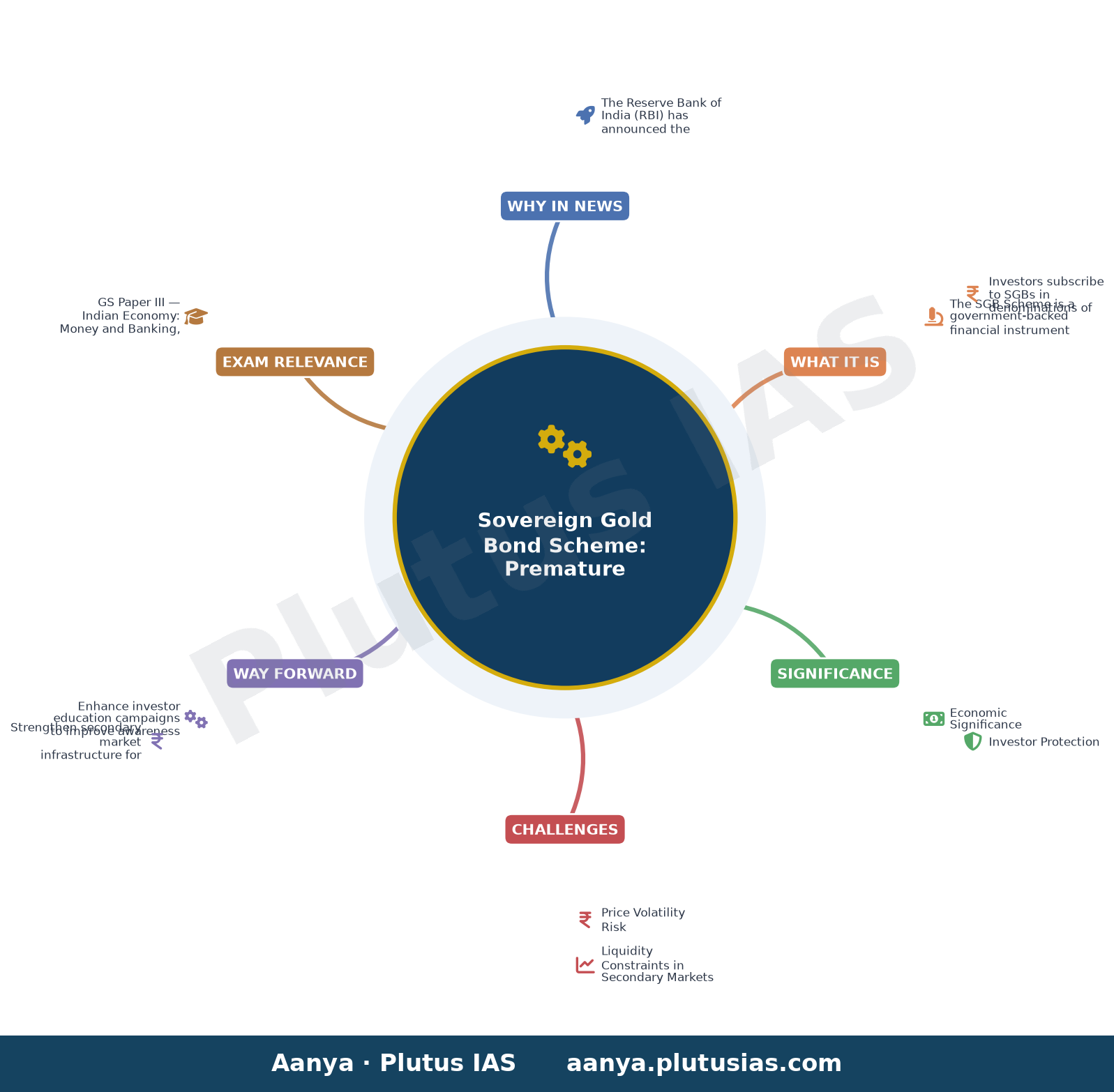
Why is this in the news?
The Reserve Bank of India (RBI) has announced the redemption price for the premature redemption of the Sovereign Gold Bond (SGB) 2018-19 Series VI, scheduled for August 12, 2026. This development is significant as it underscores the operational mechanics of premature redemption under the SGB scheme, particularly the pricing mechanism based on the average closing price of gold as published by the India Bullion and Jewellers Association Ltd (IBJA). The announcement provides clarity to investors regarding the liquidity and exit options available under the scheme, which was launched to reduce the demand for physical gold and encourage financial savings.
Background
- The Sovereign Gold Bond (SGB) Scheme was introduced by the Government of India in November 2015 under the Gold Monetisation Scheme, with the objective of reducing the country’s reliance on physical gold imports and promoting financial savings among citizens.
- The scheme allows investors to buy gold in a dematerialised form, thereby eliminating storage risks and costs associated with physical gold ownership.
- SGBs are issued by the Reserve Bank of India (RBI) on behalf of the Government of India and are denominated in grams of gold, with a minimum investment of one gram and a maximum limit of 4 kg for individuals.
- Premature redemption of SGBs is permitted after the completion of five years from the date of issue, subject to the terms and conditions specified in the scheme’s operational guidelines.
- The redemption price is determined based on the simple average of the closing price of gold of 999 purity over the three preceding business days, as published by the India Bullion and Jewellers Association Ltd (IBJA), ensuring transparency and market-linked pricing.
What is the Sovereign Gold Bond (SGB) Scheme?
- The SGB Scheme is a government-backed financial instrument introduced to monetise gold holdings and reduce the country’s dependence on gold imports, which have significant implications for the current account deficit.
- Investors subscribe to SGBs in denominations of grams of gold, with the bond’s value linked to the prevailing market price of gold, ensuring inflation hedging and capital appreciation potential.
- SGBs are issued in both dematerialised and paper form, with the latter being transferable by endorsement and delivery, while the former is held in a demat account, facilitating ease of trading and liquidity.
- The scheme offers an annual fixed interest rate of 2.5% on the issue price, payable semi-annually, providing a steady income stream in addition to capital gains from gold price appreciation.
- Premature redemption is permitted after the fifth year from the date of issue, subject to the terms and conditions specified by the RBI, with the redemption price calculated as the simple average of the closing price of gold over the three preceding business days as published by IBJA.
- SGBs are eligible for trading on stock exchanges, providing investors with an exit option before maturity, subject to market conditions and liquidity constraints.
- The scheme is open to resident individuals, Hindu Undivided Families (HUFs), trusts, universities, and charitable institutions, with specific investment limits applicable to each category.
- SGBs are exempt from capital gains tax on redemption if held till maturity, making them a tax-efficient investment avenue compared to physical gold or gold ETFs.
Key Features
| Feature | Significance |
|---|---|
| Premature Redemption Eligibility | Permits redemption after the fifth year from issue date, aligning with the SGB scheme’s liquidity provisions for investors requiring early liquidity. |
| Redemption Price Calculation | Based on the simple average of the closing price of 999 purity gold over the three preceding business days, as published by IBJA, ensuring market-linked valuation. |
| Issue Date and Tranche | Series VI of the 2018-19 SGB tranche was issued on February 12, 2019, with premature redemption due on August 12, 2026, marking a seven-year cycle from issue. |
| Government Notification Basis | Premature redemption permitted under GOI notification F.No.4(22)-B(W&M)/2018 dated October 08, 2018, demonstrating the scheme’s structured regulatory framework. |
| Price Determination Mechanism | Uses IBJA’s gold price benchmark, a standardised and transparent system, reducing valuation disputes and ensuring fairness for investors. |
Why it Matters
Economic Significance
- Enhances liquidity for SGB investors without requiring full maturity, balancing long-term investment incentives with short-term liquidity needs.
- Provides a market-determined exit option, reducing reliance on secondary markets for liquidity.
- Supports the government’s objective of reducing physical gold demand by offering a sovereign-backed alternative with assured returns.
- Encourages broader participation in SGBs by mitigating the risk of illiquidity for retail investors.
Investor Protection
- Ensures fair valuation through transparent price determination using IBJA’s benchmark, preventing arbitrary pricing by issuers.
- Mitigates the risk of capital loss by linking redemption price to prevailing gold prices, aligning investor returns with market conditions.
- Provides a structured exit mechanism, reducing the likelihood of distress sales in secondary markets.
Fiscal and Monetary Policy
- Reduces the fiscal burden on the government by promoting SGBs as a substitute for physical gold imports, thereby supporting current account stability.
- Contributes to the monetisation of gold holdings, aligning with the RBI’s broader strategy to integrate gold into the formal financial system.
- Supports monetary policy objectives by channeling gold-related savings into financial assets, enhancing the efficacy of interest rate transmission.
Market Development
- Strengthens the secondary market for SGBs by providing a clear redemption pathway, potentially increasing trading volumes and price discovery.
- Encourages the development of gold price derivatives and hedging instruments, further deepening the gold market ecosystem.
Challenges
1. Price Volatility Risk
- Gold prices are inherently volatile, and the redemption price may fluctuate significantly between issue and redemption dates, exposing investors to market risk.
- The three-day average pricing mechanism, while transparent, may not fully capture intra-day volatility, leading to potential mismatches in investor expectations.
UPSC Link: GS3: Commodity Markets and Price Volatility
2. Liquidity Constraints in Secondary Markets
- While premature redemption is permitted, secondary market liquidity for SGBs remains limited, potentially forcing investors to redeem at suboptimal prices.
- The absence of a deep secondary market may deter some investors from participating, despite the redemption option.
UPSC Link: GS3: Financial Market Liquidity
3. Investor Awareness and Education
- Many retail investors lack awareness of the premature redemption provisions, leading to missed opportunities or suboptimal financial decisions.
- Inadequate understanding of the redemption price calculation mechanism may result in dissatisfaction or disputes with the issuer.
UPSC Link: GS3: Financial Inclusion and Literacy
4. Operational and Administrative Burden
- The RBI and issuing entities must manage redemption requests efficiently, particularly during peak periods, to avoid delays or errors.
- Ensuring accurate and timely price dissemination requires robust infrastructure and coordination between the RBI, IBJA, and issuing banks.
UPSC Link: GS3: Public Financial Management
5. Counterparty Risk in Redemption Process
- Investors face the risk of delays or defaults by issuing entities (e.g., banks, post offices) in processing redemption requests, particularly in remote areas.
- The absence of a centralised redemption mechanism may exacerbate operational inefficiencies and increase transaction costs.
UPSC Link: GS3: Financial Sector Reforms
Challenges — UPSC Perspective
| Issue | Concern |
|---|---|
| Volatility in Gold Prices | Exposure to market risk due to fluctuations in gold prices between issue and redemption dates. |
| Secondary Market Liquidity | Limited trading volumes in the secondary market may constrain exit options for investors. |
| Investor Awareness Gaps | Lack of understanding of redemption provisions and pricing mechanisms among retail investors. |
| Operational Delays | Potential bottlenecks in processing redemption requests, particularly during high-demand periods. |
| Counterparty Risk | Risk of delays or defaults by issuing entities in fulfilling redemption obligations. |
| Price Benchmarking Accuracy | Three-day average pricing may not fully reflect real-time market conditions, leading to valuation discrepancies. |
Government Initiatives — Must-Memorise for Prelims
- Sovereign Gold Bond (SGB) Scheme 2018-19 Series VI
Way Forward
- Enhance investor education campaigns to improve awareness of premature redemption provisions and pricing mechanisms, particularly targeting retail investors.
- Strengthen secondary market infrastructure for SGBs by encouraging participation from institutional investors and market makers.
- Explore the introduction of a centralised redemption portal to streamline the process and reduce operational delays.
- Develop hedging instruments (e.g., gold futures, options) to allow investors to manage price volatility risk associated with premature redemption.
- Conduct periodic reviews of the redemption pricing mechanism to assess its alignment with market conditions and investor expectations.
- Promote the use of digital platforms for redemption requests to improve accessibility and reduce transaction costs for investors.
- Collaborate with financial literacy initiatives under the RBI and SEBI to integrate SGB-related education into broader financial inclusion programs.
- Assess the feasibility of offering partial redemption options to provide greater flexibility to investors.
UPSC Value Addition
Keywords for Mains Answer-Writing
Sovereign Gold Bond Scheme (SGB) · premature redemption · Reserve Bank of India (RBI) · India Bullion and Jewellers Association Ltd (IBJA) · gold pricing mechanism · financial instruments · capital markets · monetary policy instruments · government securities · investment avenues · asset classes · liquidity management
Concept Flow
Issue of SGB 2018-19 Series VI on February 12, 2019 → Investor holds bond for five years → Eligibility for premature redemption on August 12, 2026 → RBI announces redemption price based on IBJA’s three-day average gold price → Investor submits redemption request to issuing entity → Issuing entity processes request and disburses redemption amount → Investor receives proceeds in bank account → Market impact: Potential reduction in secondary market liquidity for SGBs → Feedback loop: Investor awareness and operational efficiency improvements
Prelims Practice Questions
Q1. Consider the following statements regarding the Sovereign Gold Bond (SGB) Scheme:
1. Premature redemption is permitted after the fifth year from the date of issue.
2. The redemption price is determined by the average closing price of gold of 999 purity over the previous three business days as published by IBJA.
3. The SGB Scheme is issued by the Ministry of Finance, Government of India.
How many of the above statements are correct?
- Only one
- Only two
- All three
- None
Answer: All three — Statements 1 and 2 are correct as per the RBI notification and SGB scheme guidelines. Statement 3 is incorrect because the SGB Scheme is issued by the Reserve Bank of India on behalf of the Government of India.
Q2. Assertion (A): The Sovereign Gold Bond Scheme provides an alternative to holding physical gold.
Reason (R): The bonds are denominated in grams of gold and offer returns linked to the price of gold, along with an annual interest rate.
- Both A and R are true and R is the correct explanation of A
- Both A and R are true but R is not the correct explanation of A
- A is true but R is false
- A is false but R is true
Answer: Both A and R are true but R is not the correct explanation of A — Both the assertion and reason are true. The SGB Scheme indeed provides an alternative to holding physical gold by offering bonds denominated in grams of gold, which are linked to gold prices and carry an annual interest rate.
Q3. Match the following features of the Sovereign Gold Bond Scheme with their respective descriptions:
Column I (Feature)
A. Issuing Authority
B. Redemption Price Determination
C. Premature Redemption Eligibility
D. Interest Rate
Column II (Description)
1. After the fifth year from the date of issue
2. Reserve Bank of India on behalf of the Government of India
3. Simple average of closing price of gold of 999 purity over the previous three business days as published by IBJA
4. Fixed at 2.5% per annum payable semi-annually
- A-2, B-3, C-1, D-4
- A-1, B-2, C-3, D-4
- A-3, B-1, C-4, D-2
- A-4, B-3, C-2, D-1
Answer: A-2, B-3, C-1, D-4 — The correct match is: A (Issuing Authority) – 2 (Reserve Bank of India on behalf of the Government of India), B (Redemption Price Determination) – 3 (Simple average of closing price of gold of 999 purity over the previous three business days as published by IBJA), C (Premature Redemption Eligibility) – 1 (After the fifth year from the date of issue), D (Interest Rate) – 4 (Fixed at 2.5% per annum payable semi-annually).
Mains Practice Question
✍ The Sovereign Gold Bond (SGB) Scheme represents a strategic integration of monetary policy instruments with investment avenues in India. Critically examine the rationale behind the introduction of the SGB Scheme, its operational framework, and the significance of the redemption price mechanism in ensuring investor confidence. Also, analyse the role of the Reserve Bank of India (RBI) in administering the scheme and its implications for monetary policy and capital markets. (15 Marks)
Approach: MODEL-ANSWER SKELETON:
1. **Rationale for SGB Scheme** (4 points):
– Reduce demand for physical gold imports and ease pressure on the current account deficit (CAD).
– Provide a sovereign-backed, interest-bearing alternative to physical gold.
– Promote financial savings and diversify investment portfolios.
– Align with the government’s objective of reducing gold imports and promoting digital gold investments.
2. **Operational Framework** (4 points):
– Issued by the RBI on behalf of the Government of India, with tranches offered periodically.
– Bonds denominated in grams of gold, with a fixed interest rate (2.5% per annum, payable semi-annually).
– Tenure of 8 years, with an option for premature redemption after the fifth year.
– Redemption price linked to the market price of gold, ensuring transparency and fairness.
3. **Redemption Price Mechanism** (4 points):
– Determined as the simple average of the closing price of gold of 999 purity over the previous three business days, published by the India Bullion and Jewellers Association Ltd (IBJA).
– Ensures market-linked returns and protects investors from price volatility.
– Enhances investor confidence by providing a transparent and verifiable pricing mechanism.
– Example: The redemption price for SGB 2018-19 Series VI due on August 12, 2026, was ₹15,102 per unit, based on the average of gold prices on August 7, 10, and 11, 2026.
4. **Role of RBI and Implications** (3 points):
– RBI acts as the issuing and servicing authority, ensuring operational efficiency and investor protection.
– The scheme supports monetary policy objectives by reducing gold import dependency and promoting financial savings.
– Enhances the depth and liquidity of the gold market in India, benefiting capital markets and investors.
Source: RBI
Generated by AanyaAi for educational purpose.

- गुजरात ATS ने EEZ में 526 किलो नशीली दवाओं की जब्ती कर इतिहास रचा - September 30, 2026
- CAQM Reviews Stubble Burning & Emission Control Strategies for UPSC - September 30, 2026
- ग्रीन एनर्जी कॉरिडोर-III: बीईएसएस सहित इंट्रा-स्टेट ट्रांसमिशन प्रणाली को मजबूत करेगी सरकार - September 30, 2026

No Comments