


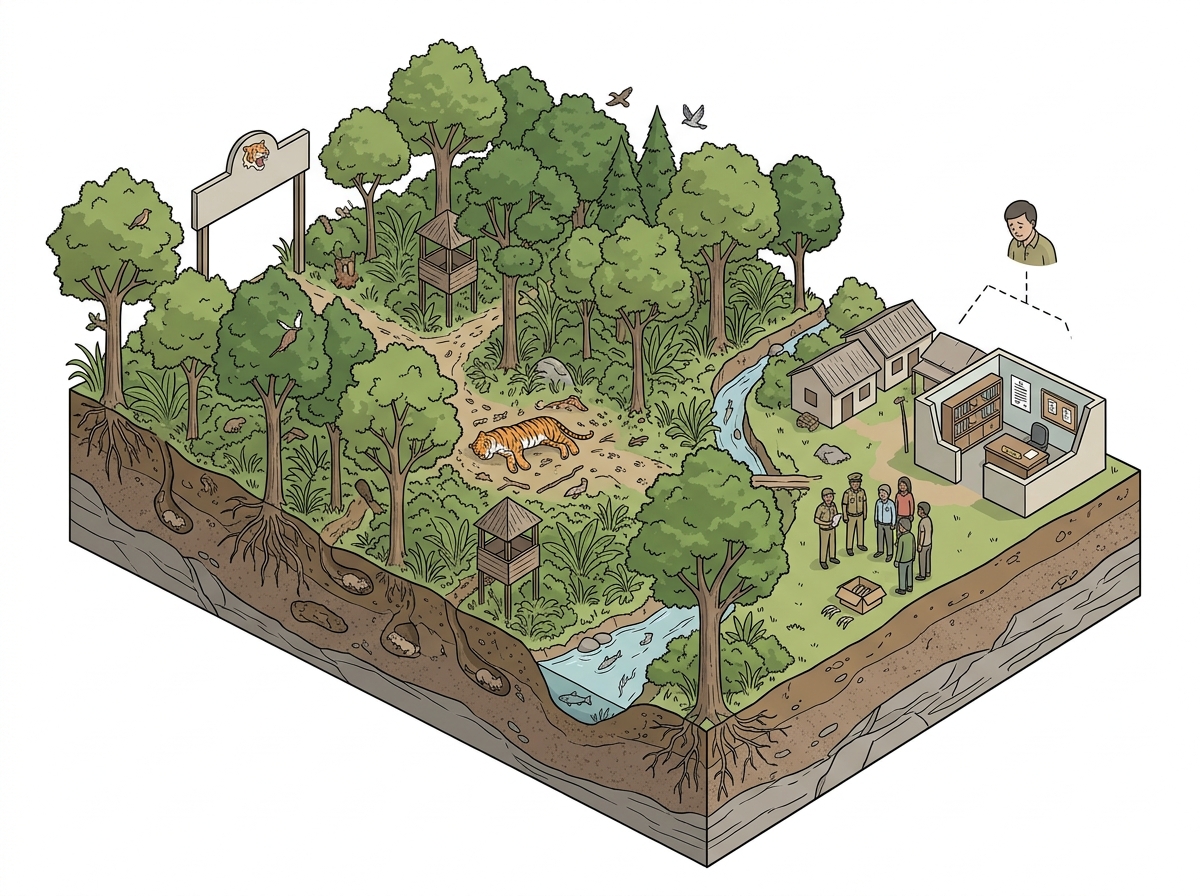
12 Aug Tiger Death in Andhra’s Nagarjunasagar Reserve: Official Suspended for Cover-Up
Tiger ReserveField staffWildlife mortalityPoaching threatsConservation authorities✎ The concealment of a tigress’s death in NSTR and the subsequent recovery of suspected tiger claws underscore the critical need for strict adherence to the Wildlife (Protection) Act, 1972, and the implementation of robust…
Subject Relevance — Where This Topic Fits
- GS Paper III — Environment and Biodiversity | GS Paper III — Disaster and Disaster Management | GS Paper IV — Ethics and Human Interface (Accountability and Transparency)
- Prelims: Nagarjunasagar Srisailam Tiger Reserve (NSTR), Project Tiger Division, Undetected Offence Report (UDOR), Wildlife (Protection) Act, 1972, Central Zoo Authority, CCMB (Centre for Cellular and Molecular Biology), snare traps, tiger mortality, forensic wildlife investigation
- Essay: Conservation of biodiversity: Balancing ecological imperatives with institutional accountability, The role of transparency and ethical governance in wildlife protection initiatives
Quick Revision: The concealment of a tigress’s death in NSTR and the subsequent recovery of suspected tiger claws underscore the critical need for strict adherence to the Wildlife (Protection) Act, 1972, and the implementation of robust monitoring mechanisms to prevent poaching and ensure institutional accountability in wildlife conservation.
Why is this in the news?
The Nagarjunasagar Srisailam Tiger Reserve (NSTR) in Andhra Pradesh has recently come under scrutiny following the belated disclosure of a tigress’s death in September 2025, which was concealed by field staff and resulted in the suspension of an official. The incident underscores systemic failures in wildlife mortality reporting protocols, the circumvention of legal provisions under the Wildlife (Protection) Act, 1972, and the broader challenges in ensuring accountability within India’s tiger conservation framework. Concurrently, the recovery of suspected tiger claws from individuals arrested in the vicinity highlights the persistent threats posed by poaching and illegal wildlife trade, necessitating a multi-pronged response from enforcement agencies and conservation authorities.
Background
- The Nagarjunasagar Srisailam Tiger Reserve (NSTR), spanning Andhra Pradesh and Telangana, is one of India’s largest tiger reserves, designated under Project Tiger and recognised as a critical habitat for the Bengal tiger (Panthera tigris tigris).
- Project Tiger, launched in 1973, is a centrally sponsored scheme aimed at ensuring the viability of tiger populations in designated reserves through habitat management, anti-poaching measures, and community engagement.
- The Wildlife (Protection) Act, 1972, is the primary legal framework governing wildlife conservation in India, mandating strict protocols for the reporting, investigation, and disposal of wildlife mortalities, including tigers.
- India’s tiger population has shown a positive trend, with the 2022 census reporting 3,167 tigers, but challenges such as habitat fragmentation, human-wildlife conflict, and poaching persist.
- The Centre for Cellular and Molecular Biology (CCMB) in Hyderabad is a premier institution for forensic wildlife investigations, including DNA analysis of seized animal parts to establish species and individual identity.
What is the Nagarjunasagar Srisailam Tiger Reserve (NSTR) and its significance in India’s tiger conservation framework?
- NSTR is a designated Project Tiger Reserve under the Wildlife (Protection) Act, 1972, and spans the districts of Kurnool, Prakasam, and Guntur in Andhra Pradesh, as well as parts of Telangana.
- It is one of the largest tiger reserves in India, covering approximately 3,568 square kilometres, and serves as a critical corridor for tiger movement between the Eastern and Western Ghats.
- The reserve is home to a diverse range of flora and fauna, including the Bengal tiger, leopard, sloth bear, and several endangered bird species, making it a biodiversity hotspot.
- Project Tiger, launched in 1973, provides financial and technical support to NSTR for habitat restoration, prey base management, anti-poaching operations, and community-based conservation initiatives.
- The reserve operates under a multi-tiered governance structure, including the National Tiger Conservation Authority (NTCA), State Forest Department, and local Project Tiger Divisions, with clear mandates for monitoring and enforcement.
- NSTR follows a zoning approach, with core, buffer, and transition zones, to balance conservation needs with sustainable development and local livelihoods.
- The reserve is subject to periodic monitoring through the All India Tiger Estimation (AITE) exercise, which assesses tiger populations, habitat health, and prey density using camera traps and field surveys.
- Recent incidents, including the reported death of a tigress in a snare trap, highlight the operational challenges in enforcing anti-poaching measures and ensuring compliance with wildlife protection protocols.
Key Features
| Feature | Significance |
|---|---|
| Undetected Offence Report (UDOR) registration | Institutes formal legal proceedings against unidentified perpetrators responsible for illegal snare placement leading to tiger death. |
| Disciplinary action against forest staff | Highlights procedural lapses in wildlife crime reporting and carcass disposal, underscoring the need for adherence to Standard Operating Procedures (SOPs). |
| Forensic analysis of suspected remains | Emphasises the role of scientific investigation (e.g., bone fragment analysis) in wildlife crime resolution, aligning with forensic wildlife protocols. |
| Collaboration with CCMB Hyderabad | Demonstrates inter-institutional coordination for species identification, reinforcing the importance of laboratory support in wildlife conservation. |
| Arrest of suspects in possession of tiger claws | Exposes illegal wildlife trade networks, a critical threat to tiger populations under the Wildlife Protection Act, 1972. |
Why it Matters
Conservation Governance
- Exposes systemic failures in wildlife crime detection and reporting within protected areas, necessitating stricter enforcement of the Wildlife Protection Act, 1972.
- Underscores the role of Project Tiger Division in maintaining accountability for field-level staff, ensuring compliance with conservation protocols.
- Highlights the importance of real-time monitoring systems (e.g., camera traps, patrol logs) to prevent delays in reporting wildlife deaths.
Legal and Institutional Frameworks
- Reinforces the legal mandate under Section 9 of the Wildlife Protection Act, 1972, which prohibits the use of snares and other lethal traps in tiger reserves.
- Demonstrates the application of forensic science in wildlife crime investigations, as mandated by the National Wildlife Crime Control Bureau (NWCCB).
- Illustrates the procedural rigour required under the Indian Forest Act, 1927, and state forest rules for carcass disposal and evidence preservation.
Ecological and Biodiversity Impact
- Tiger mortality due to snares disrupts population stability, particularly in critical habitats like Nagarjunasagar Srisailam Tiger Reserve (NSTR), a key tiger corridor.
- Poaching for body parts (e.g., claws) exacerbates threats to tiger populations, already listed as endangered under the IUCN Red List.
- Undocumented deaths hinder demographic studies and conservation planning, as vital data on mortality causes and age structures are lost.
Societal and Ethical Dimensions
- Raises public awareness about the consequences of illegal wildlife trade and habitat encroachment, fostering community participation in conservation.
- Highlights ethical obligations of forest departments to uphold transparency and accountability in wildlife management.
- Underscores the need for capacity-building among forest staff in forensic techniques and wildlife crime investigation.
Challenges
1. Procedural Lapses in Wildlife Crime Reporting
- Delayed or absent reporting of wildlife deaths compromises conservation data integrity and delays criminal investigations.
- Disposal of carcasses without forensic examination obstructs evidence collection, impeding prosecution under wildlife laws.
- Inadequate staff training in Standard Operating Procedures (SOPs) for wildlife crime reporting and evidence preservation.
UPSC Link: Wildlife Protection Act, 1972 – Section 9 (Prohibited Acts)
2. Illegal Wildlife Trade Networks
- Poaching for tiger body parts (e.g., claws, bones) remains a persistent threat, driven by demand in illegal markets.
- Inadequate surveillance and intelligence-sharing mechanisms to dismantle wildlife trafficking syndicates operating near tiger reserves.
- Limited inter-state and inter-agency coordination to track and apprehend poachers across jurisdictions.
UPSC Link: Wildlife (Protection) Act, 1972 – Schedule I (Absolute Protection)
3. Habitat Fragmentation and Human-Wildlife Conflict
- Snare placements often occur in peripheral zones of tiger reserves, where human encroachment and resource extraction pressures are high.
- Lack of alternative livelihoods for local communities exacerbates dependence on forest resources, increasing human-wildlife conflict.
- Inadequate enforcement of the Forest Rights Act, 2006, leading to unregulated access to critical tiger habitats.
UPSC Link: Forest Rights Act, 2006 – Section 3 (Recognition of Forest Rights)
4. Forensic and Scientific Capacity Gaps
- Limited access to advanced forensic laboratories for species identification and DNA analysis in wildlife crime cases.
- Insufficient training for forest staff in forensic techniques, including evidence collection and chain-of-custody protocols.
- Delays in processing samples at institutions like CCMB Hyderabad due to high caseloads and resource constraints.
UPSC Link: National Wildlife Crime Control Bureau (NWCCB) – Forensic Guidelines
5. Institutional Accountability and Transparency
- Need for independent audits of forest department functioning to identify systemic gaps in wildlife crime prevention.
- Strengthening of internal grievance redressal mechanisms to address procedural violations without fear of retribution.
- Public disclosure of investigation outcomes to build trust and demonstrate commitment to conservation ethics.
UPSC Link: Wildlife Protection Act, 1972 – Section 50 (Powers of Officers)
Challenges — UPSC Perspective
| Issue | Concern |
|---|---|
| Delayed reporting of wildlife deaths | Loss of critical evidence for forensic analysis and criminal prosecution. |
| Poaching for tiger body parts | Drives population decline and undermines conservation efforts. |
| Inadequate staff training in forensic protocols | Compromises evidence integrity and legal outcomes. |
| Habitat encroachment and human-wildlife conflict | Increases poaching risks and reduces tiger habitat connectivity. |
| Limited inter-agency coordination | Obstructs dismantling of wildlife trafficking networks. |
| Resource constraints in forensic laboratories | Delays species identification and evidence processing. |
Way Forward
- Strengthen real-time monitoring systems (e.g., camera traps, GPS-enabled patrol logs) in tiger reserves to detect wildlife deaths promptly.
- Conduct mandatory forensic training for forest staff, including evidence collection, chain-of-custody, and wildlife crime investigation protocols.
- Enhance inter-agency coordination with the National Wildlife Crime Control Bureau (NWCCB) to dismantle poaching syndicates.
- Implement community-based surveillance programs to report illegal activities and reduce human-wildlife conflict.
- Establish a dedicated forensic unit within the forest department for rapid species identification and evidence analysis.
- Review and enforce Standard Operating Procedures (SOPs) for carcass disposal, ensuring forensic examination is mandatory.
- Promote public-private partnerships to augment forensic infrastructure and capacity in wildlife crime investigations.
- Undertake habitat restoration initiatives in peripheral zones of tiger reserves to reduce poaching opportunities.
UPSC Value Addition
Keywords for Mains Answer-Writing
Project Tiger Division · Nagarjunasagar Srisailam Tiger Reserve · wildlife crime and poaching · tiger mortality and snare traps · forest staff accountability · Undetected Offence Report (UDOR) · wildlife forensic examination · forest protection mechanisms · wildlife conservation governance · institutional compliance in forestry
Concept Flow
Illegal snare placement in tiger reserve → Tiger mortality (undiscovered in September 2025) → Delayed reporting by field staff → Disposal of carcass without forensic examination → Suspension of officials and UDOR registration → Arrest of suspects in possession of tiger claws → Forensic analysis at CCMB Hyderabad → Ongoing investigation to identify perpetrators.
Prelims Practice Questions
Q1. Consider the following statements about the Project Tiger Division in India:
1. It operates under the aegis of the National Tiger Conservation Authority (NTCA).
2. The Nagarjunasagar Srisailam Tiger Reserve is located in Andhra Pradesh and Telangana.
3. The Project Tiger Division is responsible for the management of all wildlife sanctuaries in India.
4. The Division enforces the Wildlife Protection Act, 1972, and related rules.
How many of the above statements are correct?
- Only one
- Only two
- Only three
- All four
Answer: Only three — Statements 1 and 4 are correct. Statement 2 is partially correct but the reserve lies entirely within Andhra Pradesh. Statement 3 is incorrect as the Division manages tiger reserves, not all wildlife sanctuaries.
Q2. Assertion (A): The Wildlife Protection Act, 1972, provides for the establishment of the National Tiger Conservation Authority (NTCA).
Reason (R): The NTCA is mandated to approve the Tiger Conservation Plans prepared by the State Governments.
Options:
A. Both A and R are true, and R is the correct explanation of A.
B. Both A and R are true, but R is not the correct explanation of A.
C. A is true but R is false.
D. A is false but R is true.
Answer: ? — The Wildlife Protection Act, 1972, under Section 38L, establishes the NTCA. The NTCA is indeed mandated to approve Tiger Conservation Plans under Section 38V(1). Hence, both A and R are true, and R correctly explains A.
Q3. Match the following Tiger Reserves in Column I with their respective States in Column II:
Column I
1. Nagarjunasagar Srisailam
2. Periyar
3. Sariska
4. Ranthambore
Column II
A. Rajasthan
B. Kerala
C. Andhra Pradesh
D. Karnataka
E. Tamil Nadu
- 1-C, 2-B, 3-A, 4-D
- 1-C, 2-B, 3-A, 4-E
- 1-D, 2-B, 3-A, 4-E
- 1-E, 2-B, 3-A, 4-D
Answer: 1-C, 2-B, 3-A, 4-E — Nagarjunasagar Srisailam is in Andhra Pradesh, Periyar in Kerala, Sariska in Rajasthan, and Ranthambore in Rajasthan (not Karnataka or Tamil Nadu).
Mains Practice Question
✍ The institutional framework for tiger conservation in India is designed to ensure accountability at multiple levels. Critically examine the governance mechanisms under the Wildlife Protection Act, 1972, and the Project Tiger Division, with reference to recent incidents of tiger mortality in protected areas. Also, assess the adequacy of existing accountability measures in addressing lapses in field-level enforcement. (15 Marks)
Approach: MODEL-ANSWER SKELETON:
1. **Legal and Institutional Framework (4 marks)**
– Wildlife Protection Act, 1972: Sections 38L (NTCA), 38O (Tiger Conservation Plans), 38V (approval and oversight).
– Role of National Tiger Conservation Authority (NTCA) and State Forest Departments.
– Project Tiger Division: Structure, functions, and reporting mechanisms under NTCA.
– Institutional hierarchy: Deputy Director Project Tiger, Range Officers, field staff.
2. **Incident Analysis (5 marks)**
– Nagarjunasagar Srisailam Tiger Reserve case: Delayed reporting, disposal of carcass, snare traps, and forensic gaps.
– UDOR (Undetected Offence Report) and its legal implications under the Wildlife Protection Act.
– Role of outsourced watchers and accountability of forest officials.
– Recent arrests (suspected tiger claws) and their connection to poaching networks.
3. **Accountability Measures (4 marks)**
– Disciplinary actions: Suspension of Section Officer, disengagement of outsourced staff.
– Gaps in field-level enforcement: Delayed reporting, lack of real-time monitoring, forensic delays.
– Role of technology: Use of camera traps, GPS tracking, and digital reporting systems.
– Comparative analysis: Lessons from other tiger reserves (e.g., Sariska, Ranthambore) where lapses were addressed.
4. **Way Forward (2 marks)**
– Strengthening real-time monitoring: Integration of AI and remote sensing.
– Capacity building for field staff: Training on forensic protocols and reporting timelines.
– Public-private partnerships: Involvement of NGOs and local communities in monitoring.
– Legal reforms: Mandatory forensic examination of carcasses and stricter penalties for poaching.
Source: The Hindu
Generated by AanyaAi for educational purpose.

- Gurugram’s groundwater extraction exceeds limit by 212%; HC seeks ban - October 4, 2026
- स्वतंत्रता सेनानी श्यामजी कृष्ण वर्मा की जन्म जयंती पर पीएम का श्रद्धांजलि - October 4, 2026
- KWML’s Feasibility Reports for Water Metro in 18 Cities: UPSC & PCS Insights - October 3, 2026

No Comments