


12 Aug Government’s Roadmap for Self-Reliant & Competitive Nuclear Energy Ecosystem
✎ India’s nuclear energy roadmap targets 100 GW capacity by 2047 through indigenous PHWRs, SMRs, and thorium utilisation, supported by the Atomic Energy Mission and the Nuclear Energy (Peaceful Uses and Development for India's…
Subject Relevance — Where This Topic Fits
- GS Paper III — Science and Technology (Energy Sector, Nuclear Technology, Indigenous Innovation) | GS Paper III — Environment and Disaster Management (Energy Transition, Low-Carbon Development)
- Prelims: Nuclear Power Corporation of India Limited (NPCIL), Atomic Energy Regulatory Board (AERB), Bhabha Atomic Research Centre (BARC), Indira Gandhi Centre for Atomic Research (IGCAR), Small Modular Reactors (SMRs), Pressurised Heavy Water Reactors (PHWR), Fast Breeder Reactors (FBR), Thorium-based Nuclear Fuel Cycle, Nuclear Energy Act 2025, Atomic Energy Commission (AEC), Department of Atomic Energy (DAE)
- Essay: Energy Transition and Sustainable Development: The Role of Nuclear Power, Indigenous Innovation and Self-Reliance in Critical Technologies
Quick Revision: India’s nuclear energy roadmap targets 100 GW capacity by 2047 through indigenous PHWRs, SMRs, and thorium utilisation, supported by the Atomic Energy Mission and the Nuclear Energy (Peaceful Uses and Development for India’s Transformation) Act, 2025.
Why is this in the news?
The Union Minister of State for Personnel, Public Grievances and Pensions and Prime Minister’s Office, Dr. Jitendra Singh, presented in the Lok Sabha a comprehensive government roadmap aimed at achieving an indigenous, globally competitive nuclear energy ecosystem. This initiative is anchored in the Atomic Energy Mission announced in the Union Budget 2025-26 and seeks to expand India’s nuclear power capacity to 100 GW by 2047 through a dual strategy of deploying large indigenous Pressurised Heavy Water Reactors (PHWRs) and accelerating the development and deployment of Small Modular Reactors (SMRs), leveraging domestic manufacturing, private sector participation, and thorium-based fuel cycles.
Background
- India’s nuclear energy programme is governed by the three-stage nuclear power programme formulated by Dr. Homi J. Bhabha in the 1950s, which envisages progressive utilisation of India’s vast thorium reserves to ensure long-term energy security.
- The Atomic Energy Act, 1962 (amended in 2025 as the Nuclear Energy (Peaceful Uses and Development for India’s Transformation) Act, 2025) provides the legal framework for the development, regulation, and utilisation of nuclear energy in India, including provisions for public and private sector participation.
- The Department of Atomic Energy (DAE), established in 1954, is the nodal agency responsible for the formulation and implementation of India’s nuclear energy policies and programmes.
- The Atomic Energy Commission (AEC), chaired by the Prime Minister, oversees the DAE and its constituent units, including BARC, IGCAR, and NPCIL.
- The Union Budget 2025-26 introduced the Atomic Energy Mission to accelerate the deployment of nuclear power, including the development of indigenous Small Modular Reactors (SMRs) and advanced reactor technologies.
What constitutes India’s strategic roadmap for a competitive nuclear energy ecosystem?
- The roadmap is structured around the three-stage nuclear power programme, which aims to progressively utilise India’s thorium resources to achieve long-term energy security and reduce dependence on imported uranium.
- The Atomic Energy Mission, announced in Budget 2025-26, sets a target of 100 GW nuclear power capacity by 2047, a significant increase from the current ~7.5 GW, to be achieved through a dual strategy: large indigenous PHWRs and advanced reactor designs at greenfield sites, and SMRs at brownfield sites (e.g., decommissioned fossil fuel plants, captive power plants, and off-grid locations).
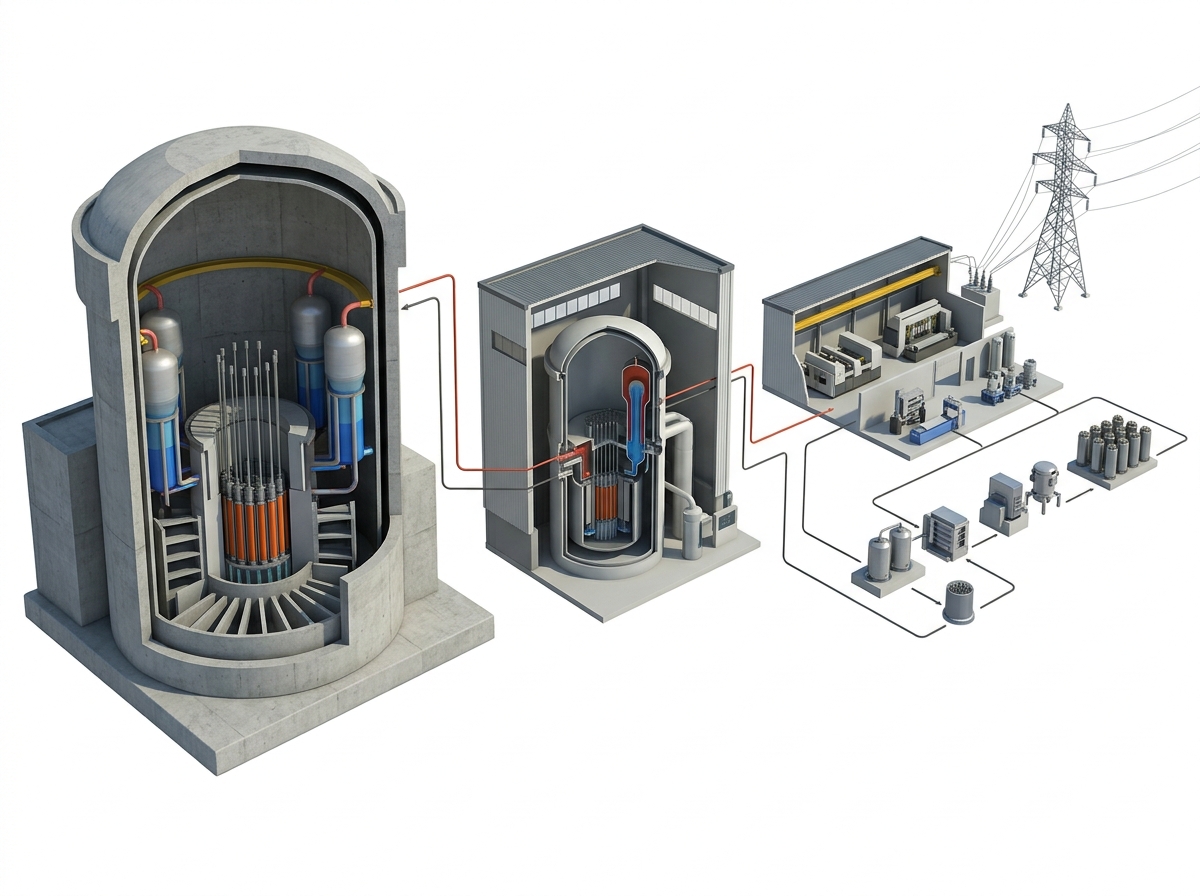
- Small Modular Reactors (SMRs) are compact, scalable, and flexible nuclear reactors designed for modular deployment, enhanced safety, and suitability for remote or industrial applications. India aims to operationalise at least five indigenous SMRs by 2033.
- Bhabha Atomic Research Centre (BARC) is developing indigenous SMR technologies, including the 220 MW Bharat Small Modular Reactor (BSMR-200) and the 55 MW SMR-55, as well as High-Temperature Gas-Cooled Reactors (HTGRs) with potential for hydrogen production via thermochemical cycles.
- Indira Gandhi Centre for Atomic Research (IGCAR) is advancing Fast Breeder Reactor (FBR) technology and associated closed fuel cycle facilities, which are critical for the second stage of India’s nuclear programme and for utilising thorium in the third stage.
- The Nuclear Energy (Peaceful Uses and Development for India’s Transformation) Act, 2025, enacted to foster a comprehensive domestic nuclear ecosystem, enables broader participation of public and private entities in nuclear energy projects, including manufacturing, R&D, and deployment.
- The roadmap emphasises domestic manufacturing capabilities, with key components such as reactor pressure vessels and reactivity control drive mechanisms already being produced indigenously. The DAE is also strengthening private sector R&D and fostering knowledge-sharing to build a robust nuclear vendor ecosystem.
- The strategy integrates environmental sustainability by promoting low-carbon nuclear power, reducing reliance on fossil fuels, and supporting India’s commitments under international climate agreements such as the Paris Agreement.
Key Features
| Feature | Significance |
|---|---|
| Three-stage Nuclear Power Programme | Ensures long-term energy security by utilising India’s vast thorium reserves through a sequential approach of pressurised heavy water reactors, fast breeder reactors, and thorium-based reactors. |
| Small Modular Reactors (SMRs) | Enable scalable, flexible deployment in brownfield sites (e.g., decommissioned thermal plants), reducing capital costs and accelerating capacity addition. |
| Indigenous PHWRs (700 MWe) | Leverage domestic manufacturing capabilities to reduce import dependence and enhance energy self-reliance in large-scale nuclear power generation. |
| Thorium utilisation focus | Aligns with India’s strategic advantage of abundant thorium resources, supporting sustainable and long-term nuclear fuel security. |
| Nuclear Energy Mission (2025-26 Budget) | Provides institutional framework and funding to achieve 100 GW nuclear capacity by 2047 through public-private partnerships and advanced R&D. |
Why it Matters
Economic
- Reduces import dependence on uranium by leveraging domestic thorium reserves and indigenous reactor technologies.
- Lowers capital expenditure through modular deployment of SMRs in brownfield sites, optimising existing infrastructure.
- Enhances energy security by diversifying the power mix, reducing reliance on fossil fuels for baseload capacity.
Strategic
- Strengthens India’s position in global nuclear technology by developing advanced reactor designs and SMRs for export potential.
- Supports decarbonisation goals by expanding low-carbon nuclear power capacity to meet climate commitments.
- Ensures technological sovereignty in nuclear energy, reducing vulnerabilities in supply chains for critical components.
Technological
- Advances indigenous nuclear reactor design, including high-temperature gas-cooled reactors (HTGR) for hydrogen production.
- Accelerates R&D in fast breeder reactors (FBR) and closed fuel cycle facilities, enhancing fuel efficiency and waste minimisation.
- Promotes private sector participation in nuclear R&D, fostering innovation and reducing the burden on public institutions.
Environmental
- Supports India’s net-zero targets by increasing the share of nuclear power in the energy mix, a low-carbon baseload source.
- Facilitates transition of coal-based captive power plants to SMRs, reducing local air pollution and carbon emissions.
- Enables off-grid applications in remote areas, reducing diesel dependency and associated environmental costs.
Challenges
1. Regulatory and Licensing Hurdles
- Stringent safety and environmental regulations for nuclear projects, particularly for SMRs and advanced reactors, may delay project timelines.
- Need for harmonised regulatory frameworks to accommodate novel reactor designs and private sector participation.
- Public perception and local stakeholder engagement challenges in siting nuclear facilities, including brownfield conversions.
UPSC Link: GS-III: Energy, Environment & Disaster Management
2. Technological and R&D Gaps
- Indigenous development of SMRs and advanced reactors requires sustained investment in R&D and testing infrastructure.
- Limited domestic manufacturing capacity for critical nuclear components (e.g., reactor pressure vessels, fuel fabrication) necessitates scaling up.
- Integration of thorium fuel cycles in fast breeder reactors remains a complex technological challenge requiring long-term R&D.
UPSC Link: GS-III: Science & Technology
3. Financial and Investment Constraints
- High upfront capital costs for nuclear projects, despite modularisation, pose financing challenges for public and private investors.
- Need for innovative financing models (e.g., viability gap funding, green bonds) to attract private capital into nuclear energy.
- Competition with other renewable energy sources (solar, wind) for limited public and private sector investment.
UPSC Link: GS-III: Investment Models & Infrastructure
4. Supply Chain and Raw Material Dependence
- Dependence on imported critical materials (e.g., high-grade steel, specialised alloys) for reactor construction and fuel fabrication.
- Vulnerability to global supply chain disruptions, particularly for components requiring high precision manufacturing.
- Need to develop domestic supply chains for nuclear-grade materials to ensure long-term resilience.
UPSC Link: GS-III: Industrial Policy & Supply Chain
5. Human Resource and Skill Development
- Shortage of skilled nuclear engineers, technicians, and safety personnel to support the expansion of nuclear capacity.
- Need for specialised training programmes and collaborations with academic institutions to build a talent pipeline.
- Retention of nuclear scientists and engineers amid competition from private sector and international opportunities.
UPSC Link: GS-II: Human Resource Development
Challenges — UPSC Perspective
| Issue | Concern |
|---|---|
| Public Acceptance | Local opposition to nuclear projects, particularly in brownfield conversions or new greenfield sites. |
| Regulatory Delays | Lengthy approval processes for nuclear projects due to safety and environmental clearances. |
| Fuel Cycle Complexity | Technological challenges in thorium fuel utilisation and closed fuel cycles. |
| Private Sector Reluctance | Limited private investment in nuclear R&D due to high risks and long gestation periods. |
| Grid Integration | Challenges in integrating variable nuclear output with existing grid infrastructure and renewable energy systems. |
Way Forward
- Accelerate indigenous development of SMRs and advanced reactors through increased funding for BARC and IGCAR, with clear timelines for prototype deployment.
- Establish a dedicated public-private partnership (PPP) framework for nuclear projects, including viability gap funding and risk-sharing mechanisms.
- Strengthen domestic manufacturing of critical nuclear components by incentivising private sector participation and investing in specialised industrial clusters.
- Develop a national skill development programme for nuclear energy, collaborating with IITs, NITs, and international institutions to address the talent gap.
- Streamline regulatory processes for SMRs and advanced reactors by creating a dedicated nuclear safety authority with expertise in novel technologies.
- Expand thorium utilisation research by scaling up pilot projects and integrating thorium fuel cycles into existing fast breeder reactors.
- Promote international collaborations for technology transfer and joint R&D in advanced nuclear systems, while ensuring compliance with non-proliferation norms.
- Enhance public awareness campaigns to address misconceptions about nuclear energy and highlight its role in energy security and climate action.
UPSC Value Addition
Keywords for Mains Answer-Writing
Atomic Energy Act, 1962 (Amendment) 2025 · Small Modular Reactors (SMR) · Three-stage Nuclear Power Programme · Thorium utilisation in India · Nuclear Power Corporation of India Limited (NPCIL) · Indira Gandhi Centre for Atomic Research (IGCAR) · Bhabha Atomic Research Centre (BARC) · Nuclear Power Mission 2047 · Pressurised Heavy Water Reactors (PHWR) · Public-Private Partnership in nuclear sector · Peaceful Nuclear Energy utilisation · Domestic nuclear manufacturing ecosystem · Advanced reactor technologies · Fast Breeder Reactors (FBR) · Greenfield and Brownfield nuclear sites
Concept Flow
India’s Three-Stage Nuclear Power Programme → Sequential utilisation of uranium, fast breeder reactors, and thorium-based reactors for long-term energy security. → Indigenous Reactor Development (PHWRs, SMRs) → Reduces import dependence and enhances technological sovereignty. → Nuclear Energy Mission (2025-26 Budget) → Provides institutional and financial framework for capacity expansion to 100 GW by 2047. → Public-Private Partnerships → Encourages private sector investment in R&D and project execution, accelerating deployment. → Brownfield Site Utilisation (SMRs) → Repurposes decommissioned thermal plants, reducing capital costs and environmental impact. → Thorium Fuel Cycle Integration → Leverages India’s strategic advantage in thorium reserves for sustainable nuclear energy. → Regulatory and Safety Framework → Ensures compliance with international standards while fostering innovation in reactor designs.
Prelims Practice Questions
Q1. Consider the following statements regarding India’s Three-Stage Nuclear Power Programme:
1. The first stage utilises Pressurised Heavy Water Reactors (PHWRs) fuelled by natural uranium.
2. The second stage involves Fast Breeder Reactors (FBRs) using plutonium-based fuel.
3. The third stage aims at utilising thorium as fuel in Advanced Heavy Water Reactors (AHWRs).
How many of the above statements are correct?
- Only one
- Only two
- All three
- None
Answer: All three — Statements 1 and 2 are correct as PHWRs are the backbone of Stage-I and FBRs are central to Stage-II. Statement 3 is incorrect because the third stage targets thorium utilisation in Advanced Heavy Water Reactors (AHWRs), not PHWRs.
Q2. Assertion (A): The Atomic Energy Act, 1962 (Amendment) 2025 enables public-private partnership in India’s nuclear sector.
Reason (R): The amendment introduces provisions for private sector participation in nuclear power generation and allied activities while maintaining the state’s monopoly over fissile material.
- Both A and R are true, and R is the correct explanation of A
- Both A and R are true, but R is NOT the correct explanation of A
- A is true but R is false
- A is false but R is true
Answer: Both A and R are true, and R is the correct explanation of A — Both the assertion and reason are factually correct. The amendment indeed facilitates public-private partnerships by allowing private entities to participate in nuclear power projects while the state retains control over fissile materials under the Act.
Q3. Match the following components of India’s nuclear power programme with their respective institutions:
Column I (Component) | Column II (Institution)
———————————————–|—————————
A. Development of Small Modular Reactors (SMR) | 1. Nuclear Power Corporation of India Limited (NPCIL)
B. Research on Fast Breeder Reactors (FBR) | 2. Indira Gandhi Centre for Atomic Research (IGCAR)
C. Pressurised Heavy Water Reactors (PHWR) | 3. Bhabha Atomic Research Centre (BARC)
D. Thorium utilisation research | 4. Atomic Energy Regulatory Board (AERB)
- A-3, B-2, C-1, D-3; A-1, B-2, C-3, D-4; A-3, B-2, C-1, D-4; A-2, B-1, C-3, D-4
- answer_indexes_are_integer_array_but_not_asked_here
- explain_in_json_is_not_required_for_match_format
- format
- match
- q_in_full_is_provided_above
Answer: A-3, B-2, C-1, D-3; A-1, B-2, C-3, D-4; A-3, B-2, C-1, D-4; A-2, B-1, C-3, D-4 —
Q4. Which of the following best describes the primary objective of India’s Nuclear Power Mission 2047?
A. To achieve 100 GW of nuclear power capacity by 2047 through indigenous technologies and public-private partnerships.
B. To replace all thermal power plants with nuclear plants by 2047.
C. To export nuclear reactors to developing countries by 2047.
D. To decommission all existing nuclear reactors by 2047.
- A
- B
- C
- D
Answer: A — The Nuclear Power Mission 2047 aims to expand India’s nuclear power capacity to 100 GW by 2047 using indigenous technologies and fostering public-private partnerships, as outlined in the Atomic Energy (Amendment) Act, 2025 and subsequent policy measures.
Mains Practice Question
✍ Critically analyse the significance of Small Modular Reactors (SMRs) in India’s quest for energy security and self-reliance in the nuclear sector. In your answer, discuss the technological, economic, and strategic advantages they offer, and evaluate the challenges in their large-scale deployment. (15 Marks)
Approach: MODEL-ANSWER SKELETON:
1. **Introduction (2 Marks)**
– Define SMRs: Small Modular Reactors are advanced nuclear reactors with power output typically less than 300 MWe, designed for modular fabrication and scalability.
– Context: India’s Nuclear Power Mission 2047 aims for 100 GW capacity by 2047, necessitating diversification beyond large PHWRs and FBRs.
2. **Technological Advantages (4 Marks)**
– **Modularity and Flexibility**: SMRs can be factory-fabricated and transported to site, reducing construction time and costs (e.g., BARC’s BSM-55 and BSM-200 designs).
– **Safety and Passive Systems**: Enhanced safety features such as passive cooling and lower power density reduce risk of meltdowns.
– **Hybrid Applications**: Potential for co-generation (electricity + hydrogen production via thermochemical cycles, e.g., HTGRs under development at BARC).
– **Integration with Existing Infrastructure**: Deployment in brownfield sites (e.g., retired thermal plants, remote grids) leverages existing grid connectivity.
3. **Economic and Strategic Benefits (4 Marks)**
– **Cost Efficiency**: Lower capital expenditure due to modular construction and shorter project timelines.
– **Energy Access**: Ideal for decentralised power in remote areas (e.g., Andaman & Nicobar Islands, Ladakh) and industrial clusters.
– **Indigenous Manufacturing**: Promotes domestic nuclear industry, reducing import dependence (e.g., reactor pressure vessels, control drive mechanisms).
– **Public-Private Partnerships (PPP)**: Enabled by Atomic Energy (Amendment) Act, 2025, fostering innovation and investment (e.g., NPCIL’s role in scaling SMRs).
4. **Challenges in Deployment (4 Marks)**
– **Regulatory Hurdles**: Stringent safety norms under Atomic Energy Regulatory Board (AERB) require robust licensing frameworks for SMRs.
– **Public Perception and Acceptance**: Addressing concerns related to nuclear safety, waste management, and proliferation risks.
– **Supply Chain and Skilling**: Need for indigenous supply chains for advanced materials (e.g., low-alloy steel forging) and skilled workforce.
– **Economic Viability**: Competitiveness with other energy sources (e.g., solar, wind) in cost-sensitive markets.
5. **Conclusion (1 Mark)**
– SMRs represent a transformative opportunity for India’s nuclear sector, aligning with the goals of energy security, self-reliance, and sustainability. However, their success hinges on overcoming regulatory, technological, and socio-economic challenges through sustained R&D, PPP models, and public awareness campaigns.
Source: PIB (Press Information Bureau)
Generated by AanyaAi for educational purpose.


No Comments