


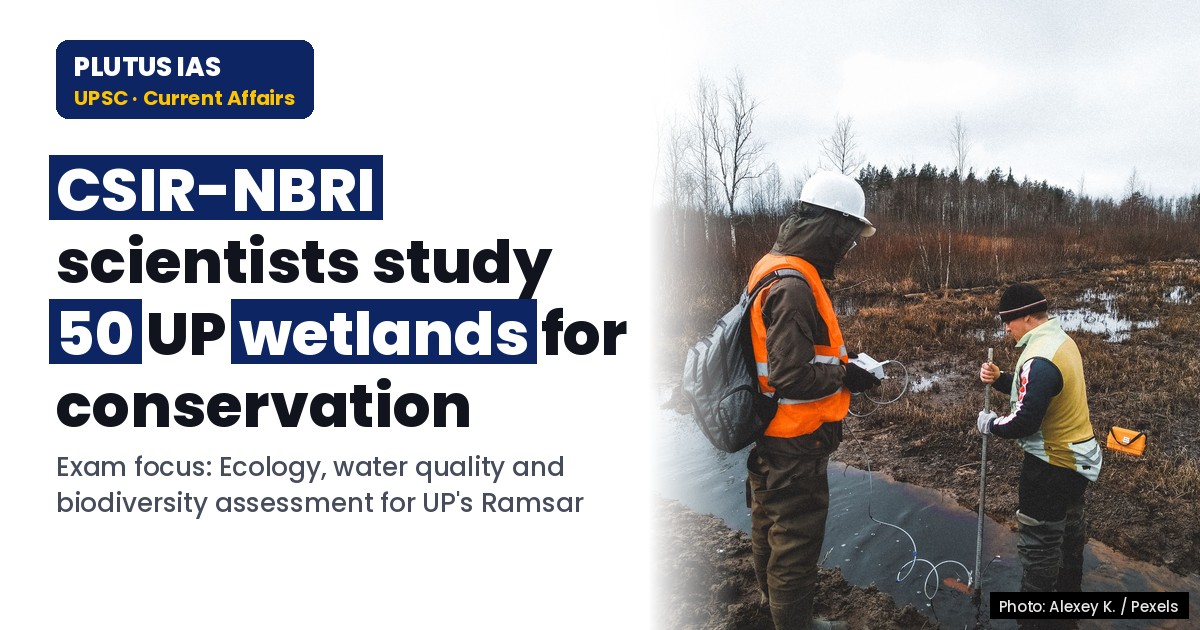
04 Oct Uttar Pradesh Launches Scientific Study of 50 Wetlands Including Ramsar Sites
✎ Wetlands are multifunctional ecosystems critical for biodiversity conservation, climate regulation, and human well-being, and their ecological health must be scientifically assessed using hydrological, biological, and chemical…
Subject Relevance — Where This Topic Fits
- GS Paper III — Environment, Ecology, Biodiversity and Climate Change
- Prelims: Wetlands, Ramsar Convention, Biodiversity Hotspots, Ecological Services, Groundwater Recharge, Water Purification, Climate Change Mitigation, Wetland Conservation
- Essay: Conservation of Natural Resources: Balancing Development and Ecological Sustainability
Quick Revision: Wetlands are multifunctional ecosystems critical for biodiversity conservation, climate regulation, and human well-being, and their ecological health must be scientifically assessed using hydrological, biological, and chemical indicators to inform conservation policy and management.
Why is this in the news?
The CSIR-National Botanical Research Institute (NBRI), Lucknow, has initiated a comprehensive scientific assessment of 50 wetlands in Uttar Pradesh, including 13 Ramsar sites, to evaluate ecological health, water quality, and biodiversity. This multi-site study aims to strengthen conservation efforts and ecological balance by generating critical data on anthropogenic pressures, biological diversity, and ecosystem services, thereby addressing gaps in wetland management and policy implementation.
Background
- Wetlands constitute a critical component of India’s natural capital, providing essential ecosystem services such as groundwater recharge, flood mitigation, water purification, and climate regulation.
- India is a signatory to the Ramsar Convention (1971), an intergovernmental treaty for the conservation and sustainable use of wetlands.
- Uttar Pradesh, with its diverse riverine and lacustrine systems, hosts 13 Ramsar sites, including internationally significant bird habitats such as Surha Tal, Samaspur, and Bakhira Wildlife Sanctuary.
- Wetlands in Uttar Pradesh face increasing anthropogenic pressures including agricultural runoff, aquaculture, pesticide use, and encroachment, necessitating systematic ecological monitoring.
What is a Wetland? Understanding Its Ecological and Scientific Significance
- A wetland is a land area that is saturated with water, either permanently or seasonally, such that it takes on the characteristics of a distinct ecosystem. These include marshes, swamps, peatlands, and lakes.
- Wetlands are classified into various types based on hydrology, soil, and vegetation: coastal wetlands (e.g., mangroves), inland wetlands (e.g., lakes, rivers), and man-made wetlands (e.g., reservoirs).
- They perform vital ecological services: groundwater recharge, flood control, sediment trapping, water purification through nutrient and pollutant filtration, and carbon sequestration.
- Wetlands are biodiversity hotspots, supporting a wide range of flora and fauna, including migratory birds and endemic species.
- The Ramsar Convention defines wetlands of international importance as those meeting criteria related to species and ecological communities, rarity, representativeness, and hydrological functions.
- Scientific assessment of wetlands involves hydrological monitoring, water quality analysis (pH, dissolved oxygen, heavy metals, nutrients), biodiversity surveys (flora, fauna, avifauna), and socio-economic impact studies.
- Anthropogenic threats to wetlands include agricultural intensification, urbanization, industrial discharge, invasive species, over-extraction of water, and climate-induced changes such as altered precipitation patterns.
Key Features
| Feature | Significance |
|---|---|
| Scientific assessment of 50 wetlands | Provides empirical data on ecological health, water quality, and biodiversity for evidence-based conservation planning. |
| Focus on 13 Ramsar Sites in Uttar Pradesh | Ensures alignment with international commitments under the Ramsar Convention for wetland protection and sustainable use. |
| Multi-disciplinary study by CSIR-NBRI | Integrates botany, ecology, and environmental science to address complex wetland management challenges. |
| Field sampling of water and flora | Enables monitoring of pollution levels, invasive species, and ecological degradation in real time. |
| Assessment of anthropogenic pressures | Identifies human activities (agriculture, aquaculture, pesticide use) impacting wetland integrity for targeted mitigation. |
Why it Matters
Ecological
- Maintains critical habitats for migratory and resident avifauna, supporting global biodiversity conservation.
- Sustains groundwater recharge and flood mitigation, reducing vulnerability to climate-induced disasters.
- Preserves native aquatic flora and fauna, preventing ecosystem collapse and species extinction.
Economic
- Supports livelihoods of local communities dependent on fisheries, agriculture, and ecotourism around wetlands.
- Enhances water security for agricultural and domestic use, reducing dependency on external sources.
- Boosts regional tourism through bird-watching and nature-based recreational activities.
Policy and Governance
- Strengthens implementation of the National Wetland Conservation Programme and State Wetland Authority directives.
- Provides data for updating the National Wetland Inventory and Ramsar Information Sheets.
- Facilitates compliance with the Wetlands (Conservation and Management) Rules, 2017.
Scientific
- Generates baseline data for long-term ecological monitoring and climate change impact assessment.
- Supports research on wetland restoration techniques and invasive species control.
- Enhances understanding of nutrient cycling and carbon sequestration in inland aquatic ecosystems.
Challenges
1. Anthropogenic Pressure
- Agricultural runoff introducing nutrients and pesticides, leading to eutrophication and algal blooms.
- Unregulated aquaculture and fishing practices degrading water quality and disrupting food webs.
- Urbanization and land-use change reducing wetland area and fragmenting habitats.
UPSC Link: Environmental Pollution and Degradation
2. Inadequate Enforcement
- Limited capacity of State Wetland Authorities to monitor and regulate activities in protected wetlands.
- Lack of inter-departmental coordination between forest, agriculture, and water resource departments.
- Insufficient funding for wetland restoration and community-based conservation initiatives.
UPSC Link: Environmental Governance
3. Climate Change Vulnerability
- Increased frequency of extreme weather events (floods, droughts) altering wetland hydrology.
- Rising temperatures affecting species distribution and reproductive cycles of aquatic organisms.
- Salinization of freshwater wetlands due to sea-level rise and groundwater depletion.
UPSC Link: Climate Change Impacts
4. Data Gaps and Monitoring
- Incomplete baseline data on wetland biodiversity and ecological processes in many regions.
- Limited use of remote sensing and GIS technologies for real-time wetland health assessment.
- Inadequate integration of traditional ecological knowledge in modern wetland management.
UPSC Link: Environmental Monitoring
5. Policy Implementation Gaps
- Delayed notification of wetlands under the Wetlands (Conservation and Management) Rules, 2017.
- Overlapping jurisdictions between central and state agencies leading to regulatory conflicts.
- Insufficient penalties for violations of wetland conservation norms.
UPSC Link: Environmental Policy
Challenges — UPSC Perspective
| Issue | Concern |
|---|---|
| Nutrient and pesticide runoff | Eutrophication, algal blooms, and loss of aquatic biodiversity. |
| Unregulated aquaculture | Water quality degradation, introduction of invasive species, and habitat destruction. |
| Urban encroachment | Reduction in wetland area, fragmentation of habitats, and increased pollution loads. |
| Limited enforcement capacity | Non-compliance with conservation norms, delayed restoration efforts. |
| Climate change impacts | Altered hydrological regimes, species migration, and ecosystem instability. |
Way Forward
- Conduct regular ecological assessments of all 50 wetlands using standardized protocols for comparability.
- Strengthen State Wetland Authorities with technical and financial resources for effective monitoring.
- Promote community-based wetland management through awareness campaigns and participatory conservation.
- Integrate remote sensing and GIS technologies to enhance real-time wetland health tracking.
- Develop site-specific restoration plans for degraded wetlands, prioritizing Ramsar Sites.
- Enhance inter-departmental coordination to address overlapping regulatory jurisdictions.
- Establish a centralised wetland database to consolidate ecological and socio-economic data.
- Encourage research collaborations between CSIR-NBRI and academic institutions for long-term studies.
UPSC Value Addition
Keywords for Mains Answer-Writing
Wetlands conservation in India · Ramsar Convention · National Wetland Conservation Programme · CSIR-NBRI · Biodiversity assessment · Ecosystem services of wetlands · Wetland management plans · National Wetland Authority · Ramsar Sites in Uttar Pradesh · Water quality monitoring · Sustainable wetland utilisation · Anthropogenic pressures on wetlands · National Mission for Clean Ganga · Environmental Impact Assessment · Participatory conservation
Concept Flow
Anthropogenic pressures (agriculture, aquaculture, urbanization) degrade wetland ecosystems. → Degradation reduces water quality, biodiversity, and ecosystem services (flood control, groundwater recharge). → Scientific assessment by CSIR-NBRI identifies ecological stress points and pollution sources. → Data informs policy interventions under the Wetlands (Conservation and Management) Rules, 2017. → State Wetland Authorities enforce conservation measures and restoration plans. → Monitoring and adaptive management ensure sustained ecological health and compliance with Ramsar Convention.
Prelims Practice Questions
Q1. Consider the following statements regarding the Ramsar Convention:
1. It is a treaty signed in 1971 in the city of Ramsar, Iran.
2. India is a signatory to the Ramsar Convention.
3. The convention aims to conserve and sustainably utilise all wetlands of international importance.
4. The designation of a Ramsar Site confers legal protection under Indian law.
How many of the above statements are correct?
- Only one
- Only two
- Only three
- All
Answer: All — Statements 1, 2, and 3 are correct. Statement 4 is incorrect as Ramsar Site designation does not automatically confer legal protection under Indian law, though it guides conservation efforts.
Q2. Assertion (A): Wetlands play a crucial role in groundwater recharge and flood mitigation.
Reason (R): Wetlands act as natural sponges, absorbing excess water during floods and releasing it slowly during dry periods.
Options:
A. Both A and R are true, and R is the correct explanation of A.
B. Both A and R are true, but R is NOT the correct explanation of A.
C. A is true, but R is false.
D. A is false, but R is true.
Answer: ? — Both Assertion (A) and Reason (R) are true, and Reason (R) correctly explains Assertion (A). Wetlands function as natural sponges, moderating water flow and mitigating flood impacts while replenishing groundwater.
Q3. Match the following Ramsar Sites in Uttar Pradesh with their respective districts:
Column I (Ramsar Site) Column II (District)
A. Upper Ganga River 1. Sant Kabir Nagar
B. Surha Tal 2. Etawah
C. Sarsai Nawar Jheel 3. Balia
D. Bakhira Wildlife Sanctuary 4. Agra
Options:
A. A-3, B-1, C-2, D-4
B. A-4, B-3, C-2, D-1
C. A-2, B-3, C-4, D-1
D. A-1, B-2, C-3, D-4
Answer: ? — Correct matches: A. Upper Ganga River (Brajghat to Narora) – Agra district; B. Surha Tal (Jai Prakash Narayan Bird Sanctuary) – Balia; C. Sarsai Nawar Jheel – Etawah; D. Bakhira Wildlife Sanctuary – Sant Kabir Nagar.
Mains Practice Question
✍ Wetlands constitute critical ecological infrastructure that underpins biodiversity and human welfare. In this context, critically examine the role of scientific assessment in the conservation and sustainable management of Ramsar Sites in India. (15 Marks)
Approach: MODEL-ANSWER SKELETON:
1. **Introduction (2 Marks)**
– Define wetlands and their ecological and socio-economic significance (ecosystem services: groundwater recharge, flood regulation, carbon sequestration, biodiversity support).
– Briefly introduce the Ramsar Convention (1971) and India’s obligations as a Contracting Party.
2. **Scientific Assessment: Core Components (5 Marks)**
– **Biodiversity monitoring**: Species inventories, habitat mapping, and ecological integrity assessment (e.g., CSIR-NBRI’s current study in Uttar Pradesh’s 50 wetlands).
– **Water quality analysis**: Parameters such as pH, dissolved oxygen, heavy metals, and nutrient loading to identify pollution sources.
– **Anthropogenic pressure mapping**: Land-use changes, agricultural runoff, aquaculture, and urban encroachment.
– **Climate change resilience**: Assessing vulnerability to altered hydrological regimes and temperature shifts.
3. **Institutional and Policy Framework (4 Marks)**
– **National Wetland Conservation Programme (NWCP)** and **National Mission for Clean Ganga (NMCG)** as guiding frameworks.
– **National Wetland Authority (NWA)** and State Wetland Authorities: Roles in site-specific management plans.
– **Environmental Impact Assessment (EIA) 2006** and **Wetlands (Conservation and Management) Rules, 2017**: Legal instruments mandating scientific assessment.
4. **Challenges in Scientific Assessment (2 Marks)**
– Data gaps in baseline inventories and long-term monitoring.
– Interdisciplinary coordination between scientific institutions (e.g., CSIR-NBRI, Botanical Survey of India), state agencies, and local communities.
– Balancing conservation with livelihood needs (e.g., traditional fishing, agriculture).
5. **Way Forward (2 Marks)**
– Strengthening participatory monitoring (citizen science, community-based conservation).
– Integrating traditional ecological knowledge with modern scientific tools.
– Enhancing funding and capacity-building for wetland research and management.
**Balance of Views**: Highlight the necessity of scientific rigour in conservation while acknowledging the limitations posed by resource constraints and socio-political complexities.
Source: amarujala.com
Generated by AanyaAi for educational purpose.
Related guides on our sites
- Anthropology VS PSIR
- Best PSIR optional coaching
- Best PSIR optional coaching online
- Best geography optional coaching


No Comments