


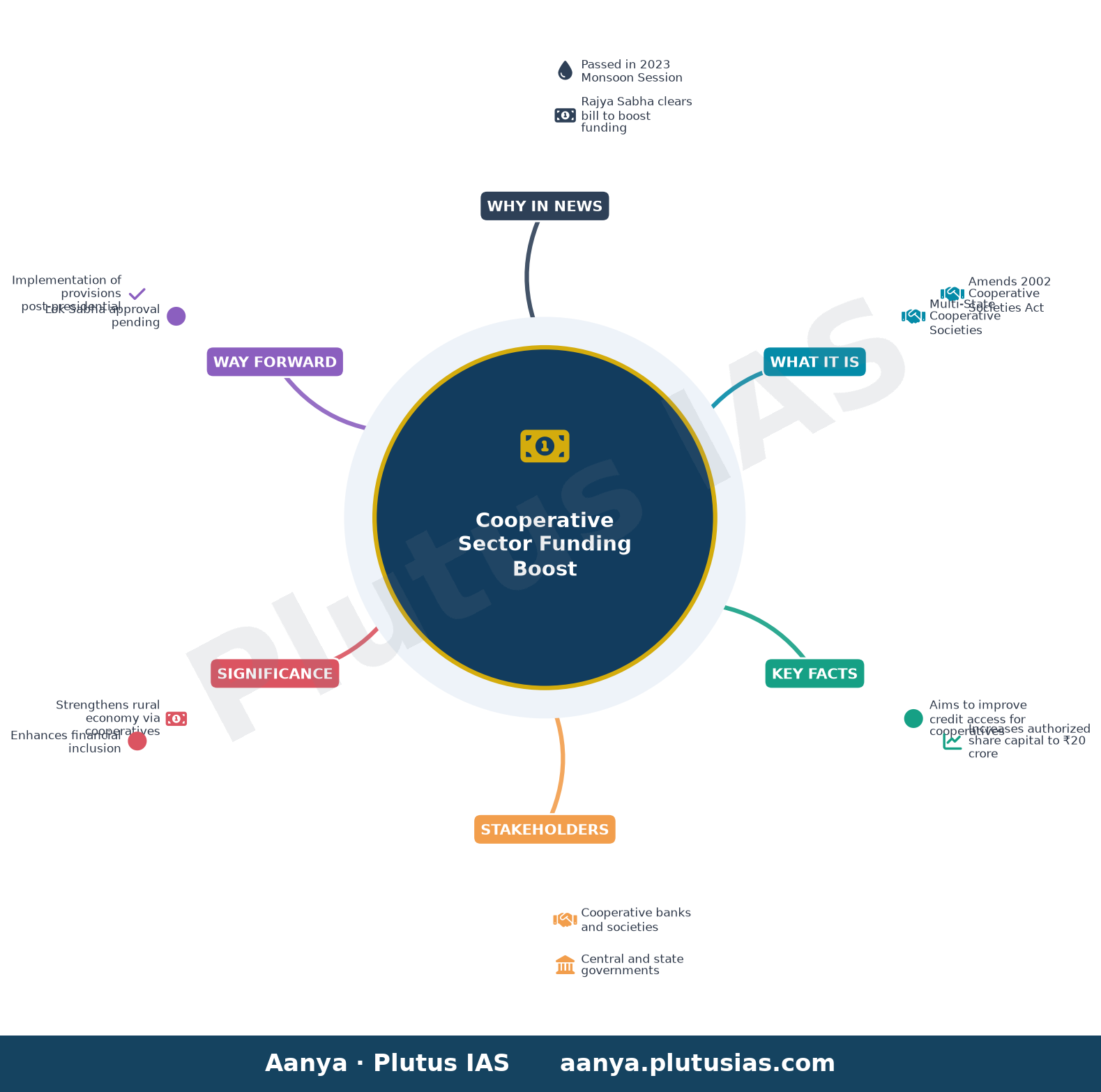
12 Aug Rajya Sabha Passes Bill to Strengthen Cooperative Sector Funding
✎ The bill aims to modernize cooperative sector funding and improve financial accessibility for cooperatives in India.
Relevance for UPSC & State PCS: Polity
The Rajya Sabha’s recent clearance of the **Multi-State Cooperative Societies (Amendment) Bill, 2023** marks a significant step toward revitalizing India’s cooperative sector, which has long grappled with structural inefficiencies and funding constraints. The bill, which seeks to amend the **Multi-State Cooperative Societies Act, 2002**, introduces provisions for easier access to capital, enhanced governance, and stricter accountability mechanisms. By enabling cooperatives to raise funds through equity participation, debentures, and loans from financial institutions, the legislation addresses a critical gap in their financial sustainability. This move aligns with the government’s broader vision of promoting **‘Sahkar se Samriddhi’** (prosperity through cooperation) and could potentially unlock the sector’s latent potential in sectors like agriculture, dairy, and rural credit.
For **UPSC aspirants**, the bill’s passage underscores key themes in **Indian polity and governance**, particularly the role of Parliament in economic reforms and sectoral development. The amendments reflect the **legislative process**—from introduction to debate and passage—highlighting the functioning of the Rajya Sabha as a revising chamber. Additionally, the bill’s focus on **multi-state cooperatives** ties into federalism debates, as these entities operate across state boundaries, necessitating coordinated policy frameworks. The **cooperative sector’s constitutional status** (Entry 32 of the State List) also makes this a pertinent case study for understanding the division of powers between the Centre and states, a recurring theme in UPSC’s polity syllabus.
State **PCS aspirants**, especially those preparing for exams like **UPPSC, BPSC, or MPPSC**, should note how this legislation could impact **state-level cooperative policies**. Many states have their own cooperative societies acts, and amendments at the central level may necessitate corresponding state-level adjustments to ensure alignment. For instance, states like **Maharashtra, Gujarat, and Karnataka**, with strong cooperative movements in dairy and sugar, could see enhanced financial flows to their cooperatives, boosting rural economies. The bill’s emphasis on **transparency and governance** also ties into broader administrative reforms, a frequent topic in state PCS examinations, where questions often probe the interplay between central initiatives and state implementations.
The bill’s passage also carries **long-term socio-economic implications**, particularly for **marginalized sections** dependent on cooperatives for credit, marketing, and employment. By strengthening the cooperative ecosystem, the government aims to reduce dependence on informal credit markets and enhance **financial inclusion**. For UPSC mains, this could be linked to **GS Paper II (Governance, Constitution, and Social Justice)** or **GS Paper III (Economic Development)**. State PCS aspirants might encounter questions on how such reforms could be leveraged for **local economic development** or **rural upliftment**. The bill
Source: ndtv.com
Practice Questions
Q1. Which of the following statements is correct regarding the recent Bill passed by the Rajya Sabha to boost funding for the cooperative sector?
- The Bill aims to provide tax exemptions to all cooperative societies without any conditions.
- The Bill seeks to amend the existing legal framework to enhance the financial viability and operational efficiency of cooperative societies.
- The Bill proposes to merge all cooperative banks with commercial banks to improve liquidity.
- The Bill mandates that cooperative societies must convert into public limited companies within five years.
Answer
The Bill seeks to amend the existing legal framework to enhance the financial viability and operational efficiency of cooperative societies. — The Bill passed by the Rajya Sabha is intended to amend the legal framework to improve funding and operational efficiency for cooperative societies, not to impose tax exemptions, mergers, or conversion mandates.
Q2. What is the primary objective of the Bill cleared by the Rajya Sabha for the cooperative sector?
- To reduce the number of cooperative societies in India.
- To enhance the financial resources and competitiveness of cooperative societies.
- To nationalize all cooperative banks.
- To restrict cooperative societies to only rural areas.
Answer
To enhance the financial resources and competitiveness of cooperative societies. — The primary objective of the Bill is to boost funding and improve the competitiveness of cooperative societies by enhancing their financial resources and operational capabilities.
Generated by AanyaAi for educational purpose.


No Comments