


12 Aug Lok Sabha Passes MMDR Amendment Bill 2026 Without Debate: Key Provisions
✎ The Mines and Minerals (Development and Regulation) Amendment Bill, 2026, seeks to restrict state governments from imposing additional taxes on mineral rights and mineral-bearing lands, centralise regulatory control over…
Subject Relevance — Where This Topic Fits
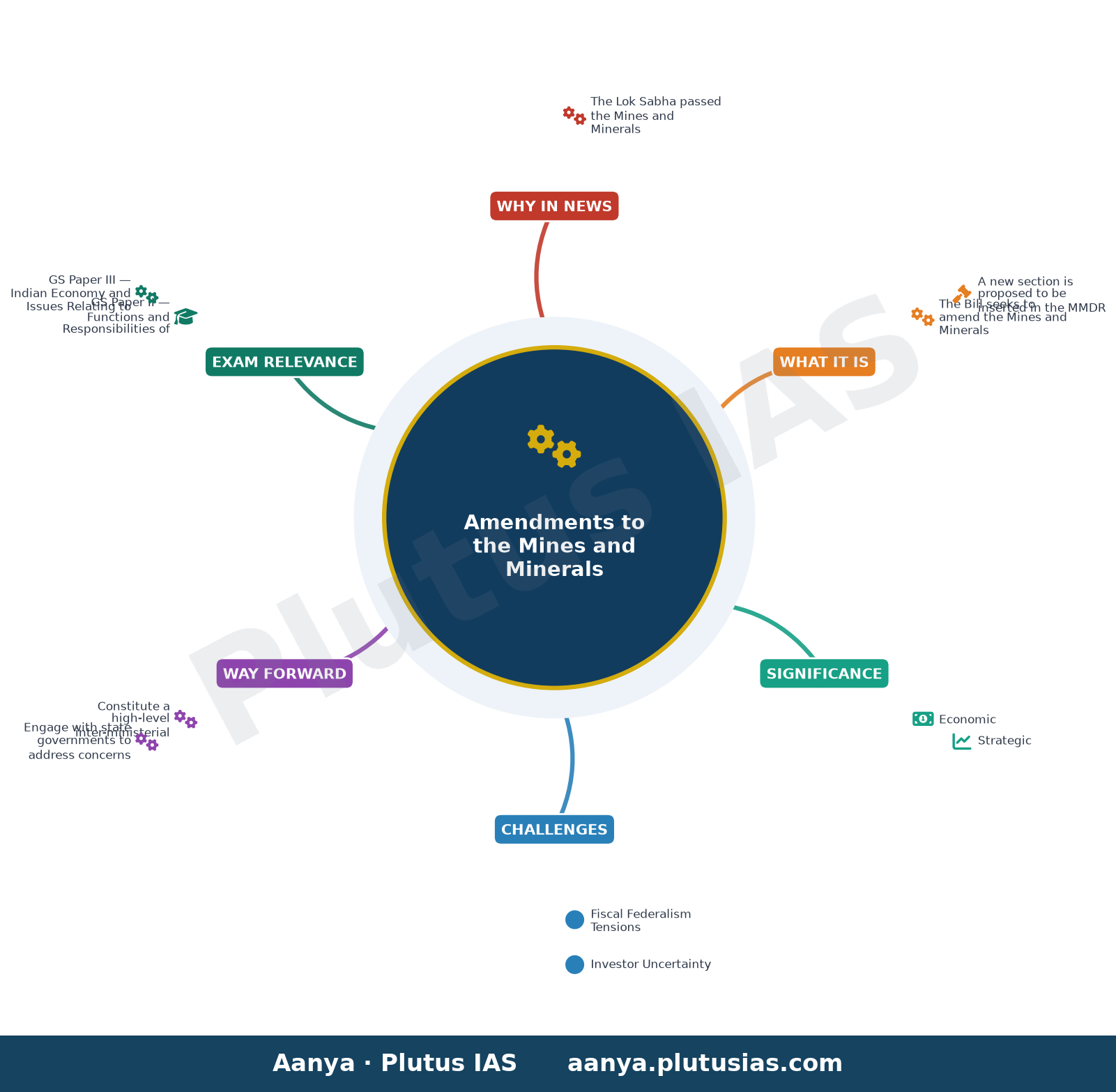
- GS Paper II — Functions and Responsibilities of the Union and the States, Devolution of Powers and Finances up to Local Levels and Challenges Therein | GS Paper III — Indian Economy and Issues Relating to Planning, Mobilisation of Resources, Growth, Development and Employment, Infrastructure: Energy, Ports, Roads, Airports, Railways etc. | GS Paper III — Effects of Liberalisation on the Economy, Changes in Industrial Policy and their Effects on Industrial Growth | GS Paper III — Conservation, Environmental Pollution and Degradation, Environmental Impact Assessment
- Prelims: Mines and Minerals (Development and Regulation) Act, 1957, Fiscal Federalism in India, Atmanirbhar Bharat, Viksit Bharat 2047, Environmental Impact Assessment (EIA) 2006, Union List vs State List under Seventh Schedule, Royalty on minerals, Cess and surcharge on minerals
- Essay: The balance between economic growth and environmental sustainability in resource governance, Federalism in India: Challenges of cooperative and competitive federalism in the context of natural resource regulation
Quick Revision: The Mines and Minerals (Development and Regulation) Amendment Bill, 2026, seeks to restrict state governments from imposing additional taxes on mineral rights and mineral-bearing lands, centralise regulatory control over mineral-bearing lands, and ensure fiscal certainty in the mineral sector to support Atmanirbhar Bharat and Viksit Bharat 2047.
Why is this in the news?
The Lok Sabha passed the Mines and Minerals (Development and Regulation) Amendment Bill, 2026 without debate on 12 August 2026, introducing significant changes to the fiscal regime governing mineral rights and mineral-bearing lands. The amendments seek to restrict state governments from imposing additional taxes, cesses, or levies on mineral rights, aiming to enhance certainty, stability, and predictability in the mineral sector. The Bill also centralises regulatory control over mineral-bearing lands, aligning with the Union’s existing authority under the MMDR Act. The legislative action follows concerns over regional disparities in fiscal impositions, potential market distortions, and the impact on India’s self-reliance in critical minerals.
Background
- The Mines and Minerals (Development and Regulation) Act, 1957 (MMDR Act) is the primary legislation governing the regulation of mines and the development of minerals in India, falling under the Union List (Entry 54) of the Seventh Schedule of the Constitution.
- State governments have historically levied additional taxes, cesses, or levies on mineral rights and mineral-bearing lands, leading to fiscal disparities and regulatory uncertainty in the mineral sector.
- The MMDR Act, 1957, empowers the Union government to frame rules for the grant of mineral concessions, regulate mineral development, and impose royalties, while states retain certain fiscal and administrative roles within their jurisdictions.
- Concerns have been raised about the impact of uneven fiscal impositions by states on the cost of domestic mineral supply, leading to increased transportation costs, market distortions, and potential reliance on imports despite domestic resource availability.
- The Atmanirbhar Bharat initiative and the vision of Viksit Bharat by 2047 underscore the need for a stable and predictable regulatory environment to attract investment and promote sustainable mineral development.
- The Union government’s proposal to centralise regulatory control over mineral-bearing lands aligns with its broader objective of ensuring uniform standards and reducing regulatory fragmentation in the mineral sector.
What is the Mines and Minerals (Development and Regulation) Amendment Bill, 2026?
- The Bill seeks to amend the Mines and Minerals (Development and Regulation) Act to restrict state governments from imposing additional taxes, cesses, or levies on mineral rights and mineral-bearing lands, except as prescribed by the central government.
- A new section is proposed to be inserted in the MMDR Act to explicitly prohibit states from levying taxes, cesses, or other levies on mineral rights, thereby ensuring fiscal certainty and stability in the mineral sector.
- The Bill centralises regulatory control over mineral-bearing lands under the Union government, aligning with the existing provisions of the MMDR Act that vest regulatory authority in the Union for mines and mineral development.
- Any taxes, cesses, or levies imposed by states on mineral rights or mineral-bearing lands that are not deposited or recovered before the commencement of the Amendment Act shall be deemed invalid, though amounts already deposited or recovered shall not be refundable.
- The amendments aim to address regional disparities in fiscal impositions, reduce market distortions, and promote domestic mineral supply by ensuring cost competitiveness and reducing transportation costs.
- The Bill is framed to support the objectives of Atmanirbharta (self-reliance) in critical minerals and the vision of Viksit Bharat by 2047 by fostering a predictable and investment-friendly regulatory environment.
- The proposed changes are intended to mitigate risks of increased imports of minerals despite domestic availability, thereby reducing the environmental footprint associated with long-distance mineral transportation.
- The amendments reflect the Union government’s emphasis on cooperative federalism, where uniform standards and regulatory frameworks are established to balance state autonomy with national economic priorities.
Key Features
| Feature | Significance |
|---|---|
| Restriction on State Taxation | Prohibits state governments from levying additional taxes, cess, or levies on mineral rights or mineral-bearing lands, ensuring uniformity in fiscal regime. |
| Centralisation of Mineral Regulation | Empowers the Union government to regulate mineral-bearing lands based on prescribed parameters, enhancing national oversight. |
| Retrospective Validation | Declares invalid any state-imposed taxes not deposited or recovered before the Act’s commencement, while exempting pre-deposited levies from refunds. |
| Fiscal Stability and Predictability | Aims to provide certainty in mineral sector taxation, reducing regional disparities and promoting long-term investment. |
| Alignment with National Objectives | Supports Atmanirbhar Bharat and Viksit Bharat 2047 by ensuring cost-effective domestic mineral supply and reducing import dependency. |
Why it Matters
Economic
- Facilitates a uniform fiscal regime for the mineral sector, reducing transaction costs and enhancing investor confidence.
- Promotes domestic mineral utilisation, reducing reliance on imports and supporting self-reliance in critical sectors.
- Encourages optimal development of mineral resources by minimising regional disparities in taxation burdens.
- May lower transportation costs by incentivising local supply chains, thereby reducing logistical inefficiencies.
Strategic
- Strengthens central oversight of mineral resources, aligning with national security and resource security imperatives.
- Supports the development of strategic minerals essential for green energy transitions, defence, and high-tech industries.
- Ensures equitable access to mineral resources across states, preventing monopolistic or exploitative local practices.
Legal and Governance
- Clarifies the division of fiscal powers between the Union and States under the Constitution, particularly in concurrent and residual domains.
- Provides legal certainty by validating past state levies while invalidating future non-compliant impositions.
Environmental
- Indirectly supports environmental sustainability by reducing the need for long-distance mineral transport, thereby lowering carbon emissions.
Challenges
1. Fiscal Federalism Tensions
- Potential conflict between Union and State governments over the extent of central control over mineral resources.
- Risk of undermining state autonomy in revenue generation, particularly for mineral-rich states.
UPSC Link: GS II: Federalism
2. Investor Uncertainty
- Short-term disruption in state revenue streams may deter investment in mineral-rich regions.
- Lack of clarity on the transition process for existing state levies could create legal ambiguities.
3. Regional Inequities
- Mineral-rich states may perceive the Bill as a loss of fiscal autonomy, exacerbating inter-state disparities.
- May disproportionately affect states with limited alternative revenue sources.
4. Implementation Challenges
- Need for robust mechanisms to monitor compliance with central regulations across states.
- Potential delays in operationalising the new framework due to administrative and legal hurdles.
5. Environmental Trade-offs
- Centralised regulation may prioritise economic efficiency over local environmental considerations in mineral extraction.
Challenges — UPSC Perspective
| Issue | Concern |
|---|---|
| State Revenue Loss | Reduction in state-level fiscal autonomy and potential shortfall in revenue for mineral-rich states. |
| Legal Ambiguities | Uncertainty regarding the validity of past levies and the transition to the new regime. |
| Investor Skepticism | Perceived instability in state-level fiscal policies may deter long-term investments. |
| Regulatory Overreach | Risk of excessive centralisation undermining state-level governance in mineral-rich regions. |
| Environmental Neglect | Possible prioritisation of economic gains over local environmental safeguards in mineral extraction. |
Way Forward
- Constitute a high-level inter-ministerial committee to draft detailed rules for implementing the amended provisions, ensuring clarity on compliance and transition mechanisms.
- Engage with state governments to address concerns over fiscal autonomy and revenue loss, exploring compensatory mechanisms where feasible.
- Establish a grievance redressal mechanism for stakeholders to resolve disputes arising from the new fiscal regime.
- Strengthen data systems to monitor mineral production, taxation, and compliance across states, ensuring transparency.
- Conduct a comprehensive impact assessment within six months to evaluate the economic, fiscal, and environmental outcomes of the amendments.
- Promote awareness campaigns to inform industry stakeholders about the changes and their implications.
- Align the amendments with existing environmental and social safeguards to mitigate unintended ecological impacts.
- Facilitate dialogue with mineral-dependent industries to align policy with market realities and long-term sustainability goals.
UPSC Value Addition
Keywords for Mains Answer-Writing
Mines and Minerals (Development and Regulation) Act, 1957 · MMDR Amendment Bill 2026 · federal fiscal federalism · mineral rights taxation · Atmanirbhar Bharat · Viksit Bharat 2047 · economic federalism · resource nationalism · parliamentary procedure · legislative accountability · mineral-bearing lands · royalty and cess regimes · fiscal stability in mineral sector · inter-state fiscal imbalances · Parliamentary Monsoon Session 2026 · Lok Sabha legislative process
Constitutional & Policy Linkages
- Article 246: Division of Legislative Powers (Union, State, Concurrent Lists)
- Article 262: Adjudication of disputes relating to water and inter-state rivers
- Seventh Schedule: List I (Union List), List II (State List), List III (Concurrent List)
- Article 293: Borrowing powers of States
Concept Flow
Introduction of the Bill in Parliament → Statement of Objects and Reasons highlights fiscal uniformity and national objectives → Opposition protests over federalism concerns → Voice vote passage without debate → Centralisation of mineral regulation under MMDR Act → Restriction on state taxation of mineral rights → Retrospective validation of past levies while invalidating future non-compliant impositions → Potential investor confidence and economic growth → Regional disparities in mineral taxation addressed → Long-term alignment with Atmanirbhar Bharat and Viksit Bharat 2047
Prelims Practice Questions
Q1. Consider the following statements regarding the Mines and Minerals (Development and Regulation) Amendment Bill, 2026:
1. The Bill restricts state governments from levying any tax, cess, or levy on mineral rights.
2. The Bill empowers the central government to regulate mineral-bearing lands based on mineral quantity, value, or royalty.
3. The Bill mandates the refund of all previously collected taxes, cesses, or levies on mineral rights.
4. The Bill aims to provide fiscal stability and predictability in the mineral sector.
How many of the above statements are correct?
- Only one
- Only two
- Only three
- All four
Answer: All four — Statements 1, 2, and 4 are correct. Statement 3 is incorrect as the Bill explicitly states that previously collected taxes shall not be refunded.
Q2. Assertion (A): The Mines and Minerals (Development and Regulation) Amendment Bill, 2026 seeks to centralise the regulation of mineral-bearing lands.
Reason (R): The Bill aims to ensure fiscal stability and predictability in the mineral sector by restricting state-level taxation on mineral rights.
Options:
A. Both A and R are true, and R is the correct explanation of A.
B. Both A and R are true, but R is not the correct explanation of A.
C. A is true, but R is false.
D. A is false, but R is true.
Answer: ? — Both Assertion (A) and Reason (R) are true, and R correctly explains A, as centralisation of regulation is a means to achieve fiscal stability.
Q3. Match the following provisions of the Mines and Minerals (Development and Regulation) Amendment Bill, 2026 with their correct descriptions:
Column I (Provision) | Column II (Description)
1. Restriction on state taxation | A. Central government to regulate mineral-bearing lands
2. Fiscal stability objective | B. Prohibition of additional levies on mineral rights
3. Refund of past taxes | C. No refund of previously collected taxes
4. Centralised regulation | D. Aim to provide certainty and predictability in fiscal regime
Options:
A. 1-B, 2-D, 3-C, 4-A
B. 1-A, 2-B, 3-C, 4-D
C. 1-C, 2-D, 3-A, 4-B
D. 1-D, 2-A, 3-B, 4-C
Answer: ? — Correct matches are: 1-B (Restriction on state taxation), 2-D (Fiscal stability objective), 3-C (No refund of past taxes), 4-A (Centralised regulation).
Mains Practice Question
✍ The Mines and Minerals (Development and Regulation) Amendment Bill, 2026 seeks to centralise the regulation of mineral-bearing lands and restrict state governments from levying additional taxes on mineral rights. Critically examine the constitutional and federal implications of these provisions. Also analyse how such centralisation aligns with the broader objectives of Atmanirbhar Bharat and Viksit Bharat 2047. (15 Marks)
Approach: MODEL-ANSWER SKELETON:
1. **Constitutional Framework and Federalism (4 Marks)**
– Article 246 read with Seventh Schedule (Union List Entry 54: regulation of mines and mineral development).
– Doctrine of federal supremacy vs. cooperative federalism (S.R. Bommai v. Union of India, 1994).
– 7th Schedule Entry 50 (taxes on mineral rights) and Entry 49 (taxes on lands and buildings).
– Judicial precedents on fiscal federalism (e.g., West Bengal v. Union of India, 1963).
2. **Provisions of the MMDR Amendment Bill, 2026 (3 Marks)**
– Insertion of new section restricting state taxation on mineral rights.
– Centralisation of regulation of mineral-bearing lands based on mineral quantity, value, or royalty.
– Non-refundability of previously collected taxes.
– Statement of Objects and Reasons: fiscal stability, predictability, and national economic growth.
3. **Federal Implications (4 Marks)**
– Erosion of state fiscal autonomy vs. need for uniform mineral policy.
– Potential for inter-state fiscal imbalances and resource nationalism.
– Impact on state revenue streams and local development priorities.
– Comparison with GST model (cooperative federalism) and its limitations.
4. **Alignment with Atmanirbhar Bharat and Viksit Bharat 2047 (3 Marks)**
– Mineral sector as a critical input for industrialisation and self-reliance.
– Need for stable fiscal regime to attract investment (e.g., National Mineral Policy 2019).
– Trade-offs between centralised control and local developmental goals.
– Role of mineral auctions (MMDR Act 2015) in ensuring transparency and revenue sharing.
5. **Conclusion (1 Mark)**
– Balancing centralisation for national objectives with federal principles of subsidiarity and local governance.
Source: The Hindu
Generated by AanyaAi for educational purpose.

- मद्रास उच्च न्यायालय में ‘वेट्ट्री पयणम’ योजना को असंवैधानिक घोषित करने की मांग - October 4, 2026
- Gurugram’s groundwater extraction exceeds limit by 212%; HC seeks ban - October 4, 2026
- स्वतंत्रता सेनानी श्यामजी कृष्ण वर्मा की जन्म जयंती पर पीएम का श्रद्धांजलि - October 4, 2026

No Comments