


12 Aug Karnataka to Move SC Against Cauvery Water Release Order
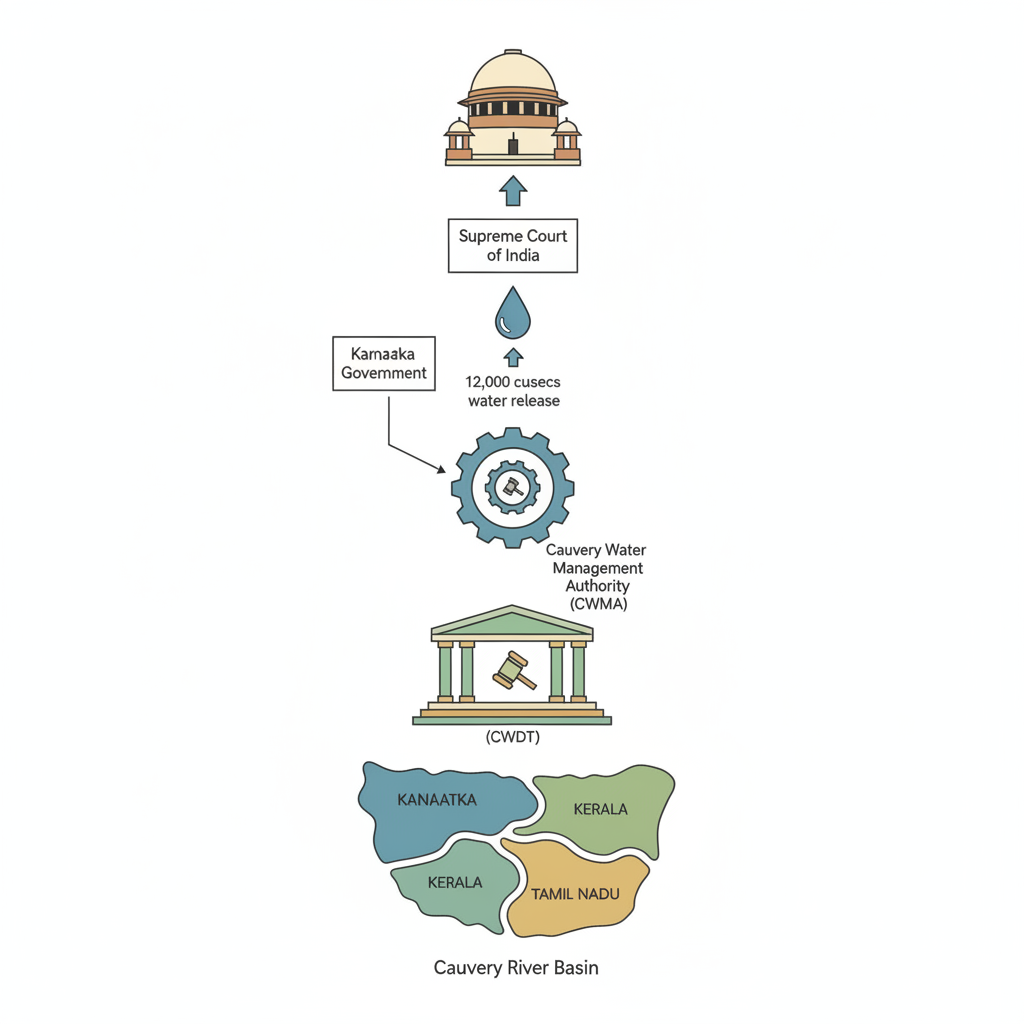
Cauvery RiverKarnataka GovernmentSupreme CourtCWMACWDT✎ The Cauvery Water Management Authority (CWMA) and Cauvery Water Regulation Committee (CWRC) are statutory bodies established to implement the Cauvery Water Disputes Tribunal’s award and ensure equitable water sharing between…
Subject Relevance — Where This Topic Fits
- GS Paper II — Functions and Responsibilities of the Union and the States, Issues and Challenges Pertaining to the Federal Structure, Devolution of Powers and Finances up to Local Levels and Challenges Therein | GS Paper III — Conservation, Environmental Pollution and Degradation, Environmental Impact Assessment
- Prelims: Cauvery Water Disputes Tribunal (CWDT), Cauvery Water Management Authority (CWMA), Cauvery Water Regulation Committee (CWRC), Inter-State Water Disputes Act, 1956, Supreme Court jurisdiction under Article 136, Tamil Nadu-Karnataka water sharing, cusecs (cubic feet per second), tmcft (thousand million cubic feet), monsoon variability and water storage
- Essay: Federalism and cooperative governance in water resource management, Judicial intervention in resolving inter-state disputes: Balancing equity and constitutional federalism
Quick Revision: The Cauvery Water Management Authority (CWMA) and Cauvery Water Regulation Committee (CWRC) are statutory bodies established to implement the Cauvery Water Disputes Tribunal’s award and ensure equitable water sharing between Karnataka and Tamil Nadu.
Why is this in the news?
The Karnataka government has announced its intention to approach the Supreme Court against the Cauvery Water Management Authority’s (CWMA) decision to uphold the Cauvery Water Regulation Committee’s (CWRC) directive requiring Karnataka to release 12,000 cusecs of water daily for 15 days to Tamil Nadu. This development underscores the persistent challenges in inter-state water sharing, the role of constitutional institutions in dispute resolution, and the judicial recourse available under the Inter-State Water Disputes Act, 1956.
Background
- The Cauvery river basin is a shared resource between Karnataka, Tamil Nadu, Kerala, and the Union Territory of Puducherry, necessitating equitable distribution mechanisms.
- The Cauvery Water Disputes Tribunal (CWDT), constituted in 1990 under the Inter-State Water Disputes Act, 1956, delivered its final award in 2007, allocating water shares among the riparian states.
- The CWDT’s award was modified by the Supreme Court in 2018, reducing Karnataka’s share and increasing Tamil Nadu’s allocation, while also directing the establishment of the Cauvery Water Management Authority (CWMA) and the Cauvery Water Regulation Committee (CWRC) to implement the award.
- The CWMA and CWRC were constituted in 2018 to monitor and enforce the Cauvery water-sharing arrangements, including real-time water release directives during deficit or surplus conditions.
- Karnataka has historically contested the implementation of the CWMA/CWRC directives, citing agrarian distress, drinking water shortages, and monsoon variability as mitigating factors.
- The current dispute arises amid Karnataka’s assertion that the mandated release of 12,000 cusecs for 15 days would deplete its reservoirs, exacerbating drinking water shortages and agricultural stress.
Institutional Framework for Cauvery Water Dispute Resolution
- The Inter-State Water Disputes Act, 1956, empowers the Union Government to constitute tribunals for adjudicating disputes over water sharing between states, as seen in the Cauvery Water Disputes Tribunal (CWDT).
- The CWDT’s final award in 2007 provided a detailed water-sharing formula, including monthly allocations and contingency provisions for surplus or deficit monsoons.
- The Supreme Court, in its 2018 judgment, upheld the CWDT’s award but modified the allocation, reducing Karnataka’s share and increasing Tamil Nadu’s, while also directing the establishment of the CWMA and CWRC for implementation.
- The Cauvery Water Management Authority (CWMA) is a statutory body under the Ministry of Jal Shakti, tasked with implementing the CWDT’s award and ensuring compliance with water-sharing directives.
- The Cauvery Water Regulation Committee (CWRC) functions under the CWMA and is responsible for real-time monitoring of water releases, including during critical periods such as the monsoon season.
- The CWMA/CWRC directives are binding on the riparian states, and non-compliance may lead to legal recourse, including appeals to the Supreme Court under Article 136 (Special Leave Petition).
- The Supreme Court’s jurisdiction under Article 136 allows it to entertain appeals against orders of any court or tribunal in India, including those related to inter-state water disputes.
- The current dispute highlights the tension between statutory directives and state-level priorities, such as drinking water security and agricultural needs, necessitating judicial intervention for resolution.
Key Features
| Feature | Significance |
|---|---|
| Cauvery Water Management Authority (CWMA) | Constitutional body established under the Inter-State River Water Disputes Act, 1956, tasked with implementing the final award of the Cauvery Water Disputes Tribunal (2007) and ensuring equitable water distribution among riparian states. |
| Cauvery Water Regulation Committee (CWRC) | Executive arm of CWMA responsible for real-time monitoring, regulation, and enforcement of water releases from Karnataka to Tamil Nadu as per tribunal directives. |
| Inter-State River Water Disputes Act, 1956 | Provides the legal framework for adjudication and resolution of inter-state river water disputes, including the establishment of tribunals and implementation mechanisms. |
| Final Award of the Cauvery Water Disputes Tribunal (2007) | Legally binding decision on water sharing between Karnataka, Tamil Nadu, Kerala, and Puducherry, later modified by the Supreme Court in 2018. |
| Supreme Court’s Role in Water Disputes | Judicial authority to interpret tribunal awards, issue directions, and resolve disputes between states under Article 136 and constitutional principles of federalism. |
Why it Matters
Legal and Constitutional
- The dispute underscores the constitutional framework for inter-state water governance, where the Supreme Court acts as the final arbiter in matters of federal disputes under Article 136 and the doctrine of federal supremacy.
- The CWMA and CWRC function as institutional mechanisms to operationalise the Cauvery Tribunal’s award, ensuring compliance with judicial directives while balancing state interests.
- The invocation of the Supreme Court highlights the role of the judiciary in resolving disputes that arise from the implementation of tribunal awards, particularly during periods of water scarcity.
Administrative and Governance
- The decision reflects the operational challenges faced by states in implementing tribunal-mandated water releases, especially during drought conditions, necessitating real-time adjustments by regulatory bodies.
- It demonstrates the need for integrated water resource management, where technical, legal, and political considerations must converge to address competing demands (agriculture, drinking water, ecology).
- The Minister’s statement on prioritising drinking water reflects the administrative imperative to balance statutory obligations with human-centric governance during water stress.
Economic and Agricultural
- Water releases for irrigation in Tamil Nadu during Karnataka’s distress period may exacerbate agricultural losses in Karnataka, particularly in districts dependent on the Cauvery basin for paddy cultivation.
- The economic cost of releasing 15 tmcft of water (as estimated by Karnataka) could impact Karnataka’s rural economy, highlighting the trade-offs between inter-state obligations and local livelihoods.
- Long-term water security concerns for Karnataka, as forecasted deficient monsoon, may necessitate policy shifts toward drought-proofing agriculture and water conservation.
Environmental and Ecological
- Sustained high releases (12,000 cusecs) may deplete Karnataka’s reservoir levels, affecting downstream ecosystems and groundwater recharge in the Cauvery basin.
- Climate variability, as indicated by the Minister’s reference to deficient monsoon forecasts, exacerbates the ecological stress on the river system, necessitating adaptive management strategies.
Challenges
1. Implementation of Tribunal Awards During Water Scarcity
- States face conflicting obligations: compliance with tribunal awards vs. meeting local water needs during droughts, leading to administrative and legal friction.
- Real-time monitoring by CWRC may not account for sudden changes in hydrological conditions, necessitating dynamic adjustments to release schedules.
- Political and public pressure on state governments to prioritise domestic water supply over inter-state commitments can undermine institutional compliance.
UPSC Link: GS-II: Federalism, Inter-State Relations
2. Balancing Competing Water Demands
- The Cauvery basin supports multiple uses: irrigation, drinking water, industrial supply, and ecological flows, creating inherent conflicts in allocation.
- Agricultural demands in both Karnataka and Tamil Nadu (e.g., paddy cultivation) intensify pressure on limited water resources during deficit monsoons.
- Urbanisation and industrial growth in riparian states further strain water availability, necessitating integrated basin-level planning.
UPSC Link: GS-III: Water Resources, Sustainable Agriculture
3. Judicial Intervention in Water Disputes
- Frequent recourse to the Supreme Court indicates the limitations of tribunal awards in addressing real-time hydrological variability and state-level contingencies.
- Judicial directives, while binding, may not always align with ground realities, leading to implementation gaps and administrative challenges.
- The Supreme Court’s role in modifying tribunal awards (e.g., 2018 judgment) highlights the need for flexibility in dispute resolution mechanisms.
UPSC Link: GS-II: Judiciary, Constitutional Governance
4. Climate Change and Water Security
- Erratic monsoon patterns, as cited by Karnataka’s Minister, exacerbate water scarcity, necessitating climate-resilient water management strategies.
- Long-term projections of reduced rainfall in the Cauvery basin may require states to adopt drought mitigation measures, such as rainwater harvesting and groundwater recharge.
- The dispute underscores the urgency of integrating climate adaptation into inter-state water governance frameworks.
UPSC Link: GS-III: Climate Change, Disaster Management
5. Institutional Coordination and Transparency
- The CWMA and CWRC must ensure transparent, data-driven decision-making to maintain credibility and public trust in their regulatory functions.
- Lack of consensus among states on data sharing (e.g., reservoir levels, rainfall forecasts) can hinder effective dispute resolution.
- Public participation and stakeholder consultations are essential to balance technical decisions with social and economic realities.
UPSC Link: GS-II: Cooperative Federalism, Governance
Challenges — UPSC Perspective
| Issue | Concern |
|---|---|
| Statutory Compliance vs. Local Needs | Karnataka’s obligation to release water to Tamil Nadu conflicts with its domestic water security during drought. |
| Hydrological Variability | Monsoon deficits and reservoir depletion undermine the feasibility of fixed release schedules mandated by the tribunal. |
| Judicial Overreach in Implementation | Supreme Court directives may not account for ground-level constraints, leading to administrative bottlenecks. |
| Data Discrepancies | Disputes over reservoir levels, rainfall data, and water usage estimates hinder objective decision-making by CWRC. |
| Agricultural vs. Ecological Flows | High releases for irrigation in Tamil Nadu may compromise downstream ecological health and groundwater recharge. |
| Public and Political Pressure | State governments face competing demands from farmers, urban populations, and environmental groups, complicating policy execution. |
Way Forward
- States must adopt **dynamic water allocation frameworks** that integrate real-time hydrological data, climate forecasts, and basin-wide water budgets to adjust releases during scarcity.
- Strengthen **institutional capacity** of CWMA and CWRC by enhancing data-sharing protocols, transparency, and stakeholder consultations to build trust and reduce disputes.
- Promote **climate-resilient agriculture** in the Cauvery basin through drought-resistant crop varieties, precision irrigation, and water-efficient farming practices.
- Develop **inter-state agreements** on contingency plans for drought years, including mechanisms for temporary reallocation of water shares based on basin-wide storage levels.
- Enhance **public awareness** on water conservation, with campaigns targeting urban, agricultural, and industrial sectors to reduce demand during deficit periods.
- Invest in **multi-purpose reservoirs and inter-basin transfers** to augment storage capacity and mitigate the impact of monsoon variability.
- Establish a **neutral technical committee** comprising hydrologists, economists, and ecologists to advise CWMA on equitable and sustainable water allocation.
- Leverage **judicial reforms** to streamline dispute resolution, such as setting up dedicated benches for inter-state water disputes with expertise in hydrology and federalism.
UPSC Value Addition
Keywords for Mains Answer-Writing
Inter-State River Water Disputes Act, 1956 · Cauvery Water Disputes Tribunal (CWDT) · Cauvery Water Management Authority (CWMA) · Cauvery Water Regulation Committee (CWRC) · Supreme Court of India · Inter-State Water Disputes · Federalism and Water Governance · Water Sharing Agreements · Constitutional Provisions (Article 262) · River Basin Management · Environmental Flows · Water Security and Prioritisation · Monsoon Variability and Water Scarcity
Constitutional & Policy Linkages
- [‘Article 262’, ‘Inter-State Water Disputes’]
- [‘Article 136’, “Supreme Court’s Special Leave Jurisdiction”]
- [‘Article 263’, ‘Inter-State Council’]
Concept Flow
Cauvery Tribunal Award (2007) → Implementation by CWMA/CWRC → Real-time monitoring and release directives → Karnataka’s compliance challenges during drought → CWMA upholds Tamil Nadu’s demand for higher releases → Karnataka approaches Supreme Court for relief → Judicial intervention in water allocation → Broader implications for federal water governance and climate adaptation.
Prelims Practice Questions
Q1. Consider the following statements regarding the Cauvery Water Disputes Tribunal (CWDT):
1. The CWDT was constituted under the Inter-State River Water Disputes Act, 1956.
2. The CWDT’s award was notified by the Government of India in 2013.
3. The CWDT’s award is binding on the states involved and cannot be challenged in any court.
How many of the above statements are correct?
- Only one
- Only two
- All three
- None
Answer: Only two — Statement 1 is correct as the CWDT was constituted under the Inter-State River Water Disputes Act, 1956. Statement 2 is correct as the CWDT’s award was notified by the Government of India in 2013. Statement 3 is incorrect as the Supreme Court, in its 2018 judgment, modified the CWDT’s award and retained jurisdiction to supervise the implementation.
Q2. Which of the following Committees/Authorities is responsible for the implementation of the Cauvery Water Disputes Tribunal’s award?
- Cauvery River Authority
- Cauvery Water Management Authority (CWMA)
- National Water Commission
- Central Water Commission
Answer: Cauvery Water Management Authority (CWMA) — The Cauvery Water Management Authority (CWMA) was constituted by the Government of India in 2018 to implement the Cauvery Water Disputes Tribunal’s award and to ensure compliance with its directions.
Q3. Assertion (A): The Cauvery Water Regulation Committee (CWRC) functions under the administrative control of the Cauvery Water Management Authority (CWMA).
Reason (R): The CWMA was established to oversee the implementation of the Cauvery Water Disputes Tribunal’s award and the CWRC assists in day-to-day regulation of water releases.
In the context of the above statements, which of the following is correct?
- Both A and R are true, and R is the correct explanation of A
- Both A and R are true, but R is not the correct explanation of A
- A is true, but R is false
- A is false, but R is true
Answer: Both A and R are true, and R is the correct explanation of A — Both the Assertion (A) and Reason (R) are true, and the Reason (R) correctly explains the Assertion (A). The CWRC functions under the administrative control of the CWMA, which was established to implement the Tribunal’s award.
Mains Practice Question
✍ The Supreme Court’s role in adjudicating inter-state river water disputes has evolved significantly over time. In light of the recent developments in the Cauvery water-sharing dispute, critically examine the constitutional and legal framework governing inter-state water disputes in India. Also, analyse the challenges faced in the implementation of such awards and suggest measures to ensure equitable and sustainable water governance. (15 Marks)
Approach: MODEL-ANSWER SKELETON:
1. **Constitutional and Legal Framework (4 marks)**
– Article 262 of the Constitution: Exclusion of jurisdiction of courts in inter-state water disputes.
– Inter-State River Water Disputes Act, 1956: Provision for tribunals and their awards.
– Cauvery Water Disputes Tribunal (CWDT): Constitution, jurisdiction, and award (2007, notified 2013).
– Supreme Court’s 2018 judgment: Modification of the CWDT’s award and retention of jurisdiction.
– Role of the Cauvery Water Management Authority (CWMA) and Cauvery Water Regulation Committee (CWRC).
2. **Evolution of Supreme Court’s Role (4 marks)**
– From judicial restraint (e.g., *State of Bihar v. State of Orissa*, 2000) to proactive intervention (e.g., *M. Nagaraj v. Union of India*, 2006; *Krishna Water Disputes Tribunal-II*, 2013).
– Balancing federalism and equity: The Supreme Court’s approach in the Cauvery dispute (2018 judgment).
– Critique: Whether the Supreme Court’s intervention undermines the federal structure or ensures justice.
3. **Challenges in Implementation (4 marks)**
– Political sensitivities and state-level resistance (e.g., Karnataka’s recent stance).
– Variability in monsoon patterns and climate change impacts.
– Prioritisation of water uses: Drinking water vs. agricultural and industrial needs.
– Lack of a permanent mechanism for inter-state water governance.
4. **Measures for Equitable and Sustainable Governance (3 marks)**
– Strengthening the CWMA and CWRC with technical and financial autonomy.
– Integration of climate change considerations in water-sharing agreements.
– Promotion of basin-level cooperation and data-sharing mechanisms.
– Legal reforms: Codification of principles for equitable water sharing (e.g., ‘equitable apportionment’ as per the International Law Commission’s Draft Articles on the Law of the Non-Navigational Uses of International Watercourses).
Source: The Hindu
Generated by AanyaAi for educational purpose.

- मद्रास उच्च न्यायालय में ‘वेट्ट्री पयणम’ योजना को असंवैधानिक घोषित करने की मांग - October 4, 2026
- Gurugram’s groundwater extraction exceeds limit by 212%; HC seeks ban - October 4, 2026
- स्वतंत्रता सेनानी श्यामजी कृष्ण वर्मा की जन्म जयंती पर पीएम का श्रद्धांजलि - October 4, 2026

No Comments