


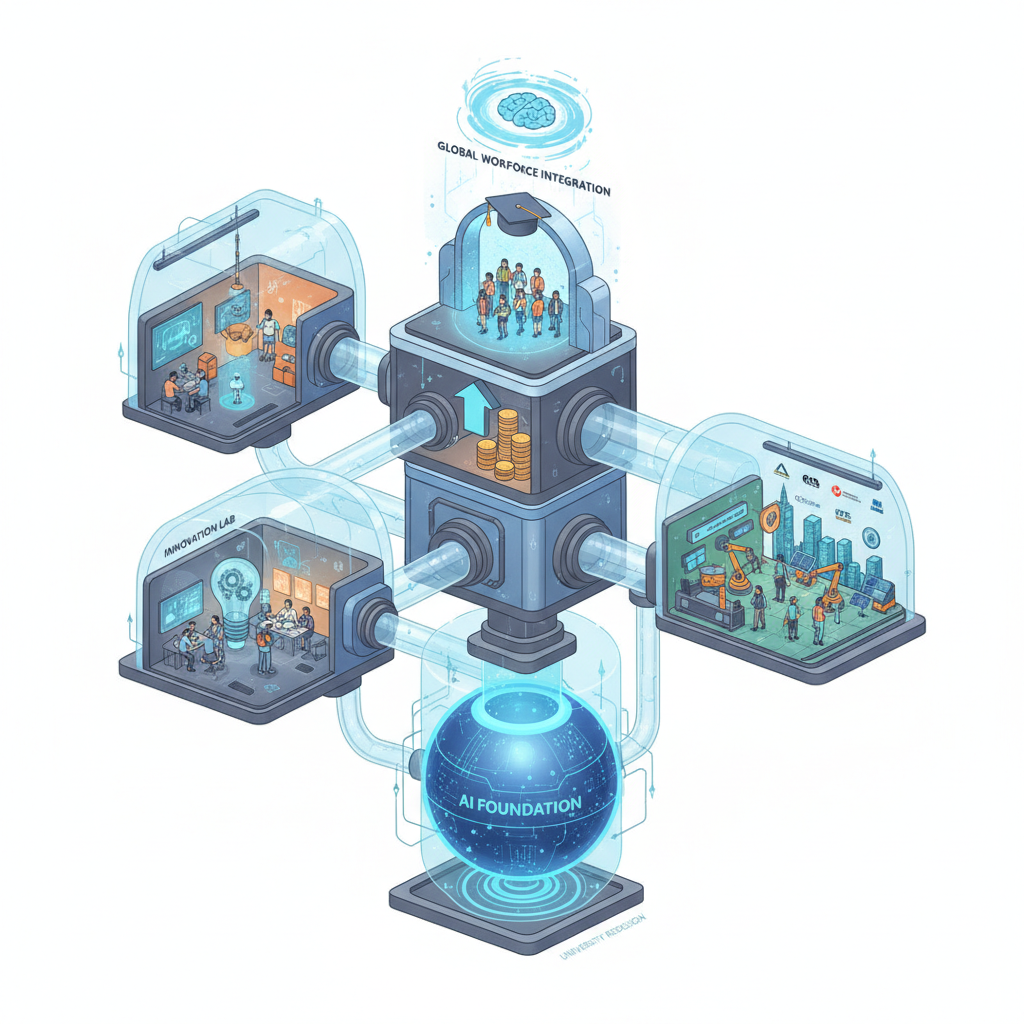
13 Aug AI & Industry-Ready Skills: How Universities Are Redesigning Freshers’ Induction Programs
AI-driven orientation modulesIndustry partnership programsInnovation bootcampsEntrepreneurship incubatorsSoft skills trainingCross-disciplinary project labs✎ University induction programmes are evolving into transformative, multi-week experiences that integrate AI literacy, innovation training, entrepreneurship education, and industry exposure to prepare students for the demands of an…
Subject Relevance — Where This Topic Fits
- GS Paper II — Governance, Administration and Challenges (Higher Education) | GS Paper III — Technology, Economic Development and Employment
- Prelims: Induction programmes in higher education, National Education Policy (NEP) 2020, AI literacy in education, Experiential learning, Startup ecosystem in India, Interdisciplinary education, Design thinking in curriculum, Industry-academia collaboration
- Essay: The role of higher education in fostering innovation and entrepreneurship, Balancing tradition and modernity in academic induction programmes
Quick Revision: University induction programmes are evolving into transformative, multi-week experiences that integrate AI literacy, innovation training, entrepreneurship education, and industry exposure to prepare students for the demands of an innovation-driven economy.
Why is this in the news?
The redesign of university induction programmes to incorporate artificial intelligence, innovation, entrepreneurship, and industry exposure reflects a paradigm shift in higher education, aligning with the evolving demands of the global workforce. This transformation is necessitated by the rapid integration of AI across sectors, the rise of interdisciplinary careers, and the need for graduates to possess both technical and soft skills. Institutions are moving beyond traditional orientation activities to create immersive, skill-building experiences that prepare students for an innovation-driven economy.
Background
- The global workforce is increasingly characterised by interdisciplinary roles, with AI and automation reshaping job profiles across sectors such as healthcare, finance, law, and manufacturing.
- Traditional university induction programmes have historically focused on administrative orientation, campus familiarisation, and academic regulations, often limited to a single day.
What are AI-Integrated, Innovation-Focused, and Industry-Exposed University Induction Programmes?
- These programmes represent a departure from conventional orientation activities by incorporating AI literacy, innovation ecosystems, entrepreneurship training, and industry exposure as core components.
- AI integration in induction includes awareness of AI tools, ethical considerations, responsible use of technology, and problem-solving approaches to complement human capabilities rather than replace them.
- Innovation-focused induction introduces students to design thinking, interdisciplinary challenges, problem-solving exercises, and interactions with researchers and innovators to foster curiosity and collaboration.
- The programmes aim to develop critical thinking, adaptability, and interdisciplinary problem-solving skills, which are essential for thriving in a rapidly evolving job market.
- The objective is to transition students from passive recipients of information to active learners and innovators, fostering a culture of lifelong learning and adaptability.
Key Features
| Feature | Significance |
|---|---|
| Integration of AI awareness | Equips students with foundational understanding of AI’s role in modern professions, ethical considerations, and responsible technology use, fostering adaptability in an AI-driven workforce. |
| Innovation and experiential learning | Shifts focus from passive orientation to active problem-solving through design thinking workshops, interdisciplinary challenges, and researcher interactions, promoting curiosity and collaborative learning. |
| Entrepreneurship as a pillar | Encourages entrepreneurial mindset by exposing students to startup ecosystems, innovation challenges, and mentorship, aligning with India’s growing startup culture and job-creation imperatives. |
| Industry exposure during induction | Facilitates early engagement with industry through internships, guest lectures, and collaborative projects, bridging the academia-industry gap and enhancing employability. |
| Interdisciplinary challenges | Promotes cross-disciplinary collaboration by integrating problems requiring inputs from multiple fields, preparing students for careers in emerging sectors like AI ethics, green technology, and data science. |
Why it Matters
Economic
- Enhances employability by aligning university induction with industry demands, reducing the skills gap in emerging sectors such as AI, data science, and green technology.
- Fosters entrepreneurship, potentially accelerating job creation and economic growth through startup ecosystems supported by universities.
- Promotes interdisciplinary innovation, which is critical for addressing complex global challenges like climate change, healthcare, and sustainable development.
Educational
- Transforms induction from a procedural orientation to a transformative learning experience, embedding critical thinking and adaptability from the outset.
- Encourages a culture of lifelong learning by exposing students to emerging technologies and interdisciplinary problem-solving early in their academic journey.
- Supports the National Education Policy (NEP) 2020’s emphasis on experiential learning, flexibility, and multidisciplinary education.
Strategic
- Positions India as a global leader in higher education by integrating cutting-edge technologies like AI and fostering innovation-driven ecosystems.
- Strengthens the link between academia and industry, ensuring that university programs remain relevant to evolving economic needs.
- Prepares students to navigate a rapidly changing job market, where adaptability and technological literacy are increasingly essential.
Challenges
1. Resource constraints
- Limited funding for state-of-the-art AI tools, innovation labs, and industry collaborations may hinder the implementation of redesigned induction programs.
- Faculty capacity-building requires significant investment in training and upskilling to effectively integrate AI, experiential learning, and entrepreneurship into induction.
UPSC Link: NEP 2020 – Funding for Higher Education
2. Equity and accessibility
- Digital divide may exclude students from rural or underprivileged backgrounds from accessing AI tools and online experiential learning modules.
- Ensuring inclusivity in innovation and entrepreneurship programs requires targeted support for students from diverse socio-economic backgrounds.
UPSC Link: RTE Act – Inclusive Education
3. Curriculum alignment
- Redesigning induction programs to include AI, innovation, and entrepreneurship may conflict with traditional disciplinary boundaries, requiring curricular reforms.
- Balancing foundational academic rigor with experiential learning demands careful pedagogical planning to avoid dilution of core competencies.
UPSC Link: NEP 2020 – Curriculum Flexibility
4. Industry-academia collaboration
- Sustaining long-term industry partnerships for internships, guest lectures, and collaborative projects requires formalized agreements and mutual incentives.
- Mismatch between industry expectations and academic priorities may lead to superficial engagements rather than meaningful skill development.
UPSC Link: National Skill Development Mission
5. Ethical and regulatory concerns
- Early exposure to AI raises ethical questions about data privacy, algorithmic bias, and responsible technology use, necessitating clear guidelines and oversight.
- Ensuring compliance with data protection laws (e.g., DPDP Act 2023) while integrating AI tools into induction programs poses operational challenges.
UPSC Link: DPDP Act 2023 – Data Privacy
Challenges — UPSC Perspective
| Issue | Concern |
|---|---|
| Faculty training | Insufficient expertise among faculty to integrate AI, innovation, and entrepreneurship into induction programs effectively. |
| Infrastructure gaps | Lack of access to AI labs, innovation hubs, and industry-grade tools for students during induction. |
| Student preparedness | Variations in prior exposure to technology and entrepreneurship among incoming students may lead to unequal participation. |
| Sustainability of partnerships | Difficulty in maintaining long-term, mutually beneficial collaborations with industry for experiential learning. |
| Regulatory compliance | Navigating ethical, legal, and data protection requirements while incorporating AI tools into induction programs. |
Way Forward
- Establish dedicated innovation hubs within universities, equipped with AI tools and interdisciplinary labs, to facilitate experiential learning during induction.
- Develop faculty development programs focused on AI literacy, experiential pedagogy, and entrepreneurship mentorship to build internal capacity.
- Formalize partnerships with industry through Memoranda of Understanding (MoUs) to ensure structured internships, guest lectures, and collaborative projects for students.
- Integrate AI ethics and responsible technology use into induction curricula, with modules on data privacy, algorithmic bias, and digital citizenship.
- Leverage government schemes such as the Scheme for Promotion of Academic and Research Collaboration (SPARC) and the National Initiative for Technical Textiles (NITT) to fund AI and innovation initiatives in universities.
- Pilot interdisciplinary induction challenges with real-world problems, evaluated by both academic and industry experts to ensure relevance and rigor.
- Implement mentorship programs pairing senior students, faculty, and industry professionals to guide incoming students in innovation and entrepreneurship.
- Monitor and evaluate the impact of redesigned induction programs through student feedback, employability metrics, and industry satisfaction surveys to drive continuous improvement.
UPSC Value Addition
Keywords for Mains Answer-Writing
Higher Education in India · National Education Policy 2020 · Induction Programmes in Universities · Artificial Intelligence in Education · Innovation and Entrepreneurship · Experiential Learning · Industry-Academia Interface · Curriculum Redesign · 21st Century Skills · Interdisciplinary Learning · Design Thinking · AI Ethics and Responsible Use · Global Workforce Demands
Concept Flow
Evolving workforce demands → Universities redesign induction programs → Integration of AI, innovation, and entrepreneurship → Development of critical thinking and adaptability → Alignment with NEP 2020 goals → Enhanced employability and economic growth.
Prelims Practice Questions
Q1. Consider the following statements regarding the National Education Policy (NEP) 2020 and its provisions for higher education in India:
1. The NEP 2020 mandates the integration of artificial intelligence (AI) and computational thinking into school and higher education curricula.
2. It emphasizes the establishment of ‘Academic Bank of Credits’ to facilitate multiple entry and exit points in higher education.
3. The policy recommends the abolition of all undergraduate programmes in the arts, humanities, and social sciences to focus solely on STEM education.
How many of the above statements are correct?
- Only one
- Only two
- All three
- None
Answer: Only two — Statement 1 is correct as NEP 2020 explicitly advocates for the inclusion of AI and computational thinking. Statement 2 is correct as the Academic Bank of Credits system is a key feature of NEP 2020. Statement 3 is incorrect as the policy does not advocate for the abolition of arts, humanities, or social sciences programmes.
Q2. Assertion (A): The National Education Policy 2020 encourages universities to redesign induction programmes to foster innovation, entrepreneurship, and industry exposure among students.
Reason (R): The policy aims to align higher education with the evolving demands of the global workforce and the 21st-century skills required for employability.
Options:
A. Both A and R are true, and R is the correct explanation of A.
B. Both A and R are true, but R is not the correct explanation of A.
C. A is true, but R is false.
D. A is false, but R is true.
- A
- B
- C
- D
Answer: A — Both Assertion (A) and Reason (R) are true, and Reason (R) correctly explains Assertion (A). The NEP 2020 explicitly emphasizes the redesign of induction programmes to align with global workforce demands and 21st-century skills.
Q3. Match the following initiatives with their respective objectives as outlined in the National Education Policy 2020:
Column I (Initiative) | Column II (Objective)
————————————————–|—————————————-
1. Academic Bank of Credits | A. Facilitating multiple entry and exit points in higher education
2. Multidisciplinary Education | B. Promoting flexibility and mobility across institutions
3. National Research Foundation | C. Enhancing research capabilities and funding in higher education
4. Artificial Intelligence Integration | D. Encouraging interdisciplinary learning and skill development
Options:
A. 1-A, 2-D, 3-C, 4-B
B. 1-B, 2-D, 3-C, 4-A
C. 1-A, 2-B, 3-C, 4-D
D. 1-B, 2-A, 3-D, 4-C
- A
- B
- C
- D
Answer: A — The correct matches are: 1-A (Academic Bank of Credits facilitates multiple entry and exit points), 2-D (Multidisciplinary Education encourages interdisciplinary learning), 3-C (National Research Foundation enhances research capabilities), and 4-B (Artificial Intelligence Integration promotes flexibility and mobility across institutions).
Mains Practice Question
✍ Critically examine the rationale behind the redesign of university induction programmes in India with a focus on artificial intelligence, innovation, entrepreneurship, and industry exposure. How far does this approach align with the provisions of the National Education Policy 2020? (15 Marks)
Approach: MODEL-ANSWER SKELETON:
1. **Introduction (2 marks)**: Define induction programmes in higher education and their traditional role. Highlight the shift towards skill and mindset development in contemporary times.
2. **Rationale for Redesign (5 marks)**:
– **AI Integration**: Discuss the role of AI in transforming industries and the need for early exposure to AI tools, ethics, and responsible use (cite NEP 2020 provisions on AI and computational thinking).
– **Innovation and Entrepreneurship**: Explain the emphasis on design thinking, experiential learning, and interdisciplinary challenges to foster creativity and problem-solving (link to NEP 2020’s focus on skill development and employability).
– **Industry Exposure**: Highlight the importance of industry-academia interface in bridging the skills gap and aligning education with global workforce demands (reference NEP 2020’s emphasis on vocational and practical training).
3. **Alignment with NEP 2020 (5 marks)**:
– **Multidisciplinary Education**: Discuss how the redesign aligns with NEP 2020’s push for multidisciplinary learning and flexibility in higher education.
– **Academic Bank of Credits**: Explain how the focus on experiential learning and industry exposure complements the NEP’s provision for multiple entry and exit points.
– **Research and Innovation**: Link the emphasis on innovation ecosystems to NEP 2020’s call for a National Research Foundation and enhanced research capabilities.
4. **Critical Evaluation (3 marks)**:
– **Challenges**: Discuss potential challenges such as resource constraints, faculty training, and ensuring equitable access to AI tools and industry exposure.
– **Balanced View**: Acknowledge that while the approach is forward-looking, its success depends on effective implementation and alignment with institutional capacities.
Source: Hindustan Times
Generated by AanyaAi for educational purpose.

- CBN Rajasthan celebrates National Anti-Drug Day with Gandhi Jayanti events - October 4, 2026
- महाराष्ट्र में ग्रीन इंडिया मिशन: सीएजी ने बताए पौधों के मरने के कारण - October 4, 2026
- Odisha Extends EV Policy Validity Till 2026 for UPSC & PCS - October 4, 2026

No Comments