


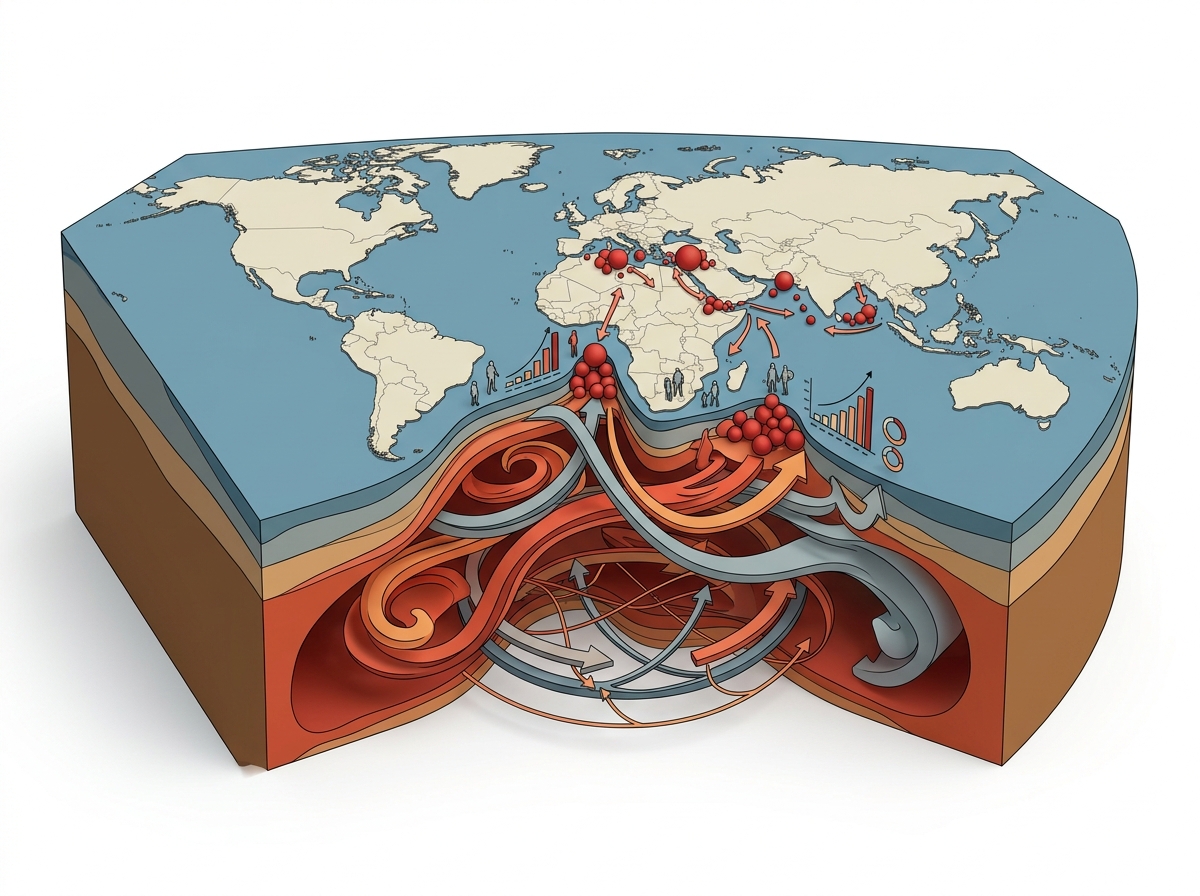
13 Aug UN Report: Migrant Deaths Surge by 111% in 2026, Key Routes Analyzed
Migrant fatalitiesDisplacement Tracking MatrixMissing Migrants ProjectCentral Mediterranean routeEastern Mediterranean routeBay of Bengal route✎ The International Organization for Migration (IOM) has released updated data in 2026 indicating a sharp increase in migrant fatalities across multiple global routes, including the central Mediterranean, eastern Mediterranean, and…
Subject Relevance — Where This Topic Fits
- GS Paper II — International Relations (Migration, Refugee Crises, Human Rights) | GS Paper III — Economy (Labour Migration, Human Trafficking, Economic Pressures)
- Prelims: Migrant deaths, Displacement Tracking Matrix, Missing Migrants Project, Central Mediterranean Route, Eastern Mediterranean Route, Rohingya refugees, Human trafficking, Cyclone Harry, Andaman Sea, Bay of Bengal, Ceuta and Melilla, Horn of Africa, Rakhine state
- Essay: Humanitarian crises and the failure of global governance: A study of migrant fatalities in 2026, The ethical dimensions of migration: Balancing sovereignty and human rights in cross-border mobility
Why is this in the news?
The International Organization for Migration (IOM) has released updated data in 2026 indicating a sharp increase in migrant fatalities across multiple global routes, including the central Mediterranean, eastern Mediterranean, and the Bay of Bengal. This surge, attributed to severe weather, conflict, economic pressures, and policy shifts, underscores the urgent need for data-driven governance and international cooperation to address the humanitarian and security dimensions of irregular migration.
Background
- Migration is a defining feature of the 21st century, with over 304 million international migrants globally, nearly half of whom move within their own regions for work, family reunification, education, or safety.
- The IOM’s Displacement Tracking Matrix and Missing Migrants Project provide critical data on migration flows, fatalities, and missing persons, enabling evidence-based policymaking.
- Climate change exacerbates migration pressures by intensifying weather-related disasters, which disrupt livelihoods and force displacement, particularly in vulnerable regions such as South and Southeast Asia.
- Human trafficking networks exploit migration routes, particularly in conflict zones and areas with weak governance, leading to increased fatalities and human rights abuses.
- The Rohingya crisis, marked by decades of persecution in Myanmar, has resulted in over 1.2 million refugees in Bangladesh, with many undertaking perilous sea journeys to escape statelessness and poverty.
- Policy responses to migration often prioritise border control over humanitarian protection, leading to unintended consequences such as increased fatalities and human rights violations.
What is the Global Overview of Migration Routes Report?
- The report is a publication by the International Organization for Migration (IOM) that maps global migration flows, fatalities, and missing persons across major routes.
- It synthesises data from the Displacement Tracking Matrix, Missing Migrants Project, and regional partners to provide a comprehensive picture of migration dynamics.
- The report highlights disparities between arrivals and fatalities, demonstrating that reduced arrivals do not necessarily indicate safer journeys, as migrants often resort to more dangerous routes.
- It categorises migration routes into regional and inter-regional pathways, such as the central Mediterranean, eastern Mediterranean, western Mediterranean, and the Bay of Bengal.
- The report identifies key drivers of migration, including conflict, economic deprivation, climate change, and policy shifts that reshape migration patterns.
- It serves as a critical tool for policymakers, humanitarian organisations, and international bodies to design targeted interventions for migrant protection and assistance.
- The report also underscores the role of human trafficking in exacerbating fatalities, particularly in conflict-affected and stateless communities.
- It advocates for a human rights-based approach to migration governance, emphasising shared responsibility among states and international organisations.
Key Features
| Feature | Significance |
|---|---|
| Global Overview of Migration Routes Report (IOM) | Provides route-specific data on migrant movements, fatalities, and policy impacts, enabling evidence-based governance and humanitarian responses. |
| Displacement Tracking Matrix (IOM) | A systematic tool for real-time monitoring of displacement and migration patterns, critical for crisis management and resource allocation. |
| Missing Migrants Project (IOM) | Tracks migrant deaths and disappearances globally, highlighting high-risk routes and informing search-and-rescue operations. |
| Cyclone Harry (Central Mediterranean) | Exacerbated migrant fatalities in January 2026, demonstrating how climate-induced disasters intersect with migration crises. |
| Rohingya Refugee Crisis (Bangladesh/Myanmar) | Illustrates the intersection of statelessness, persecution, and perilous sea crossings, with disproportionate impacts on women and children. |
Why it Matters
Humanitarian
- The surge in migrant deaths underscores the failure of existing protection mechanisms, necessitating urgent reforms in search-and-rescue operations and humanitarian corridors.
- Climate-induced disasters (e.g., Cyclone Harry) compound migration risks, requiring integrated disaster-risk reduction strategies for vulnerable populations.
- The Rohingya crisis highlights the gendered and intergenerational toll of forced displacement, demanding gender-sensitive and child-focused interventions.
Geopolitical
- Shifting migration routes (e.g., Western Mediterranean to Ceuta and Melilla) reflect evolving geopolitical pressures, including border policies and regional conflicts.
- Displacement in the Middle East (e.g., Lebanon, Syria) exacerbates transnational migration flows, straining host countries and necessitating regional cooperation.
- The decline in arrivals to the western African Atlantic route does not correlate with safer journeys, indicating policy-induced displacement rather than reduced danger.
Economic
- Migrant remittances, a critical income source for many developing economies, are jeopardized by perilous migration routes, impacting livelihoods and macroeconomic stability.
- Human trafficking and scams along migration routes divert economic resources into illicit networks, undermining formal labor markets and governance structures.
- The economic burden of search-and-rescue operations and humanitarian aid falls disproportionately on transit and destination countries, requiring burden-sharing mechanisms.
Legal/Institutional
- The lack of harmonized international legal frameworks for migrant protection (e.g., search-and-rescue obligations) contributes to the crisis, necessitating multilateral agreements.
- Data gaps in migrant fatalities and disappearances hinder accountability and policy formulation, emphasizing the need for standardized reporting mechanisms.
- The role of regional organizations (e.g., IOM, UNHCR) in coordinating responses highlights the importance of institutional capacity-building in crisis management.
Challenges
1. Climate-Induced Migration Risks
- Extreme weather events (e.g., Cyclone Harry) are increasingly intersecting with migration routes, exacerbating fatalities and displacement.
- Adaptation strategies for migrant populations, such as early warning systems and resilient infrastructure, remain underdeveloped.
- Policy responses often lack integration between climate adaptation and migration governance, creating gaps in risk mitigation.
UPSC Link: GS3: Disaster Management
2. Human Trafficking and Exploitation
- Traffickers exploit migrants through deceptive recruitment, forced labor, and sexual exploitation, particularly in high-risk routes like the Andaman Sea and Bay of Bengal.
- Weak law enforcement and corruption in transit countries enable trafficking networks to operate with impunity.
- Victims of trafficking face barriers to justice, including lack of legal recourse, language barriers, and fear of deportation.
UPSC Link: GS2: International Relations / GS3: Internal Security
3. Statelessness and Forced Displacement
- The Rohingya crisis exemplifies how statelessness and persecution drive perilous migration, with long-term implications for regional stability.
- Host countries (e.g., Bangladesh) face challenges in providing durable solutions, including integration, resettlement, and repatriation.
- The lack of legal frameworks for stateless persons exacerbates their vulnerability to exploitation and rights violations.
UPSC Link: GS2: Citizenship / GS2: Human Rights
4. Policy-Induced Displacement
- Strict border controls and restrictive migration policies (e.g., shifts in departure points) do not reduce migration risks but displace them to more dangerous routes.
- The disconnect between policy objectives (e.g., reducing arrivals) and humanitarian outcomes (e.g., increased fatalities) highlights the need for evidence-based governance.
- Multilateral cooperation is hindered by divergent national interests, complicating the development of cohesive migration policies.
UPSC Link: GS2: International Organizations
5. Data Gaps and Accountability
- Incomplete or inconsistent data on migrant fatalities and disappearances impedes effective policy responses and humanitarian interventions.
- The absence of standardized reporting mechanisms (e.g., across regions and agencies) obscures the true scale of the crisis.
- Accountability for migrant deaths is often elusive due to jurisdictional ambiguities and lack of legal frameworks.
UPSC Link: GS2: Governance / GS3: Technology
Challenges — UPSC Perspective
| Issue | Concern |
|---|---|
| Climate-Induced Migration Risks | Increased fatalities due to extreme weather events intersecting with migration routes. |
| Human Trafficking and Exploitation | Exploitation of migrants by traffickers, particularly in high-risk sea routes. |
| Statelessness and Forced Displacement | Persecution and statelessness driving perilous migration, as seen in the Rohingya crisis. |
| Policy-Induced Displacement | Restrictive border policies displacing migration risks to more dangerous routes. |
| Data Gaps and Accountability | Incomplete data on migrant fatalities hindering effective policy responses. |
Way Forward
- Strengthen search-and-rescue operations in high-risk migration routes (e.g., central Mediterranean, Bay of Bengal) through international cooperation and resource-sharing.
- Develop climate-resilient migration strategies, including early warning systems and infrastructure for vulnerable populations.
- Enhance anti-trafficking measures by improving law enforcement coordination, victim protection, and cross-border intelligence sharing.
- Expand durable solutions for stateless persons and refugees, including legal pathways for integration, resettlement, and repatriation.
- Establish standardized, real-time data collection mechanisms for migrant fatalities and disappearances to inform policy and humanitarian responses.
- Promote burden-sharing among transit and destination countries to address the economic and humanitarian impacts of migration crises.
- Advocate for harmonized international legal frameworks to clarify obligations for migrant protection, including search-and-rescue duties.
- Invest in community-based resilience programs in origin countries to reduce the push factors driving perilous migration.
UPSC Value Addition
Keywords for Mains Answer-Writing
International Organization for Migration (IOM) · Missing Migrants Project · Global Overview of Migration Routes · Rohingya refugee crisis · human trafficking · migrant fatalities · central Mediterranean route · Bay of Bengal migration · climate-induced migration · human rights-based migration governance · displacement tracking matrix · UN Human Rights Council · migration policy and governance · crisis of irregular migration
Constitutional & Policy Linkages
- [‘Article 21 (Right to Life)’, ‘Protection of migrants from perilous journeys and state obligations in search-and-rescue operations.’]
- [‘Article 51(c) (International Cooperation)’, ‘Mandate for India to engage in multilateral efforts to address migration crises and human trafficking.’]
Concept Flow
Climate change and conflict → Increased displacement and migration pressures → Perilous migration routes (e.g., central Mediterranean, Bay of Bengal) → Surge in migrant fatalities and disappearances → Human trafficking and exploitation → Statelessness and forced displacement → Policy responses (e.g., border controls) → Displacement of risks to more dangerous routes → Data gaps and accountability challenges → Urgent need for integrated, evidence-based governance and humanitarian interventions.
Prelims Practice Questions
Q1. Consider the following statements regarding the International Organization for Migration (IOM):
1. The IOM is a specialized agency of the United Nations responsible for migration governance.
2. The IOM’s Missing Migrants Project tracks migrant deaths and disappearances globally.
3. The IOM’s Global Overview of Migration Routes report is solely based on data from European migration routes.
4. The IOM’s Displacement Tracking Matrix monitors internal displacement within countries.
How many of the above statements are correct?
- Only one
- Only two
- Only three
- All
Answer: Only three — Statements 1, 2, and 4 are correct. Statement 3 is incorrect as the report covers global migration routes, not solely European routes.
Q2. Assertion (A): The central Mediterranean route witnessed a 111% increase in migrant deaths in early 2026 compared to the previous year.
Reason (R): This surge was primarily due to Cyclone Harry striking the region in January 2026.
- Both A and R are true, and R is the correct explanation of A
- Both A and R are true, but R is not the correct explanation of A
- A is true, but R is false
- A is false, but R is true
Answer: Both A and R are true, but R is not the correct explanation of A — Both the assertion and reason are true, and the reason correctly explains the assertion as Cyclone Harry directly contributed to the spike in deaths.
Q3. Match the following migration routes with their respective regions:
Column I (Migration Route) | Column II (Region)
1. Central Mediterranean route | A. Bay of Bengal
2. Western African Atlantic route | B. Mediterranean Sea
3. Horn of Africa eastern route | C. Atlantic Ocean off West Africa
4. Bay of Bengal route | D. Eastern Mediterranean
Choose the correct match:
- 1-B, 2-C, 3-D, 4-A
- 1-D, 2-B, 3-A, 4-C
- 1-A, 2-B, 3-C, 4-D
- 1-C, 2-A, 3-D, 4-B
Answer: 1-B, 2-C, 3-D, 4-A — The correct matches are: 1-B (Central Mediterranean route → Mediterranean Sea), 2-C (Western African Atlantic route → Atlantic Ocean off West Africa), 3-D (Horn of Africa eastern route → Eastern Mediterranean), 4-A (Bay of Bengal route → Bay of Bengal).
Mains Practice Question
✍ The surge in migrant fatalities in 2026, as highlighted by the International Organization for Migration (IOM), underscores systemic failures in global migration governance. Critically examine the structural, policy, and environmental factors contributing to this crisis. Also, evaluate the role of international institutions in addressing these challenges. (15 Marks)
Approach: MODEL-ANSWER SKELETON:
1. **Structural Factors:**
– Global inequality and economic disparities driving migration.
– Role of human trafficking networks and exploitative migration pathways.
– Weak enforcement of anti-trafficking laws (e.g., Palermo Protocol, 2000; UN Convention against Transnational Organized Crime).
2. **Policy Failures:**
– Restrictive migration policies in destination countries (e.g., EU’s externalization of borders, Operation Sophia).
– Lack of safe and legal migration pathways leading to reliance on perilous routes.
– Inadequate implementation of the Global Compact for Migration (2018) and its non-binding nature.
3. **Environmental Factors:**
– Climate-induced displacement (e.g., Cyclone Harry in the Mediterranean, 2026).
– Rising sea levels and extreme weather events exacerbating migration risks.
– Link to the Sendai Framework for Disaster Risk Reduction (2015-2030).
4. **Role of International Institutions:**
– **IOM:** Functions under UN mandate; coordinates Missing Migrants Project and Displacement Tracking Matrix. Critique: Limited operational reach and reliance on voluntary state cooperation.
– **UNHCR:** Mandate for refugees; challenges in addressing mixed migration flows.
– **UN Human Rights Council:** Calls for human rights-based approaches but lacks enforcement mechanisms.
5. **Way Forward:**
– Strengthening international cooperation (e.g., through the Global Compact for Migration).
– Expanding safe and legal migration pathways (e.g., labour mobility agreements).
– Enhancing climate adaptation and disaster risk reduction in migration-prone regions.
6. **Balanced View:**
– Acknowledge successes: IOM’s data systems and UNHCR’s protection services.
– Highlight gaps: Non-binding frameworks, political unwillingness to reform restrictive policies.
Source: news.un.org
Generated by AanyaAi for educational purpose.


No Comments