


13 Aug NCERT Textbook Delays & Exam Reforms: Panel Flags Curriculum Gap for UPSC 2026
NCERT textbooksCBSE examsNEP 2020NCF 2023✎ The curriculum-implementation gap in school education arises from the misalignment between policy-driven curriculum reforms (NEP 2020, NCF 2023) and ground-level realities, particularly delays in textbook revisions by NCERT and…
Subject Relevance — Where This Topic Fits
- GS Paper II — Governance, Transparency and Accountability | GS Paper IV — Ethics in Governance (Public Service Delivery) | GS Paper V — Human Resource Development (Education)
- Prelims: National Education Policy 2020, National Curriculum Framework 2023, CBSE curriculum reforms, NCERT textbook revision cycle, Application-based assessment in board examinations, Estimates Committee (Lok Sabha), Union Budget 2026-27 allocation for education, Teacher capacity-building programmes
- Essay: The challenge of aligning policy intent with ground-level implementation in public education, Balancing academic rigour and equity in India’s school education system
Quick Revision: The curriculum-implementation gap in school education arises from the misalignment between policy-driven curriculum reforms (NEP 2020, NCF 2023) and ground-level realities, particularly delays in textbook revisions by NCERT and the need for teacher capacity-building to adopt application-based assessment methods.
Why is this in the news?
A parliamentary committee has highlighted a critical implementation gap in India’s school education system, where the alignment of curriculum with the National Education Policy (NEP) 2020 and the National Curriculum Framework (NCF) 2023 has outpaced the availability of updated textbooks and the preparedness of teachers. The delay in textbook revisions by the National Council of Educational Research and Training (NCERT) and the introduction of application-based examination patterns by the Central Board of Secondary Education (CBSE) have created academic stress and confusion among students, particularly those in Classes 9 to 12. The committee’s observations, presented in the Tenth Report of the Committee on Estimates (2026-27), underscore the need for urgent measures to bridge the transition gap and ensure equitable access to quality education.
Background
- The National Education Policy (NEP) 2020, approved by the Union Cabinet in July 2020, envisages a transformative shift in India’s education system, emphasizing holistic development, critical thinking, and application-based learning.
- The National Curriculum Framework (NCF) 2023 provides the pedagogical and curricular guidelines to operationalize the NEP 2020, including revisions to textbooks and assessment patterns.
- The Central Board of Secondary Education (CBSE) has initiated reforms to align its curriculum with NEP 2020 and NCF 2023, including the introduction of application-based questions in board examinations for Classes 10 and 12.
- The National Council of Educational Research and Training (NCERT) is responsible for the development, revision, and distribution of textbooks for school education in India, including those for Classes 9 to 12.
- The Union Budget 2026-27 allocated ₹1,39,286 crore to the Ministry of Education, reflecting an 8.27% increase over the previous year, with a focus on improving access, equity, and quality in education.
- The Committee on Estimates (Lok Sabha) is a parliamentary body tasked with examining the budgetary allocations and policy initiatives of ministries, including the Ministry of Education, to ensure efficient and effective public expenditure.
What is the curriculum-implementation gap in school education?
- The curriculum-implementation gap refers to the disparity between the intended educational reforms outlined in policies such as NEP 2020 and NCF 2023 and their actual execution on the ground, particularly in terms of textbook availability and teacher preparedness.
- The NEP 2020 advocates for a shift from rote learning to competency-based and application-oriented education, necessitating changes in curriculum design, assessment patterns, and pedagogical practices.
- The NCF 2023 provides the framework for revising school textbooks to align with NEP 2020, ensuring that content is updated, interdisciplinary, and promotes critical thinking and problem-solving skills.
- The CBSE has revised its examination patterns to include application-based questions, aiming to assess higher-order cognitive skills such as analysis, evaluation, and synthesis, rather than mere memorization.
- However, the non-availability of new textbooks for Classes 9 to 12, as noted by the parliamentary committee, has forced schools to rely on outdated materials while teaching an updated curriculum, creating confusion and academic stress among students.
- The delay in textbook revisions by NCERT is attributed to the complexity of the revision process to ensure alignment with NEP 2020 and NCF 2023.
- The introduction of application-based examinations by CBSE requires teachers to adopt new pedagogical approaches, such as experiential learning and project-based assessments, which necessitates significant capacity-building efforts.
- The parliamentary committee has recommended fast-tracking the development, printing, and distribution of new textbooks, as well as launching nationwide teacher-training programmes to bridge the implementation gap.
Key Features
| Feature | Significance |
|---|---|
| National Education Policy (NEP) 2020 | Provides the overarching framework for transforming India’s education system, emphasizing holistic development, critical thinking, and application-based learning. |
| National Curriculum Framework (NCF) 2023 | Outlines the pedagogical and curricular reforms aligned with NEP 2020, including competency-based education and reduced rote learning. |
| CBSE Curriculum Alignment (Grades 9–12) | Ensures that school education adheres to NEP 2020 and NCF 2023 objectives, particularly through competency-based and application-oriented assessments. |
| NCERT Textbook Revision Process | Aims to update textbooks to reflect NCF 2023, but faces delays, creating a mismatch between curriculum design and available study materials. |
| Application-Based Board Examinations | Introduces higher-order thinking questions in Class 10 and 12 exams, increasing academic stress due to reliance on outdated textbooks. |
| Teacher Capacity-Building Programmes | Mandates annual professional development for teachers to adapt to new pedagogical methods, with mixed implementation across government and private schools. |
Why it Matters
Educational Governance
- Exposes systemic gaps in translating policy into practice, particularly in textbook revision and teacher training.
- Highlights the role of parliamentary oversight in identifying implementation failures in centrally sponsored schemes.
- Demonstrates the interplay between curriculum design (NCF 2023) and assessment reforms (CBSE Board exams).
Pedagogical Reforms
- Reinforces the shift from rote learning to competency-based education, as envisaged in NEP 2020.
- Underscores the need for alignment between curriculum content, textbooks, and examination patterns to reduce student stress.
- Emphasizes the critical role of teacher training in implementing application-based pedagogy.
Equity and Access
- Raises concerns about disparities in teacher training access between government and private schools, particularly in rural areas.
- Examines the financial burden on private school teachers for mandatory training, which may exacerbate inequities.
- Flags potential academic disadvantage for students in schools lacking updated textbooks.
Challenges
1. Delay in NCERT Textbook Revision
- Creates a mismatch between the prescribed curriculum and available study materials, leading to confusion among students and teachers.
- Undermines the objectives of NEP 2020 and NCF 2023 by delaying the transition to competency-based education.
- Increases academic stress for Class 10 and 12 students preparing for application-based Board examinations.
UPSC Link: GS Paper 2: Education Policy
2. Implementation Gap in Teacher Training
- Mandatory 50-hour annual training for teachers is not uniformly implemented, with a sharp decline in online training participation.
- Private school teachers, especially in rural areas, face financial barriers to mandatory training, creating inequities in professional development.
- Inadequate training in application-based pedagogy limits the effectiveness of NEP 2020 reforms.
UPSC Link: GS Paper 2: Teacher Education
3. Curriculum-Assessment Mismatch
- CBSE’s shift to application-based exams assumes students have access to updated textbooks and trained teachers, which is not uniformly true.
- Students relying on older textbooks struggle with higher-order questions, leading to performance anxiety and stress.
- Examination reforms outpace curriculum and resource availability, defeating the purpose of competency-based education.
UPSC Link: GS Paper 2: Examination Reforms
4. Resource Disparities Across Schools
- Government schools benefit from free teacher training and subsidized textbooks, while private schools, particularly in rural areas, bear additional costs.
- Lack of updated textbooks in private schools widens the learning gap between students from different socio-economic backgrounds.
- Financial constraints in rural schools exacerbate the challenges of implementing NEP 2020 reforms.
UPSC Link: GS Paper 2: Education Equity
Challenges — UPSC Perspective
| Issue | Concern |
|---|---|
| Textbook Revision Delays | Creates a disconnect between curriculum design and available study materials, increasing student stress. |
| Teacher Training Participation Decline | Sharp drop in online teacher training (from 5.3M in 2022 to 1.6L in 2025) undermines pedagogical reforms. |
| Financial Barriers for Private Teachers | Additional costs (e.g., Rs 700 per workshop) for private school teachers in rural areas limit access to mandatory training. |
| Curriculum-Assessment Discrepancy | Application-based Board exams are not supported by updated textbooks, leading to confusion and inequitable assessment. |
| Rural-Urban Disparities | Lack of resources in rural schools exacerbates inequities in implementing NEP 2020 reforms. |
| Student Performance Anxiety | Reliance on outdated textbooks for higher-order exam questions increases academic stress among Class 10 and 12 students. |
Way Forward
- Fast-track the development, printing, and nationwide distribution of NCERT textbooks for Classes 9–12 to align with NCF 2023.
- Strengthen coordination between NCERT, CBSE, and state education boards to ensure seamless curriculum implementation.
- Expand and subsidize teacher training programmes, particularly for private school educators in rural and underserved areas.
- Introduce phased implementation of application-based Board examinations to allow schools adequate time to adapt.
- Enhance digital infrastructure to support online teacher training and textbook distribution, reducing regional disparities.
- Monitor and evaluate the effectiveness of teacher training programmes through periodic assessments and feedback mechanisms.
- Establish a grievance redressal mechanism for students and teachers facing challenges due to curriculum-assessment mismatches.
- Promote public-private partnerships to accelerate textbook printing and distribution, ensuring equitable access.
UPSC Value Addition
Keywords for Mains Answer-Writing
National Education Policy (NEP) 2020 · National Curriculum Framework (NCF) 2023 · Central Board of Secondary Education (CBSE) · National Council of Educational Research and Training (NCERT) · Parliamentary Standing Committee on Estimates · Application-based pedagogy · Teacher capacity-building programmes · Curriculum-Textbook-Teacher (CTT) linkage · Class 10 and 12 Board examinations · Educational governance and implementation gaps
Concept Flow
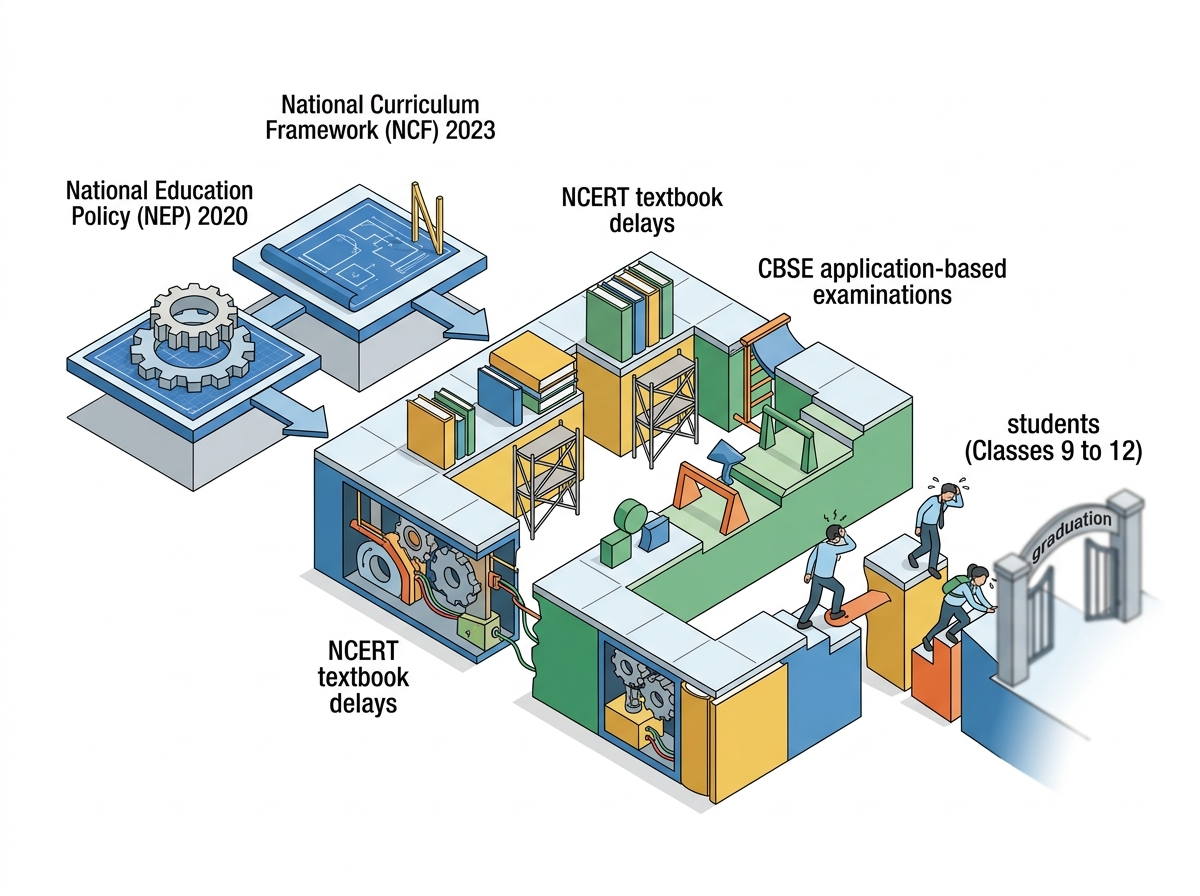
NEP 2020 and NCF 2023 → Curriculum design (competency-based, application-oriented) → CBSE Board examination reforms → NCERT textbook revision delays → Mismatch between curriculum and study materials → Increased student stress and academic confusion → Parliamentary oversight identifies gaps → Recommendations for fast-tracking textbook distribution and teacher training → Implementation challenges persist due to resource disparities → Need for systemic reforms in governance and equity.
Prelims Practice Questions
Q1. Consider the following statements regarding the National Curriculum Framework (NCF) 2023:
1. It is aligned with the objectives of the National Education Policy (NEP) 2020.
2. It mandates application-based pedagogy for Classes 9 to 12.
3. It is developed by the Central Board of Secondary Education (CBSE).
How many of the above statements are correct?
- Only one
- Only two
- All three
- None
Answer: Only two — Statement 1 is correct as NCF 2023 is aligned with NEP 2020. Statement 2 is correct as NCF 2023 emphasizes application-based learning. Statement 3 is incorrect as NCF is developed by the National Council of Educational Research and Training (NCERT), not CBSE.
Q2. Assertion (A): The Parliamentary Standing Committee on Estimates has flagged delays in the release of new NCERT textbooks for Classes 9 to 12.
Reason (R): The non-availability of textbooks has created a gap between curriculum design and implementation, leading to academic stress among students.
- Both A and R are true, and R is the correct explanation of A
- Both A and R are true, but R is not the correct explanation of A
- A is true, but R is false
- A is false, but R is true
Answer: Both A and R are true, and R is the correct explanation of A — Both the assertion and reason are factually accurate, and the reason correctly explains the assertion as per the report of the Parliamentary Standing Committee.
Q3. Match the following institutions with their respective roles in the Indian education system:
Column I (Institution) | Column II (Role)
— | —
A. NCERT | 1. Conducts Board examinations for Classes 10 and 12
B. CBSE | 2. Develops national curriculum frameworks and textbooks
C. NEP 2020 | 3. Provides policy framework for school education reforms
D. NCF 2023 | 4. Aligns curriculum with educational policy objectives
- A-2, B-1, C-3, D-4
- A-1, B-2, C-4, D-3
- A-3, B-4, C-1, D-2
- A-4, B-3, C-2, D-1
Answer: A-2, B-1, C-3, D-4 — NCERT develops national curriculum frameworks and textbooks (A-2). CBSE conducts Board examinations (B-1). NEP 2020 provides the policy framework for school education reforms (C-3). NCF 2023 aligns curriculum with educational policy objectives (D-4).
Mains Practice Question
✍ The alignment of the school curriculum with the National Education Policy (NEP) 2020 and the National Curriculum Framework (NCF) 2023 has introduced significant pedagogical shifts, particularly towards application-based learning. Critically examine the challenges in implementing these reforms, with special reference to the delay in textbook availability and the capacity of teachers to deliver the revised curriculum. (15 Marks)
Approach: MODEL-ANSWER SKELETON:
1. **Introduction (2 Marks)**
– Briefly state the objectives of NEP 2020 and NCF 2023, emphasizing the shift towards competency-based and application-oriented learning.
– Mention the Parliamentary Standing Committee’s observations on the implementation gap.
2. **Curriculum-Textbook-Teacher (CTT) Linkage (4 Marks)**
– Explain the triad of curriculum design, textbook availability, and teacher preparedness as critical to successful implementation.
– Highlight the delay in NCERT textbook releases for Classes 9–12 and its impact on classroom teaching.
– Reference the Parliamentary panel’s recommendation to fast-track textbook distribution.
3. **Teacher Capacity and Pedagogical Shifts (4 Marks)**
– Discuss the requirement for teachers to adopt application-based pedagogy and the challenges in transitioning from rote learning.
– Cite the decline in online teacher training (from 5.3 million in 2022 to 1,62,814 in 2025) and the financial burden on private school teachers.
– Mention CBSE’s mandatory 50-hour annual teacher training and its role in bridging the gap.
4. **Institutional Coordination and Governance (3 Marks)**
– Examine the role of NCERT, CBSE, and the Ministry of Education in ensuring smooth implementation.
– Highlight the need for coordinated efforts to align textbook development, teacher training, and examination reforms.
5. **Conclusion (2 Marks)**
– Summarize the key challenges and propose actionable steps, such as accelerated textbook printing, equitable teacher training access, and phased examination reforms.
– Emphasize the importance of a synchronized approach to avoid academic stress and ensure equitable learning outcomes.
Source: The Indian Express
Generated by AanyaAi for educational purpose.

- मद्रास उच्च न्यायालय में ‘वेट्ट्री पयणम’ योजना को असंवैधानिक घोषित करने की मांग - October 4, 2026
- Gurugram’s groundwater extraction exceeds limit by 212%; HC seeks ban - October 4, 2026
- स्वतंत्रता सेनानी श्यामजी कृष्ण वर्मा की जन्म जयंती पर पीएम का श्रद्धांजलि - October 4, 2026

No Comments