


13 Aug UPSC Alert: 73% Students Drop Out Before Class 12 – Key Findings
✎ The 73% dropout rate before higher secondary education underscores the need for structural reforms in school infrastructure, policy alignment with RTE and NEP 2020, and inclusive provisions for CwSN to ensure equitable access and…
Subject Relevance — Where This Topic Fits
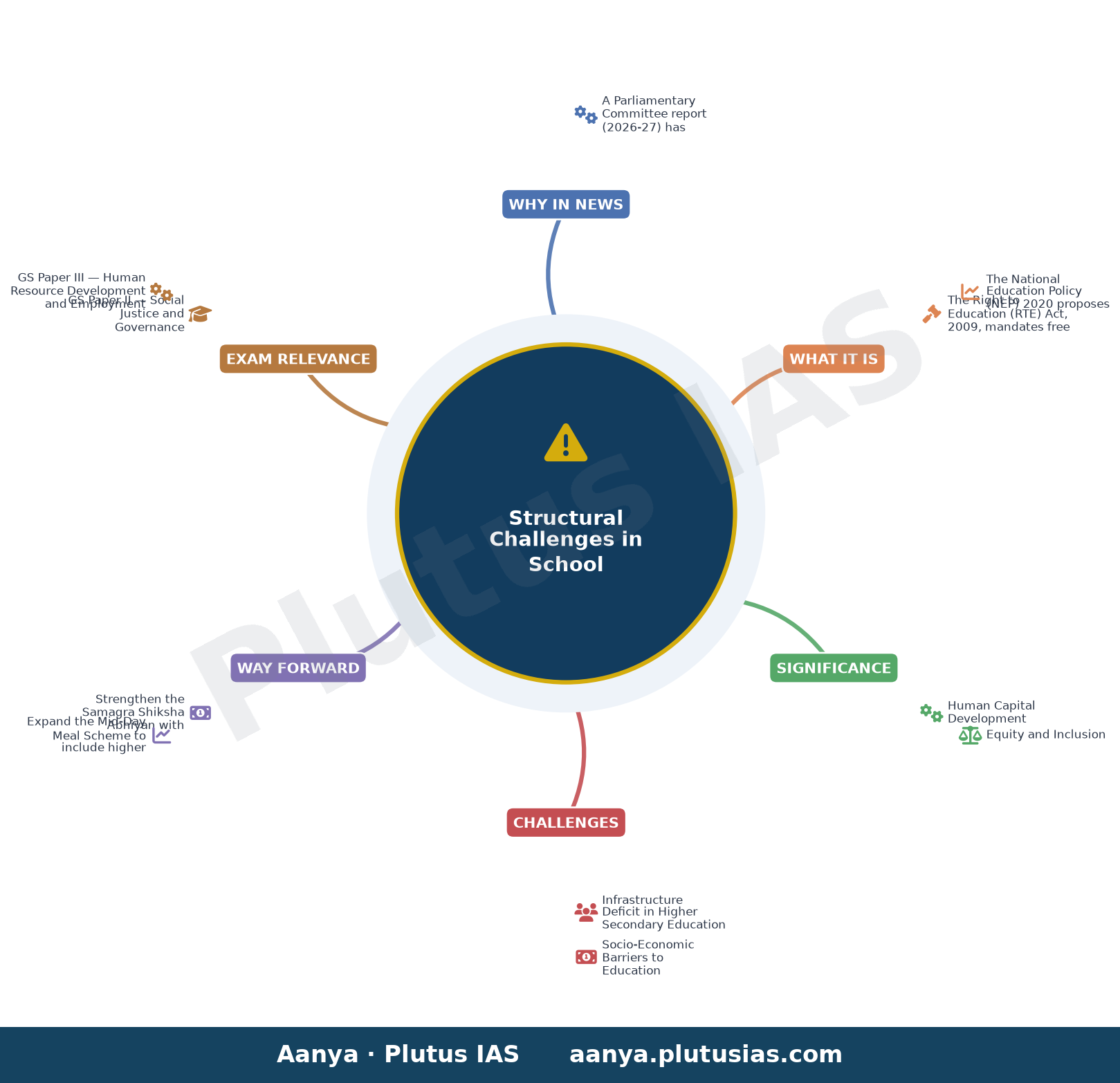
- GS Paper II — Social Justice and Governance (Education) | GS Paper III — Human Resource Development and Employment
- Prelims: Right to Education (RTE) Act, 2009, Sarva Shiksha Abhiyan (SSA), National Education Policy (NEP) 2020, CwSN (Children with Special Needs), Gross Enrolment Ratio (GER), School Infrastructure Gaps
- Essay: Education as a tool for social equity: Bridging the gap between access and retention, The paradox of universal schooling: Why enrolment does not guarantee completion
Quick Revision: The 73% dropout rate before higher secondary education underscores the need for structural reforms in school infrastructure, policy alignment with RTE and NEP 2020, and inclusive provisions for CwSN to ensure equitable access and retention.
Why is this in the news?
A Parliamentary Committee report (2026-27) has highlighted a significant decline in student enrolment from primary to higher secondary levels, with 73% of students dropping out before completing higher secondary education. The report underscores systemic gaps in school infrastructure, particularly the paucity of secondary and higher secondary schools, and the lack of facilities for children with special needs (CwSN), raising concerns about the efficacy of existing educational policies and their alignment with constitutional mandates for equitable access to quality education.
Background
- The Right to Education (RTE) Act, 2009, guarantees free and compulsory education for children aged 6–14 years, mandating universal enrolment in primary and upper primary stages.
- The National Education Policy (NEP) 2020 emphasises universal access to education up to the age of 18, aiming to reduce dropout rates and enhance learning outcomes through structural reforms in school education.
- Sarva Shiksha Abhiyan (SSA) and its successor, Samagra Shiksha Abhiyan, have historically focused on expanding school infrastructure, but gaps persist in transitioning students from primary to secondary and higher secondary levels.
- The Gross Enrolment Ratio (GER) in higher secondary education remains significantly lower than in primary education, reflecting systemic barriers such as geographical access, economic constraints, and socio-cultural factors.
- The 2026-27 Parliamentary Committee report aligns with earlier observations by bodies like the NITI Aayog and UNICEF, which have flagged disparities in school infrastructure and retention rates across states and socio-economic groups.
Understanding the Dropout Crisis: Structural and Policy Dimensions
- The Right to Education (RTE) Act, 2009, mandates free and compulsory education for children aged 6–14 years, but does not explicitly address retention beyond this stage, creating a policy gap for secondary education.
- The National Education Policy (NEP) 2020 proposes a ‘5+3+3+4’ school structure to ensure continuity from early childhood to higher secondary, aiming to reduce dropout rates by integrating foundational, preparatory, middle, and secondary stages.
- The decline in enrolment from 6.18 crore at the primary level to 1.64 crore at the higher secondary level (73% dropout rate) reflects systemic inefficiencies, including lack of transport facilities, economic pressures on families, and socio-cultural barriers such as early employment or early marriage.
- The Parliamentary Committee report highlights a critical shortage of secondary and higher secondary schools, with only 1,61,808 secondary and 90,866 higher secondary schools compared to 9,11,032 primary schools, exacerbating access challenges.
- Children with Special Needs (CwSN) face compounded barriers due to the absence of inclusive infrastructure, such as ramps, accessible toilets, and trained special educators, in a majority of government schools, violating the Rights of Persons with Disabilities (RPwD) Act, 2016.
- The GER in higher secondary education is disproportionately lower in states with high tribal and Dalit populations, indicating intersectional inequities in educational access and retention.
- The Committee recommends upgrading existing primary and secondary schools to higher secondary schools to improve transition rates and reduce dropout rates, aligning with the NEP 2020’s goal of universal secondary education by 2030.
Key Features
| Feature | Significance |
|---|---|
| Declining student enrolment from primary to higher secondary | Highlights systemic gaps in India’s education pipeline, indicating potential loss of human capital and reduced access to secondary education. |
| Disproportionate distribution of schools across education levels | Primary and upper primary schools dominate (9.11 lakh and 4.13 lakh respectively), while secondary and higher secondary schools are scarce (1.62 lakh and 90,866), exacerbating access issues. |
| Dropout rate of 73% before higher secondary | Reflects structural barriers such as economic constraints, lack of infrastructure, and socio-cultural factors that impede sustained educational attainment. |
| Inadequate CwSN (Children with Special Needs) infrastructure | Only a fraction of schools are equipped to accommodate students with disabilities, violating the Right to Education (RTE) Act, 2009, and the Rights of Persons with Disabilities Act, 2016. |
| Recommendation for upgrading schools to higher secondary level | Proposes a policy intervention to convert existing primary/secondary schools into higher secondary institutions to improve vertical mobility and reduce dropout rates. |
Why it Matters
Human Capital Development
- Sustained enrolment is critical for building a skilled workforce, essential for India’s demographic dividend and economic growth.
Equity and Inclusion
- High dropout rates disproportionately affect marginalised groups, including girls, rural populations, and children with disabilities, deepening socio-economic inequalities.
Policy Accountability
- The parliamentary committee’s findings underscore the need for rigorous monitoring of educational outcomes and targeted interventions under the Right to Education (RTE) Act.
Economic Costs of Dropout
- Early school leaving results in lower lifetime earnings, reduced tax contributions, and higher social welfare expenditures, straining public resources.
Global Education Benchmarks
- India’s dropout rate contrasts with global averages (e.g., ~5% in OECD countries), highlighting the urgency of systemic reforms to align with Sustainable Development Goal 4 (SDG 4).
Challenges
1. Infrastructure Deficit in Higher Secondary Education
- Severe shortage of secondary and higher secondary schools, particularly in rural and tribal areas, limiting access to advanced education.
UPSC Link: GS2: Education – Infrastructure Gaps
2. Socio-Economic Barriers to Education
- Poverty, child labour, early marriage, and lack of transportation deter students from continuing education beyond primary levels.
UPSC Link: GS1: Poverty and Development
3. Inadequate Teacher Training and Availability
- Shortage of trained teachers, especially in subjects like science and mathematics, and lack of professional development for educators in rural areas.
UPSC Link: GS2: Education – Teacher Training
4. CwSN Exclusion and Stigma
- Absence of barrier-free infrastructure, trained special educators, and inclusive curricula excludes children with disabilities from mainstream education.
UPSC Link: GS2: Rights of Persons with Disabilities Act
5. Quality and Relevance of Curriculum
- Curriculum often fails to align with vocational and market needs, reducing motivation for students to continue education.
UPSC Link: GS2: Education – Curriculum Reform
6. Monitoring and Data Gaps
- Lack of real-time, disaggregated data on dropout causes and outcomes hinders targeted policy interventions.
UPSC Link: GS2: Education – Data Systems
Challenges — UPSC Perspective
| Issue | Concern |
|---|---|
| School Infrastructure | Disproportionate concentration of primary schools; severe shortage of secondary/higher secondary institutions, especially in rural and tribal regions. |
| Economic Constraints | Household poverty, child labour, and lack of financial incentives (e.g., scholarships) for continued education. |
| Social and Cultural Factors | Early marriage, gender discrimination, and societal attitudes towards education, particularly for girls and marginalised communities. |
| Policy Implementation Gaps | Inadequate enforcement of the RTE Act, 2009, and lack of convergence between central and state education policies. |
| Teacher Shortages | Insufficient trained teachers in secondary education, particularly in STEM subjects, and poor teacher-student ratios in rural areas. |
| Inclusive Education Deficits | Limited infrastructure for CwSN, lack of accessible transport, and absence of trained special educators. |
Way Forward
- Strengthen the Samagra Shiksha Abhiyan with targeted funding for upgrading primary/upper primary schools to higher secondary levels in underserved regions.
- Expand the Mid-Day Meal Scheme to include higher secondary students to incentivise continued enrolment and reduce dropout rates.
- Implement the Right to Education (RTE) Act, 2009, with stricter monitoring of infrastructure and teacher deployment in secondary schools.
- Establish a National Education Data Repository to track enrolment, dropout, and transition rates by gender, caste, and disability status.
- Launch a National Teacher Training Programme for secondary education, focusing on STEM subjects and inclusive pedagogy.
- Introduce vocational education modules in higher secondary curricula to align with market demands and improve employability.
- Enhance the Accessible India Campaign to ensure barrier-free infrastructure in all government schools, prioritising CwSN facilities.
- Conduct annual state-wise audits of school infrastructure and publish findings to enhance accountability and resource allocation.
UPSC Value Addition
Keywords for Mains Answer-Writing
School Education System · Dropout Rates · Right to Education Act 2009 · Secondary and Higher Secondary Education · School Infrastructure Gaps · Children with Special Needs (CwSN) · Parliamentary Standing Committee on Education · Sarva Shiksha Abhiyan · National Education Policy 2020 · Equitable Access to Education
Constitutional & Policy Linkages
- Article 21A – Right to Education as a Fundamental Right for children aged 6-14 years, mandating free and compulsory education.
- Article 45 – Directive Principle of State Policy to provide early childhood care and education for all children up to the age of 6.
Concept Flow
Primary Education Expansion (post-2009 RTE) → Increased enrolment in primary/upper primary schools → Inadequate secondary/higher secondary infrastructure → High dropout rates before higher secondary → Loss of human capital and reduced access to higher education → Reinforcement of socio-economic inequalities → Policy interventions (e.g., SSA upgrades) to bridge gaps → Sustained educational attainment and workforce readiness.
Prelims Practice Questions
Q1. Consider the following statements regarding the Right to Education Act, 2009:
1. It guarantees free and compulsory education to all children aged 6-14 years.
2. The Act mandates the establishment of neighbourhood schools within a defined walking distance.
3. It requires all private schools to reserve 25% of seats for children from weaker sections and disadvantaged groups.
4. The Act provides for the establishment of a School Management Committee in every school.
How many of the above statements are correct?
- Only one
- Only two
- Only three
- All
Answer: All — Statements 1, 2, and 3 are correct under the RTE Act. Statement 4 is incorrect as School Management Committees are mandated only in government and aided schools, not all schools.
Q2. Assertion (A): The Right to Education Act, 2009, mandates the provision of free and compulsory education to children with special needs (CwSN) in neighbourhood schools.
Reason (R): The Act requires all schools to be barrier-free and inclusive by 2020.
Options:
A. Both A and R are true, and R is the correct explanation of A.
B. Both A and R are true, but R is NOT the correct explanation of A.
C. A is true, but R is false.
D. A is false, but R is true.
Answer: ? — Assertion (A) is true as the RTE Act mandates inclusion of CwSN in neighbourhood schools. Reason (R) is true but incorrect as the Act does not set a 2020 deadline for barrier-free infrastructure; compliance remains incomplete.
Q3. Match the following educational initiatives with their respective objectives:
Column I (Initiative) Column II (Objective)
A. Sarva Shiksha Abhiyan (SSA) 1. Universalisation of secondary education
B. Rashtriya Madhyamik Shiksha Abhiyan (RMSA) 2. Universalisation of elementary education
C. Samagra Shiksha Abhiyan 3. Integrated scheme for school education
D. National Education Policy 2020 4. Holistic and multidisciplinary education
Select the correct match:
- A-2, B-1, C-3, D-4
- A-1, B-2, C-3, D-4
- A-3, B-2, C-1, D-4
- A-2, B-3, C-1, D-4
Answer: A-2, B-1, C-3, D-4 — A-2 (SSA aims at universal elementary education), B-1 (RMSA targets universal secondary education), C-3 (Samagra Shiksha integrates SSA, RMSA, and teacher education), D-4 (NEP 2020 promotes holistic education).
Mains Practice Question
✍ The Parliamentary Standing Committee on Education has highlighted a critical gap in India’s school education system: a steep decline in student enrolment from primary to higher secondary levels, with approximately 73% of students dropping out before completing higher secondary education. Critically examine the structural, socio-economic, and institutional factors contributing to this trend. Also, assess the adequacy of existing policy frameworks such as the Right to Education Act, 2009, and the National Education Policy 2020, in addressing these challenges. (15 Marks)
Approach: MODEL-ANSWER SKELETON:
1. **Structural Factors**:
– Inadequate infrastructure at secondary and higher secondary levels (e.g., fewer schools: 1,61,808 secondary vs 9,11,032 primary schools).
– Geographic disparities: rural and tribal areas lack access to secondary schools; high reliance on single-teacher schools.
– Data from the Parliamentary Committee Report (2026) on school distribution and enrolment decline.
2. **Socio-Economic Factors**:
– Poverty and child labour: economic compulsions force students to leave school for work (NSSO 2023 data on child labour).
– Gender disparities: higher dropout rates among girls due to early marriage, safety concerns, and lack of sanitation facilities (UNESCO 2025 report).
– Caste and social exclusion: marginalised communities face systemic barriers in accessing quality education.
3. **Institutional Factors**:
– Teacher shortages and poor quality of teaching at secondary levels (DISE 2025 data on pupil-teacher ratio).
– Lack of inclusive infrastructure for Children with Special Needs (CwSN), as noted by the Committee.
– Weak implementation of mid-day meal schemes and scholarship programmes at higher levels.
4. **Policy Frameworks**:
– **Right to Education Act, 2009**: Covers ages 6–14; gaps in secondary education coverage and enforcement.
– **National Education Policy 2020**: Aims for 100% GER in school education by 2030; focuses on foundational literacy, vocational integration, and digital infrastructure. However, implementation challenges persist.
– **Samagra Shiksha Abhiyan**: Integrates SSA and RMSA but lacks targeted interventions for retention at higher levels.
5. **Critical Assessment**:
– Policies are progressive but suffer from fragmented implementation, underfunding, and lack of accountability.
– Need for convergence between education, social welfare, and employment policies to address root causes.
6. **Way Forward**:
– Expand secondary school infrastructure, especially in underserved regions (e.g., Aspirational Districts Programme).
– Strengthen vocational training and bridge courses to retain students.
– Enhance teacher training and inclusive infrastructure for CwSN.
– Strengthen monitoring mechanisms (e.g., DISE, UDISE+) to track dropout rates and address systemic gaps.
Source: amarujala.com
Generated by AanyaAi for educational purpose.

- छत्तीसगढ़ में अतिथि व्याख्याता नीति बदली: मूल निवासियों को मिलेगी वरीयता - September 30, 2026
- AI Translation Tool for Official Docs: CAG-BHASHINI Anuvaad Launch - September 30, 2026
- गुजरात ATS ने EEZ में 526 किलो नशीली दवाओं की जब्ती कर इतिहास रचा - September 30, 2026

No Comments