


13 Aug Kerala Assembly Row: Governor Slams Partial Vande Mataram Playback Policy
✎ The 'Vande Mataram' controversy in Kerala exemplifies the constitutional balance between cultural symbolism and institutional protocol, underscoring the Governor's role in upholding constitutional propriety and the need for clear…
Subject Relevance — Where This Topic Fits
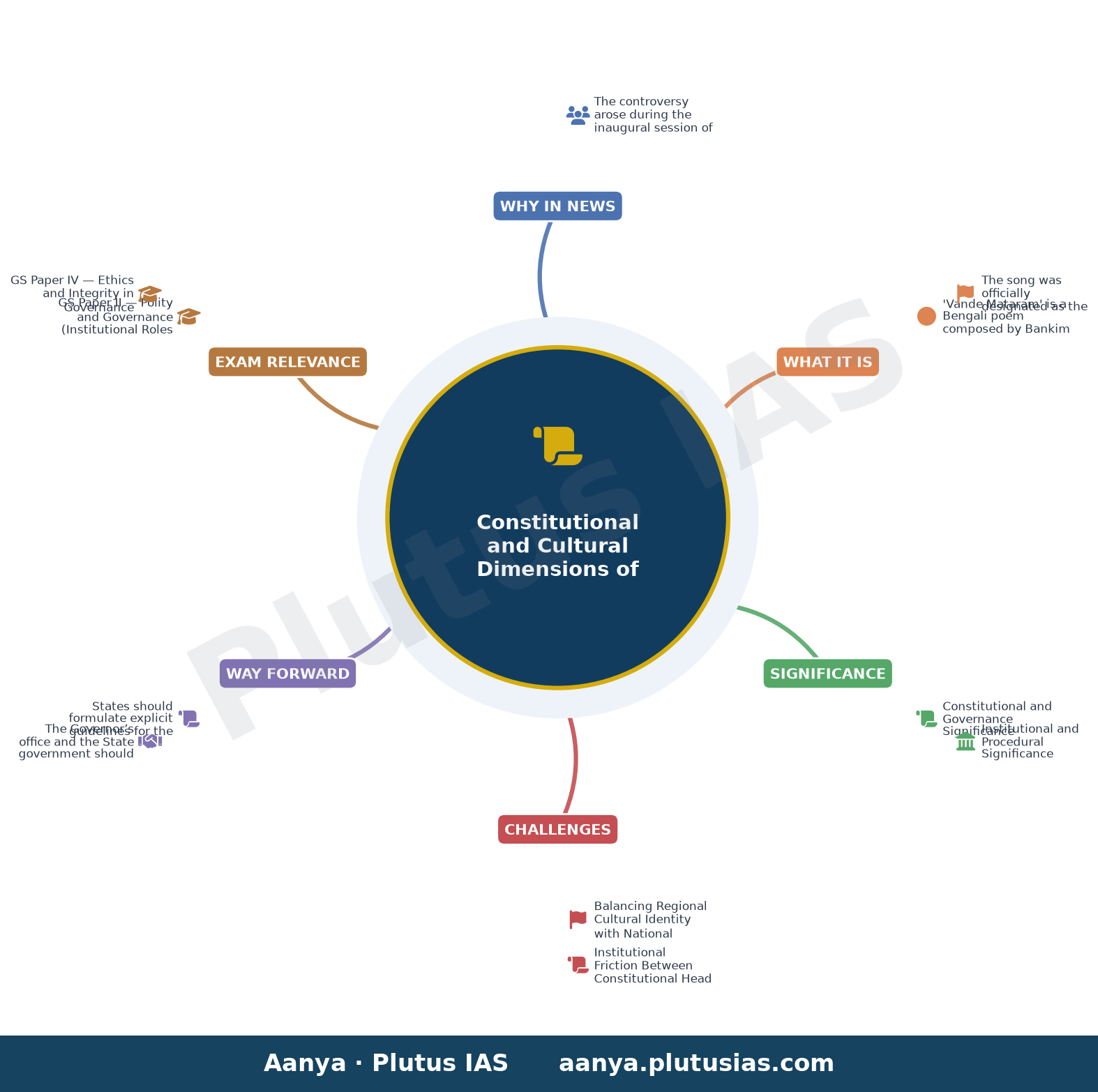
- GS Paper II — Polity and Governance (Institutional Roles and Constitutional Provisions) | GS Paper IV — Ethics and Integrity in Governance (Symbolism and Cultural Representation)
- Prelims: Fundamental Duties (Article 51A), Governor’s discretionary powers (Article 163), Cultural Symbols and National Integration, Federalism and Centre-State Relations, Official Language and Cultural Expression
- Essay: The interplay between cultural symbolism and constitutional governance in a pluralistic society, Federalism and the balance of power between the executive and ceremonial heads in Indian democracy
Quick Revision: The ‘Vande Mataram’ controversy in Kerala exemplifies the constitutional balance between cultural symbolism and institutional protocol, underscoring the Governor’s role in upholding constitutional propriety and the need for clear guidelines on the rendition of national symbols in governance.
Why is this in the news?
The controversy arose during the inaugural session of the 16th Kerala Legislative Assembly when the Kerala Police band did not play ‘Vande Mataram’ in its entirety, leading to a dispute between the state government and the Governor. The Governor publicly objected to the government’s decision, framing it as a deviation from established protocol, thereby highlighting the constitutional and symbolic dimensions of cultural representation in governance.
Background
- The song ‘Vande Mataram’, composed by Bankim Chandra Chattopadhyay, holds significant cultural and historical importance in India, often associated with the freedom struggle and national identity.
- The Government of India, through the Ministry of Culture, has designated ‘Vande Mataram’ as the national song, and its rendition is a customary practice in official and legislative proceedings across many states.
- The Kerala Assembly, like other state legislatures, follows established protocols for ceremonial functions, including the playing of national symbols during inaugural sessions.
- The incident occurred during the opening session of the 16th Kerala Legislative Assembly, where the state government and the Governor’s office clashed over the interpretation of protocol regarding the rendition of ‘Vande Mataram’.
- The controversy reflects broader debates on the role of cultural symbols in governance, the balance of power between elected governments and constitutional authorities, and the interpretation of constitutional provisions in a federal structure.
- The dispute underscores the need for clarity in institutional protocols governing the rendition of national symbols in legislative and administrative settings.
What is ‘Vande Mataram’ and its Constitutional and Cultural Significance?
- ‘Vande Mataram’ is a Bengali poem composed by Bankim Chandra Chattopadhyay in 1876, later included in his novel ‘Anandamath’. It was adopted as a rallying cry during the Indian independence movement.
- The song was officially designated as the ‘National Song of India’ by the Constituent Assembly on January 24, 1950, alongside the national anthem, ‘Jana Gana Mana’.
- The rendition of ‘Vande Mataram’ is governed by the Ministry of Culture’s guidelines, which emphasize its cultural and historical significance in fostering national unity and identity.
- In legislative and administrative settings, the playing of ‘Vande Mataram’ is often treated as a symbolic gesture of respect for national unity and cultural heritage, though its rendition is not legally mandated in all contexts.
- The Constitution of India, under Part IVA (Fundamental Duties), encourages citizens to value and preserve the rich heritage of the composite culture of India (Article 51A(f)), which includes respect for national symbols.
- The role of the Governor in state legislatures is primarily ceremonial, acting as a constitutional link between the Centre and the state, and is expected to uphold constitutional propriety and protocol.
- Disputes over the rendition of national symbols often arise from differing interpretations of constitutional provisions, institutional protocols, and cultural sensitivities, requiring resolution through dialogue and adherence to established norms.
- The controversy highlights the need for clear, uniform guidelines on the rendition of national symbols in legislative and administrative settings to avoid institutional conflicts and ensure consistency in governance.
Key Features
| Feature | Significance |
|---|---|
| Constitutional position of the Governor as the constitutional head of the State | The Governor’s role is ceremonial and apolitical, yet the Constitution (Article 153-167) empowers them to act as a link between the Centre and the State, ensuring adherence to constitutional norms. |
| Conduct of State Assembly proceedings and protocol norms | The opening session of the State Assembly is governed by the Rules of Procedure and Conduct of Business in the Kerala Legislative Assembly, which prescribe protocols for ceremonial functions, including the rendition of national songs. |
| Role of the State Police Band in official ceremonies | The State Police Band is a ceremonial unit tasked with rendering national symbols during official events, reflecting the State’s commitment to constitutional patriotism and protocol. |
| Interpretation of cultural symbols in governance | The rendition of ‘Vande Mataram’—a national song enshrined in the Constitution’s Eighth Schedule—raises questions about its symbolic representation in State functions and the balance between cultural expression and constitutional obligations. |
Why it Matters
Constitutional and Governance Significance
- The incident underscores the delicate balance between State autonomy in cultural expression and the constitutional obligation to uphold national symbols, as enshrined in Article 51A(a) of the Constitution, which enjoins citizens to promote harmony and the spirit of common brotherhood.
- The Governor’s intervention highlights the constitutional duty of the Head of State to ensure adherence to established protocols, even in matters of cultural symbolism, to maintain the dignity of State functions.
- The dispute reflects the broader challenge of reconciling regional cultural identities with national symbols, a recurring theme in India’s federal structure, particularly in States with distinct linguistic and cultural traditions.
Institutional and Procedural Significance
- The Kerala Police Band’s decision to truncate the rendition of ‘Vande Mataram’ raises procedural questions about the enforcement of ceremonial protocols in State Assemblies, governed by the Rules of Procedure of the respective legislatures.
- The incident exemplifies the potential for institutional friction between the constitutional head of the State (Governor) and the elected executive (State government), a dynamic that can impact the smooth functioning of parliamentary democracy.
- The episode demonstrates the need for clear, written guidelines on the rendition of national symbols in State functions to avoid ambiguity and ensure consistency in protocol adherence.
Cultural and Symbolic Significance
- ‘Vande Mataram’, composed by Bankim Chandra Chattopadhyay, holds deep cultural and historical significance in India’s freedom struggle and is enshrined in the Eighth Schedule of the Constitution, underscoring its status as a national symbol.
- The debate over its rendition in State functions reflects broader societal discussions on the interpretation and representation of national symbols, particularly in States with diverse cultural identities.
- The incident may influence public perception of the State’s commitment to constitutional values, particularly in matters of cultural expression and national integration.
Challenges
1. Balancing Regional Cultural Identity with National Symbols
- States with distinct cultural identities may interpret national symbols differently, leading to potential conflicts in their rendition during official ceremonies.
- The challenge lies in ensuring that the rendition of national symbols does not become a point of contention, thereby undermining the spirit of constitutional patriotism.
- The incident highlights the need for States to adopt a uniform approach to the rendition of national symbols, while respecting their regional cultural contexts.
UPSC Link: GS-II: Federalism and State Autonomy
2. Institutional Friction Between Constitutional Head and Elected Executive
- The Governor’s intervention in the matter raises questions about the limits of their constitutional role, particularly in matters of cultural symbolism and ceremonial protocols.
- Such disputes can erode the trust between the constitutional head and the elected executive, potentially impacting the smooth functioning of State governance.
- The episode underscores the need for clear delineation of roles and responsibilities between the Governor and the State government to avoid institutional friction.
UPSC Link: GS-II: Role of the Governor
3. Ensuring Consistency in Ceremonial Protocols
- The lack of clear guidelines on the rendition of national symbols in State functions can lead to ambiguity and potential disputes, as seen in the Kerala incident.
- States must establish written protocols for ceremonial functions to ensure consistency and avoid misinterpretation of national symbols.
- The challenge is to balance the need for uniformity with the respect for regional cultural identities.
UPSC Link: GS-II: State Legislature and Procedures
4. Public Perception and Constitutional Patriotism
- The incident may influence public perception of the State’s commitment to constitutional values, particularly in matters of cultural expression and national integration.
- The challenge lies in ensuring that the rendition of national symbols is perceived as a unifying gesture rather than a point of contention.
- States must proactively communicate the rationale behind their ceremonial protocols to foster public trust and constitutional patriotism.
UPSC Link: GS-II: Citizenship and Fundamental Duties
Challenges — UPSC Perspective
| Issue | Concern |
|---|---|
| Interpretation of National Symbols in State Functions | Potential for disputes over the rendition of national symbols, leading to institutional friction and erosion of public trust. |
| Lack of Clear Guidelines on Ceremonial Protocols | Ambiguity in the enforcement of protocols can result in inconsistencies and conflicts during State functions. |
| Balancing Regional Cultural Identity with National Symbols | Risk of undermining the spirit of constitutional patriotism by prioritizing regional identities over national symbols. |
| Institutional Friction Between Governor and State Government | Potential for disputes to erode trust and impact the smooth functioning of State governance. |
Way Forward
- States should formulate explicit guidelines for the rendition of national symbols in official ceremonies, ensuring consistency and adherence to constitutional norms.
- The Governor’s office and the State government should engage in constructive dialogue to clarify roles and responsibilities, particularly in matters of ceremonial protocols.
- Public awareness campaigns should be conducted to explain the significance of national symbols and the rationale behind ceremonial protocols, fostering constitutional patriotism.
- The Kerala Legislative Assembly Rules of Procedure should be reviewed to incorporate specific provisions on the rendition of national symbols, reducing ambiguity.
- Institutional mechanisms, such as inter-departmental committees, should be established to address disputes over ceremonial protocols in a timely and impartial manner.
- State governments should proactively communicate with the public on the importance of national symbols, ensuring that their rendition is perceived as a unifying gesture.
- The Election Commission of India and the State Election Commissions may consider issuing advisory guidelines on the rendition of national symbols during official State functions to ensure uniformity.
UPSC Value Addition
Keywords for Mains Answer-Writing
Constitutional position of the Governor · Parliamentary Sovereignty · Federalism and Centre-State Relations · Role of the State Legislature · Article 175 of the Constitution · Constitutional conventions · Symbolic representation and cultural expression · Judicial review of gubernatorial actions · Protocol in State Legislatures · Doctrine of Constitutional Morality
Constitutional & Policy Linkages
- Article 153: Governor’s role as the constitutional head of the State
- Article 163: Council of Ministers to aid and advise the Governor
- Article 212: Courts not to inquire into proceedings of the State Legislature
Concept Flow
State Assembly convenes for the opening session → Kerala Police Band renders ‘Vande Mataram’ partially → Governor objects to truncated rendition → Governor’s intervention raises procedural and constitutional questions → Dispute escalates into a political and institutional issue → Need for clear guidelines on ceremonial protocols emerges → Broader debate on regional identity vs. national symbols intensifies.
Prelims Practice Questions
Q1. Consider the following statements regarding the role of the Governor in the Indian parliamentary system:
1. The Governor is bound by the aid and advice of the Council of Ministers in the exercise of his functions.
2. The Governor may address the State Legislature and may send messages to the House(s) thereof.
3. The Governor is empowered to withhold assent to a Bill passed by the State Legislature.
4. The Governor can act in his discretion in matters relating to the appointment of the Chief Minister.
How many of the above statements are correct?
- Only one
- Only two
- Only three
- All four
Answer: Only three — Statements 1, 2, and 3 are correct as they reflect the constitutional provisions under Articles 163, 175, and 200 respectively. Statement 4 is incorrect as the Governor acts on the aid and advice of the Council of Ministers in the appointment of the Chief Minister, except in a situation of constitutional breakdown.
Q2. Assertion (A): The Governor of a State can refuse to give assent to a Bill passed by the State Legislature.
Reason (R): The Governor is the constitutional head of the State and acts as a representative of the President of India.
Options:
A. Both A and R are true, and R is the correct explanation of A.
B. Both A and R are true, but R is not the correct explanation of A.
C. A is true, but R is false.
D. A is false, but R is true.
Answer: ? — Both Assertion (A) and Reason (R) are true. The Governor can withhold assent to a Bill under Article 200, and the Governor’s role as the constitutional head and representative of the President is correct. However, the Governor’s power to withhold assent is not solely because of the latter role but is a constitutional power exercisable in specific circumstances.
Q3. Match the following provisions of the Constitution of India with their respective Articles:
Column I (Provision) | Column II (Article)
— | —
1. Governor’s address to the State Legislature | A. Article 161
2. Power of the Governor to grant pardons | B. Article 175
3. Assent to Bills passed by the State Legislature | C. Article 200
4. Discretionary powers of the Governor | D. Article 163
Options:
A. 1-B, 2-A, 3-C, 4-D
B. 1-A, 2-B, 3-C, 4-D
C. 1-D, 2-A, 3-B, 4-C
D. 1-C, 2-B, 3-A, 4-D
- A
- B
- C
- D
Answer: A — The correct matches are: 1-B (Governor’s address to the State Legislature under Article 175), 2-A (Power to grant pardons under Article 161), 3-C (Assent to Bills under Article 200), and 4-D (Discretionary powers under Article 163).
Mains Practice Question
✍ The recent controversy in Kerala regarding the playing of ‘Vande Mataram’ in the State Assembly raises significant questions about the balance between constitutional conventions, cultural symbolism, and the role of the Governor. Critically analyse the constitutional and institutional dimensions of this issue. Also, examine the implications of such disputes for the federal structure of India. (15 Marks)
Approach: MODEL-ANSWER SKELETON:
1. **Constitutional Position of the Governor (3 points)**:
– Article 153-161: Governor as constitutional head; bound by aid and advice (Article 163).
– Article 175: Governor’s address to the State Legislature; discretion in framing the address.
– Article 200: Governor’s powers regarding assent to Bills; no absolute veto but options like reservation for President’s consideration.
2. **Constitutional Conventions and Protocol (3 points)**:
– The playing of ‘Vande Mataram’ is a matter of parliamentary convention, not a constitutional requirement.
– Governors’ addresses are ceremonial; the content is typically agreed upon by the government.
– The dispute reflects a clash between executive protocol and gubernatorial expectations.
3. **Federalism and Centre-State Relations (4 points)**:
– Article 161: Governor’s role in pardoning powers; no parallel in federal disputes.
– Article 256: Union’s power to give directions to States; but cultural matters fall under State List (List II, Seventh Schedule).
– The issue highlights the tension between State autonomy and the Governor’s role as a representative of the Union.
4. **Judicial Precedents and Doctrinal Framework (3 points)**:
– **B.P. Singhal v. Union of India (2010)**: Governor’s discretion is limited to constitutional provisions.
– **Rameshwar Prasad v. Union of India (2006)**: Governors cannot act arbitrarily; must adhere to constitutional conventions.
– **S.R. Bommai v. Union of India (1994)**: Federalism and the need to respect State autonomy.
5. **Implications and Way Forward (2 points)**:
– Erosion of constitutional conventions can lead to institutional distrust.
– The need for inter-institutional dialogue to resolve protocol disputes without politicisation.
Balance of Views:
– Pro-executive: Governor’s address is a platform for governance priorities; cultural symbols should align with constitutional values.
– Pro-federalism: State governments have autonomy in legislative proceedings; protocol should respect democratic conventions.
Source: The Hindu
Generated by AanyaAi for educational purpose.

- मद्रास उच्च न्यायालय में ‘वेट्ट्री पयणम’ योजना को असंवैधानिक घोषित करने की मांग - October 4, 2026
- Gurugram’s groundwater extraction exceeds limit by 212%; HC seeks ban - October 4, 2026
- स्वतंत्रता सेनानी श्यामजी कृष्ण वर्मा की जन्म जयंती पर पीएम का श्रद्धांजलि - October 4, 2026

No Comments