


13 Aug Parliamentary Panel Warns of NCERT Textbook Delays vs NEP 2020 Curriculum
NCERT textbooksCurriculum designNEP 2020NCF 2023Textbook pipeline✎ The governance gap between curriculum design (NEP 2020, NCF 2023) and textbook availability for Classes 9–12 necessitates urgent coordination among NCERT, CBSE, and the Ministry of Education to ensure timely updates, equitable…
Subject Relevance — Where This Topic Fits
- GS Paper II — Social Justice and Governance | GS Paper III — Technology, Environment and Education
- Prelims: National Education Policy (NEP) 2020, National Curriculum Framework (NCF) 2023, NCERT, CBSE, textbook development cycle, Parliamentary Standing Committee on Estimates, Right to Education (RTE) Act, 2009, National Achievement Survey (NAS), Digital Infrastructure for Knowledge Sharing (DIKSHA)
- Essay: The interplay between policy formulation and ground-level implementation in governance, Equity in educational access and opportunity
Quick Revision: The governance gap between curriculum design (NEP 2020, NCF 2023) and textbook availability for Classes 9–12 necessitates urgent coordination among NCERT, CBSE, and the Ministry of Education to ensure timely updates, equitable access, and effective teacher training.
Why is this in the news?
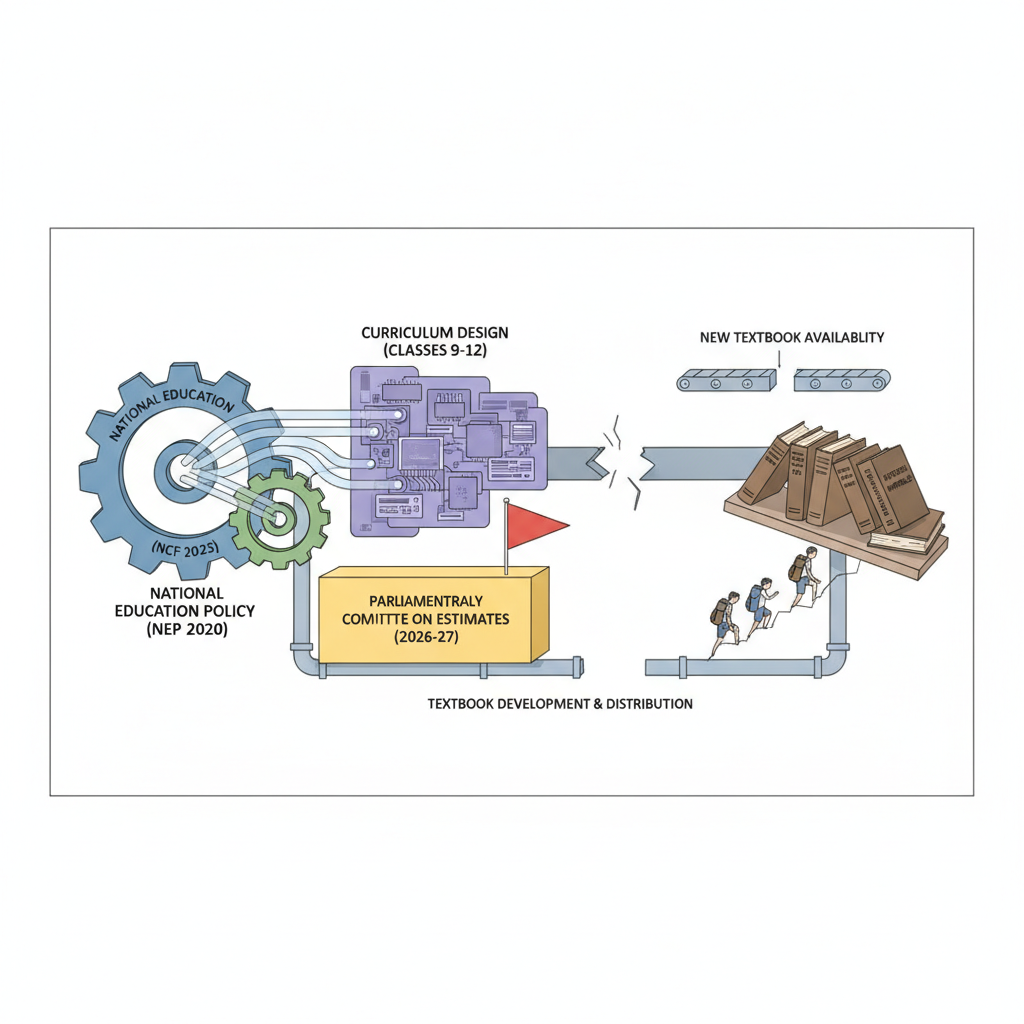
A Parliamentary Committee on Estimates (2026-27) has highlighted a critical governance gap in school education, wherein the National Council of Educational Research and Training (NCERT) has not finalised textbooks for Classes 9–12 despite curriculum revisions aligned with the National Education Policy (NEP) 2020 and the National Curriculum Framework (NCF) 2023. This delay has forced schools to rely on outdated materials, exacerbating challenges for students preparing for board examinations. The Committee’s observations underscore systemic inefficiencies in the textbook development and distribution pipeline, necessitating urgent administrative and policy interventions.
Background
- The National Education Policy (NEP) 2020 introduced sweeping reforms in school education, emphasising holistic development, critical thinking, and skill-based learning, which were operationalised through the National Curriculum Framework (NCF) 2023.
- The Central Board of Secondary Education (CBSE) revised its curriculum for Classes 9–12 to align with NEP 2020 and NCF 2023, necessitating corresponding updates in NCERT textbooks.
- NCERT is statutorily responsible for developing and publishing textbooks for school education, including those for Classes 9–12, in accordance with the National Curriculum Framework.
What is the Curriculum-Textbook Synchronisation Challenge?
- Curriculum-Textbook Synchronisation refers to the alignment between the intended learning outcomes prescribed by the curriculum (e.g., NCF 2023) and the actual content, pedagogy, and assessment materials provided in textbooks.
- The NEP 2020 and NCF 2023 advocate for competency-based, experiential, and multidisciplinary learning, necessitating textbooks that reflect these pedagogical shifts rather than rote memorisation.
- The textbook development cycle involves multiple stages: curriculum finalisation, textbook drafting, expert review, pilot testing, public feedback, finalisation, printing, and distribution. Delays at any stage disrupt the entire pipeline.
- The CBSE’s curriculum revisions for Classes 9–12, based on NEP 2020 and NCF 2023, have outpaced the NCERT’s textbook development process, creating a mismatch between what is taught and what is assessed.
- Schools, particularly those affiliated with CBSE, are compelled to use outdated textbooks or supplementary materials, which may not cover the revised curriculum comprehensively, thereby disadvantaging students preparing for board examinations.
- Teacher training programmes, such as those conducted by CBSE, are essential to bridge the gap between curriculum intent and classroom practice, but their reach and accessibility remain uneven.
- The Parliamentary Committee’s report highlights the need for coordinated governance between NCERT, CBSE, and the Ministry of Education to ensure timely textbook availability and equitable access to teacher training.
- Equity concerns arise as delays disproportionately affect students in rural areas, where access to digital resources (e.g., DIKSHA) may be limited, and teachers in private schools may face financial barriers to professional development.
Key Features
| Feature | Significance |
|---|---|
| Curriculum alignment with NEP 2020 and NCF 2023 | Ensures modern pedagogical standards and competency-based learning for Classes 9–12, reflecting national education policy reforms. |
| Textbook availability gap | Causes disruption in classroom instruction and exam preparation, particularly for board-exam candidates relying on updated study materials. |
| Teacher training programmes by CBSE | Aims to equip educators with application-based teaching methods to align with revised curriculum objectives. |
| Parliamentary review mechanism | Provides oversight on budgetary allocations and policy implementation in school education, ensuring accountability in governance. |
| Fee structure for examinations | Examines equity in access to board examinations, including concessions for visually impaired students and potential barriers for economically weaker sections. |
| Enrolment trends in Classes 10–12 | Indicates demand for secondary education and potential pressure points in resource allocation and infrastructure. |
Why it Matters
Pedagogical Impact
- Discrepancy between curriculum design and textbook availability undermines the intended shift towards competency-based education (CBE) under NEP 2020.
- Students in Classes 9–12 face cognitive dissonance when taught from outdated materials despite revised learning outcomes.
- Teacher reliance on obsolete resources may dilute the effectiveness of new pedagogical approaches.
Governance and Accountability
- Parliamentary committees serve as a constitutional mechanism for scrutinising public expenditure and policy execution in education.
- The report highlights systemic delays in textbook finalisation, raising questions about inter-departmental coordination (NCERT-CBSE).
- Budgetary allocations for textbook printing and distribution must align with curriculum revision timelines to avoid gaps.
Equity and Access
- Examination fee structures disproportionately affect economically weaker students, potentially limiting their participation in board exams.
- Rural private school teachers face financial barriers to professional development, exacerbating urban-rural disparities in teacher quality.
- Fee exemptions for visually impaired students set a precedent for inclusive policy design but require broader application.
Human Resource Development
- Teacher training programmes are critical for translating curriculum reforms into classroom practice, particularly in application-based learning.
- The decline in online training participation (2022–2025) suggests systemic issues in outreach or perceived utility of programmes.
- Differential access to free training between government and private school teachers highlights structural inequities in professional development.
Challenges
1. Textbook Finalisation and Distribution Delays
- Lag between NCF 2023-aligned curriculum design and NCERT textbook availability disrupts classroom instruction.
- Schools resort to outdated materials, creating inconsistencies in learning outcomes for board-exam candidates.
- Printing and distribution bottlenecks exacerbate delays, particularly in remote regions.
UPSC Link: GS2: Issues relating to development and management of Social Sector/Services relating to Education
2. Teacher Training Efficacy and Participation
- Steep decline in online teacher training participation (5.3M in 2022 to 1.6L in 2025) undermines human resource development efforts.
- Private school teachers, especially in rural areas, face financial barriers to accessing training programmes.
- Perceived irrelevance or lack of incentives may reduce engagement with professional development initiatives.
UPSC Link: GS2: Issues relating to development and management of Social Sector/Services relating to Education
3. Equity in Examination Access and Fee Structure
- No fee relief for economically weaker sections (EWS) in CBSE board examinations, unlike concessions for visually impaired students.
- High examination fees (Rs 1,600) may deter participation from marginalised groups, affecting inclusivity in secondary education.
- Transparency in fee structures and need-based exemptions are essential for equitable access to board exams.
UPSC Link: GS2: Welfare schemes for vulnerable sections
4. Inter-Institutional Coordination Gaps
- Lack of synchronisation between CBSE (curriculum design) and NCERT (textbook development) leads to implementation gaps.
- Ministry of Education must streamline processes to ensure textbook finalisation precedes academic year commencement.
- Bureaucratic delays in approvals and procurement further exacerbate the textbook availability crisis.
UPSC Link: GS2: Government policies and interventions for development in various sectors
5. Curriculum-Textbook-Classroom Disconnect
- Students trained under revised curriculum face challenges when textbooks remain unchanged, creating a mismatch in expectations and resources.
- Teachers struggle to bridge the gap, often improvising with supplementary materials that may not align with assessment frameworks.
- Board exam candidates are disproportionately affected due to reliance on updated study materials.
UPSC Link: GS2: Issues relating to development and management of Social Sector/Services relating to Education
Challenges — UPSC Perspective
| Issue | Concern |
|---|---|
| Textbook finalisation delays | Disrupts classroom instruction and exam preparation for Classes 9–12. |
| Teacher training participation decline | Undermines capacity-building efforts for application-based teaching methods. |
| Fee barriers for EWS students | Limits equitable access to board examinations despite rising enrolment. |
| Rural-urban disparities in training access | Exacerbates inequities in teacher quality and student outcomes. |
| Inter-departmental coordination gaps | Leads to systemic delays in translating policy into practice. |
| Curriculum-textbook mismatch | Creates cognitive dissonance for students and teachers alike. |
Way Forward
- Accelerate textbook finalisation and distribution by setting strict deadlines for NCERT, aligned with academic calendar timelines.
- Establish a real-time dashboard to monitor progress in textbook printing, distribution, and classroom availability across states.
- Expand and incentivise teacher training programmes, with a focus on rural private school educators and application-based pedagogy.
- Introduce need-based fee waivers for economically weaker sections in board examinations, ensuring inclusivity.
- Strengthen inter-institutional coordination between CBSE, NCERT, and state education boards via quarterly review meetings.
- Enhance transparency in examination fee structures and publicise exemptions to ensure equitable access.
- Pilot a ‘textbook readiness index’ to assess and rank states on curriculum-textbook alignment ahead of academic sessions.
- Leverage digital platforms to disseminate supplementary teaching materials, reducing reliance on printed textbooks.
UPSC Value Addition
Keywords for Mains Answer-Writing
National Education Policy 2020 · National Curriculum Framework 2023 · NCERT textbooks · CBSE curriculum · Parliamentary Standing Committee on Estimates · Teacher training programmes · School education governance · Curriculum-textbook alignment · Board examinations · Inclusive education
Concept Flow
NEP 2020 and NCF 2023 → Curriculum redesign for Classes 9–12 → CBSE aligns syllabus with new learning outcomes → NCERT tasked with textbook development → Delays in textbook finalisation → Schools continue using outdated materials → Students face exam preparation challenges → Parliamentary committee reviews implementation gaps → Recommendations for corrective action → Ministry of Education addresses systemic bottlenecks.
Prelims Practice Questions
Q1. Consider the following statements regarding the National Education Policy (NEP) 2020 and the National Curriculum Framework (NCF) 2023:
1. NEP 2020 advocates for a shift from rote learning to competency-based education.
2. NCF 2023 is the latest framework guiding the design of school curricula in India.
3. NEP 2020 mandates the immediate replacement of all textbooks across classes 1-12 within one year of its notification.
4. NCF 2023 emphasizes the integration of vocational education at the secondary school level.
How many of the above statements are correct?
- Only one
- Only two
- Only three
- All four
Answer: Only three — Statements 1, 2, and 4 are correct. Statement 3 is incorrect as NEP 2020 does not mandate an immediate replacement of all textbooks but advocates for phased alignment with the NCF.
Q2. Assertion (A): The Parliamentary Standing Committee on Estimates has raised concerns over the delay in updating NCERT textbooks for Classes 9–12 despite changes in the CBSE curriculum aligned with NEP 2020 and NCF 2023.
Reason (R): The delay in textbook availability has resulted in schools using outdated study materials, creating difficulties for students preparing for board examinations.
In the context of the above two statements, which one of the following is correct?
- Both A and R are true, and R is the correct explanation of A.
- Both A and R are true, but R is not the correct explanation of A.
- A is true, but R is false.
- A is false, but R is true.
Answer: Both A and R are true, and R is the correct explanation of A. — Both the assertion and reason are true, and the reason correctly explains the assertion as the delay in textbook availability directly impacts the use of outdated materials in schools.
Q3. Match the following committees/initiatives with their respective roles in school education reform in India:
Column I (Committee/Initiative) | Column II (Role)
——————————–|—————-
A. National Education Policy (NEP) 2020 | 1. Provides a framework for curriculum design and textbook development
B. National Curriculum Framework (NCF) 2023 | 2. Recommends measures to improve teacher training and resource availability
C. Parliamentary Standing Committee on Estimates | 3. Advocates for systemic reforms in school education, including pedagogical shifts
D. CBSE Curriculum Reforms | 4. Monitors the implementation of budgetary allocations and policy recommendations in education
Choose the correct match:
- A-3, B-1, C-4, D-2
- A-1, B-3, C-2, D-4
- A-2, B-4, C-1, D-3
- A-4, B-2, C-3, D-1
Answer: A-3, B-1, C-4, D-2 — A-3 (NEP 2020 advocates systemic reforms), B-1 (NCF 2023 provides curriculum and textbook framework), C-4 (Parliamentary Committee monitors budgetary allocations), D-2 (CBSE reforms focus on curriculum and teacher training).
Mains Practice Question
✍ The alignment between curriculum design and textbook availability is critical for the effective implementation of educational reforms. Critically examine the challenges in achieving this alignment in the context of the National Education Policy (NEP) 2020 and the National Curriculum Framework (NCF) 2023, with reference to the recent observations of the Parliamentary Standing Committee on Estimates. (15 Marks)
Approach: MODEL-ANSWER SKELETON:
1. **Context and Background (2 marks)**
– Briefly explain NEP 2020 and NCF 2023, emphasizing their objectives (e.g., competency-based learning, vocational integration, pedagogical reforms).
– Mention the role of NCERT, CBSE, and the Ministry of Education in curriculum-textbook alignment.
2. **Key Challenges Identified (5 marks)**
– **Institutional Delays**: Highlight the gap between curriculum changes and textbook finalization (e.g., NCF 2023 released in 2023, but textbook delays persist).
– **Governance Issues**: Lack of coordination between NCERT and CBSE, as noted by the Parliamentary Committee.
– **Resource Constraints**: Limited printing and distribution capacity of NCERT; inequities in teacher training (e.g., free training for government teachers vs. paid for private teachers).
– **Teacher Preparedness**: Steep decline in online teacher training participation (from 5.3 million in 2022 to 1,62,814 in 2025), impacting application-based teaching.
– **Examination Pressure**: Use of outdated materials for board exams (Classes 10 and 12), exacerbating student stress.
3. **Impact on Stakeholders (3 marks)**
– **Students**: Difficulty in adapting to new curriculum due to lack of updated textbooks.
– **Teachers**: Inadequate training in new pedagogical methods, leading to reliance on traditional teaching.
– **Systemic Inequity**: Disparities in access to quality education between government and private schools, rural and urban areas.
4. **Recommendations and Way Forward (3 marks)**
– **Institutional Reforms**: Strengthen coordination between NCERT, CBSE, and state education boards; expedite textbook printing and distribution.
– **Teacher Training**: Expand and standardize teacher training programs, ensuring inclusivity (e.g., rural teachers, private school educators).
– **Monitoring Mechanisms**: Implement robust tracking systems for textbook availability and curriculum-textbook alignment.
– **Policy Integration**: Align NEP 2020 and NCF 2023 implementation timelines with realistic milestones.
5. **Conclusion (2 marks)**
– Emphasize the need for a multi-stakeholder approach to bridge the curriculum-textbook gap, ensuring equitable and quality education as envisaged by NEP 2020.
Source: Times of India
Generated by AanyaAi for educational purpose.


No Comments