


13 Aug Parliamentary Panel Highlights Delay in NCERT Textbooks for Classes 9-12
NCERT textbooksCurriculum designParliamentary panelTeacher training✎ Curriculum-textbook misalignment in Classes 9–12 under NEP 2020 and NCF 2023 arises from delayed NCERT textbook finalisation, forcing schools to use outdated materials for board examinations, necessitating urgent institutional…
Subject Relevance — Where This Topic Fits
- GS Paper II — Governance, Transparency and Accountability | GS Paper III — Human Resource Development
- Prelims: NEP 2020, NCF 2023, NCERT, CBSE, Parliamentary Standing Committee on Estimates, textbook development cycle, teacher training, curriculum implementation
- Essay: Role of institutions in educational reform: Balancing policy intent with ground-level execution, Teacher capacity-building as a cornerstone of educational transformation
Quick Revision: Curriculum-textbook misalignment in Classes 9–12 under NEP 2020 and NCF 2023 arises from delayed NCERT textbook finalisation, forcing schools to use outdated materials for board examinations, necessitating urgent institutional coordination and teacher training reforms.
Why is this in the news?
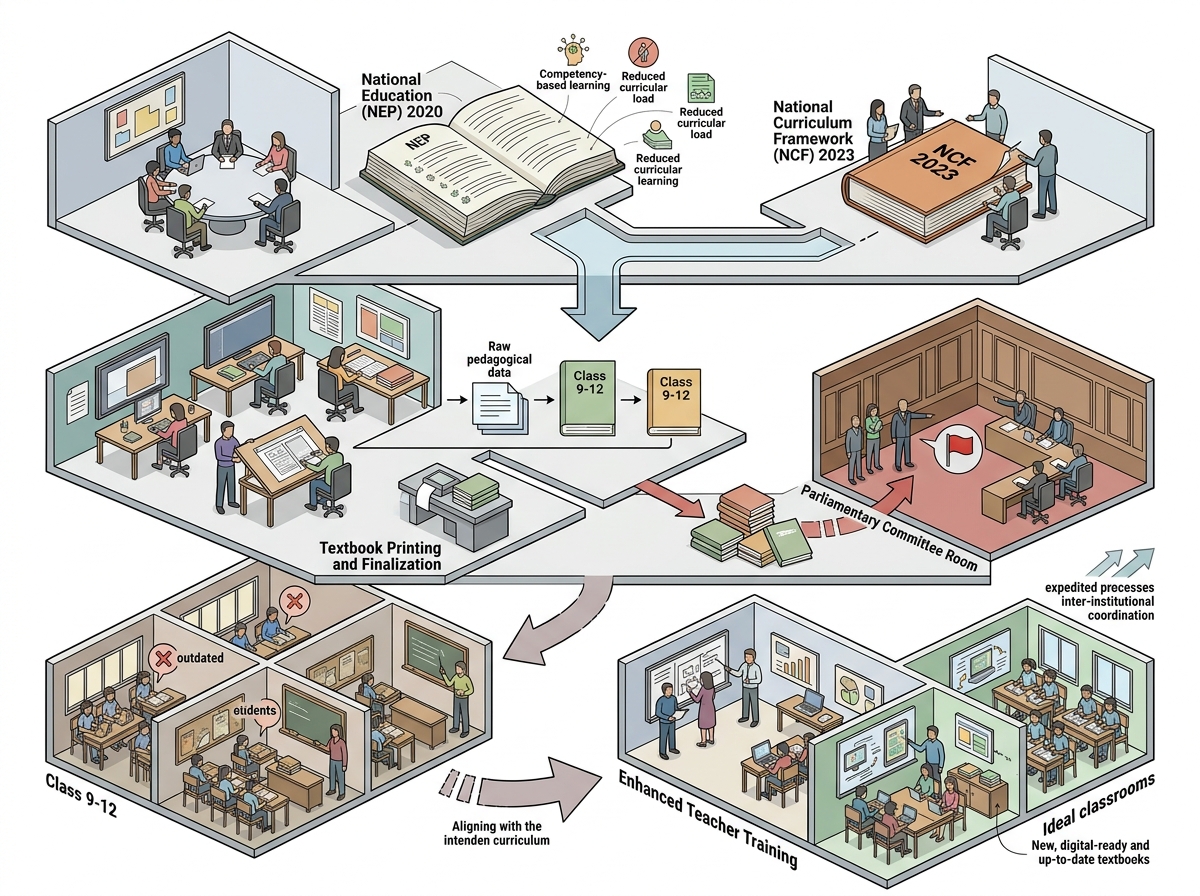
A parliamentary committee has raised concerns over the delayed release of updated NCERT textbooks for Classes 9–12, despite curriculum revisions aligned with the National Education Policy (NEP) 2020 and the National Curriculum Framework (NCF) 2023. The discrepancy has forced schools to rely on outdated materials, disproportionately affecting students preparing for board examinations, and has prompted recommendations for expedited textbook finalisation, improved inter-institutional coordination, and enhanced teacher training programmes.
Background
- The National Education Policy (NEP) 2020 introduced sweeping reforms in school education, including a shift towards competency-based learning, multidisciplinary approaches, and reduced curricular load.
- The National Curriculum Framework (NCF) 2023, released in 2023, operationalised NEP 2020’s vision by prescribing subject-wise learning outcomes, pedagogical shifts, and assessment reforms for Grades 9–12.
- The Central Board of Secondary Education (CBSE) revised its curriculum framework in alignment with NEP 2020 and NCF 2023, necessitating corresponding updates in NCERT textbooks to ensure uniformity and quality.
- NCERT is statutorily responsible for developing and publishing textbooks for Grades 1–12 under the National Curriculum Framework, serving as the primary academic resource for CBSE-affiliated schools.
- The Tenth Report of the Committee on Estimates (2026–27) examined budgetary allocations and policy implementation in school education, highlighting systemic gaps in textbook development and teacher training.
- Enrolment in Class 10 and 12 has risen, increasing pressure on examination systems and necessitating timely curriculum-textbook synchronisation to avoid learning deficits.
What is the Curriculum-Textbook Alignment Challenge?
- The alignment gap refers to the temporal and conceptual mismatch between revised curriculum frameworks (NEP 2020, NCF 2023) and the availability of corresponding textbooks, leading to pedagogical inconsistencies in classroom instruction.
- Curriculum design under NEP 2020 emphasises experiential learning, critical thinking, and skill development, which requires textbooks to incorporate updated content, activities, and assessment methodologies.
- NCERT textbooks are developed through a multi-stage process involving subject experts, national focus groups, and state consultations, followed by pilot testing and public feedback before finalisation and printing.
- CBSE, as an examination body, mandates adherence to NCERT textbooks for Classes 9–12, making textbook delays directly impact examination preparation and student outcomes.
- The parliamentary committee noted that while CBSE has revised its curriculum, NCERT’s textbook finalisation process has lagged, leaving schools to use outdated materials for high-stakes board examinations.
- Teacher training programmes, such as those conducted by CBSE’s ‘Capacity Building’ initiatives, aim to bridge the implementation gap by equipping educators with new pedagogical tools aligned with NEP 2020.
Key Features
| Feature | Significance |
|---|---|
| Curriculum-Textbook Alignment Gap | Exposes systemic delay in translating policy (NEP 2020, NCF 2023) into classroom materials, risking exam preparedness for 9–12 students. |
| NCERT-CBSE Coordination Deficit | Highlights the absence of synchronised action between curriculum design (CBSE) and content delivery (NCERT), disrupting pedagogical continuity. |
| Teacher Training Disparities | Reveals inequity in access to professional development, with online training enrolments declining sharply and private-school teachers facing financial barriers. |
| Board Exam Burden | Students in Classes 10 and 12 are compelled to use outdated textbooks, increasing cognitive load and exam stress due to delayed curriculum updates. |
| Enrolment Growth vs. Resource Lag | Rising student numbers (e.g., Class 10 enrolment from 22.5L in 2024 to 23.8L in 2025) intensify pressure on an already strained textbook supply chain. |
Why it Matters
Governance & Policy Implementation
- Demonstrates the operational challenges in translating national education policy into grassroots delivery, a critical dimension for UPSC Public Administration syllabus.
Equity in Education
- Exposes disparities in teacher training access and resource distribution, directly impacting learning outcomes across socio-economic divides.
Examination System Integrity
- Undermines the reliability of board examinations if students are assessed on outdated content, a key concern for the UPSC Prelims GS-II (Governance) segment.
Institutional Coordination
- Illustrates the necessity of inter-departmental synergy (NCERT, CBSE, Ministry of Education) for effective policy execution, relevant to UPSC syllabus on Centre-State relations.
Resource Planning
- Highlights the need for anticipatory budgeting and logistical preparedness in textbook printing and distribution, a governance challenge often tested in UPSC Mains.
Challenges
1. Curriculum-Textbook Synchronisation Lag
- Delayed NCERT textbook updates despite CBSE curriculum revisions aligned with NEP 2020 and NCF 2023.
- Forces schools to use obsolete materials, creating a mismatch between taught content and exam requirements.
- Exacerbates exam stress for students in Classes 10 and 12 due to sudden shifts in syllabus coverage.
UPSC Link: GS-II: Governance, Policy Implementation
2. Teacher Training Access Inequity
- Steep decline in online teacher training enrolments (5.3M in 2022 to 0.16M in 2025), disproportionately affecting rural and private-school educators.
- Government school teachers receive free training, while private-school teachers incur costs, widening the digital divide.
- Application-based teaching methods remain under-disseminated, limiting pedagogical innovation in classrooms.
UPSC Link: GS-II: Social Justice, Education
3. Logistical Bottlenecks in Textbook Distribution
- Printing and distribution delays for updated textbooks, despite rising student enrolments (e.g., Class 10 growth of 1.3L students).
- Centralised procurement systems may lack scalability to meet demand spikes, particularly in remote regions.
- Inventory mismanagement leads to stockouts or overstocking, further delaying classroom availability.
UPSC Link: GS-III: Economic Development, Infrastructure
4. Assessment System Misalignment
- Board examinations may assess students on outdated content, compromising the validity of evaluation outcomes.
- Sudden curriculum shifts risk disadvantaging students from resource-constrained backgrounds who lack supplementary materials.
- Examination stress amplifies due to perceived gaps between taught and examined syllabi.
UPSC Link: GS-II: Governance, Public Administration
5. Resource Allocation vs. Enrolment Growth
- Rising student numbers (e.g., Class 12 enrolments) outpace textbook production timelines, creating a supply-demand imbalance.
- Budgetary constraints in textbook printing and distribution may prioritise quantity over quality, affecting content accuracy.
- Regional disparities in resource allocation exacerbate urban-rural divides in educational access.
UPSC Link: GS-III: Economic Development, Human Resource Development
Challenges — UPSC Perspective
| Issue | Concern |
|---|---|
| NCERT Textbook Delays | Failure to update textbooks in sync with CBSE curriculum revisions, leaving students unprepared for board exams. |
| Teacher Training Gaps | Declining online training participation and inequitable access to professional development, particularly for private and rural teachers. |
| Coordination Failure | Absence of synchronised action between NCERT, CBSE, and Ministry of Education, leading to policy-execution gaps. |
| Logistical Constraints | Printing and distribution bottlenecks that delay textbook availability, especially during peak enrolment periods. |
| Assessment Integrity Risks | Potential mismatch between examined content and taught syllabus, undermining the credibility of board examinations. |
| Resource-Planning Deficits | Inability to scale textbook production and training programmes in line with enrolment growth, widening educational inequities. |
Way Forward
- Accelerate NCERT textbook updates to align with CBSE curriculum revisions, prioritising Classes 10 and 12 to mitigate exam-year pressures.
- Establish a dedicated inter-ministerial task force (NCERT, CBSE, Ministry of Education) to synchronise curriculum design, content development, and distribution timelines.
- Launch a nationwide, subsidised teacher training programme with a focus on application-based pedagogy, ensuring equitable access for private and rural educators.
- Implement a real-time inventory tracking system for textbook printing and distribution to prevent stockouts and overstocking during high-enrolment periods.
- Introduce a phased rollout of updated textbooks, with staggered distribution to schools based on examination schedules to minimise disruption.
- Strengthen digital infrastructure for teacher training, including offline modules and regional language support, to address connectivity barriers.
- Conduct periodic audits of textbook content accuracy and alignment with curriculum objectives to ensure consistency across academic years.
- Enhance transparency in resource allocation by publishing district-wise textbook supply data to identify and address regional disparities.
UPSC Value Addition
Keywords for Mains Answer-Writing
National Education Policy (NEP) 2020 · National Curriculum Framework (NCF) 2023 · Curriculum-Textbook Alignment · Parliamentary Committee on Estimates · NCERT Textbook Development Process · CBSE Curriculum Reforms · Teacher Training and Professional Development · School Education Governance · Board Examination Reforms · Educational Equity and Access
Concept Flow
National Education Policy (NEP) 2020 and National Curriculum Framework (NCF) 2023 → Curriculum design revisions by CBSE → Delayed NCERT textbook updates → Mismatch between taught content and exam syllabus → Increased exam stress for students → Parliamentary committee review → Recommendations for inter-institutional coordination and resource allocation → Implementation challenges in textbook printing and teacher training → Persistent gaps in educational equity and assessment integrity.
Prelims Practice Questions
Q1. Consider the following statements regarding the National Education Policy (NEP) 2020 and the National Curriculum Framework (NCF) 2023:
1. NEP 2020 mandates a 5+3+3+4 school education structure.
2. NCF 2023 aligns curriculum design with NEP 2020 objectives.
3. NCF 2023 is developed by the Central Board of Secondary Education (CBSE).
4. The Union Ministry of Education is the nodal agency for implementing NEP 2020.
How many of the above statements are correct?
- Only one
- Only two
- Only three
- All four
Answer: Only three — Statements 1, 2, and 4 are correct. Statement 3 is incorrect because NCF 2023 is developed by the National Council of Educational Research and Training (NCERT), not CBSE.
Q2. Assertion (A): The Parliamentary Committee on Estimates has recommended accelerated printing and distribution of NCERT textbooks for Classes 9–12 to bridge the gap between curriculum design and textbook availability.
Reason (R): The delay in textbook availability has resulted in schools relying on outdated study materials, creating challenges for students preparing for board examinations.
Options:
A. Both A and R are true, and R is the correct explanation of A.
B. Both A and R are true, but R is not the correct explanation of A.
C. A is true, but R is false.
D. A is false, but R is true.
Answer: ? — Both the Assertion (A) and Reason (R) are true, and R correctly explains A as the delay in textbook availability directly stems from the gap between curriculum design and textbook supply.
Q3. Match the following institutions with their primary roles in India’s school education system:
Column I (Institution) | Column II (Role)
1. NCERT | A. Conducts national-level teacher training programmes
2. CBSE | B. Develops national curriculum frameworks and textbooks
3. DIET | C. Regulates and conducts secondary and senior secondary examinations
4. NCTE | D. Implements in-service teacher training at the district level
Options:
A. 1-B, 2-C, 3-D, 4-A
B. 1-A, 2-B, 3-C, 4-D
C. 1-D, 2-A, 3-B, 4-C
D. 1-C, 2-D, 3-A, 4-B
- A
- B
- C
- D
Answer: A — 1-B (NCERT develops curriculum frameworks and textbooks), 2-C (CBSE regulates examinations), 3-D (DIETs implement teacher training at district level), 4-A (NCTE regulates teacher education).
Mains Practice Question
✍ The alignment between curriculum design and textbook availability in India’s school education system has been flagged as a critical governance challenge. Critically examine the institutional and procedural gaps that have led to this mismatch, particularly in the context of the National Education Policy (NEP) 2020 and the National Curriculum Framework (NCF) 2023. Also, analyse the consequences of such delays on students preparing for board examinations. (15 Marks)
Approach: A 15-mark answer must cover the following dimensions:
1. **Institutional Framework and Roles**:
– Define the roles of NCERT (curriculum and textbook development), CBSE (examination and curriculum implementation), and the Ministry of Education (policy oversight).
– Highlight the constitutional and statutory basis (e.g., Article 29 and 30 of the Constitution, Right to Education Act, 2009).
2. **Procedural Gaps**:
– Explain the curriculum-textbook alignment process under NEP 2020 and NCF 2023, including consultation stages, approvals, and printing timelines.
– Identify bottlenecks: inter-institutional coordination failures, resource constraints, and delays in approvals.
3. **Consequences for Students**:
– Impact on board examination preparation (Class 10 and 12) due to reliance on outdated materials.
– Equity concerns: differential access to updated resources between government and private schools.
– Psychological burden on students and teachers.
4. **Comparative Perspective**:
– Contrast with successful models (e.g., state-level initiatives in Kerala or Tamil Nadu) where curriculum-textbook alignment has been achieved efficiently.
5. **Way Forward**:
– Recommendations from the Parliamentary Committee (accelerated printing, teacher training, and coordination).
– Suggest structural reforms: digital textbooks, decentralised review mechanisms, and performance audits of NCERT and CBSE.
Balance: Critically weigh the systemic inertia against the urgency of reform, citing recent reports or committee findings.
Source: Times of India
Generated by AanyaAi for educational purpose.

- मद्रास उच्च न्यायालय में ‘वेट्ट्री पयणम’ योजना को असंवैधानिक घोषित करने की मांग - October 4, 2026
- Gurugram’s groundwater extraction exceeds limit by 212%; HC seeks ban - October 4, 2026
- स्वतंत्रता सेनानी श्यामजी कृष्ण वर्मा की जन्म जयंती पर पीएम का श्रद्धांजलि - October 4, 2026

No Comments