


13 Aug Parliamentary Panel Shocking Report: 73% Students Drop Out Before Class 12
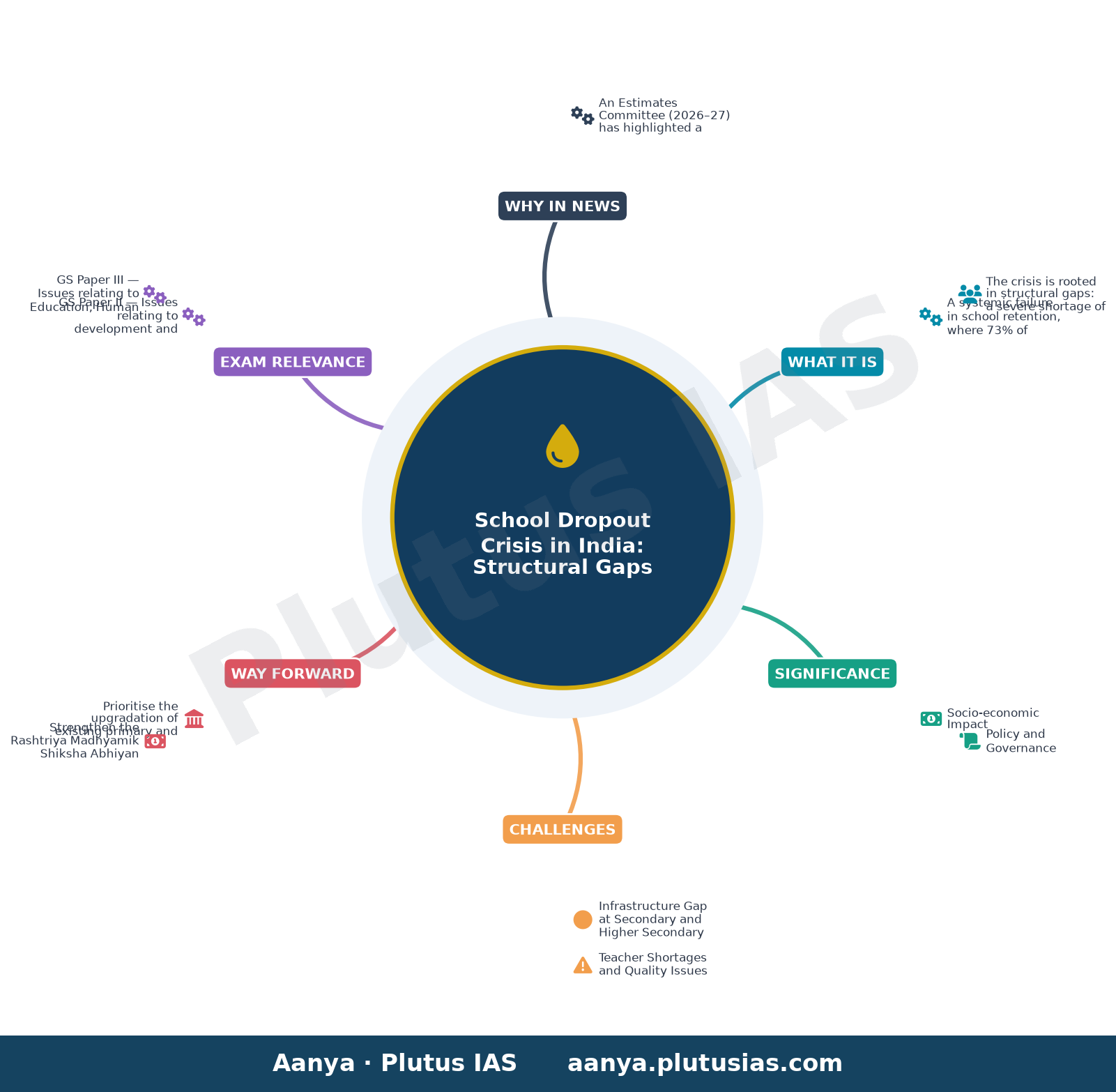
✎ India’s school dropout crisis is a structural failure: 73% of students leave before higher secondary due to lack of access, inclusive infrastructure, and socio-economic barriers, despite near-universal primary enrolment.
Subject Relevance — Where This Topic Fits
- GS Paper II — Issues relating to development and management of Social Sector/Services relating to Education | GS Paper III — Issues relating to Education, Human Resource Development
- Prelims: Right to Education Act, 2009, Sarva Shiksha Abhiyan, National Education Policy 2020, Dropout rate in secondary education, CwSN (Children with Special Needs), DIKSHA platform, PM SHRI Schools
- Essay: Education as a catalyst for social equity and economic mobility, The paradox of high enrolment and low retention in India’s school system
Quick Revision: India’s school dropout crisis is a structural failure: 73% of students leave before higher secondary due to lack of access, inclusive infrastructure, and socio-economic barriers, despite near-universal primary enrolment.
Why is this in the news?
An Estimates Committee (2026–27) has highlighted a severe structural imbalance in India’s school education system, revealing that 73% of students drop out before reaching higher secondary education. The report underscores the acute shortage of secondary and higher secondary schools, particularly in rural and marginalised regions, and calls for urgent upgradation of existing institutions to mitigate dropout rates and ensure equitable access to quality education.
Background
- The Right of Children to Free and Compulsory Education (RTE) Act, 2009, mandates free and compulsory education for children aged 6–14 years, ensuring near-universal primary enrolment.
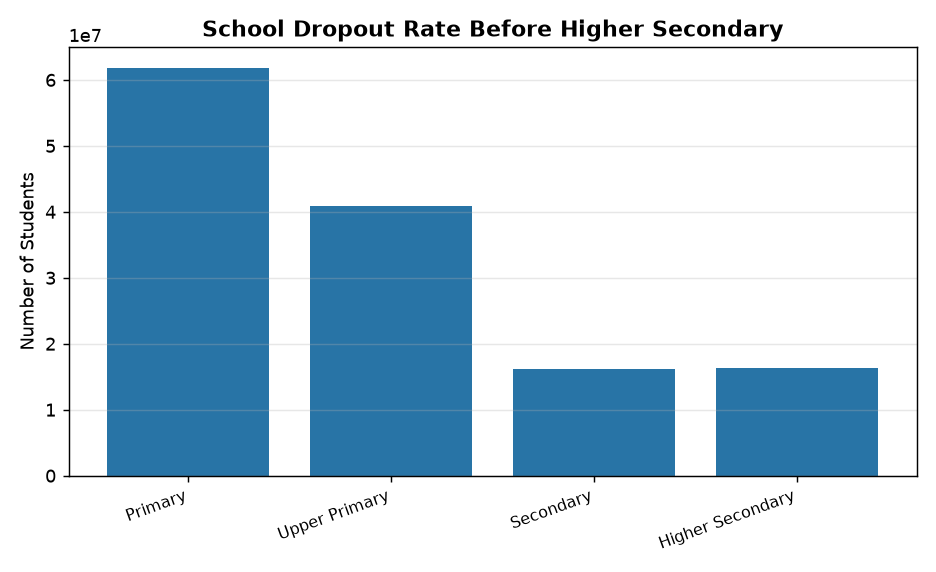
- Despite high enrolment at the primary level (6.18 crore students), the number dwindles to 1.64 crore by higher secondary, indicating systemic attrition.
- The National Education Policy (NEP) 2020 emphasises universalisation of education up to Grade 12 and recommends restructuring school complexes to improve access and quality.
- The PM SHRI Schools initiative aims to upgrade 14,500 existing schools into model institutions with modern infrastructure and pedagogical practices.
- The DIKSHA platform, launched under the Samagra Shiksha Abhiyan, provides digital learning resources but faces challenges in reach and utilisation in remote areas.
- Children with Special Needs (CwSN) face disproportionate barriers, with inadequate infrastructure and trained teachers in most government schools.
What is the school dropout crisis in India?
- A systemic failure in school retention, where 73% of students leave before higher secondary education, despite near-universal primary enrolment.
- The crisis is rooted in structural gaps: a severe shortage of secondary and higher secondary schools, particularly in rural and tribal regions, where access to Grade 9–12 is limited.
- The dropout phenomenon disproportionately affects marginalised groups—girls, children from Scheduled Castes/Scheduled Tribes, and those with disabilities—due to socio-economic barriers and lack of inclusive infrastructure.
- The RTE Act’s mandate for free and compulsory education ends at Grade 8, leaving older adolescents vulnerable to exclusion from formal education systems.
- The NEP 2020’s vision of ‘school complexes’—clusters of schools sharing resources—aims to address access gaps but requires accelerated implementation and funding.
- Inadequate teacher training, especially in inclusive pedagogy for CwSN, exacerbates dropout rates, as schools lack the capacity to accommodate diverse learning needs.
- Economic compulsions, such as child labour or household responsibilities, force many adolescents to abandon education, particularly in agrarian and informal sectors.
- The Committee’s recommendation to upgrade existing schools to higher secondary levels aligns with the NEP’s goal of ‘equitable and inclusive education’ but demands coordinated action across central and state governments.
Key Features
| Feature | Significance |
|---|---|
| Dropout rate of 73% before higher secondary education | Indicates systemic failure in retention across educational stages, undermining the Right to Education (RTE) Act’s mandate of free and compulsory education up to age 14. |
| Disproportionate decline in school numbers from primary to higher secondary | Reveals structural inadequacies in infrastructure, teacher availability, and institutional capacity at upper levels, exacerbating inequities in access. |
| Predominance of primary schools (9,11,032) over higher secondary schools (90,866) | Demonstrates a policy bias toward early-stage education, neglecting the transition to secondary and higher secondary levels, critical for skill development. |
| Deficiency in CwSN (Children with Special Needs) infrastructure | Violates the Rights of Persons with Disabilities Act, 2016, and the RTE Act, which mandate inclusive education facilities at all levels. |
| Recommendation for upgrading existing schools to higher secondary level | Proposes a scalable solution to bridge the infrastructure gap without requiring new school construction, aligning with the National Education Policy (NEP) 2020’s emphasis on foundational literacy and numeracy. |
Why it Matters
Socio-economic Impact
- High dropout rates perpetuate intergenerational poverty by limiting employability and economic mobility, particularly in marginalised communities.
- Reduces the demographic dividend by lowering the skilled workforce, impacting long-term GDP growth and global competitiveness.
- Exacerbates inequality by disproportionately affecting girls, Scheduled Castes, Scheduled Tribes, and children from low-income households.
Policy and Governance
- Exposes gaps in the implementation of the Right to Education (RTE) Act, 2009, which guarantees free and compulsory education up to age 14.
- Highlights the need for integrated planning between the Centre and States to address regional disparities in educational infrastructure.
- Underscores the urgency of aligning school infrastructure with the National Education Policy (NEP) 2020’s goals of universal access to quality education.
Human Capital Development
- Early dropout deprives students of critical cognitive and socio-emotional development stages, impairing lifelong learning capabilities.
- Limits access to vocational and technical education, reducing opportunities for non-academic career paths.
- Undermines India’s progress toward achieving Sustainable Development Goal 4 (Quality Education).
Challenges
1. Infrastructure Gap at Secondary and Higher Secondary Levels
- Insufficient number of higher secondary schools (90,866) compared to primary schools (9,11,032), leading to overcrowding and resource constraints.
- Lack of dedicated classrooms, laboratories, and libraries in many existing secondary schools.
- Geographical disparities, with rural and tribal areas facing the most severe shortages.
UPSC Link: GS2: Education Policy
2. Teacher Shortages and Quality Issues
- High student-teacher ratios in secondary schools, particularly in government institutions, affecting instructional quality.
- Inadequate professional development opportunities for teachers, leading to outdated pedagogical practices.
- Shortage of subject-specialist teachers in STEM, languages, and vocational subjects.
UPSC Link: GS2: Education Policy
3. Financial Constraints and Resource Allocation
- Insufficient budgetary allocations for school infrastructure upgrades and maintenance at the secondary level.
- Dependence on state governments for funding, leading to uneven resource distribution across regions.
- Limited private sector participation in public school infrastructure due to low returns on investment.
UPSC Link: GS3: Resource Mobilisation
4. Socio-cultural Barriers to Retention
- Economic pressures compelling children to enter the workforce prematurely, especially in agrarian and informal sectors.
- Early marriage, particularly for girls, remains a significant barrier to completion of secondary education.
- Lack of awareness about the long-term benefits of education among marginalised communities.
UPSC Link: GS1: Social Issues
5. Inclusive Education Deficits
- Only 50% of schools have CwSN-friendly infrastructure, violating the Rights of Persons with Disabilities Act, 2016.
- Lack of trained special educators and assistive technologies in mainstream schools.
- Stigma and discrimination against CwSN students in educational institutions.
UPSC Link: GS2: Welfare Schemes
Challenges — UPSC Perspective
| Issue | Concern |
|---|---|
| Inadequate school infrastructure at higher levels | Limits access to quality education, particularly in rural and tribal areas. |
| Teacher shortages and low pedagogical standards | Compromises learning outcomes and student engagement in secondary schools. |
| Financial constraints and uneven resource distribution | Delays critical infrastructure upgrades and exacerbates regional disparities. |
| Socio-economic pressures and early workforce entry | Undermines the RTE Act’s goal of universal secondary education. |
| Insufficient inclusive education facilities | Violates constitutional and statutory rights of CwSN students. |
| Lack of vocational and skill-based education pathways | Reduces employability and limits non-academic career opportunities. |
Way Forward
- Prioritise the upgradation of existing primary and upper primary schools to higher secondary level, as recommended by the Parliamentary Committee, to bridge the infrastructure gap without new construction.
- Strengthen the Rashtriya Madhyamik Shiksha Abhiyan (RMSA) to focus on secondary and higher secondary education, with enhanced budgetary allocations for infrastructure and teacher training.
- Implement targeted scholarships and conditional cash transfers for marginalised groups (girls, SC/ST, CwSN) to incentivise retention and completion of secondary education.
- Establish a dedicated fund under the Samagra Shiksha Abhiyan for inclusive education infrastructure, ensuring compliance with the Rights of Persons with Disabilities Act, 2016.
- Expand vocational education programmes under the National Skill Development Mission (NSDM) in collaboration with industries to provide alternative career pathways.
- Conduct periodic audits of school infrastructure and teacher deployment to identify gaps and ensure equitable distribution of resources.
- Launch awareness campaigns in collaboration with local communities, NGOs, and religious leaders to address socio-cultural barriers to education.
- Strengthen monitoring mechanisms under the Right to Education Act to track dropout rates and enforce compliance with retention mandates.
UPSC Value Addition
Keywords for Mains Answer-Writing
School Education · Dropout Rates · Right to Education Act 2009 · Kothari Commission · National Education Policy 2020 · Secondary Education · Inclusive Education · CwSN (Children with Special Needs) · School Infrastructure · Sarva Shiksha Abhiyan · Mid-Day Meal Scheme · Parliamentary Standing Committee on Education · Equity in Education · Vocational Education
Constitutional & Policy Linkages
- Article 21A (Right to Education)
- Article 45 (Directive Principles of State Policy – Education)
- Article 46 (Promotion of Educational and Economic Interests of SCs, STs, and Weaker Sections)
- Seventh Schedule (Concurrent List – Education)
Concept Flow
Economic and social pressures → Early workforce entry and early marriage → High dropout rates before higher secondary → Inadequate secondary school infrastructure → Limited access to quality education → Perpetuation of poverty and inequality → Compromised human capital development → Reduced national competitiveness → Need for systemic reforms in education policy and governance
Prelims Practice Questions
Q1. Consider the following statements regarding the Right to Education (RTE) Act, 2009:
1. The Act guarantees free and compulsory education to all children aged 6 to 14 years.
2. It mandates that no child shall be held back, expelled, or required to pass a board examination until the completion of elementary education.
3. The Act provides for 25% reservation for disadvantaged groups in private schools.
4. The Act is applicable only to government schools and not to private unaided schools.
How many of the above statements are correct?
- Only one
- Only two
- Only three
- All four
Answer: Only three — Statements 1, 2, and 3 are correct as per the RTE Act, 2009. Statement 4 is incorrect because the Act applies to government schools as well as private unaided schools under its 25% reservation clause.
Q2. Assertion (A): The Kothari Commission (1964-66) recommended the establishment of a common school system to promote social equity in education.
Reason (R): The Commission emphasized the need for universalisation of school education to bridge socio-economic disparities.
Options:
A. Both A and R are true, and R is the correct explanation of A.
B. Both A and R are true, but R is NOT the correct explanation of A.
C. A is true, but R is false.
D. A is false, but R is true.
Answer: ? — Both Assertion (A) and Reason (R) are true, and Reason (R) correctly explains Assertion (A). The Kothari Commission did recommend a common school system to promote social equity, and it emphasized universalisation of school education to reduce disparities.
Q3. Match the following committees/reports with their key recommendations:
Column I (Committee/Report) Column II (Key Recommendation)
A. Kothari Commission (1964-66) 1. Universalisation of secondary education
B. Yash Pal Committee (1993) 2. Focus on vocational education and skill development
C. T.S.R. Subramanian Committee (2016) 3. Common School System for equity
D. National Education Policy 2020 4. Integration of vocational education in school curriculum
Options:
A. A-3, B-4, C-2, D-1
B. A-1, B-2, C-3, D-4
C. A-3, B-1, C-4, D-2
D. A-2, B-3, C-1, D-4
Answer: ? — A-3 (Kothari Commission recommended a Common School System), B-4 (Yash Pal Committee emphasized vocational education), C-2 (T.S.R. Subramanian Committee focused on vocational education and skill development), D-1 (NEP 2020 emphasized universalisation of secondary education).
Mains Practice Question
✍ The Parliamentary Standing Committee on Education has highlighted a critical challenge in India’s school education system: a disproportionately high dropout rate as students progress from primary to higher secondary levels. Critically analyse the structural, socio-economic, and policy-related factors contributing to this trend. Also, suggest measures to enhance retention and ensure equitable access to secondary education. (15 Marks)
Approach: MODEL-ANSWER SKELETON:
1. **Introduction** (2 marks):
– Briefly state the data from the Parliamentary Standing Committee report: 73% dropout rate before higher secondary education.
– Define the stages of school education (primary, upper primary, secondary, higher secondary) and the Right to Education (RTE) Act, 2009’s mandate for free and compulsory education up to age 14.
2. **Structural Factors** (3 marks):
– **Infrastructure Gaps**: Inadequate number of secondary and higher secondary schools, especially in rural and tribal areas; lack of CwSN (Children with Special Needs) friendly infrastructure.
– **Teacher Shortages**: Vacancies and uneven distribution of teachers across stages.
– **School Clustering**: Over-reliance on primary schools with limited vertical progression pathways.
– **Vocational Education**: Limited integration of vocational education in secondary schools despite NEP 2020 recommendations.
3. **Socio-Economic Factors** (3 marks):
– **Poverty and Child Labour**: Economic compulsions force children to drop out for work; lack of awareness about RTE benefits.
– **Gender Disparities**: Higher dropout rates among girls due to socio-cultural norms, safety concerns, and early marriage.
– **Caste and Tribal Marginalisation**: Discrimination and lack of access to quality education for marginalised communities.
– **Migration**: Seasonal migration of families leading to interrupted schooling.
4. **Policy and Governance Factors** (3 marks):
– **Implementation Gaps in RTE Act**: Inadequate monitoring of enrolment, retention, and transition rates; weak grievance redressal mechanisms.
– **Mid-Day Meal Scheme**: While successful in increasing enrolment, implementation challenges persist, especially in remote areas.
– **Sarva Shiksha Abhiyan (SSA) and Samagra Shiksha Abhiyan**: Progress in universalising primary education but limited focus on secondary education.
– **State Variability**: Disparities in education outcomes across states due to differential resource allocation and governance.
5. **Measures for Enhancement** (3 marks):
– **Infrastructure Upgradation**: Expand secondary and higher secondary schools, especially in underserved regions; ensure CwSN-friendly infrastructure.
– **Vocational Integration**: Strengthen vocational education in secondary schools as per NEP 2020 to enhance employability.
– **Targeted Interventions**: Expand mid-day meal schemes, scholarships, and conditional cash transfers for marginalised groups (girls, SC/ST, disabled children).
– **Teacher Training and Deployment**: Address teacher shortages through recruitment drives and incentivise posting in rural areas.
– **Community Engagement**: Sensitise communities about the importance of secondary education and address socio-cultural barriers.
– **Data Systems**: Strengthen data collection on dropout rates, transition rates, and reasons for leaving school to inform targeted policies.
6. **Conclusion** (1 mark):
– Emphasise the need for a multi-pronged approach combining structural reforms, socio-economic support, and robust policy implementation to address the dropout crisis and ensure equitable access to secondary education.
Source: amarujala.com
Generated by AanyaAi for educational purpose.

- मद्रास उच्च न्यायालय में ‘वेट्ट्री पयणम’ योजना को असंवैधानिक घोषित करने की मांग - October 4, 2026
- Gurugram’s groundwater extraction exceeds limit by 212%; HC seeks ban - October 4, 2026
- स्वतंत्रता सेनानी श्यामजी कृष्ण वर्मा की जन्म जयंती पर पीएम का श्रद्धांजलि - October 4, 2026

No Comments