


15 Aug Supreme Court directs CBSE to protect students in OSM evaluation crisis
Supreme CourtAnswer scriptsOSM systemDigital grading✎ The Supreme Court’s directive to the CBSE to protect students affected by OSM evaluation underscores the constitutional principle that technological innovations in public examinations must prioritise fairness, transparency, and…
Subject Relevance — Where This Topic Fits
- GS Paper II — Governance, Transparency and Accountability in Public Institutions | GS Paper III — Science and Technology in Governance and Education
- Prelims: On-Screen Marking (OSM), CBSE Board Examinations, Central Board of Secondary Education (CBSE), digital evaluation, Supreme Court of India, Solicitor General of India, judicial review of administrative actions
- Essay: The Role of Technology in Transforming Public Service Delivery: Opportunities and Challenges, Balancing Innovation and Equity in Educational Reforms
Quick Revision: The Supreme Court’s directive to the CBSE to protect students affected by OSM evaluation underscores the constitutional principle that technological innovations in public examinations must prioritise fairness, transparency, and student welfare.
Why is this in the news?
The Supreme Court of India has intervened in a public interest litigation (PIL) concerning the Central Board of Secondary Education’s (CBSE) On-Screen Marking (OSM) evaluation system, directing the CBSE to protect the interests of students adversely affected by discrepancies in digital grading. The apex court has sought systemic reforms and will hear the matter next on August 21, 2026, underscoring the constitutional obligation of educational institutions to ensure fairness, transparency, and accountability in evaluation processes.
Background
- The CBSE introduced the OSM system as part of its digital transformation initiatives to streamline the evaluation of answer scripts for Class 10 and Class 12 board examinations.
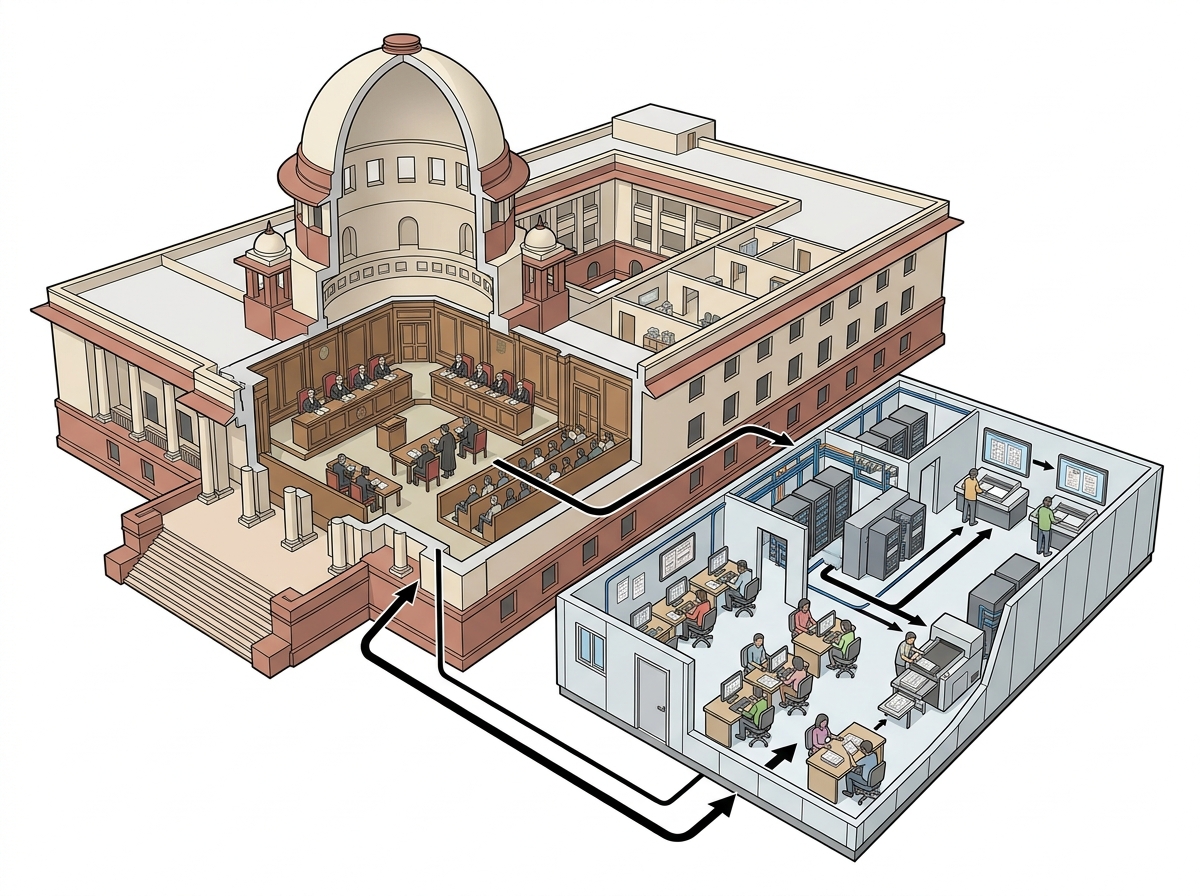
- The OSM system involves scanning physical answer sheets and assessing them digitally on computer screens, replacing the traditional manual evaluation method.
- Reports of discrepancies in marks awarded under the OSM system have emerged, leading to student grievances regarding unfair grading and denial of admissions to higher education courses.
- The PIL filed by Rakesh Binjola seeks directions for the Centre and CBSE to frame regulations governing the OSM system and constitute a high-powered committee to oversee its implementation.
- The Supreme Court, on July 15, 2026, had sought the assistance of the Solicitor General of India to address systemic issues in the OSM evaluation process.
- A one-member commission, led by former Secretary S Radha Chauhan, was constituted to review the OSM system and recommend systemic changes.
What is the On-Screen Marking (OSM) System?
- The OSM system is a digital evaluation method adopted by the CBSE to assess scanned copies of physical answer sheets on computer screens instead of manual evaluation.
- It aims to enhance efficiency, reduce human error, and expedite the declaration of results by leveraging technology in the examination process.
- The system involves scanning answer scripts, assigning them to evaluators digitally, and recording marks electronically to ensure traceability and accountability.
- The OSM system is part of the CBSE’s broader digital transformation agenda, aligning with the National Education Policy (NEP) 2020’s emphasis on leveraging technology for educational reforms.
- Concerns have been raised regarding the accuracy, fairness, and transparency of the OSM system, particularly in cases where discrepancies in marks have led to student grievances.
- The system’s implementation has highlighted the need for robust safeguards to prevent technological glitches, evaluator biases, or procedural lapses from adversely affecting student outcomes.
- The Supreme Court’s intervention underscores the importance of judicial oversight in ensuring that technological innovations in public examinations do not compromise the principles of equity and justice.
UPSC Value Addition
Keywords for Mains Answer-Writing
On-Screen Marking (OSM) system · CBSE board examinations · Supreme Court of India · evaluation reforms in education · digital assessment mechanisms · Right to Education (RTE) Act · National Education Policy (NEP) 2020 · examination malpractices and redressal · judicial intervention in administrative matters · student rights in education · standardisation of assessment processes · procedural safeguards in evaluation · constitutional remedies for grievances · educational governance and accountability
Prelims Practice Questions
Q1. Consider the following statements regarding the On-Screen Marking (OSM) system used by the CBSE for board examinations:
1. The OSM system involves teachers assessing scanned copies of answer sheets digitally.
2. The OSM system was introduced to reduce human errors in evaluation.
3. The Supreme Court has already upheld the constitutional validity of the OSM system.
4. The OSM system is governed by the Right to Education (RTE) Act, 2009.
How many of the above statements are correct?
- Only one
- Only two
- Only three
- All four
Answer: Only three — Statements 1 and 2 are correct as the OSM system involves digital assessment of scanned answer sheets to reduce errors. Statement 3 is incorrect as the Supreme Court is currently hearing a plea challenging the OSM system. Statement 4 is incorrect as the RTE Act does not govern the OSM system; it pertains to elementary education.
Q2. Assertion (A): The Supreme Court of India has the power to intervene in matters related to the conduct of board examinations by autonomous bodies like the CBSE.
Reason (R): The Supreme Court can issue directions under Article 32 of the Constitution to protect fundamental rights, including the right to education.
Options:
A. Both A and R are true, and R is the correct explanation of A.
B. Both A and R are true, but R is not the correct explanation of A.
C. A is true, but R is false.
D. A is false, but R is true.
Answer: ? — Assertion (A) is true as the Supreme Court can intervene in administrative matters affecting fundamental rights. Reason (R) is also true and correctly explains A, as the right to education is a fundamental right enforceable under Article 32.
Q3. Match the following committees/concepts with their respective roles in the context of educational reforms in India:
Column I
1. T.S.R. Subramanian Committee
2. K. Kasturirangan Committee
3. Radha Chauhan Committee
4. Justice Verma Committee
Column II
A. Drafted the National Education Policy 2020
B. Reviewed the CBSE’s On-Screen Marking (OSM) system
C. Examined issues related to women’s safety and education
D. Recommended reforms in the Right to Education Act
Options:
A. 1-A, 2-D, 3-B, 4-C
B. 1-D, 2-A, 3-B, 4-C
C. 1-B, 2-A, 3-D, 4-C
D. 1-C, 2-D, 3-A, 4-B
Answer: ? — 1-D: T.S.R. Subramanian Committee recommended reforms in the RTE Act. 2-A: K. Kasturirangan Committee drafted the NEP 2020. 3-B: Radha Chauhan Committee reviewed the OSM system. 4-C: Justice Verma Committee examined women’s safety and education.
Mains Practice Question
✍ The Supreme Court of India has recently intervened in the matter of the CBSE’s On-Screen Marking (OSM) system, directing the board to address concerns raised by students regarding evaluation discrepancies. Critically examine the constitutional and administrative dimensions of judicial oversight in educational governance, with particular reference to the OSM system. Also, analyse the procedural safeguards that must be instituted to ensure fairness and transparency in digital assessment mechanisms. (15 Marks)
Approach: MODEL-ANSWER SKELETON:
1. **Judicial Oversight in Educational Governance**:
– Article 32 of the Constitution empowers the Supreme Court to issue writs for the enforcement of fundamental rights, including the right to education (Article 21A).
– Judicial intervention in administrative matters is justified when systemic failures affect fundamental rights (e.g., Unnikrishnan vs State of Andhra Pradesh, 1993).
2. **Constitutional and Legal Framework for OSM System**:
– The OSM system is an administrative reform under the CBSE’s authority as a statutory body under the Delhi School Education Act, 1973.
– No explicit constitutional provision mandates digital assessment; however, the right to a fair evaluation process is derived from the principles of natural justice and Article 14 (equality).
3. **Procedural Safeguards for Digital Assessment**:
– **Standardisation**: Adoption of uniform marking guidelines, randomisation of answer scripts, and double-checking mechanisms.
– **Transparency**: Public disclosure of evaluation criteria, grievance redressal mechanisms, and third-party audits.
– **Accountability**: Clear delineation of roles for examiners, moderators, and the CBSE, with penalties for malpractices.
– **Technology Safeguards**: Secure scanning processes, encryption of answer scripts, and audit trails to prevent tampering.
4. **Balancing Autonomy and Accountability**:
– The CBSE must balance its autonomy in designing examination processes with the need for accountability to stakeholders.
– The Supreme Court’s role is to ensure that administrative reforms do not infringe upon fundamental rights or procedural fairness.
5. **Recent Developments and Way Forward**:
– Reference to the Radha Chauhan Committee’s recommendations and the Supreme Court’s directive for systemic reforms.
– Suggested measures: pilot testing of OSM in select regions, stakeholder consultations, and phased implementation with continuous monitoring.
Source: The Indian Express
Generated by AanyaAi for educational purpose.

- मद्रास उच्च न्यायालय में ‘वेट्ट्री पयणम’ योजना को असंवैधानिक घोषित करने की मांग - October 4, 2026
- Gurugram’s groundwater extraction exceeds limit by 212%; HC seeks ban - October 4, 2026
- स्वतंत्रता सेनानी श्यामजी कृष्ण वर्मा की जन्म जयंती पर पीएम का श्रद्धांजलि - October 4, 2026

No Comments