


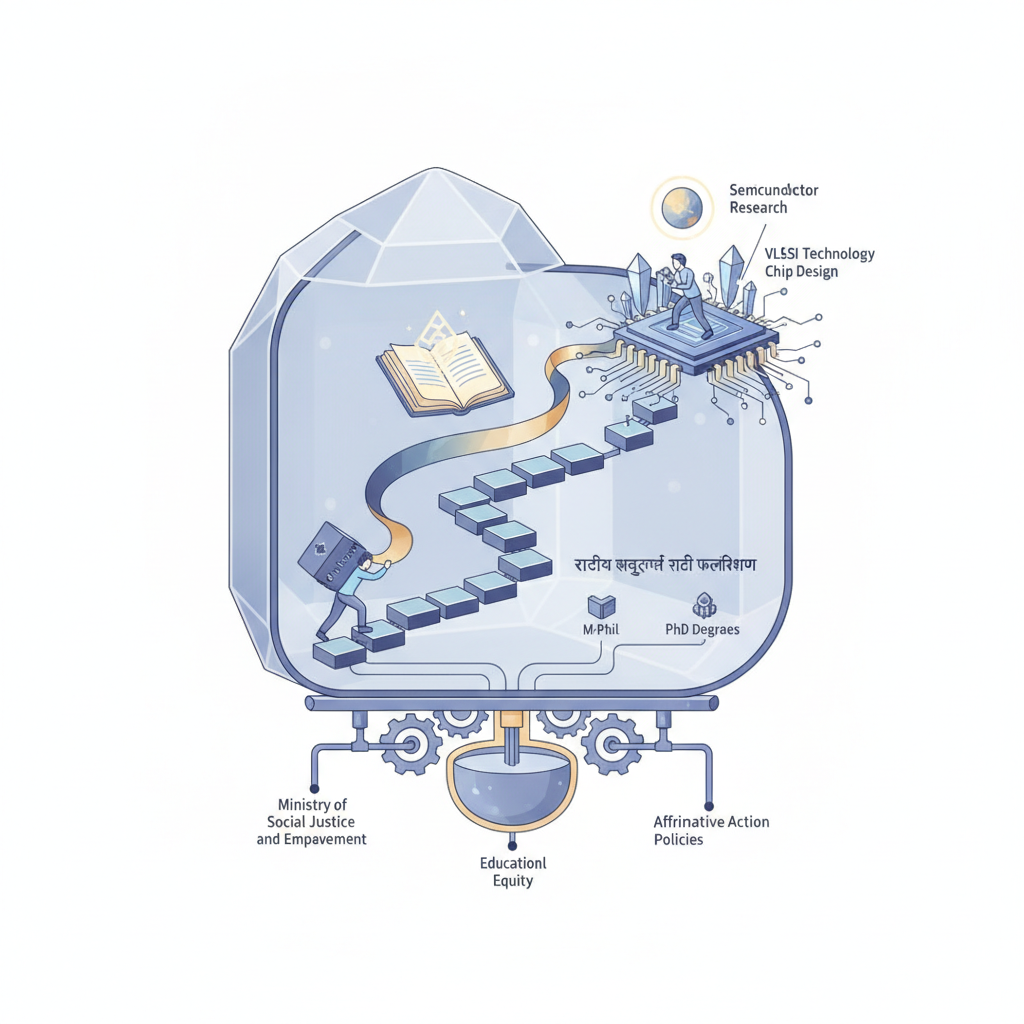
17 Aug UPSC Exam: How National SC Fellowship Helped Sangita Das Overcome PhD Challenges
PhD researchSemiconductor studyNFSC fellowshipSC scholarChip designVLSI technology✎ The National Scheduled Castes Fellowship Scheme is a constitutional mandate-driven initiative that provides ₹31,000 per month to SC scholars pursuing M.Phil/PhD, enabling them to overcome financial barriers and contribute to…
Subject Relevance — Where This Topic Fits
- GS Paper II — Social Justice and Empowerment | GS Paper III — Science and Technology
- Prelims: National Scheduled Castes Fellowship Scheme, Social Justice and Empowerment Ministry, Chip to Startup Programme, VLSI Technology, Post-doctoral Research
- Essay: The Role of State-Sponsored Scholarships in Bridging Social Inequities, Innovation and Inclusion: The Dual Imperative of India’s Research Ecosystem
Quick Revision: The National Scheduled Castes Fellowship Scheme is a constitutional mandate-driven initiative that provides ₹31,000 per month to SC scholars pursuing M.Phil/PhD, enabling them to overcome financial barriers and contribute to India’s strategic sectors like semiconductor research.
Why is this in the news?
The case of Ms. Sangita Das, a Scheduled Caste scholar who overcame multifaceted challenges in pursuing a PhD in semiconductor research with the support of the National Scheduled Castes Fellowship Scheme (NFSC), underscores the scheme’s critical role in enabling marginalised communities to access advanced education and contribute to high-technology domains such as chip design and VLSI technology.
Background
- The National Scheduled Castes Fellowship Scheme (NFSC) is administered by the Ministry of Social Justice and Empowerment under the broader framework of affirmative action policies aimed at promoting educational equity for Scheduled Castes (SCs) in higher education and research.
- The scheme provides financial assistance to SC students pursuing M.Phil and PhD degrees in Indian universities and institutions, thereby addressing systemic barriers to advanced research careers.
- Semiconductor research and VLSI technology are identified as strategic sectors under the Government of India’s ‘Chip to Startup’ programme, which seeks to foster indigenous innovation and reduce dependence on imported semiconductor technologies.
- Historically, SC communities have faced disproportionate socio-economic and educational disadvantages, necessitating targeted interventions such as scholarships to bridge the representation gap in STEM fields.
- The NFSC aligns with constitutional provisions (Articles 15(4), 16(4), and 46) that mandate state action to promote the educational and economic interests of socially and educationally backward classes.
- The scheme’s design reflects the intersectionality of caste, gender, and economic vulnerabilities, as exemplified by Ms. Das’s experience as a first-time mother and caregiver to a parent with a chronic illness.
What is the National Scheduled Castes Fellowship Scheme (NFSC)?
- Objective: To provide financial assistance to Scheduled Caste students enrolled in M.Phil and PhD programmes in Indian universities and institutions, enabling them to focus on research without financial constraints.
- Eligibility: Open to Indian nationals belonging to the Scheduled Castes who are admitted to M.Phil/PhD programmes in recognized institutions, subject to merit and income criteria.
- Financial Support: Monthly fellowship amount of ₹31,000, along with contingency grants for research-related expenses such as fieldwork, conferences, and publication costs.
- Duration: The fellowship is granted for a maximum of 5 years for integrated M.Phil-PhD programmes or 2 years for M.Phil and 3 years for PhD programmes, with periodic reviews.
- Administrative Framework: Implemented by the Ministry of Social Justice and Empowerment through designated nodal agencies, with oversight from the National Commission for Scheduled Castes.
- Complementary Provisions: Includes mentorship support, networking opportunities, and linkages with industry and research organisations to enhance employability post-fellowship.
- Impact: The scheme aims to increase the representation of SCs in high-skill research roles, particularly in STEM fields, thereby contributing to national innovation capacity and reducing disparities in knowledge production.
- Monitoring and Evaluation: Regular progress reviews, mandatory reporting of research outputs, and feedback mechanisms to ensure accountability and effectiveness.
Key Features
| Feature | Significance |
|---|---|
| Monthly financial assistance of ₹31,000 | Provides sustained economic support to scholars, enabling them to meet personal, familial, and academic obligations without financial distress. |
| Flexibility in utilisation | Allows scholars to balance research timelines, publication deadlines, and caregiving responsibilities, including childcare and elderly support. |
| Academic and research support | Facilitates access to advanced research infrastructure, mentorship, and publication incentives, critical for PhD completion. |
| Targeted inclusion of SC scholars | Ensures equitable access to higher education and research opportunities for Scheduled Caste communities, addressing historical educational disparities. |
| Integration with national initiatives | Aligns with broader programmes like the ‘Chips to Startup’ initiative, fostering industry-academia collaboration in strategic sectors. |
Why it Matters
Economic Empowerment
- Mitigates financial barriers to advanced research, reducing dropout rates among marginalised scholars.
- Enables scholars to contribute to high-value sectors like semiconductor design, aligning with India’s self-reliance goals.
- Supports intergenerational mobility by reducing the need for scholars to seek concurrent employment.
Strategic Sector Development
- Bolsters India’s semiconductor ecosystem by nurturing talent in VLSI design and chip fabrication, critical for national security and technological sovereignty.
- Complements government initiatives like the Semicon India Programme by creating a pipeline of skilled researchers.
- Enhances global competitiveness in high-tech industries through advanced research output.
Social Equity
- Addresses historical underrepresentation of Scheduled Castes in STEM fields by providing targeted financial and academic support.
- Promotes inclusive growth by enabling scholars from diverse backgrounds to contribute to cutting-edge research.
- Reduces the ‘brain drain’ by offering domestic research opportunities with competitive remuneration.
Challenges
1. Financial Constraints in Advanced Research
- High cost of PhD programmes, including laboratory access, conference participation, and publication fees, often exceeds family incomes.
- Opportunity cost of leaving employment to pursue research, particularly for scholars from low-income backgrounds.
- Delayed or irregular stipend disbursement can disrupt research continuity and increase dropout rates.
UPSC Link: GS Paper 2: Welfare schemes for vulnerable sections
2. Work-Life-Research Balance
- Juggling caregiving responsibilities (e.g., elderly parents, infants) with rigorous research timelines and publication deadlines.
- Lack of institutional support for scholars with dependents, exacerbating stress and reducing research productivity.
- Gendered caregiving burdens disproportionately affect women scholars, limiting their participation in research.
UPSC Link: GS Paper 1: Social empowerment
3. Institutional and Academic Pressures
- High attrition rates in PhD programmes due to research failures, lack of mentorship, or misalignment with faculty expectations.
- Publish-or-perish culture creates mental health challenges, including anxiety and burnout.
- Limited access to advanced research infrastructure in under-resourced institutions, particularly in public universities.
UPSC Link: GS Paper 3: Science and Technology
4. Sectoral Skill Gaps
- Shortage of trained professionals in niche domains like semiconductor design and VLSI technology, despite industry demand.
- Brain drain to foreign institutions or private sectors due to better remuneration and research opportunities abroad.
- Lack of industry-academia collaboration hinders translational research and commercialisation of academic innovations.
UPSC Link: GS Paper 3: Industrial policy and employment
Challenges — UPSC Perspective
| Issue | Concern |
|---|---|
| Delayed stipend disbursement | Disrupts research continuity and increases financial stress for scholars. |
| Caregiving responsibilities | Competes with research timelines, particularly for women scholars. |
| Lack of mentorship | Leads to research failures and prolonged PhD durations. |
| High publication costs | Restricts dissemination of research findings due to financial constraints. |
| Inadequate research infrastructure | Limits the scope and quality of research in public institutions. |
| Industry-academia disconnect | Reduces opportunities for applied research and innovation commercialisation. |
Government Initiatives — Must-Memorise for Prelims
- Chips to Startup (C2S) Programme
Way Forward
- Expand the NSCF Scheme to cover post-doctoral research, ensuring continuity in academic careers.
- Strengthen institutional support for scholars with caregiving responsibilities, including childcare facilities and flexible work arrangements.
- Enhance mentorship programmes by pairing scholars with industry experts and senior academicians.
- Increase funding for research infrastructure in public universities, particularly in STEM fields.
- Promote industry-academia collaborations through joint research projects and internships.
- Establish a national database of PhD scholars to track progress, challenges, and outcomes.
- Introduce mental health support systems for scholars, including counselling and stress management workshops.
- Encourage interdisciplinary research by linking NSCF with other fellowship schemes (e.g., INSPIRE, Prime Minister’s Research Fellowship).
UPSC Value Addition
Keywords for Mains Answer-Writing
National Scheduled Castes Fellowship Scheme (NFSC) · Scheduled Castes and Scheduled Tribes (Prevention of Atrocities) Act, 1989 · Reservation for Scheduled Castes in higher education · Financial assistance for SC students in research · Chip to Startup (C2S) Programme · Semiconductor and VLSI technology · Higher education funding mechanisms · Gender and caste intersectionality in academia · Post-doctoral research in India · Academic resilience and socio-economic barriers
Concept Flow
Scheduled Castes face historical educational disparities due to socio-economic barriers. → National Scheduled Castes Fellowship (NSCF) Scheme provides targeted financial and academic support to SC scholars. → Financial assistance (₹31,000/month) enables scholars to pursue PhD research without compromising familial responsibilities. → Scholars like Sangita Das leverage NSCF to balance research, caregiving, and career goals. → Research output in strategic sectors (e.g., semiconductor design) contributes to national technological sovereignty. → Long-term benefits include reduced brain drain, enhanced sectoral skill development, and inclusive growth.
Prelims Practice Questions
Q1. Consider the following statements regarding the National Scheduled Castes Fellowship Scheme (NFSC):
1. The NFSC provides financial assistance exclusively to SC students pursuing PhD programmes in India.
2. The scheme is administered by the Ministry of Social Justice and Empowerment.
3. Under NFSC, the fellowship amount is disbursed directly to the students’ bank accounts without any intermediary.
4. The scheme also covers post-doctoral research fellowships for SC scholars.
How many of the above statements are correct?
- Only one
- Only two
- Only three
- All four
Answer: Only three — Statements 1 and 2 are correct as NFSC is designed for SC students pursuing PhD and is administered by the Ministry of Social Justice and Empowerment. Statement 3 is incorrect as disbursement mechanisms may involve institutional intermediaries. Statement 4 is incorrect as NFSC primarily supports PhD fellowships, not post-doctoral research.
Q2. Assertion (A): The Chip to Startup (C2S) Programme is a government initiative aimed at fostering semiconductor research and development in India.
Reason (R): The C2S Programme is implemented under the aegis of the Ministry of Electronics and Information Technology.
Options:
A. Both A and R are true, and R is the correct explanation of A.
B. Both A and R are true, but R is not the correct explanation of A.
C. A is true, but R is false.
D. A is false, but R is true.
Answer: ? — Both the Assertion (A) and Reason (R) are factually correct, and R correctly explains A. The C2S Programme is indeed a government initiative under the Ministry of Electronics and Information Technology to promote semiconductor research and development.
Q3. Match the following schemes with their respective ministries:
Column I (Scheme) | Column II (Ministry)
——————|——————-
A. National Scheduled Castes Fellowship Scheme (NFSC) | 1. Ministry of Education
B. Chip to Startup (C2S) Programme | 2. Ministry of Electronics and Information Technology
C. Post-Matric Scholarship for SC Students | 3. Ministry of Social Justice and Empowerment
D. National Research Foundation | 4. Ministry of Science and Technology
Options:
A. A-3, B-2, C-1, D-4
B. A-2, B-3, C-1, D-4
C. A-1, B-2, C-3, D-4
D. A-3, B-1, C-2, D-4
- A
- B
- C
- D
Answer: A — A. NFSC is administered by the Ministry of Social Justice and Empowerment (3). B. C2S Programme is under the Ministry of Electronics and Information Technology (2). C. Post-Matric Scholarship for SC Students is administered by the Ministry of Education (1). D. National Research Foundation is under the Ministry of Science and Technology (4).
Mains Practice Question
✍ The National Scheduled Castes Fellowship Scheme (NFSC) exemplifies the state’s affirmative action framework in higher education. Critically examine the constitutional and policy foundations of such fellowship schemes for Scheduled Castes. Also, analyse how these schemes address socio-economic barriers while ensuring academic excellence. (15 Marks)
Approach: MODEL-ANSWER SKELETON:
1. **Constitutional and Policy Foundations**:
– **Article 15(4) and 16(4)**: Reservation and protective discrimination for SCs in education and employment.
– **Article 46**: Directive Principle of State Policy to promote educational interests of weaker sections.
– **National Commission for Scheduled Castes (NCSC)**: Constitutional body under Article 338 to monitor implementation.
– **National Education Policy (NEP) 2020**: Emphasis on inclusive higher education and financial support for marginalised groups.
– **Scheduled Castes and Scheduled Tribes (Prevention of Atrocities) Act, 1989**: Ensures conducive academic environment.
2. **NFSC as an Affirmative Action Mechanism**:
– **Objective**: Financial and academic support for SC students pursuing PhD programmes.
– **Eligibility**: SC students enrolled in M.Phil/PhD programmes in recognised institutions.
– **Financial Assistance**: Monthly stipend (e.g., ₹31,000 as per the case) and contingency grants.
– **Coverage**: Includes tuition fees, research costs, and living expenses.
3. **Addressing Socio-Economic Barriers**:
– **Financial Constraints**: Provides a safety net against economic vulnerabilities (e.g., family responsibilities, medical emergencies).
– **Intersectionality**: Addresses challenges faced by SC women (e.g., childcare, gendered expectations) as highlighted in the case of Ms. Sangita Das.
– **Institutional Support**: Reduces dropout rates by mitigating financial distress.
4. **Ensuring Academic Excellence**:
– **Research Incentives**: Encourages high-quality research through structured funding and mentorship.
– **Networking Opportunities**: Facilitates participation in conferences, workshops, and collaborations.
– **Post-Doctoral Pathways**: Prepares scholars for global research opportunities (e.g., Ms. Das’s aspiration for post-doctoral research abroad).
5. **Challenges and Criticisms**:
– **Coverage Gaps**: Limited to PhD programmes; excludes post-doctoral and professional courses.
– **Implementation Bottlenecks**: Delayed disbursement, bureaucratic hurdles, and institutional inefficiencies.
– **Sustainability**: Dependence on annual budget allocations; vulnerability to political and economic fluctuations.
– **Quality vs. Quantity**: Balancing inclusivity with maintaining academic standards.
6. **Comparative Perspective**:
– **International Models**: Compare with fellowships like Fulbright (USA) or Chevening (UK) for SC/ST scholars.
– **Private Sector Initiatives**: Role of CSR in supplementing government schemes (e.g., Tata Trusts, Infosys Foundation).
7. **Way Forward**:
– **Expansion**: Include post-doctoral and professional courses under NFSC.
– **Digital Platforms**: Leverage technology for transparent disbursement and monitoring (e.g., DBT under PM-KISAN).
– **Partnerships**: Collaborate with industry (e.g., C2S Programme) for applied research opportunities.
– **Monitoring and Evaluation**: Strengthen NCSC’s role in assessing impact and addressing grievances.
Source: PIB (Press Information Bureau)
Generated by AanyaAi for educational purpose.

- मद्रास उच्च न्यायालय में ‘वेट्ट्री पयणम’ योजना को असंवैधानिक घोषित करने की मांग - October 4, 2026
- Gurugram’s groundwater extraction exceeds limit by 212%; HC seeks ban - October 4, 2026
- स्वतंत्रता सेनानी श्यामजी कृष्ण वर्मा की जन्म जयंती पर पीएम का श्रद्धांजलि - October 4, 2026

No Comments