


18 Aug NGT Slams Kerala PCB Over Incomplete Kadambrayar River Pollution Report
✎ The National Green Tribunal Act, 2010 empowers the NGT to enforce environmental laws, impose penalties under the 'polluter pays principle', and ensure expeditious disposal of environmental disputes, with orders enforceable…
Subject Relevance — Where This Topic Fits
- GS Paper III — Environment and Disaster Management | GS Paper II — Constitutional and Statutory Bodies
- Prelims: National Green Tribunal (NGT), Polluter Pays Principle, Central Pollution Control Board (CPCB), Kadambrayar River, Kerala State Pollution Control Board (KSPCB), faecal contamination, sewage treatment plant, environmental compensation
- Essay: Environmental Governance and Sustainable Development, Role of Judicial Institutions in Environmental Protection
Quick Revision: The National Green Tribunal Act, 2010 empowers the NGT to enforce environmental laws, impose penalties under the ‘polluter pays principle’, and ensure expeditious disposal of environmental disputes, with orders enforceable through contempt proceedings.
Why is this in the news?
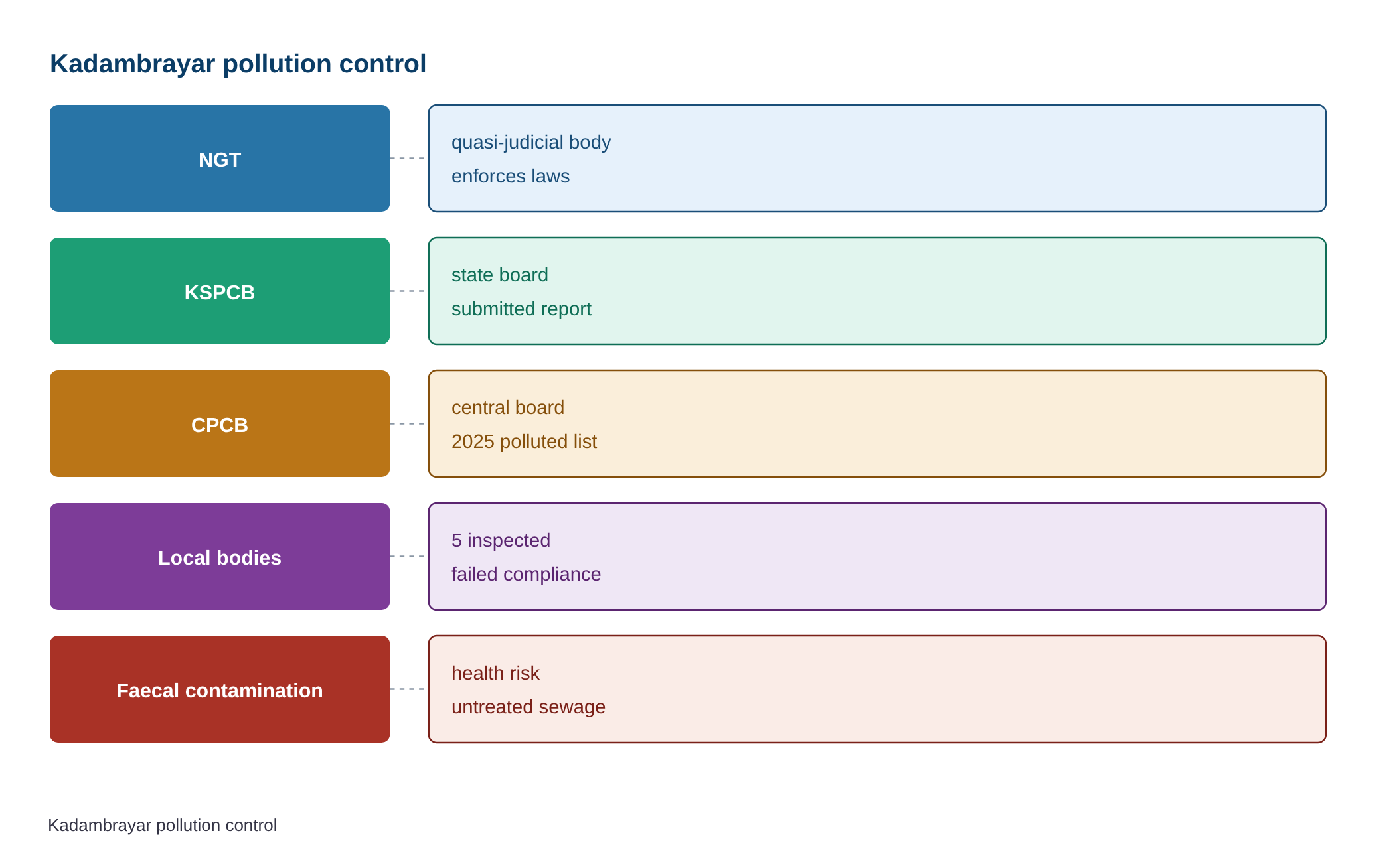
The Southern Bench of the National Green Tribunal (NGT) has admonished the Kerala State Pollution Control Board (KSPCB) for submitting an incomplete and non-compliant report on measures to curb pollution in the Kadambrayar River, Ernakulam. The tribunal rejected the report for failing to assess environmental compensation payable by violators and directed the board to file a revised report by September 11, 2026. This incident underscores the challenges in inter-institutional coordination and enforcement of environmental laws in India, particularly in the context of polluted river stretches identified under the CPCB’s 2025 report.
Background
- The Kadambrayar River in Ernakulam district is one of 32 polluted river stretches identified by the Central Pollution Control Board (CPCB) in its 2025 report titled ‘Polluted River Stretches for Restoration of Water Quality’.
- The NGT took suo motu cognisance of a report published in *The Hindu* highlighting persistent faecal contamination in the Kadambrayar River, prompting the tribunal to issue directives for remedial action.
- The tribunal invoked the ‘polluter pays principle’ and directed the KSPCB to assess environmental compensation for violations, emphasizing the need for stringent enforcement mechanisms.
- The KSPCB’s report, submitted on June 19, 2026, claimed inspections were conducted in five local bodies (Edathala, Thrikkakkara, Kunnathunadu, Kizhakkambalam, and Kochi Corporation) but failed to provide required details or documentation.
- The tribunal’s displeasure stemmed from the board’s reliance on secondary submissions (e.g., documents to be furnished later by local bodies) rather than verifying compliance independently.
- This case reflects broader systemic issues in India’s environmental governance, including delayed enforcement, inadequate monitoring infrastructure, and fragmented institutional roles.
What is the National Green Tribunal (NGT) and its Role in Environmental Governance?
- The NGT is a statutory body established under the National Green Tribunal Act, 2010, for the effective and expeditious disposal of cases relating to environmental protection and conservation of forests and other natural resources.
- It has jurisdiction over all civil cases where a substantial question relating to the environment arises, including enforcement of legal rights relating to the environment and giving relief and compensation for damages to persons and property.
- The tribunal operates through regional benches (e.g., Southern Bench in Chennai) and comprises judicial and expert members to ensure technical and legal expertise in environmental disputes.
- The NGT’s powers include issuing directions for the closure, prohibition, or regulation of any industry, operation, or process, and imposition of penalties or environmental compensation under the ‘polluter pays principle’.
- The tribunal’s orders are binding and enforceable, with provisions for penalties for non-compliance, including contempt of court proceedings.
- The NGT plays a pivotal role in bridging gaps between judicial pronouncements and executive action, particularly in cases of river pollution and industrial violations.
- The tribunal’s directives often serve as catalysts for state-level action, as seen in the Kadambrayar River case, where it compelled the KSPCB to reassess compliance and submit a revised report.
- The NGT’s functioning is guided by principles of sustainable development, precautionary principle, and intergenerational equity, aligning with constitutional provisions (e.g., Article 21, Article 48A, and Article 51A(g)).
Key Features
| Feature | Significance |
|---|---|
| Polluter Pays Principle | Mandates that entities responsible for environmental degradation bear the financial burden of restoration and compensation, aligning economic incentives with ecological sustainability. |
| Environmental Compensation Assessment | Quantifies the cost of pollution caused by violators, ensuring restitution and deterring future non-compliance through financial penalties. |
| CCTV Monitoring at River Stretches | Enables real-time surveillance of waste dumping hotspots, enhancing enforcement of anti-pollution regulations and reducing illegal discharges. |
| Sewage Treatment Plant (STP) at Brahmapuram | Addresses point-source pollution by treating domestic sewage before discharge, reducing faecal contamination in the river. |
| Compliance Verification by SPCBs | Ensures that local bodies and municipalities adhere to pollution control directives, reinforcing accountability in environmental governance. |
Why it Matters
Environmental Governance
- Demonstrates the role of quasi-judicial bodies like the NGT in enforcing environmental laws and ensuring compliance with pollution control norms.
- Highlights the importance of inter-institutional coordination between the NGT, SPCBs, and local self-governments in river restoration efforts.
Public Health
- Faecal contamination in rivers poses severe health risks, including waterborne diseases, necessitating urgent remediation to protect communities dependent on riverine resources.
- Pollution control measures directly impact the safety of drinking water sources and recreational water bodies.
Legal Framework
- Reinforces the application of the Water (Prevention and Control of Pollution) Act, 1974, and the National Green Tribunal Act, 2010, in addressing river pollution.
- Illustrates the enforcement of the ‘precautionary principle’ and ‘sustainable development’ principles in environmental jurisprudence.
Local Governance
- Underscores the responsibility of urban local bodies (ULBs) in managing solid waste and sewage, particularly in peri-urban and riverine areas.
- Exposes gaps in institutional capacity and resource allocation for pollution monitoring and enforcement at the grassroots level.
Challenges
1. Incomplete Compliance Reporting
- Failure of the Kerala State Pollution Control Board (KSPCB) to submit a comprehensive report despite NGT directives, indicating systemic deficiencies in data collection and verification.
- Lack of pre-submission scrutiny by the Member Secretary, leading to procedural lapses and judicial rebuke.
UPSC Link: Water Act 1974 | NGT Act 2010 | Environmental Governance
2. Inadequate Monitoring Infrastructure
- Absence of CCTV surveillance at critical river stretches, particularly in Kizhakkambalam grama panchayat, hampering real-time detection of illegal waste dumping.
- Limited deployment of IoT-enabled sensors for continuous water quality monitoring, restricting evidence-based enforcement.
UPSC Link: Environmental Monitoring | Pollution Control
3. Resource Constraints in ULBs
- Insufficient financial and technical capacity among local bodies to implement pollution control measures, as evidenced by partial compliance in municipalities and panchayats.
- Delays in surveying waste discharge sources and installing STPs, prolonging the period of environmental degradation.
UPSC Link: Local Governance | Urban Planning
4. Faecal Contamination Persistence
- Continued presence of faecal coliform bacteria in the Kadambrayar River despite prior interventions, indicating a breakdown in sanitation infrastructure and waste management systems.
- Risk of disease outbreaks in downstream communities relying on the river for domestic and agricultural purposes.
UPSC Link: Public Health | Water Quality Standards
5. Multi-Stakeholder Coordination Gaps
- Lack of synchronised action between the KSPCB, Department of Local Self-Government, and municipalities, leading to fragmented and ineffective pollution control strategies.
- Absence of a unified river basin management plan for Kadambrayar, exacerbating jurisdictional overlaps and accountability issues.
UPSC Link: Intergovernmental Relations | Environmental Policy
Challenges — UPSC Perspective
| Issue | Concern |
|---|---|
| Incomplete NGT Compliance Reports | Systemic failure in institutional verification and procedural adherence by the KSPCB. |
| Absence of CCTV Surveillance | Inability to monitor and deter illegal waste dumping in real time. |
| Delayed STP Installation | Prolonged discharge of untreated sewage, exacerbating faecal contamination. |
| Inadequate ULB Capacity | Resource constraints prevent effective implementation of pollution control measures. |
| Multi-Stakeholder Fragmentation | Lack of coordination between agencies undermines holistic river restoration efforts. |
Way Forward
- Direct the Kerala State Pollution Control Board to conduct a third-party audit of the Kadambrayar River’s pollution sources and compliance status by October 2026.
- Mandate the installation of CCTV cameras at all vulnerable bridge locations and river stretches within 60 days, with live-streaming to the KSPCB control room.
- Accelerate the commissioning of the 100 KLD sewage treatment plant at Brahmapuram and expand its capacity to meet the river’s current wastewater load.
- Constitute a multi-departmental task force comprising KSPCB, Local Self-Government Department, and Kochi Corporation to oversee real-time monitoring and enforcement.
- Implement a graded penalty system for municipalities and panchayats based on compliance timelines, with provisions for administrative sanctions for non-adherence.
- Launch a community awareness campaign in collaboration with NGOs to educate residents on waste segregation and the hazards of riverine pollution.
- Integrate IoT-based water quality sensors at 10 critical points along the river to enable data-driven decision-making and public transparency.
- Submit a consolidated action plan to the NGT by September 11, 2026, detailing timelines, responsible agencies, and measurable milestones for river restoration.
UPSC Value Addition
Keywords for Mains Answer-Writing
National Green Tribunal (NGT) · Kerala State Pollution Control Board (KSPCB) · Kadambrayar River pollution · Polluter Pays Principle · Environmental Compensation · Central Pollution Control Board (CPCB) · Polluted River Stretches for Restoration of Water Quality · Local Self-Government · Sewage Treatment Plant (STP) · Environmental Governance · Judicial Activism in Environmental Law · Water (Prevention and Control of Pollution) Act, 1974 · Constitutional Mandate for Environmental Protection (Article 48A, Article 51A(g)) · River Rejuvenation Initiatives
Concept Flow
River pollution in Kadambrayar due to untreated sewage and solid waste dumping → NGT takes suo motu cognisance based on media report → Tribunal directs KSPCB to assess environmental compensation under ‘polluter pays principle’ → KSPCB submits incomplete report → NGT rejects report, cites procedural lapses → Tribunal directs revised compliance report by September 11, 2026 → Enforcement agencies face renewed scrutiny and accountability.
Prelims Practice Questions
Q1. Consider the following statements regarding the National Green Tribunal (NGT):
1. The NGT is a statutory body established under the National Green Tribunal Act, 2010.
2. It has the power to enforce both civil and criminal liabilities for environmental violations.
3. The tribunal consists of a Chairperson, Judicial Members, and Expert Members.
4. The NGT can hear appeals against orders passed by the Central Pollution Control Board (CPCB) but not by State Pollution Control Boards (SPCBs).
How many of the above statements are correct?
- Only one
- Only two
- Only three
- All
Answer: Only three — Statements 1, 2, and 3 are correct. Statement 4 is incorrect as the NGT can hear appeals against orders passed by both CPCB and SPCBs.
Q2. Assertion (A): The ‘Polluter Pays Principle’ is a fundamental doctrine in environmental law that mandates the polluter to bear the cost of pollution.
Reason (R): The principle is enshrined in the Water (Prevention and Control of Pollution) Act, 1974, and is also recognized under the National Green Tribunal Act, 2010.
Options:
A. Both A and R are true, and R is the correct explanation of A.
B. Both A and R are true, but R is not the correct explanation of A.
C. A is true, but R is false.
D. A is false, but R is true.
Answer: ? — Both A and R are true, and R correctly explains A as the principle is legally recognized and mandates cost-bearing by the polluter.
Q3. Match the following provisions with their respective Acts:
Column I (Provision)
A. Establishment of the National Green Tribunal
B. Regulation of sewage discharge into water bodies
C. Environmental protection as a constitutional duty
D. Powers of the State Pollution Control Boards
Column II (Act)
1. Water (Prevention and Control of Pollution) Act, 1974
2. National Green Tribunal Act, 2010
3. Constitution of India (Article 48A and 51A(g))
4. Environmental Protection Act, 1986
Options:
A. A-2, B-1, C-3, D-4
B. A-2, B-4, C-3, D-1
C. A-4, B-1, C-3, D-2
D. A-1, B-2, C-4, D-3
Answer: ? — A-2 (National Green Tribunal Act, 2010), B-1 (Water Act, 1974), C-3 (Constitution of India), D-4 (Environmental Protection Act, 1986).
Mains Practice Question
✍ The National Green Tribunal (NGT) has recently reprimanded the Kerala State Pollution Control Board (KSPCB) for submitting an incomplete report on remedial measures for the polluted Kadambrayar River. Critically analyse the role of the NGT in enforcing environmental governance in India, with particular reference to the ‘Polluter Pays Principle’ and the constitutional mandate for environmental protection. Also, examine the challenges faced by State Pollution Control Boards in implementing such directives. (15 Marks)
Approach: MODEL-ANSWER SKELETON:
1. **Introduction (2 marks)**
– Brief on the NGT’s establishment under the National Green Tribunal Act, 2010, and its quasi-judicial nature.
– Mention the constitutional basis: Article 48A (DPSP) and Article 51A(g) (Fundamental Duty) for environmental protection.
– Reference to the Kadambrayar River case as a contemporary example.
2. **Role of NGT in Environmental Governance (4 marks)**
– **Judicial Activism**: NGT’s proactive role in directing environmental compensation and remedial actions (e.g., Vedanta Sterlite case, 2018).
– **Polluter Pays Principle**: Legal grounding in the Water (Prevention and Control of Pollution) Act, 1974, and its application in the Kadambrayar case.
– **Constitutional Mandate**: How NGT upholds the Directive Principles and Fundamental Duties through suo motu cognisance and strict compliance directives.
– **Multi-disciplinary Approach**: Composition of NGT with judicial and expert members for informed decision-making.
3. **Challenges Faced by State Pollution Control Boards (4 marks)**
– **Institutional Constraints**: Limited financial and technical capacity of SPCBs (e.g., inadequate monitoring infrastructure like CCTV in the Kadambrayar case).
– **Inter-agency Coordination**: Issues in coordination between local bodies (municipalities, panchayats) and SPCBs (e.g., delayed survey of waste discharge sources).
– **Political and Bureaucratic Interference**: Resistance to enforcement due to local political pressures or lack of accountability.
– **Resource Allocation**: Inadequate funding for sewage treatment plants (e.g., 100 KLD STP in Brahmapuram) and enforcement mechanisms.
4. **Way Forward and Balanced View (3 marks)**
– **Strengthening SPCBs**: Recommendations from the Gadgil Committee (2011) and Kasturirangan Committee (2013) for empowering SPCBs with greater autonomy and resources.
– **Technological Integration**: Use of AI/remote sensing for real-time monitoring of pollution hotspots.
– **Public Participation**: Role of citizen suits under Section 15 of the NGT Act to supplement state efforts.
– **Judicial Reforms**: Need for faster disposal of cases and stricter penalties for non-compliance.
5. **Conclusion (2 marks)**
– Reiterate the NGT’s pivotal role in bridging the gap between constitutional ideals and ground-level implementation.
– Emphasise the need for a collaborative approach involving judiciary, executive, and civil society for sustainable environmental governance.
Source: The Hindu
Generated by AanyaAi for educational purpose.

- मद्रास उच्च न्यायालय में ‘वेट्ट्री पयणम’ योजना को असंवैधानिक घोषित करने की मांग - October 4, 2026
- Gurugram’s groundwater extraction exceeds limit by 212%; HC seeks ban - October 4, 2026
- स्वतंत्रता सेनानी श्यामजी कृष्ण वर्मा की जन्म जयंती पर पीएम का श्रद्धांजलि - October 4, 2026

No Comments