


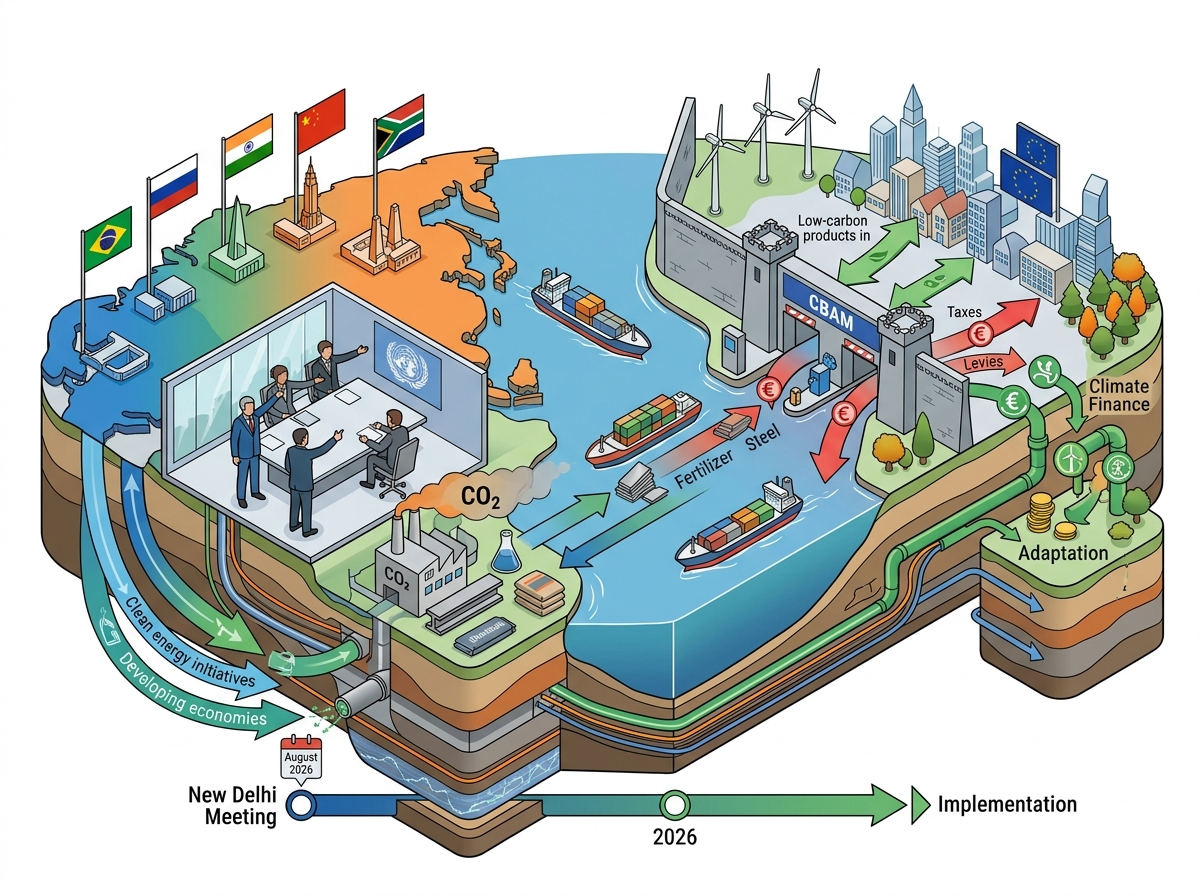
19 Aug BRICS Slams EU’s Carbon Border Tax: Impact on India & Global Trade
✎ The Carbon Border Adjustment Mechanism (CBAM) is a unilateral EU trade measure imposing a carbon price on imports of carbon-intensive goods, widely criticized by developing nations for its potential to undermine equity in global…
Subject Relevance — Where This Topic Fits
- GS Paper II — International Relations: Multilateral institutions and global governance | GS Paper II — International Relations: Climate change negotiations and global environmental governance | GS Paper III — Economy: Trade barriers and non-tariff measures | GS Paper III — Environment: Climate change and international commitments
- Prelims: Carbon Border Adjustment Mechanism (CBAM), Common but Differentiated Responsibilities and Respective Capabilities (CBDR-RC), New Collective Quantified Goal (NCQG), Climate finance, Adaptation finance, Non-tariff barriers (NTBs), Paris Agreement, COP 30 (Belem), BRICS Environment Ministers’ Meeting, Circular economy standards
- Essay: The tension between unilateral climate measures and multilateral environmental governance, Equity in global climate action: Reconciling development imperatives with emission reduction targets
Quick Revision: The Carbon Border Adjustment Mechanism (CBAM) is a unilateral EU trade measure imposing a carbon price on imports of carbon-intensive goods, widely criticized by developing nations for its potential to undermine equity in global climate governance and violate multilateral trade principles.
Why is this in the news?
The 12th BRICS Environment Ministers’ Meeting, held in New Delhi in August 2026, issued a joint statement opposing the European Union’s Carbon Border Adjustment Mechanism (CBAM), terming it a unilateral, discriminatory, and protectionist measure that undermines the principles of equity and common but differentiated responsibilities in climate governance. This development is significant as it highlights the growing divergence between developed and developing nations on the implementation of climate-related trade measures and the urgent need for scaled-up climate finance, particularly for adaptation in vulnerable economies.
Background
- The European Union’s Carbon Border Adjustment Mechanism (CBAM) was introduced as a unilateral trade measure to address carbon leakage by imposing a levy on imports of carbon-intensive goods such as steel, iron, fertilizers, aluminium, and cement, effective from January 1, 2026.
- CBAM is part of the EU’s broader climate strategy under the European Green Deal, aiming to ensure that imported goods meet the same carbon pricing standards as domestically produced goods.
- Developing nations, including BRICS members, have consistently argued that CBAM violates the principles of equity enshrined in the United Nations Framework Convention on Climate Change (UNFCCC), particularly the principle of ‘Common but Differentiated Responsibilities and Respective Capabilities’ (CBDR-RC).
- The BRICS bloc, representing a significant share of global emissions and economic activity, has emerged as a vocal advocate for differentiated climate action, emphasizing the need for developed nations to provide adequate climate finance and technology transfer to support mitigation and adaptation in developing countries.
- The joint statement from the BRICS Environment Ministers’ Meeting follows the conclusion of COP 30 in Belem, Brazil, where parties agreed to establish the New Collective Quantified Goal (NCQG) to triple adaptation finance for developing countries by 2035.
What is the Carbon Border Adjustment Mechanism (CBAM)?
- CBAM is a unilateral trade measure introduced by the European Union to impose a carbon price on imports of carbon-intensive goods, thereby addressing the risk of ‘carbon leakage’—where industries relocate to regions with less stringent climate policies.
- The mechanism applies to goods such as iron, steel, cement, aluminium, fertilizers, electricity, and hydrogen, with the scope potentially expanding to other sectors in the future.
- CBAM operates through a system of CBAM certificates, which importers must purchase and surrender based on the embedded carbon emissions of the imported goods. The mechanism entered its full implementation phase on January 1, 2026, following a transitional reporting phase that began on October 1, 2023.
- The EU has justified CBAM as a tool to level the playing field for domestic industries and incentivize global decarbonization, aligning with its commitment to achieve climate neutrality by 2050 under the European Green Deal.
- Critics, particularly from developing nations, argue that CBAM is a disguised trade barrier that disproportionately affects their export competitiveness and violates the principles of equity and non-discrimination enshrined in international trade law.
- The mechanism has sparked debates on the compatibility of unilateral climate measures with the multilateral framework of the World Trade Organization (WTO) and the UNFCCC, raising questions about the legality and legitimacy of such trade-restrictive environmental policies.
- CBAM is part of a broader trend of ‘green protectionism,’ where countries seek to use environmental regulations as tools to protect domestic industries while advancing climate goals.
- The EU has stated that CBAM is designed to be WTO-compliant, with provisions for differential treatment based on the level of development of trading partners, though developing nations remain skeptical of its fairness and effectiveness.
Key Features
| Feature | Significance |
|---|---|
| Carbon Border Adjustment Mechanism (CBAM) | A unilateral EU policy imposing import levies on carbon-intensive goods to reduce embedded emissions, transitioning from a reporting phase (Oct 2023–Dec 2025) to full implementation (Jan 2026). |
| BRICS Joint Statement on CBAM | A collective opposition by nine developing economies, branding CBAM as ‘unilateral, punitive, discriminatory’ and inconsistent with international law, particularly the principle of Common but Differentiated Responsibilities and Respective Capabilities (CBDR-RC). |
| Climate Finance Urgency | BRICS nations reiterated the need for developed countries to scale up climate finance, referencing the New Collective Quantified Goal (NCQG) agreed at COP30 (Belem, 2025) to triple adaptation finance to developing nations by 2035. |
| Principle of CBDR-RC | A foundational UNFCCC principle reaffirmed in the BRICS statement, emphasizing differentiated responsibilities based on national circumstances, capacities, and historical emissions, while ensuring voluntary cooperation in climate actions. |
| Technical Work by BRICS Working Groups | A year-long collaborative process by the BRICS Environment Working Group and Contact Group on Climate Change, culminating in a joint declaration that integrates climate resilience, circular economy standards, and forest fire protocols. |
Why it Matters
Economic/Trade
- CBAM introduces a trade barrier for developing economies reliant on carbon-intensive exports (e.g., steel, cement, aluminium), potentially distorting global trade flows and increasing compliance costs for exporters.
- The mechanism may incentivize carbon-intensive industries to relocate to non-CBAM jurisdictions, raising concerns about carbon leakage and undermining global climate goals.
- Developing nations argue that CBAM violates WTO principles of non-discrimination and national treatment, as it imposes unequal burdens based on production methods rather than product characteristics.
- The opposition reflects broader concerns about the proliferation of unilateral trade measures under the guise of climate action, which could fragment global climate governance.
Environmental Governance
- The BRICS joint statement underscores the tension between unilateral climate measures and multilateral frameworks like the UNFCCC, where climate actions are expected to align with the principle of CBDR-RC.
- The emphasis on climate finance highlights the unresolved debate over who bears the cost of adaptation, particularly for vulnerable nations disproportionately affected by climate change.
- The call for tripling adaptation finance by 2035 aligns with the Global Goal on Adaptation (GGA) under the Paris Agreement, but its implementation remains contingent on political will and financial commitments from developed nations.
- The BRICS bloc’s focus on ‘climate resilience’ and ‘circular economy standards’ signals a shift toward integrating climate adaptation into broader economic and industrial policies.
Geopolitical/Institutional
- The BRICS Environment Ministers’ meeting, chaired by India, demonstrates the bloc’s growing role in shaping global climate discourse, particularly among developing economies.
- The inclusion of non-BRICS members (e.g., UAE, Indonesia, Iran) in the joint statement reflects an expanding coalition of nations opposing unilateral trade measures, potentially reshaping climate diplomacy.
- The handover of hosting duties to China for the 13th BRICS Environment Ministers’ meeting in 2027 underscores the bloc’s institutional continuity and strategic priorities in climate governance.
Legal/Regulatory
- The BRICS statement invokes international law, particularly the UNFCCC and its principles, to challenge the legality of CBAM, framing it as a violation of sovereignty and multilateralism.
- The opposition to CBAM aligns with broader critiques of ‘green protectionism,’ where environmental policies are used to justify trade restrictions that disproportionately affect developing economies.
- The BRICS bloc’s emphasis on ‘voluntary’ and ‘calibrated’ commitments contrasts with the EU’s binding regulatory approach, highlighting divergent philosophies in global climate governance.
Challenges
1. Trade Distortion and WTO Compliance
- CBAM risks violating WTO rules on Most Favoured Nation (MFN) treatment and national treatment, as it imposes additional costs on imports based on production methods rather than product characteristics.
- Developing nations may challenge CBAM at the WTO, arguing that it constitutes an illegal subsidy for domestic industries or an unjustified technical barrier to trade.
- The EU’s defense of CBAM as a climate measure may set a precedent for other jurisdictions to adopt similar unilateral policies, exacerbating trade tensions.
UPSC Link: WTO dispute settlement mechanisms
2. Carbon Leakage and Industrial Relocation
- CBAM could drive carbon-intensive industries to relocate to countries without equivalent carbon pricing, undermining global emissions reductions and exacerbating emissions in non-CBAM jurisdictions.
- The mechanism may fail to address the root cause of carbon leakage—global disparities in carbon pricing—without complementary international agreements or border adjustments that account for regional variations.
- Developing economies with limited fiscal space may struggle to adopt carbon pricing or transition to low-carbon industries, further entrenching carbon-intensive growth models.
UPSC Link: Carbon leakage mechanisms
3. Climate Finance and Equity Gaps
- The BRICS bloc’s demand for scaled-up climate finance reflects persistent inequities in global climate governance, where developed nations have yet to meet their $100 billion annual finance commitment (pledged in 2009).
- The New Collective Quantified Goal (NCQG) to triple adaptation finance by 2035 faces implementation challenges, including identifying sources of finance, ensuring additionality, and aligning with national priorities.
- Without adequate finance, developing nations may lack the resources to implement adaptation measures, leaving vulnerable populations exposed to climate risks.
UPSC Link: Climate finance architecture
4. Fragmentation of Global Climate Governance
- Unilateral measures like CBAM risk fragmenting global climate governance, as nations adopt divergent policies that prioritize domestic interests over collective action.
- The BRICS bloc’s opposition to CBAM may lead to retaliatory measures or the formation of competing climate coalitions, further complicating international negotiations.
- The lack of a unified approach to carbon pricing and trade measures could undermine the effectiveness of multilateral frameworks like the Paris Agreement.
UPSC Link: Multilateral environmental agreements
5. Technical and Compliance Burdens on Exporters
- CBAM imposes significant administrative and technical burdens on exporters, who must calculate embedded emissions, purchase certificates, and comply with reporting requirements, particularly for complex supply chains.
- Developing nations with limited institutional capacity may struggle to meet CBAM’s compliance demands, leading to market exclusion or increased costs for their industries.
- The mechanism’s complexity may deter small and medium-sized enterprises (SMEs) from participating in global trade, exacerbating economic inequalities.
UPSC Link: Trade facilitation and compliance
Challenges — UPSC Perspective
| Issue | Concern |
|---|---|
| WTO Compliance of CBAM | Potential violation of MFN and national treatment principles; risk of trade disputes and retaliatory measures. |
| Carbon Leakage | Relocation of carbon-intensive industries to non-CBAM jurisdictions, undermining global emissions reductions. |
| Climate Finance Gaps | Insufficient and delayed delivery of promised finance by developed nations, exacerbating adaptation deficits in developing countries. |
| Fragmentation of Climate Governance | Divergent unilateral policies may weaken multilateral frameworks like the Paris Agreement and UNFCCC. |
| Compliance Burdens | High administrative and technical costs for exporters, particularly in developing economies with limited capacity. |
| Equity in Climate Action | Perceived imbalance in responsibilities between developed and developing nations, risking backlash against global climate efforts. |
Way Forward
- Establish a multilateral framework under the UNFCCC to harmonize carbon border measures, ensuring compliance with WTO rules and alignment with the principle of CBDR-RC.
- Accelerate negotiations on the New Collective Quantified Goal (NCQG) to finalize funding mechanisms, sources, and modalities for tripling adaptation finance by 2035.
- Develop technical assistance programs to help developing nations build capacity for carbon accounting, emissions monitoring, and compliance with climate policies like CBAM.
- Promote international cooperation on carbon pricing mechanisms, including the potential for a global carbon market or sector-specific agreements to reduce trade distortions.
- Strengthen the role of the WTO in addressing trade-related climate measures, including the creation of a dedicated dispute settlement mechanism for environmental disputes.
- Encourage the adoption of circular economy principles and low-carbon industrial policies in developing nations to reduce reliance on carbon-intensive exports.
- Facilitate South-South cooperation on climate adaptation, including knowledge sharing, technology transfer, and joint projects to build resilience in vulnerable regions.
- Enhance transparency in climate finance flows, ensuring that funds are allocated based on need, additionality, and alignment with national priorities.
UPSC Value Addition
Keywords for Mains Answer-Writing
Carbon Border Adjustment Mechanism (CBAM) · Climate finance · Common but Differentiated Responsibilities and Respective Capabilities (CBDR-RC) · New Collective Quantified Goal (NCQG) · BRICS Environment Ministers’ Meeting · Climate adaptation and resilience · Trade and climate policy · Paris Agreement · Sustainable Development Goals (SDGs) · Global North-South divide in climate action
Concept Flow
EU adopts CBAM as a unilateral climate measure → Developing nations (including BRICS) oppose it as discriminatory and protectionist → BRICS bloc issues joint statement invoking CBDR-RC and calling for scaled-up climate finance → Tension between unilateral measures and multilateral frameworks like UNFCCC intensifies → Risk of trade disputes and fragmentation of global climate governance increases → Need for harmonized, WTO-compliant carbon border mechanisms and equitable climate finance becomes urgent.
Prelims Practice Questions
Q1. Consider the following statements regarding the European Union’s Carbon Border Adjustment Mechanism (CBAM):
1. CBAM is an import levy imposed on carbon-intensive goods like steel, iron, fertilizers, aluminium, and cement.
2. CBAM was fully implemented on January 1, 2026, requiring importers to purchase and surrender CBAM certificates tied to embedded carbon emissions in goods.
3. CBAM aims to reduce the carbon footprint of imported goods and is aligned with the principle of Common but Differentiated Responsibilities and Respective Capabilities (CBDR-RC).
How many of the above statements are correct?
- Only one
- Only two
- All three
- None
Answer: All three — Statements 1 and 2 are correct as CBAM is an import levy on carbon-intensive goods and was fully implemented on January 1, 2026. Statement 3 is incorrect because CBAM is seen as a unilateral measure and does not align with the CBDR-RC principle, which emphasizes differentiated responsibilities based on national circumstances.
Q2. Assertion (A): The European Union’s Carbon Border Adjustment Mechanism (CBAM) has been criticized by developing countries as a trade barrier.
Reason (R): CBAM imposes a levy on carbon-intensive goods, which increases the cost of imports and may disproportionately affect developing economies.
(a) Both A and R are true, and R is the correct explanation of A.
(b) Both A and R are true, but R is not the correct explanation of A.
(c) A is true, but R is false.
(d) A is false, but R is true.
- (a)
- (b)
- (c)
- (d)
Answer: (b) — Both the assertion and reason are true. CBAM has been criticized by developing countries as a trade barrier because it imposes additional costs on their exports of carbon-intensive goods, thereby affecting their trade competitiveness.
Q3. Match the following principles/concepts with their descriptions:
Column I
A. Common but Differentiated Responsibilities and Respective Capabilities (CBDR-RC)
B. New Collective Quantified Goal (NCQG)
C. Carbon Border Adjustment Mechanism (CBAM)
D. Climate adaptation and resilience
Column II
1. A goal to mobilize climate finance for developing countries to adapt to climate change impacts.
2. A mechanism to impose a levy on carbon-intensive imports to reduce their carbon footprint.
3. A principle acknowledging that all countries have a common responsibility to address climate change, but differentiated responsibilities based on their national circumstances.
4. Efforts to reduce the vulnerability of communities and ecosystems to the impacts of climate change.
Select the correct match:
- A-3, B-1, C-2, D-4
- A-1, B-3, C-2, D-4
- A-3, B-2, C-1, D-4
- A-4, B-1, C-2, D-3
Answer: A-3, B-1, C-2, D-4 — The correct matches are: A-3 (CBDR-RC acknowledges common but differentiated responsibilities), B-1 (NCQG aims to mobilize climate finance for adaptation), C-2 (CBAM is a levy on carbon-intensive imports), and D-4 (Climate adaptation and resilience refers to efforts to reduce vulnerability to climate impacts).
Mains Practice Question
✍ The European Union’s Carbon Border Adjustment Mechanism (CBAM) has been criticized by the BRICS bloc and other developing countries as a unilateral and discriminatory trade measure. Critically examine the rationale behind this opposition, with reference to the principles of global climate governance and the evolving architecture of international trade. (15 Marks)
Approach: MODEL-ANSWER SKELETON:
1. **Introduction (2 marks)**: Define CBAM and its stated objective (reducing carbon footprint of imported goods). Briefly introduce the opposition from BRICS and developing countries.
2. **Rationale for Opposition (6 marks)**:
– **Unilateral and Discriminatory Nature**: Explain how CBAM is perceived as a unilateral measure imposed by the EU without multilateral consensus, violating the principle of common but differentiated responsibilities (CBDR-RC) enshrined in the UNFCCC and Paris Agreement.
– **Trade Barrier Concerns**: Discuss how CBAM may act as a non-tariff barrier, disproportionately affecting developing countries’ exports of carbon-intensive goods (e.g., steel, cement, fertilizers) and undermining their economic growth.
– **Lack of Alignment with International Law**: Highlight the argument that CBAM may contravene WTO rules, particularly the Most Favoured Nation (MFN) principle and national treatment obligations, as it imposes additional costs on imports without addressing the carbon pricing mechanisms of the exporting countries.
3. **Global Climate Governance Principles (4 marks)**:
– **CBDR-RC**: Explain this principle as a cornerstone of the UNFCCC and Paris Agreement, emphasizing differentiated responsibilities based on national circumstances and capabilities.
– **Equity and Justice**: Discuss the argument that developed countries, which have historically contributed more to global emissions, should bear a greater burden in addressing climate change, including through providing climate finance and technology transfer.
4. **Conclusion (3 marks)**:
– Summarize the key arguments against CBAM.
– Highlight the need for a multilateral approach to climate action that balances trade and environmental objectives, possibly through mechanisms like the New Collective Quantified Goal (NCQG) for climate finance.
– Conclude with a balanced view acknowledging the EU’s intent while emphasizing the importance of inclusive and equitable climate governance.
Source: The Indian Express
Generated by AanyaAi for educational purpose.

- मद्रास उच्च न्यायालय में ‘वेट्ट्री पयणम’ योजना को असंवैधानिक घोषित करने की मांग - October 4, 2026
- Gurugram’s groundwater extraction exceeds limit by 212%; HC seeks ban - October 4, 2026
- स्वतंत्रता सेनानी श्यामजी कृष्ण वर्मा की जन्म जयंती पर पीएम का श्रद्धांजलि - October 4, 2026

No Comments