


19 Aug How AI is Reshaping Education & Jobs: UPSC & PCS Perspective
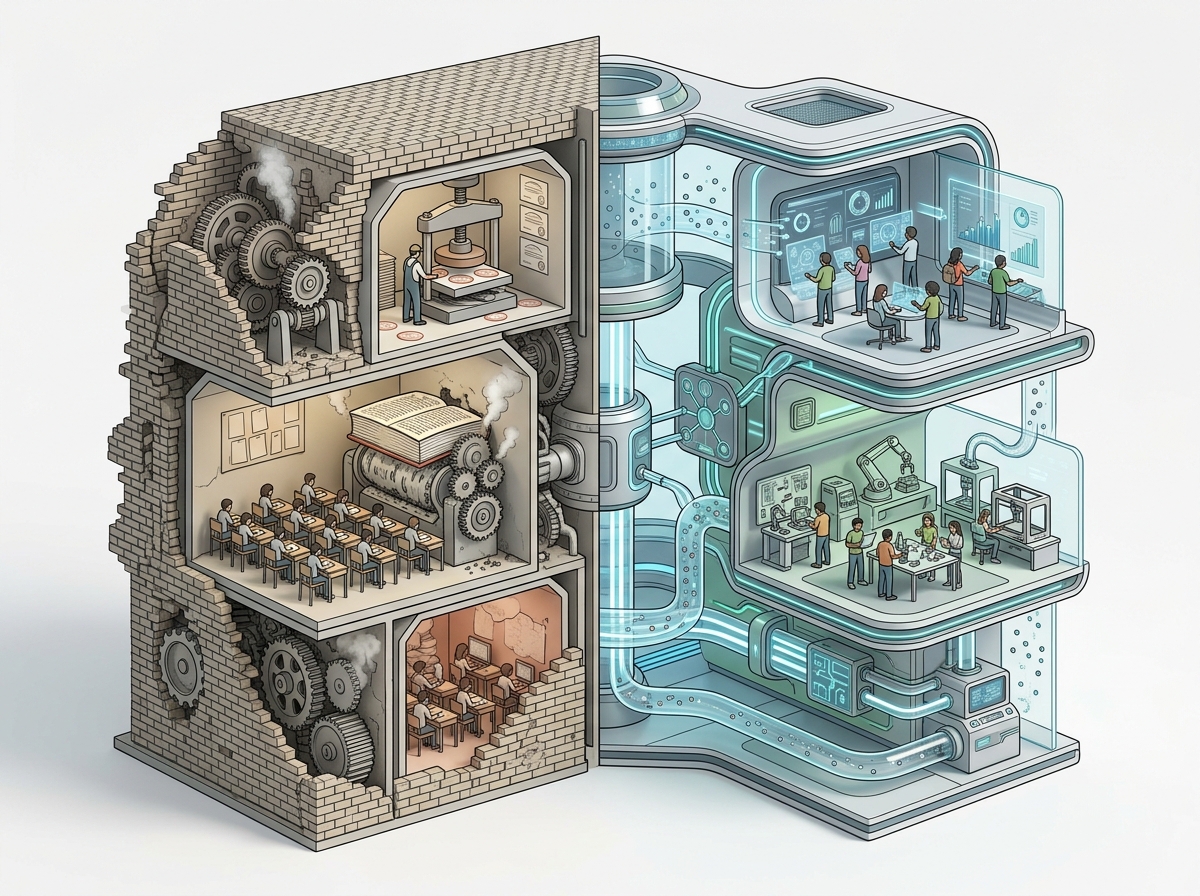
Curriculum designPedagogical approachesSkill requirementsExperiential learningMeta-cognitive skills✎ The future of work demands education systems that cultivate adaptability, critical thinking, and interdisciplinary problem-solving, rather than the mere accumulation of information.
Subject Relevance — Where This Topic Fits
- GS Paper II — Governance, Constitution, Polity, Social Justice and International Relations | GS Paper III — Technology, Economic Development, Bio-Technology, Environment, Security
- Prelims: Artificial Intelligence (AI), National Education Policy (NEP) 2020, National Curriculum Framework (NCF) 2023, Skill India Mission, Digital India, AI-driven automation, biosimilars, generic drugs, robotics in manufacturing, machine vision, bioreactors, fill-finish lines
- Essay: The intersection of technology and human capital: Preparing for an unpredictable future, Education as the bedrock of national resilience in the era of AI-driven disruption
Quick Revision: The future of work demands education systems that cultivate adaptability, critical thinking, and interdisciplinary problem-solving, rather than the mere accumulation of information.
Why is this in the news?
The article highlights the urgent need for systemic reforms in India’s higher education to address the disruptive impact of Artificial Intelligence (AI) on the nature of work, industrial processes, and skill requirements. It argues that traditional pedagogical approaches—characterised by rote learning and syllabus overload—are ill-equipped to prepare students for an AI-augmented future where adaptability, critical thinking, and interdisciplinary problem-solving are paramount. The piece underscores the necessity of a curriculum that prioritises depth over breadth, experiential learning, and the cultivation of meta-cognitive skills to navigate an unpredictable technological landscape.
Background
- The National Education Policy (NEP) 2020 envisages a transformative shift in India’s education system, emphasising flexibility, multidisciplinary learning, and the integration of technology in pedagogy.
- The National Curriculum Framework (NCF) 2023, released under NEP 2020, advocates for competency-based education and the reduction of rote learning in favour of conceptual understanding and application.
- India’s pharmaceutical and biotechnology sectors are rapidly adopting AI-driven tools for drug discovery, formulation, and manufacturing, necessitating a workforce skilled in computational biology, data science, and systems thinking.
- Global trends indicate that AI is reshaping labour markets, with routine cognitive and manual tasks being automated, while demand for roles requiring creativity, emotional intelligence, and complex problem-solving is rising.
Artificial Intelligence and the Evolving Landscape of Work and Education
- Artificial Intelligence (AI) refers to the simulation of human intelligence processes by machines, particularly computer systems, including learning, reasoning, problem-solving, perception, and language understanding.
- AI systems are increasingly capable of performing tasks traditionally associated with human cognition, such as pattern recognition, predictive analytics, and decision-making, thereby augmenting or substituting human labour in various sectors.
- In the pharmaceutical and biotechnology industries, AI is revolutionising drug discovery through techniques like molecular docking, virtual screening, and generative design, significantly reducing the time and cost of bringing new drugs to market.
- Robotics and machine vision are being integrated into manufacturing processes to enhance precision, efficiency, and quality control, particularly in sectors like generic drugs, biosimilars, and vaccine production.
- The automation of routine tasks by AI-driven tools does not imply the obsolescence of human expertise; rather, it necessitates a shift towards roles that require deep domain knowledge, interdisciplinary thinking, and the ability to manage AI systems.
- The unpredictability of AI’s impact on the job market underscores the need for education systems to prioritise adaptability, lifelong learning, and the development of higher-order cognitive skills over rote memorisation.
- India’s education policy frameworks, including NEP 2020 and NCF 2023, recognise the need for curricular reforms to align with technological advancements, though implementation challenges persist due to resource constraints and institutional inertia.
- The integration of AI in education itself—through personalised learning platforms, adaptive assessments, and AI-driven tutoring systems—presents both opportunities and ethical considerations, including data privacy and algorithmic bias.
UPSC Value Addition
Keywords for Mains Answer-Writing
Artificial Intelligence in education · Curriculum reform for AI era · 21st-century skills · Higher education transformation · AI-driven job market changes · Domain expertise over rote learning · Adaptive learning systems · Multidisciplinary education · Critical thinking in AI age · National Education Policy 2020 · Industry-academia collaboration · Lifelong learning frameworks
Prelims Practice Questions
Q1. Consider the following statements regarding the impact of Artificial Intelligence (AI) on the education sector:
1. AI systems are rendering routine coding tasks obsolete, necessitating a shift in educational focus.
2. The National Education Policy 2020 explicitly mandates the integration of AI in school curricula from Class 6 onwards.
3. Domain expertise remains irreplaceable even as AI automates entry-level tasks in industries like generic drugs and vaccine manufacturing.
How many of the above statements are correct?
- Only one
- Only two
- All three
- None
Answer: All three — Statement 1 is correct as AI tools like ‘vibe coding’ are making routine coding tasks redundant. Statement 2 is incorrect as the NEP 2020 does not mandate AI integration from Class 6; it encourages digital literacy and AI awareness. Statement 3 is correct as industries will still require deep domain expertise despite AI-driven automation.
Q2. Assertion (A): The primary goal of education in the AI era should be to teach students how to learn quickly in unfamiliar situations rather than merely storing vast amounts of information.
Reason (R): AI systems can retrieve and process information far more efficiently than humans, making rote memorization obsolete.
Options:
A) Both A and R are true, and R is the correct explanation of A.
B) Both A and R are true, but R is NOT the correct explanation of A.
C) A is true but R is false.
D) A is false but R is true.
Answer: ? — Both Assertion (A) and Reason (R) are true. The Reason (R) correctly explains Assertion (A), as the efficiency of AI in information retrieval diminishes the value of rote memorization, shifting the educational focus to adaptive learning and critical thinking.
Q3. Match the following sectors with the AI-driven transformations they are experiencing:
Column I (Sector)
1. Generic drugs and biosimilars
2. Vaccine development and manufacture
3. Manufacturing
4. Coding and software development
Column II (AI Transformation)
A. Molecule screening and formulation using AI
B. Designing antigens and predicting immune responses
C. Automation of routine coding tasks
D. Robotics and machine vision handling synthesis and quality control
Options:
A) 1-A, 2-B, 3-D, 4-C
B) 1-B, 2-A, 3-C, 4-D
C) 1-D, 2-C, 3-B, 4-A
D) 1-C, 2-D, 3-A, 4-B
Answer: ? — The correct matches are: 1-A (Generic drugs and biosimilars use AI for molecule screening and formulation), 2-B (Vaccine development uses AI for designing antigens and predicting immune responses), 3-D (Manufacturing uses robotics and machine vision for synthesis and quality control), and 4-C (Coding and software development face automation of routine tasks).
Mains Practice Question
✍ The traditional model of education, which prioritises the accumulation of information, is increasingly inadequate in an era dominated by Artificial Intelligence. Critically analyse the need for a paradigm shift in higher education to foster adaptability, critical thinking, and domain expertise. Substantiate your arguments with reference to the evolving job market and technological advancements. (15 Marks)
Approach: MODEL-ANSWER SKELETON:
1. **Introduction (2 Marks)**
– Briefly define the traditional education model and its limitations in the AI era.
– State the need for a paradigm shift toward adaptability, critical thinking, and domain expertise.
2. **Evolving Job Market and AI Impact (4 Marks)**
– Discuss how AI is reshaping industries (e.g., generic drugs, vaccine manufacturing, coding) by automating routine tasks.
– Highlight the rise of AI-driven tools like ‘vibe coding’ and their impact on entry-level positions.
– Emphasise the continued demand for deep domain expertise in sectors where AI augments human roles.
3. **Limitations of Rote Learning (3 Marks)**
– Critique the traditional focus on rote memorisation and information retention.
– Explain why AI systems outperform humans in information retrieval and processing.
– Argue that education must shift from ‘what to know’ to ‘how to learn’ and ‘what to understand deeply’.
4. **Proposed Paradigm Shift (4 Marks)**
– Discuss the need to ‘thin out’ curricula to focus on core concepts and interdisciplinary learning.
– Highlight the role of adaptive learning systems and experiential learning in fostering critical thinking.
– Reference the National Education Policy (NEP) 2020’s emphasis on skill development, multidisciplinary education, and lifelong learning.
– Mention the importance of industry-academia collaboration to align education with industry needs.
5. **Challenges and Way Forward (2 Marks)**
– Acknowledge challenges such as resistance to change, resource constraints, and unequal access to technology.
– Suggest measures like teacher training, policy reforms, and public-private partnerships to facilitate the transition.
**Balanced View:**
– Acknowledge that while AI disrupts traditional education, it also offers opportunities for personalised and inclusive learning.
Source: The Hindu
Generated by AanyaAi for educational purpose.

- मद्रास उच्च न्यायालय में ‘वेट्ट्री पयणम’ योजना को असंवैधानिक घोषित करने की मांग - October 4, 2026
- Gurugram’s groundwater extraction exceeds limit by 212%; HC seeks ban - October 4, 2026
- स्वतंत्रता सेनानी श्यामजी कृष्ण वर्मा की जन्म जयंती पर पीएम का श्रद्धांजलि - October 4, 2026

No Comments