


19 Aug How Gujarat’s AI & Tech Saved Lions from Railway Deaths in 2024-26
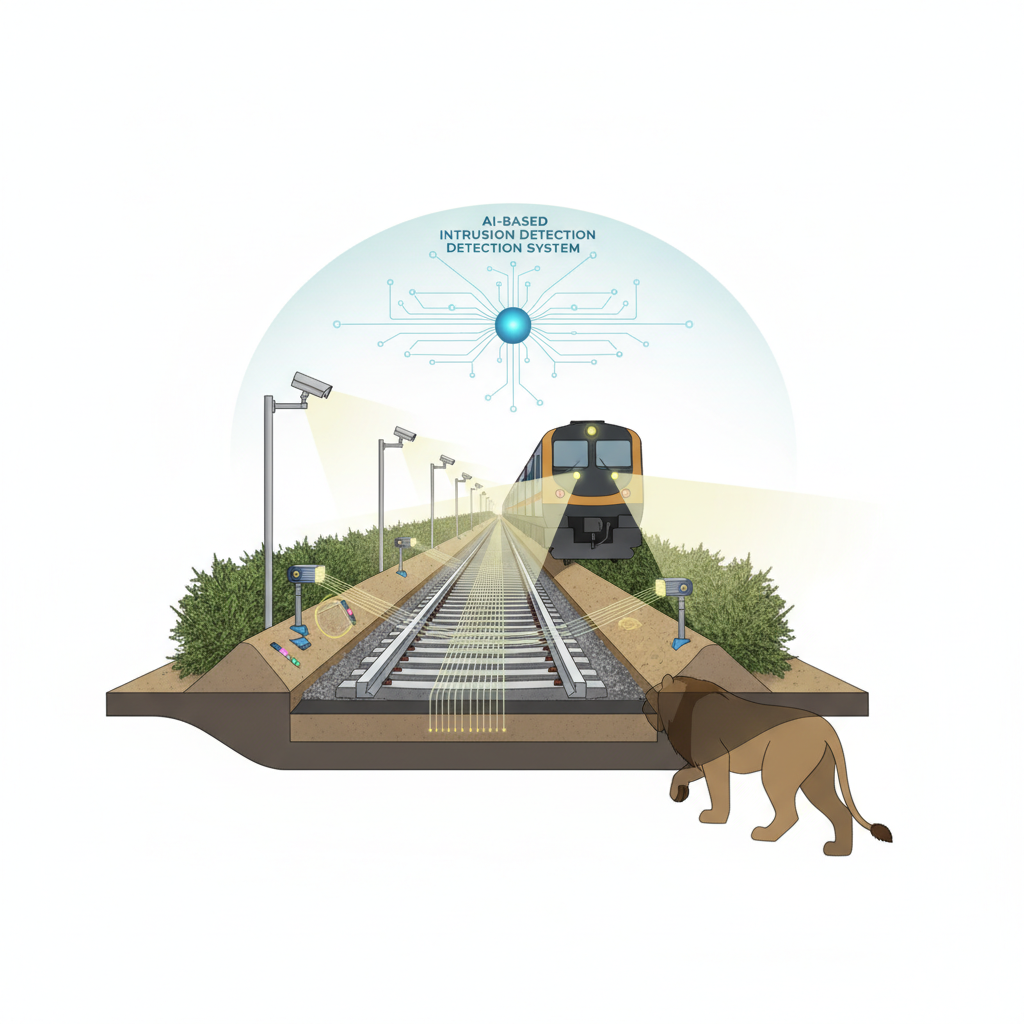
✎ The Gujarat model demonstrates how AI-driven Intrusion Detection Systems, habitat modifications, and infrastructure adaptations can effectively mitigate human-wildlife conflict in railway corridors, ensuring coexistence between…
Subject Relevance — Where This Topic Fits
- GS Paper III — Environment, Biodiversity and Climate Change | GS Paper III — Science and Technology — Developments and their Applications
- Prelims: Asiatic Lion (Panthera leo persica), Intrusion Detection System (IDS), Optical Fibre Sensing, Wildlife Corridor, Railway Underpasses, Human-Wildlife Conflict, CITES Appendix I, Gir National Park, Saurashtra Peninsula
- Essay: Ethical imperatives of technological intervention in wildlife conservation, Balancing developmental infrastructure with ecological sustainability
Quick Revision: The Gujarat model demonstrates how AI-driven Intrusion Detection Systems, habitat modifications, and infrastructure adaptations can effectively mitigate human-wildlife conflict in railway corridors, ensuring coexistence between expanding wildlife populations and developmental infrastructure.
Why is this in the news?
The Gujarat High Court, in a suo motu Public Interest Litigation, has been monitoring the implementation of measures to prevent Asiatic lion fatalities caused by railway accidents. A recent affidavit by the Conservator of Forests, Junagadh, highlights the deployment of an Artificial Intelligence-based Intrusion Detection System (IDS), optical fibre sensing cables, CCTV surveillance, LED lighting on trains, and habitat modifications along railway tracks in the lion landscape of Saurashtra. The initiative has successfully averted lion-train collisions in the period from August 2024 to May 2026, marking a significant milestone in wildlife conservation within human-dominated landscapes.
Background
- The Asiatic lion (*Panthera leo persica*) is a critically endangered subspecies, endemic to the Gir landscape in Gujarat, with its population expanding beyond traditional boundaries into Saurashtra’s human-dominated areas.
- Between 2014 and 2024, 19 Asiatic lions were fatally struck by trains in Gujarat, underscoring the escalating human-wildlife conflict due to expanding railway networks and lion habitat overlap.
- Railway tracks in Saurashtra intersect critical wildlife corridors, including those used by lions for dispersal, migration, and genetic exchange, exacerbating the risk of collisions.
- The Gujarat High Court’s suo motu PIL was initiated to address the recurring issue of lion fatalities and to enforce accountability in wildlife protection measures along railway corridors.
What is the Gujarat Government’s Integrated Lion Safety Initiative?
- The initiative is a multi-pronged, court-monitored strategy combining technological interventions, habitat modifications, and human resource training to mitigate lion-train collisions in Saurashtra.
- Artificial Intelligence-based Intrusion Detection System (IDS): Utilises fibre optic sensing cables laid along railway tracks (e.g., Liliya-Savarkundla section) to detect lion movement signatures via vibrations or thermal signatures, triggering real-time alerts to railway authorities and forest personnel.
- CCTV Surveillance and LED Lighting: Deployment of high-resolution CCTV cameras along high-risk stretches and fitting LED lights on train locomotives to deter lions from approaching tracks, particularly during nocturnal hours.
- Habitat Modifications: Clearing encroaching vegetation (14.23 hectares) along railway corridors to reduce cover for lions, thereby minimizing ambush opportunities and improving visibility for both wildlife and railway staff.
- Wildlife Corridors and Underpasses: Retrofitting existing underpasses and constructing new ones (13 proposed) to facilitate safe passage of lions and other wildlife across railway tracks, with 62 underpasses currently assessed as functional.
- Human Resource Deployment: Deployment of 70 railway trackers, alongside joint inspections and cautionary measures.
- Data-Driven Hotspot Identification: Systematic mapping of 100 wildlife-movement hotspots to prioritize interventions.
- Legal and Institutional Framework: The Gujarat High Court’s suo motu PIL has ensured judicial oversight, with a High-Level Committee directed to oversee compliance and recommend further measures.
Key Features
| Feature | Significance |
|---|---|
| Artificial Intelligence-based Intrusion Detection System (IDS) | Enables real-time detection of lion movement along railway tracks using AI algorithms, reducing human dependency and improving response time. |
| Optic Fibre Cables for Movement Detection | Leverages fibre optic sensing technology to detect vibrations and disturbances caused by lion movement, providing high-precision alerts. |
| CCTV Surveillance with AI Integration | Augments traditional monitoring with AI-driven analytics to identify and track lion presence near railway tracks. |
| LED Lights on Trains | Enhances visibility for lions and reduces the likelihood of collisions during night-time operations. |
| Vegetation Clearance along Tracks | Reduces habitat encroachment near railway lines, minimizing the likelihood of lions straying onto tracks. |
| Railway Underpasses and Retrofitting | Provides safe crossing corridors for lions, reducing direct interaction with railway traffic. |
Why it Matters
Ecological Conservation
- Demonstrates a proactive model for mitigating human-wildlife conflict in critical habitats, ensuring the survival of the endangered Asiatic lion (Panthera leo persica).
- Balances infrastructure development with biodiversity conservation, setting a precedent for similar initiatives in other wildlife corridors.
- Reduces anthropogenic mortality of a keystone species, preserving ecological balance in the Gir landscape and adjacent regions.
Technological Innovation in Wildlife Management
- Showcases the integration of cutting-edge technologies (AI, fibre optics, CCTV) in wildlife conservation, offering scalable solutions for similar challenges.
- Highlights the role of data-driven decision-making in environmental governance, aligning with the National Mission on Biodiversity and Human Well-being.
- Provides a replicable framework for monitoring and mitigating human-wildlife conflicts in other critical habitats, such as Kaziranga National Park or the Terai region.
Institutional and Legal Safeguards
- Illustrates the effectiveness of judicial oversight (via PILs) in enforcing environmental safeguards and ensuring accountability in wildlife protection.
- Demonstrates inter-departmental coordination between forest, railway, and local authorities to address complex ecological challenges.
- Emphasizes the role of statutory bodies (e.g., Wildlife Institute of India) in providing technical expertise for conservation interventions.
Socioeconomic Implications
- Reduces economic losses associated with wildlife-related accidents, including train delays, damage to infrastructure, and compensation claims.
- Enhances local livelihoods by preserving ecosystem services and tourism revenue linked to lion conservation in Gujarat.
- Supports the objectives of the Wildlife (Protection) Act, 1972, by ensuring the protection of a Schedule I species.
Challenges
1. Technological Limitations and False Positives
- AI-based detection systems may produce false positives, leading to unnecessary train slowdowns or disruptions.
- Dependence on technology requires continuous calibration and maintenance, posing logistical challenges in remote areas.
- Limited bandwidth and connectivity in rural regions may hinder real-time data transmission and system efficiency.
UPSC Link: GS Paper 3: Science & Tech
2. Habitat Fragmentation and Infrastructure Expansion
- Ongoing railway and road expansions in lion habitats risk creating new conflict zones, necessitating adaptive mitigation strategies.
- Vegetation clearance, while beneficial, must be balanced with ecological restoration to avoid long-term habitat degradation.
- Urbanization and industrialization in Saurashtra may further encroach upon lion territories, exacerbating human-wildlife conflict.
UPSC Link: GS Paper 3: Environment & Biodiversity
3. Human-Wildlife Conflict Management
- Ensuring community cooperation and minimizing retaliatory killings of lions by locals remains a persistent challenge.
- Training railway personnel and loco pilots to respond effectively to alerts requires sustained capacity-building efforts.
- Balancing conservation goals with the needs of local communities, particularly pastoralists, is essential to reduce negative interactions.
UPSC Link: GS Paper 3: Disaster Management
4. Legal and Policy Gaps
- The absence of a national-level framework for human-wildlife conflict mitigation may lead to inconsistent implementation across states.
- Delays in statutory clearances for infrastructure projects in wildlife corridors can hinder conservation efforts.
- Lack of dedicated funding mechanisms for technology-driven conservation initiatives limits scalability.
UPSC Link: GS Paper 2: Governance
5. Climate Change and Ecological Shifts
- Changing climatic patterns may alter lion movement patterns, necessitating dynamic adjustments to conservation strategies.
- Increased frequency of extreme weather events (e.g., floods, droughts) could disrupt habitat connectivity and wildlife corridors.
- Invasive species and altered vegetation dynamics may impact lion prey availability, indirectly affecting their movement near tracks.
UPSC Link: GS Paper 3: Environment & Climate Change
Challenges — UPSC Perspective
| Issue | Concern |
|---|---|
| False Positives in AI Detection | Risk of unnecessary train slowdowns and operational inefficiencies. |
| Limited Connectivity in Remote Areas | Hampers real-time data transmission and system reliability. |
| Habitat Fragmentation Due to Infrastructure | Creates new conflict zones and disrupts wildlife corridors. |
| Community Resistance to Conservation Measures | May lead to retaliatory killings or non-cooperation with authorities. |
| Inadequate Funding for Scalability | Restricts the replication of the model in other critical habitats. |
| Climate Change-Induced Habitat Shifts | Alters lion movement patterns, requiring adaptive management strategies. |
Way Forward
- Expand AI-based monitoring to other high-risk railway sections in lion habitats, prioritizing corridors identified in the Wildlife Institute of India’s reports.
- Develop a national-level framework for human-wildlife conflict mitigation, integrating technological solutions with community-based conservation strategies.
- Enhance inter-departmental coordination by formalizing roles between the Ministry of Environment, Forest and Climate Change, Ministry of Railways, and state forest departments.
- Invest in capacity-building programs for railway personnel, including loco pilots, trackers, and station staff, to improve response times to wildlife alerts.
- Conduct periodic ecological impact assessments to evaluate the long-term effectiveness of vegetation clearance and underpass retrofitting.
- Establish a dedicated fund for technology-driven conservation initiatives, leveraging corporate social responsibility (CSR) contributions and international partnerships.
- Promote research on lion movement ecology using GPS collaring and satellite imagery to refine AI algorithms and hotspot identification.
- Strengthen legal safeguards by amending the Wildlife (Protection) Act, 1972, to include provisions for mandatory wildlife corridors and technology-based mitigation in infrastructure projects.
UPSC Value Addition
Keywords for Mains Answer-Writing
Asiatic Lion conservation · Gir landscape management · Human-wildlife conflict mitigation · Intrusion Detection System (IDS) for wildlife · Optical fibre sensing for wildlife monitoring · Railway track safety in wildlife corridors · Wildlife corridor management in India · High-Level Committee on wildlife safety · Artificial Intelligence in wildlife conservation · Wildlife underpasses and retrofitting · Wildlife trackers and loco-pilot training · Public Interest Litigation (PIL) in environmental governance · Vegetation clearance for wildlife safety · Wildlife movement hotspots identification · Wildlife safety measures along linear infrastructure
Constitutional & Policy Linkages
- [‘Article 48A’, ‘Duty of the State to protect and improve the environment’]
- [‘Article 51A(g)’, ‘Fundamental Duty to protect wildlife’]
Concept Flow
Expansion of railway network in lion habitats → Increased human-wildlife conflict → Rise in lion mortality due to train collisions (2014–2024) → → Pilots and judicial intervention (High Court PIL) → Formation of High-Level Committee → → Technology deployment (AI, fibre optics, CCTV) + Infrastructure modifications (underpasses, vegetation clearance) → → Reduction in lion-train collisions (zero fatalities in Aug 2024–May 2026) → → Data-driven monitoring and adaptive management → → Scalability to other wildlife corridors → → Long-term ecological balance and conservation of Asiatic lion
Prelims Practice Questions
Q1. Consider the following statements regarding the Intrusion Detection System (IDS) deployed for Asiatic Lion safety in Gujarat:
1. The IDS uses Artificial Intelligence-based monitoring to detect lion movement.
2. Optical fibre sensing cables have been laid along the Liliya-Savarkundla section in Amreli district.
3. The IDS includes fitting LED lights on trains to deter wildlife from railway tracks.
4. The system relies solely on CCTV surveillance without any fibre optic or AI components.
How many of the above statements are correct?
- Only one
- Only two
- Only three
- All four
Answer: Only three — Statements 1, 2, and 3 are correct as per the affidavit. Statement 4 is incorrect because the IDS includes multiple components: AI-based monitoring, optical fibre sensing, LED lights on trains, and CCTV surveillance.
Q2. Assertion (A): The Gujarat High Court suo motu PIL on Asiatic Lion deaths by railway accidents led to the formation of a High-Level Committee for examining safety measures.
Reason (R): The committee was tasked with assessing incidents and recommending preventive measures, including technological interventions like intrusion detection systems.
Options:
A. Both A and R are true, and R is the correct explanation of A.
B. Both A and R are true, but R is not the correct explanation of A.
C. A is true, but R is false.
D. A is false, but R is true.
Answer: ? — Both the Assertion and Reason are correct, and the Reason accurately explains the Assertion. The suo motu PIL prompted the High Court to direct the formation of the High-Level Committee to examine and prevent railway accidents involving lions.
Q3. Match the following wildlife safety measures implemented in Gujarat with their respective locations or components:
Column I (Measure) | Column II (Location/Component)
——————————————–|————————————
1. Optical fibre sensing cables | A. Savarkundla and Liliya
2. Watch towers | B. Junagadh, Gir-Somnath districts
3. Retrofitting of underpasses | C. Vadiya-Haveli and Vavdi stations
4. LED lights on trains | D. Railway tracks in lion landscape
Options:
A. 1-A, 2-B, 3-C, 4-D
B. 1-A, 2-D, 3-B, 4-C
C. 1-B, 2-A, 3-D, 4-C
D. 1-A, 2-B, 3-D, 4-C
Answer: ? — 1-A (Optical fibre sensing cables laid in Savarkundla and Liliya), 2-B (Watch towers in Junagadh, Gir-Somnath districts), 3-D (Retrofitting of underpasses along railway tracks in lion landscape), 4-C (LED lights on trains near Vadiya-Haveli and Vavdi stations).
Mains Practice Question
✍ The deployment of Artificial Intelligence (AI)-based Intrusion Detection Systems (IDS) and other technological interventions has significantly reduced railway-related Asiatic Lion fatalities in Gujarat. Critically examine the efficacy of these measures in balancing wildlife conservation with infrastructure development. Also, discuss the role of judicial oversight in ensuring accountability in such conservation efforts. (15 Marks)
Approach: MODEL-ANSWER SKELETON:
1. **Introduction (2 Marks)**: Define the Asiatic Lion conservation challenge in Gujarat, highlighting the conflict between railway infrastructure and wildlife corridors. Mention the historical context of lion fatalities (19 deaths between 2014–2024) and the shift towards technological solutions.
2. **Technological Interventions (5 Marks)**:
– **AI-based IDS**: Explain the mechanism of AI-driven detection, optical fibre sensing, and CCTV surveillance. Cite the affidavit data (e.g., 6,682 lions diverted, no fatalities in Aug 2024–May 2026).
– **Infrastructure Adaptations**: Discuss underpasses (14 retrofitted, 13 proposed), vegetation clearance (14.23 hectares), and LED lights on trains. Reference the role of railway trackers (70 deployed) and loco-pilot training (136 pilots trained).
– **Data-Driven Approach**: Highlight the identification of 100 wildlife-movement hotspots and the systematic issuance of caution orders (5,909).
3. **Balancing Conservation and Development (4 Marks)**:
– **Effectiveness**: Assess the success of the measures in reducing fatalities and expanding lion habitats beyond Gir. Discuss the incident of November 14, 2025 (cub hit but survived) as a case study.
– **Challenges**: Address limitations such as retrofitting delays, maintenance of underpasses, and potential ecological disruptions from vegetation clearance.
– **Comparative Perspective**: Briefly compare Gujarat’s approach with other wildlife corridors in India (e.g., Kaziranga National Park’s measures for rhinos).
4. **Judicial Oversight and Accountability (4 Marks)**:
– **Role of the High Court**: Explain the suo motu PIL and the High-Level Committee’s mandate. Reference the July 31, 2026, order by the Gujarat High Court and the affidavit by the Conservator of Forests.
– **Accountability Mechanisms**: Discuss how judicial oversight ensures transparency, periodic reviews, and compliance with conservation directives. Highlight the court’s role in directing technological interventions and infrastructure adaptations.
5. **Conclusion (2 Marks)**: Summarize the efficacy of AI and judicial oversight in mitigating human-wildlife conflict. Emphasize the need for sustained funding, inter-departmental coordination, and adaptive management for long-term success.
Source: The Indian Express
Generated by AanyaAi for educational purpose.

- मद्रास उच्च न्यायालय में ‘वेट्ट्री पयणम’ योजना को असंवैधानिक घोषित करने की मांग - October 4, 2026
- Gurugram’s groundwater extraction exceeds limit by 212%; HC seeks ban - October 4, 2026
- स्वतंत्रता सेनानी श्यामजी कृष्ण वर्मा की जन्म जयंती पर पीएम का श्रद्धांजलि - October 4, 2026

No Comments