


20 Aug EC notices to voters over electoral roll discrepancies: CPI(M) leader’s criticism
Electoral rollsElection CommissionVoter verificationSpecial Intensive RevisionDisenfranchisement risks✎ The Special Intensive Revision (SIR) of electoral rolls is a governance exercise to update and verify voter records, governed by the Representation of the People Act, 1950, and the Conduct of Elections Rules, 1961, with notices…
Subject Relevance — Where This Topic Fits
- GS Paper II — Constitutional and Statutory Bodies (Role and Functions of the Election Commission of India) | GS Paper III — Electoral Reforms and Governance Challenges
- Prelims: Electoral Rolls, Special Intensive Revision (SIR), Electoral Discrepancies, Voter Verification, Election Commission of India (ECI), Transliteration Errors, Draft Electoral Rolls, Door-to-Door Verification
- Essay: The integrity of electoral processes as a cornerstone of democratic governance, Balancing administrative efficiency with citizen rights in electoral reforms
Quick Revision: The Special Intensive Revision (SIR) of electoral rolls is a governance exercise to update and verify voter records, governed by the Representation of the People Act, 1950, and the Conduct of Elections Rules, 1961, with notices for discrepancies issued under principles of natural justice to safeguard the franchise.
Why is this in the news?
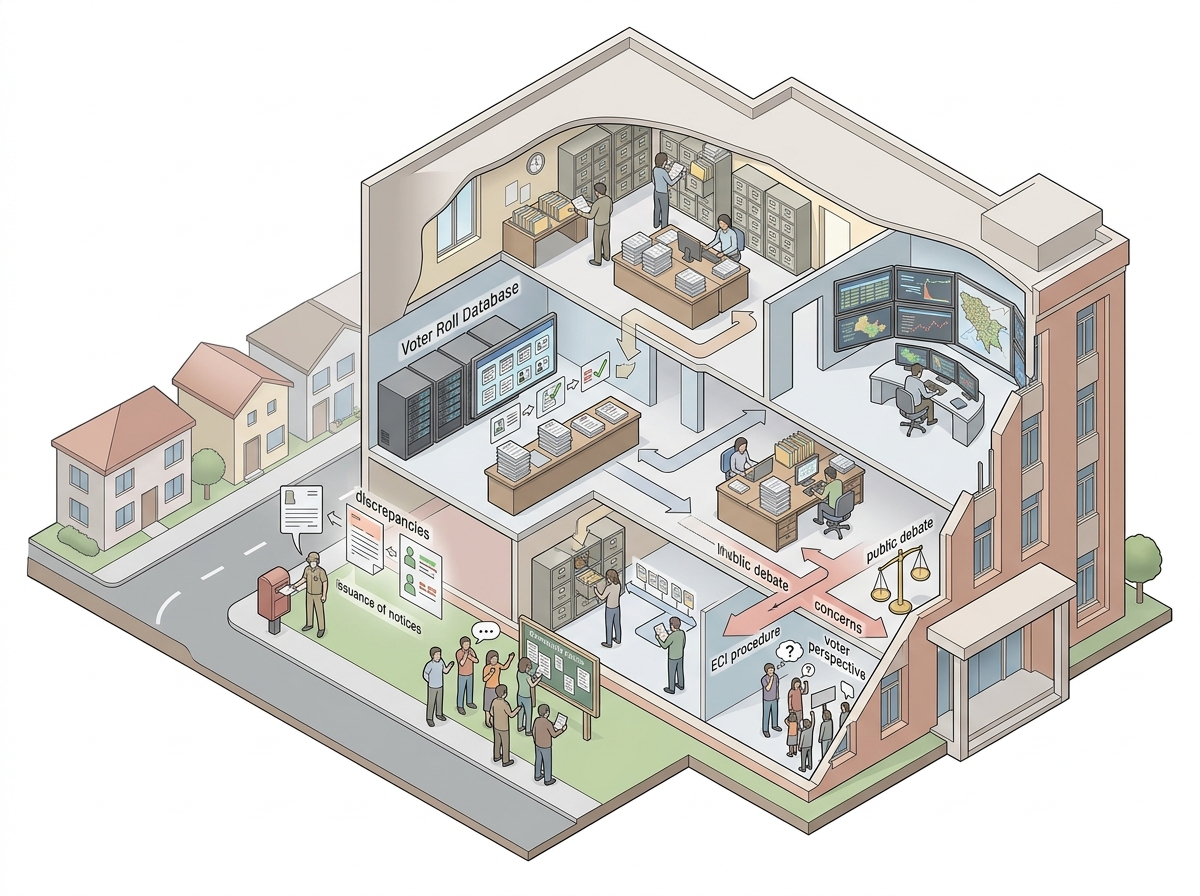
The issuance of notices to voters over discrepancies in electoral rolls during the Special Intensive Revision (SIR) exercise has sparked public debate regarding the transparency, fairness, and procedural rigour of the Election Commission of India’s (ECI) voter verification processes. Concerns have been raised about the potential disenfranchisement of eligible voters due to clerical or technical errors, such as transliteration discrepancies, and the adequacy of mechanisms to address such errors without undermining the franchise.
Background
- The Election Commission of India (ECI) conducts periodic revisions of electoral rolls to ensure accuracy, completeness, and inclusivity, with the Special Intensive Revision (SIR) being a critical exercise to update records ahead of elections.
- Discrepancies in electoral rolls may arise from data-entry errors, transliteration inconsistencies (particularly in names across languages), or outdated records, necessitating verification processes to maintain electoral integrity.
- The ECI’s Model Code of Conduct and legal provisions under the Representation of the People Act, 1950, and the Conduct of Elections Rules, 1961, govern the preparation, revision, and publication of electoral rolls, including procedures for handling objections and discrepancies.
- Voter disenfranchisement due to administrative errors is a recurring concern in electoral governance, with past instances highlighting the need for robust grievance redressal mechanisms.
- The ECI has historically emphasised the use of technology, such as the Electoral Roll Management System (ERMS), to minimise errors and streamline verification processes, though challenges persist in implementation.
- Public scrutiny of electoral roll revisions has intensified in recent years, with civil society organisations and political entities advocating for greater transparency and citizen-centric approaches in the revision process.
What is the Special Intensive Revision (SIR) of Electoral Rolls?
- The Special Intensive Revision (SIR) is a targeted exercise conducted by the Election Commission of India (ECI) to comprehensively update and verify electoral rolls, typically ahead of major elections, to ensure accuracy, completeness, and inclusivity.
- The SIR process involves door-to-door verification, scrutiny of existing records, and the resolution of discrepancies such as incorrect names, addresses, ages, or missing details, with the aim of publishing a corrected draft electoral roll.
- Under the Representation of the People Act, 1950, and the Conduct of Elections Rules, 1961, the ECI is empowered to issue notices to voters for verification of discrepancies, though such notices must adhere to principles of natural justice, including fair opportunity for representation and redressal.
- Discrepancies in electoral rolls may stem from clerical errors, data-entry mistakes, transliteration inconsistencies (e.g., in names across scripts), or outdated records, necessitating a systematic verification process to rectify errors without disenfranchising eligible voters.
- The ECI’s guidelines mandate that notices for discrepancies must be issued with clear reasons, and voters must be provided with an opportunity to submit documentary evidence to resolve the issue, including through in-person hearings where necessary.
- Transparency in the SIR process is critical, with the ECI required to publish draft electoral rolls for public scrutiny, invite objections, and address grievances through designated mechanisms, such as Electoral Registration Officers (EROs) and Appellate Authorities.
- The use of technology, such as the Electoral Roll Management System (ERMS) and Aadhaar-based verification, is intended to reduce errors and streamline the revision process, though implementation challenges may persist in certain regions.
- The ECI’s approach to discrepancies must balance administrative efficiency with the protection of the franchise, ensuring that eligible voters are not inadvertently excluded due to technical or procedural lapses.
UPSC Value Addition
Keywords for Mains Answer-Writing
Electoral Rolls · Special Intensive Revision (SIR) · Right to Vote · Electoral Discrepancies · Election Commission of India · Transliteration Errors · Data Entry Errors · Voter Deletion · Door-to-Door Verification · Electoral Justice · Constitutional Provisions for Elections · Representation of the People Act, 1950 · Electoral Transparency · Voter Disenfranchisement · Electoral Reforms
Prelims Practice Questions
Q1. Consider the following statements regarding the Special Intensive Revision (SIR) of electoral rolls in India:
1. The SIR is conducted annually to update electoral rolls.
2. The Election Commission of India (ECI) is empowered to issue notices to voters for discrepancies under the Representation of the People Act, 1950.
3. The ECI can delete names from electoral rolls solely on the basis of clerical errors without providing an opportunity of being heard.
How many of the above statements are correct?
- Only one
- Only two
- All three
- None
Answer: Only two — Statement 1 is incorrect; the SIR is not conducted annually but periodically as per the ECI’s discretion. Statement 2 is correct; the ECI can issue notices under Section 22 of the Representation of the People Act, 1950. Statement 3 is incorrect; the ECI must provide an opportunity of being heard before deleting names, as per constitutional principles of natural justice.
Q2. Assertion (A): The Election Commission of India (ECI) is a constitutional body mandated to ensure free and fair elections.
Reason (R): The ECI derives its powers from Article 324 of the Constitution of India.
Options:
A. Both A and R are true, and R is the correct explanation of A.
B. Both A and R are true, but R is not the correct explanation of A.
C. A is true, but R is false.
D. A is false, but R is true.
Answer: ? — Assertion (A) is true; the ECI is a constitutional body under Article 324. Reason (R) is also true and directly explains the assertion, as Article 324 vests the ECI with superintendence, direction, and control of elections.
Q3. Match the following pairs related to electoral reforms in India:
Column I (Provision/Committee)
1. Representation of the People Act, 1950
2. Article 326 of the Constitution
3. Dinesh Goswami Committee
4. Voter Verifiable Paper Audit Trail (VVPAT)
Column II (Purpose/Feature)
A. Ensures universal adult suffrage
B. Regulates the preparation and revision of electoral rolls
C. Recommended electoral reforms including the use of VVPAT
D. Provides for electronic voting machines with paper trail
Select the correct match:
- 1-B, 2-A, 3-C, 4-D
- 1-A, 2-B, 3-D, 4-C
- 1-C, 2-D, 3-A, 4-B
- 1-D, 2-C, 3-B, 4-A
Answer: 1-B, 2-A, 3-C, 4-D — 1-B: The Representation of the People Act, 1950 regulates electoral rolls. 2-A: Article 326 guarantees universal adult suffrage. 3-C: The Dinesh Goswami Committee recommended electoral reforms, including VVPAT. 4-D: VVPAT is a feature of electronic voting machines.
Mains Practice Question
✍ The Special Intensive Revision (SIR) of electoral rolls, while aimed at ensuring accuracy, has led to concerns of voter disenfranchisement due to technical discrepancies. Critically examine the constitutional and legal framework governing the preparation and revision of electoral rolls in India. Also, analyse the implications of such discrepancies on the fundamental right to vote guaranteed under the Constitution. (15 Marks)
Approach: MODEL-ANSWER SKELETON:
1. Constitutional Framework:
– Article 324: Superintendence, direction, and control of elections vested in the Election Commission of India (ECI).
– Article 326: Universal adult suffrage as a constitutional guarantee.
– Article 19(1)(a): Freedom of expression, which includes the right to vote as a form of political expression.
2. Legal Framework:
– Representation of the People Act, 1950: Governs the preparation and revision of electoral rolls (Sections 21, 22, 23).
– Representation of the People Act, 1951: Provides for electoral disputes and appeals.
– Conduct of Elections Rules, 1961: Procedural details for revision of electoral rolls.
3. Principles of Natural Justice:
– Opportunity of being heard (Audi alteram partem) before deletion of names.
– Proportionality: Measures to address discrepancies must not disproportionately disenfranchise voters.
4. Contemporary Issues:
– Transliteration and data-entry errors as highlighted in the news.
– Role of technology (EVMs, VVPAT) in ensuring accuracy.
– Need for door-to-door verification and use of current documents.
5. Judicial Precedents:
– Reference to Supreme Court judgments on electoral rolls (e.g., *Krishna Kumar v. Union of India*, 2017).
6. Balancing Act:
– Accuracy vs. inclusivity: Ensuring no eligible voter is disenfranchised.
– ECI’s discretion vs. statutory safeguards.
7. Suggested Reforms:
– Use of Aadhaar for de-duplication.
– Simplified grievance redressal mechanisms.
– Periodic audits of electoral roll preparation processes.
Source: The Hindu
Generated by AanyaAi for educational purpose.

- मद्रास उच्च न्यायालय में ‘वेट्ट्री पयणम’ योजना को असंवैधानिक घोषित करने की मांग - October 4, 2026
- Gurugram’s groundwater extraction exceeds limit by 212%; HC seeks ban - October 4, 2026
- स्वतंत्रता सेनानी श्यामजी कृष्ण वर्मा की जन्म जयंती पर पीएम का श्रद्धांजलि - October 4, 2026

No Comments