


20 Aug BHU’s 6 ICMR Grants Boost Biomedical Research & UPSC Polity Prep
✎ The NIRF-Specialised Grant Initiative of the Indian Council of Medical Research (ICMR) exemplifies India’s strategy to institutionalise high-impact biomedical research through competitive funding, translational focus, and…
Subject Relevance — Where This Topic Fits
- GS Paper II — Governance, Administration and Challenges (Public Health Systems) | GS Paper III — Science and Technology (Health Research and Innovation)
- Prelims: ICMR, BHU, NIRF, antimicrobial resistance (AMR), precision oncology, multi-omics, cohort studies, clinical trials
- Essay: The Role of Academic Institutions in Advancing Public Health: A Case Study of BHU’s Biomedical Research Initiatives, Science, Ethics, and Society: Balancing Innovation with Equitable Healthcare Delivery
Quick Revision: The NIRF-Specialised Grant Initiative of the Indian Council of Medical Research (ICMR) exemplifies India’s strategy to institutionalise high-impact biomedical research through competitive funding, translational focus, and interdisciplinary collaboration, positioning public universities like BHU as key drivers of indigenous healthcare innovation.
Why is this in the news?
The Banaras Hindu University (BHU) has secured six high-impact biomedical research grants under the Indian Council of Medical Research’s (ICMR) NIRF-specialised initiative, totalling approximately ₹15 crore. These grants, aimed at addressing critical national health priorities such as early cancer detection, antimicrobial resistance, and precision medicine, underscore BHU’s growing role in indigenous healthcare innovation and its alignment with national research priorities. The development highlights the institutionalisation of research excellence in public universities and its potential to bridge gaps in healthcare delivery through evidence-based interventions.
Background
- The Indian Council of Medical Research (ICMR) is the apex body in India for the formulation, coordination, and promotion of biomedical research, established under the Ministry of Health and Family Welfare.
- Public universities in India, such as BHU, serve as critical hubs for interdisciplinary research, integrating medical sciences with engineering, biotechnology, and data analytics to address complex health challenges.
- Biomedical research in India has gained momentum in recent years, driven by the need to reduce dependence on imported medical technologies and address the burden of diseases such as cancer, antimicrobial resistance, and neglected tropical diseases.
- The Government of India’s emphasis on ‘Atmanirbhar Bharat’ in healthcare has further incentivised institutions to develop indigenous solutions, fostering a culture of innovation and translational research.
- BHU, as a premier central university, has historically contributed to medical education and research, with its Institute of Medical Sciences (IMS) being a key centre for clinical and translational research in North India.
What is the NIRF-Specialised Grant Initiative of the Indian Council of Medical Research (ICMR)?
- Funding under this initiative is typically directed towards large-scale cohort studies, precision clinical trials, multi-omics biomarker discovery, and advanced laboratory analyses, with a focus on addressing national health priorities.
- The grants are awarded through a rigorous peer-review process, ensuring that only projects with strong scientific merit, feasibility, and potential for real-world application receive funding.
- The initiative aims to strengthen India’s research ecosystem by fostering collaboration between medical institutions, engineering departments, and other interdisciplinary fields to develop holistic solutions to health challenges.
- Projects supported under this initiative often involve multi-institutional partnerships, leveraging the expertise of clinicians, researchers, and data scientists to accelerate the translation of scientific discoveries into clinical practice.
- The funding also supports the development of state-of-the-art laboratory infrastructure and human resource capacity, thereby enhancing the research capabilities of recipient institutions.
- The ICMR’s focus on indigenous innovation under this initiative aligns with national policies such as the National Health Policy 2017 and the Ayushman Bharat Mission, which emphasise self-reliance in healthcare.
Key Features
| Feature | Significance |
|---|---|
| ICMR NIRF Specialised Grant Initiative | A targeted funding mechanism by ICMR to accelerate high-impact biomedical research in Indian institutions, aligning with national health priorities and fostering indigenous innovation. |
| Multi-disciplinary Collaboration | Projects span Institutes of Medical Sciences, Science, and engineering departments, demonstrating integrated research approaches across biological, clinical, and technological domains. |
| Precision Clinical Trials & Cohort Studies | Facilitates evidence-based medical research with statistically robust sample sizes, enabling translational outcomes from bench to bedside. |
| Multi-omics Biomarker Discovery | Leverages genomics, proteomics, metabolomics, and other omics technologies to identify novel biomarkers for early disease detection and targeted therapies. |
| State-of-the-Art Laboratory Infrastructure | Modernises research facilities, ensuring adherence to international standards and enhancing the university’s capacity for cutting-edge biomedical investigations. |
Why it Matters
Scientific and Academic Excellence
- Elevates BHU’s standing as a premier research institution in biomedical sciences, contributing to India’s goal of becoming a global hub for medical innovation.
- Strengthens indigenous research capabilities, reducing dependence on foreign collaborations for critical healthcare solutions.
- Enhances faculty research output and student training, aligning with the National Education Policy 2020’s emphasis on research-driven higher education.
Public Health Impact
- Addresses high-burden diseases such as gallbladder cancer, antimicrobial resistance (AMR), and pediatric septic shock, aligning with the National Health Mission’s priorities.
- Supports early detection and precision oncology, improving patient outcomes and reducing healthcare costs through targeted interventions.
- Contributes to the National Action Plan on Antimicrobial Resistance (NAP-AMR) by developing diagnostics and therapies for resistant pathogens.
Institutional Capacity Building
- Augments BHU’s research ecosystem with advanced infrastructure, enabling participation in global clinical trials and multi-centre studies.
- Fosters a culture of extramural funding acquisition, enhancing financial sustainability and institutional autonomy in research.
- Promotes interdisciplinary synergy, bridging gaps between medical sciences, basic sciences, and engineering for holistic solutions.
National Strategic Goals
- Supports India’s vision of ‘Atmanirbhar Bharat’ in healthcare by reducing reliance on imported diagnostics and therapeutics.
- Aligns with the National Research Foundation (NRF) framework, promoting high-quality, high-impact research in priority sectors.
- Contributes to the Sustainable Development Goals (SDGs), particularly SDG 3 (Good Health and Well-being) and SDG 9 (Industry, Innovation, and Infrastructure).
Challenges
1. Sustainability of Research Funding
- Dependence on competitive grants creates uncertainty in long-term project continuity, risking attrition of skilled researchers.
- Limited institutional mechanisms to absorb sudden influxes of extramural funds, necessitating robust financial governance frameworks.
UPSC Link: GS2: Government policies and interventions for development in various sectors
2. Interdisciplinary Collaboration Gaps
- Structural silos between medical, science, and engineering departments may hinder seamless integration of expertise.
- Lack of standardised protocols for cross-disciplinary research, leading to inefficiencies in project execution.
UPSC Link: GS3: Science and Technology – Developments and their applications
3. Ethical and Regulatory Compliance
- Ensuring adherence to ethical guidelines (e.g., ICMR’s Ethical Guidelines for Biomedical Research) in cohort studies and clinical trials, particularly for vulnerable populations.
- Navigating complex regulatory pathways for multi-centre trials, including approvals from institutional ethics committees and national bodies.
UPSC Link: GS2: Issues relating to development and management of Social Sector/Services relating to Health
4. Translation of Research to Public Health
- Bridging the ‘valley of death’ between laboratory findings and real-world implementation, including regulatory approvals and commercialisation.
- Limited industry-academia partnerships to scale up innovations, despite the presence of state-of-the-art infrastructure.
UPSC Link: GS3: Science and Technology – Developments and their applications
5. Human Resource Development
- Shortage of trained personnel in advanced omics technologies, precision medicine, and clinical trial management.
- High turnover of postgraduate and doctoral students due to better opportunities in industry or abroad, affecting project continuity.
UPSC Link: GS2: Issues relating to development and management of Social Sector/Services relating to Health
Challenges — UPSC Perspective
| Issue | Concern |
|---|---|
| Funding Volatility | Unpredictable grant cycles may disrupt long-term research plans and discourage early-career researchers. |
| Departmental Silos | Lack of integrated governance structures to facilitate cross-departmental collaboration on complex projects. |
| Ethical Approvals | Delays in obtaining ethical clearances for multi-centre studies, impacting project timelines and data integrity. |
| Technology Transfer | Inadequate mechanisms to transition research outcomes into market-ready products or healthcare policies. |
| Capacity Building | Insufficient training programmes to develop expertise in emerging fields like multi-omics and precision oncology. |
| Data Management | Challenges in standardising data collection, storage, and sharing across institutions and stakeholders. |
Government Initiatives — Must-Memorise for Prelims
- National Health Mission (NHM)
- National Action Plan on Antimicrobial Resistance (NAP-AMR)
- National Research Foundation (NRF) framework
Way Forward
- Establish a dedicated Office of Research Administration at BHU to streamline grant management, compliance, and financial auditing.
- Develop interdisciplinary research clusters with clear governance structures to break departmental silos and foster collaboration.
- Strengthen ethical review boards with trained personnel and digital platforms for expedited approvals of clinical trials.
- Create industry-academia liaison cells to facilitate technology transfer, patenting, and commercialisation of research outcomes.
- Launch targeted capacity-building programmes in advanced biomedical technologies (e.g., multi-omics, AI-driven diagnostics) for faculty and students.
- Institutionalise mentorship programmes pairing senior researchers with early-career scientists to ensure project continuity.
- Collaborate with national bodies (e.g., ICMR, DBT) to align BHU’s research agenda with national health priorities and funding opportunities.
- Develop a data-sharing policy compliant with global standards (e.g., FAIR principles) to enhance inter-institutional research collaboration.
UPSC Value Addition
Keywords for Mains Answer-Writing
ICMR-NIRF biomedical research grants · Banaras Hindu University (BHU) research ecosystem · multi-omics biomarker discovery · precision clinical trials in India · Indian Council of Medical Research (ICMR) schemes · high-impact biomedical innovation · cohesive research-education-healthcare nexus · indigenous healthcare research capacity · state-of-the-art laboratory infrastructure · ICMR extramural funding mechanisms
Constitutional & Policy Linkages
- Article 21: Right to Health (interpreted to include access to scientific research and healthcare advancements)
- Article 51A(h): Fundamental Duty to develop scientific temper and spirit of inquiry
Concept Flow
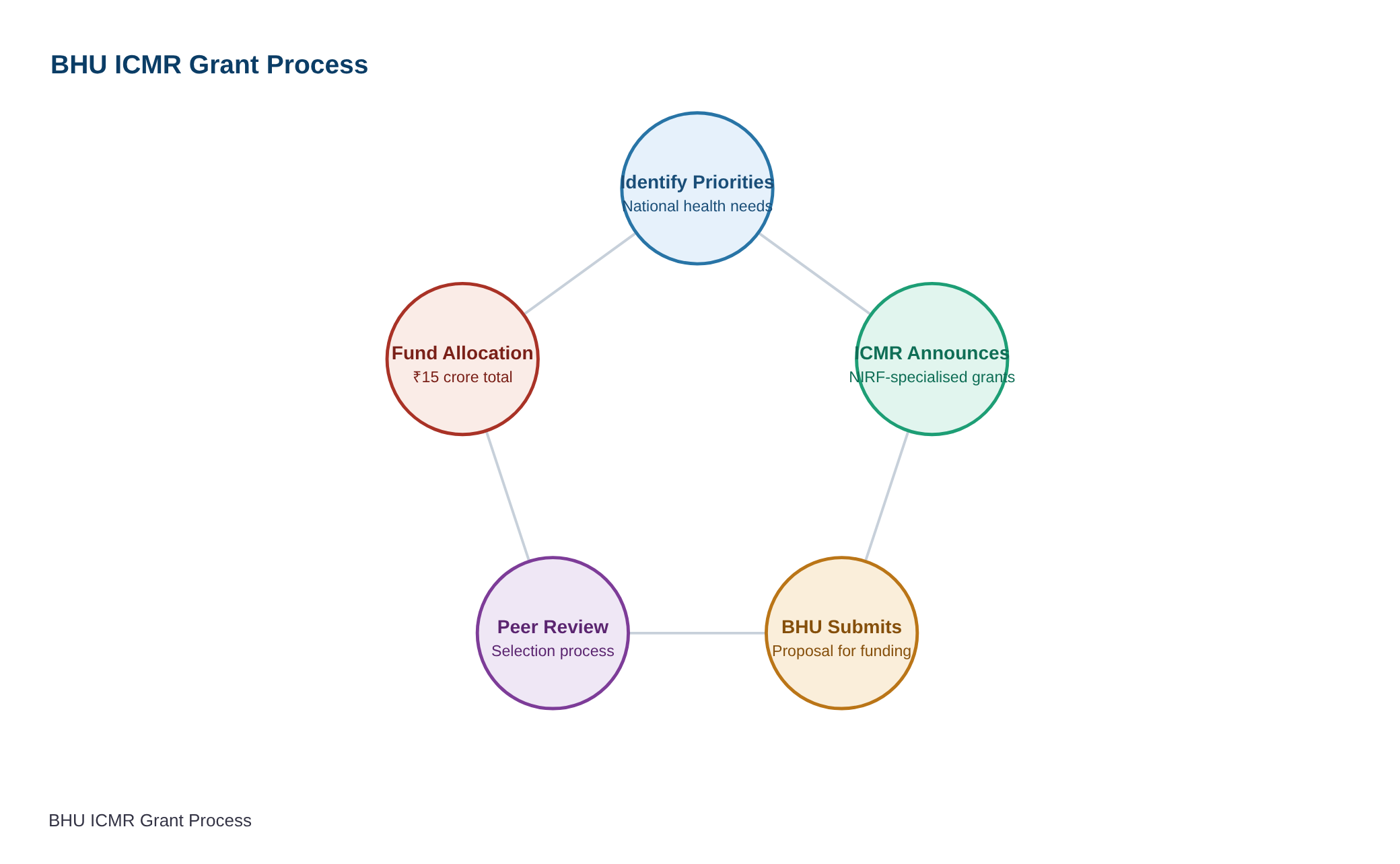
Identification of National Health Priorities → ICMR NIRF Grant Announcement → BHU’s Proposal Submission → Peer Review and Selection → Funding Disbursement → Project Implementation (Cohort Studies, Trials, Omics Research) → Data Analysis and Validation → Translation to Clinical Protocols or Policies → Dissemination and Impact Assessment
Prelims Practice Questions
Q1. Consider the following statements regarding the ICMR-NIRF specialised grant initiative:
1. The grants are exclusively allocated for clinical trials in private hospitals.
2. The initiative aims to promote indigenous healthcare research and innovation.
3. The grants facilitate multi-omics biomarker discovery and precision clinical trials.
4. The ICMR-NIRF scheme is administered by the Department of Science and Technology (DST).
How many of the above statements are correct?
- Only one
- Only two
- Only three
- All
Answer: Only three — Statements 2 and 3 are correct as the ICMR-NIRF scheme promotes indigenous healthcare research and supports multi-omics biomarker discovery and precision clinical trials. Statements 1 and 4 are incorrect: grants are not exclusive to private hospitals, and the scheme is administered by ICMR, not DST.
Q2. Assertion (A): The ICMR-NIRF specialised grant initiative primarily funds projects addressing antimicrobial resistance (AMR).
Reason (R): The initiative prioritises research that aligns with national health priorities, including AMR, as part of its broader mandate to enhance indigenous healthcare research capacity.
Options:
A. Both A and R are true, and R is the correct explanation of A.
B. Both A and R are true, but R is NOT the correct explanation of A.
C. A is true, but R is false.
D. A is false, but R is true.
- A
- B
- C
- D
Answer: B — Both Assertion (A) and Reason (R) are true. The ICMR-NIRF scheme indeed prioritises research on antimicrobial resistance (AMR) as a critical national health priority. Furthermore, Reason (R) correctly explains why AMR is a focus area under the initiative, as it aligns with the scheme’s broader mandate to enhance indigenous healthcare research capacity.
Q3. Match the following research focus areas with their corresponding ICMR-NIRF grant projects at BHU:
Column I (Research Focus Area)
1. Early detection of gallbladder cancer
2. Post-kala-azar dermal leishmaniasis diagnostics
3. Precision oncology for renal cell carcinoma
4. Antimicrobial resistance solutions
Column II (Project Description)
A. Development of novel biomarkers for early-stage detection
B. Next-generation diagnostic tools for neglected tropical diseases
C. Advanced genomic and proteomic analyses for targeted cancer therapy
D. Innovative strategies to combat drug-resistant pathogens
Options:
1-A, 2-B, 3-C, 4-D
1-B, 2-A, 3-D, 4-C
1-A, 2-D, 3-C, 4-B
1-D, 2-B, 3-A, 4-C
- 1-A, 2-B, 3-C, 4-D
- 1-B, 2-A, 3-D, 4-C
- 1-A, 2-D, 3-C, 4-B
- 1-D, 2-B, 3-A, 4-C
Answer: 1-A, 2-B, 3-C, 4-D — The correct matching is: 1-A (Early detection of gallbladder cancer aligns with novel biomarkers for early-stage detection), 2-B (Post-kala-azar dermal leishmaniasis diagnostics aligns with diagnostic tools for neglected tropical diseases), 3-C (Precision oncology for renal cell carcinoma aligns with genomic and proteomic analyses for targeted cancer therapy), and 4-D (Antimicrobial resistance solutions align with strategies to combat drug-resistant pathogens).
Mains Practice Question
✍ The integration of research, education, and healthcare delivery systems is essential for advancing indigenous biomedical innovation in India. Critically examine the role of centrally sponsored research grants, such as the ICMR-NIRF specialised initiative, in fostering this integration. Also, analyse the potential long-term implications for India’s healthcare ecosystem. (15 Marks)
Approach: MODEL-ANSWER SKELETON:
1. **Introduction (2 marks)**
– Define the ICMR-NIRF specialised grant initiative and its objectives.
– State the importance of integrating research, education, and healthcare delivery in India.
– Mention the recent BHU grants as a contemporary illustration of this integration.
2. **Role of Centrally Sponsored Research Grants (6 marks)**
– **Resource Mobilisation**: Explain how such grants (e.g., ICMR-NIRF) provide financial resources to institutions like BHU, enabling state-of-the-art infrastructure and high-impact research projects.
– **Capacity Building**: Discuss the enhancement of institutional capacity through faculty training, interdisciplinary collaboration (e.g., Institute of Medical Sciences, Institute of Science, and engineering departments), and skill development in multi-omics and precision medicine.
– **Alignment with National Priorities**: Highlight how grants prioritise research on critical health challenges (e.g., AMR, cancer, neglected tropical diseases), ensuring relevance to national health policies.
– **Institutional Synergy**: Emphasise the fostering of synergy between research, education, and healthcare delivery by enabling clinical trials, cohort studies, and translational research.
3. **Long-Term Implications for Healthcare Ecosystem (5 marks)**
– **Enhanced Indigenous Innovation**: Discuss how such grants contribute to reducing dependence on imported technologies and fostering self-reliance in biomedical research.
– **Improved Healthcare Outcomes**: Explain the potential for translating research findings into better diagnostic tools, treatments, and preventive strategies, thereby improving public health outcomes.
– **Strengthened Research Ecosystem**: Analyse the impact on India’s research ecosystem, including increased extramural funding, higher institutional rankings (e.g., NIRF), and global recognition.
– **Challenges and Constraints**: Briefly acknowledge challenges such as bureaucratic hurdles, delayed disbursement of funds, and the need for sustained political and administrative support.
4. **Conclusion (2 marks)**
– Summarise the critical role of centrally sponsored research grants in fostering integration.
– Reiterate the long-term benefits for India’s healthcare ecosystem and the need for continued investment and policy support.
Source: Hindustan Times
Generated by AanyaAi for educational purpose.

- सिम्बेक्स-2026: भारत-सिंगापुर नौसैनिक अभ्यास विशाखापत्तनम में शुरू, जानिए महत्वपूर्ण बिंदु - October 22, 2026
- PM-DAKSH Scheme: Key Features for UPSC & State PCS Aspirants - October 22, 2026
- जयशंकर और टस्क की बैठक: मोदी-टस्क वार्ता से पहले भारत-पोलैंड संबंधों की दिशा तय - October 22, 2026

No Comments