


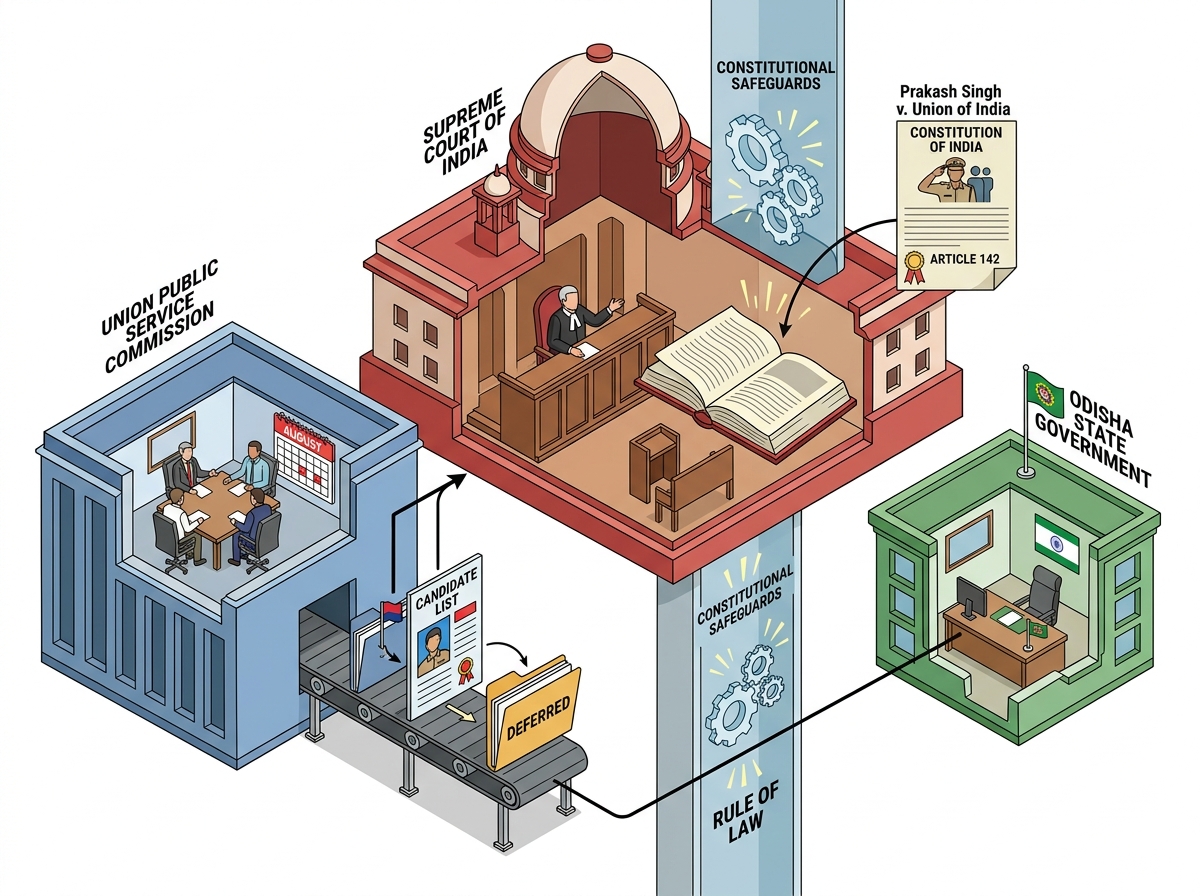
20 Aug UPSC Defers Odisha DGP Selection Process: SC Ruling on Prakash Singh Judgment
✎ The *Prakash Singh* judgment (2006) mandates that the DGP must be selected from among the three seniormost officers empanelled by the UPSC, with a fixed tenure of at least two years, to insulate the post from political…
Subject Relevance — Where This Topic Fits
- GS Paper II — Polity and Governance | GS Paper IV — Ethics, Integrity and Aptitude (Institutional Integrity)
- Prelims: Prakash Singh vs Union of India (2006), Article 142 of the Constitution, Director General of Police (DGP) selection, UPSC’s role in empanelment, Fixed tenure for DGP, Acting DGP concept, Police reforms, Supreme Court directions on police appointments
- Essay: The judiciary’s role in ensuring institutional integrity in governance, Balancing federalism and judicial oversight in police administration
Quick Revision: The *Prakash Singh* judgment (2006) mandates that the DGP must be selected from among the three seniormost officers empanelled by the UPSC, with a fixed tenure of at least two years, to insulate the post from political interference.
Why is this in the news?
The Supreme Court intervened in the selection process for the Director General of Police (DGP) in Odisha after a petition alleged violations of the landmark *Prakash Singh v. Union of India* (2006) judgment. The UPSC agreed to defer the selection meeting until August 18, 2026, citing concerns over the inclusion of a junior officer in the candidate list, allegedly promoted preemptively to influence the selection. This case underscores the judiciary’s role in upholding constitutional safeguards in police leadership appointments.
Background
- The *Prakash Singh v. Union of India* (2006) judgment is a landmark ruling by the Supreme Court that mandated structural reforms in police administration to insulate the office of the DGP from political interference.
- The judgment invoked Article 142 of the Constitution to direct that DGPs must be appointed from among the three seniormost and meritorious officers empanelled by the UPSC, ensuring meritocracy and transparency.
- The court abolished the concept of ‘acting DGPs’ and mandated a fixed tenure of at least two years for the DGP to ensure operational independence and continuity.
- Subsequent Supreme Court orders in July 2018 and March 2019 further detailed the appointment mechanism, requiring State governments to submit proposals to the UPSC three months before the incumbent DGP’s retirement.
- The UPSC is tasked with preparing a panel of suitable officers, and the State government is obligated to appoint one of the empanelled officers ‘immediately’ to uphold the principles of the judgment.
- The current controversy in Odisha arises from allegations that the State government attempted to include a junior officer in the candidate list by granting a promotion just days before the Supreme Court hearing, potentially circumventing the established process.
What is the Prakash Singh Judgment and Its Significance?
- The *Prakash Singh* judgment (2006) was delivered in response to a PIL seeking police reforms to address systemic issues such as political interference, lack of accountability, and short tenures of police chiefs.
- The Supreme Court laid down seven directives to reform police administration, including the establishment of a State Security Commission (SSC) to ensure autonomy, a Police Establishment Board (PEB) for transfers and postings, and a Police Complaints Authority (PCA) to investigate public grievances.
- The judgment explicitly barred the appointment of DGPs through ad-hoc or acting arrangements, mandating a transparent and merit-based selection process through the UPSC.
- The court held that the DGP’s tenure should be fixed (minimum two years) to prevent arbitrary removals and ensure stability in leadership, subject to satisfactory performance and disciplinary proceedings.
- The UPSC’s role was reinforced as a neutral, constitutional body tasked with empanelling officers based on merit, ensuring that political considerations do not influence appointments.
- The judgment is rooted in the constitutional framework of federalism, balancing the State’s administrative autonomy with the judiciary’s role in ensuring constitutional governance and institutional integrity.
Key Features
| Feature | Significance |
|---|---|
| Deferment of UPSC meeting on Odisha DGP selection | Ensures judicial oversight in adherence to Prakash Singh guidelines, preventing premature appointments that may violate constitutional principles. |
| Supreme Court’s invocation of Article 142 | Demonstrates the apex court’s authority to enforce structural reforms in police governance, transcending routine executive functions. |
| Prakash Singh judgment (2006) framework | Establishes a transparent, merit-based, and politically insulated process for DGP appointments, safeguarding institutional autonomy. |
| Role of amicus curiae (Raju Ramachandran) | Assists the court in interpreting the Prakash Singh directives, ensuring alignment with judicial precedents and constitutional mandates. |
| Fixed tenure for DGP (minimum two years) | Mitigates arbitrary transfers, fosters continuity in policing, and reduces susceptibility to political interference. |
Why it Matters
Constitutional Governance
- Reinforces the separation of powers by ensuring judicial scrutiny over executive appointments in sensitive institutions like the police.
- Upholds the doctrine of judicial review under Article 142 to enforce structural reforms in governance.
- Preserves the independence of the police force from external pressures, as mandated by the Prakash Singh judgment.
Institutional Integrity
- Prevents circumvention of established appointment protocols, thereby maintaining public trust in the selection process.
- Ensures that promotions and appointments are merit-driven and not influenced by short-term political considerations.
- Promotes adherence to the principle of seniority within the police hierarchy, as per judicial directives.
Judicial Precedent
- Demonstrates the Supreme Court’s proactive role in enforcing its own judgments to uphold constitutional values.
- Highlights the dynamic interpretation of constitutional provisions to address evolving governance challenges.
- Sets a precedent for future cases involving executive overreach in institutional appointments.
Challenges
1. Political Interference in Institutional Appointments
- Risk of short-term political gains overriding long-term institutional stability in police leadership.
- Potential manipulation of promotion timelines to include favoured candidates in selection panels.
- Erosion of public confidence in the impartiality of police appointments if judicial safeguards are bypassed.
UPSC Link: GS-II: Role of Civil Services in Democracy
2. Adherence to Judicial Directives
- Challenges in ensuring state governments comply with Supreme Court orders on DGP appointments.
- Need for continuous judicial monitoring to prevent circumvention of established protocols.
- Balancing executive autonomy with judicial oversight to maintain constitutional balance.
UPSC Link: GS-II: Judiciary and Executive Relations
3. Meritocracy vs. Seniority Debate
- Tension between strict seniority-based promotions and the need for meritocratic selection in high-stakes roles.
- Risk of stagnation if promotions are solely based on tenure rather than performance.
- Ensuring that the selection process remains transparent and free from bias.
UPSC Link: GS-II: Civil Services Ethics
4. Operational Delays in Appointments
- Potential vacuum in leadership if judicial interventions delay critical appointments.
- Impact on police morale and operational efficiency during prolonged selection processes.
- Need for a streamlined yet rigorous appointment mechanism to avoid governance gaps.
UPSC Link: GS-III: Internal Security
5. Public Perception and Trust
- Erosion of trust in the police force if appointments are perceived as politically motivated.
- Media scrutiny and public discourse influencing judicial and executive decisions.
- Need for transparent communication to maintain credibility in institutional processes.
UPSC Link: GS-II: Role of Media and Transparency
Challenges — UPSC Perspective
| Issue | Concern |
|---|---|
| Political interference in DGP appointments | Undermines institutional autonomy and erodes public trust in police governance. |
| Circumvention of Prakash Singh directives | Raises questions about the enforceability of judicial orders in state governance. |
| Promotion of junior officers preemptively | Indicates potential manipulation of selection criteria to favour specific candidates. |
| Judicial delays in appointments | May lead to leadership vacuums, affecting police operations and morale. |
| Lack of fixed tenure compliance | Increases susceptibility to arbitrary transfers, destabilising police leadership. |
Way Forward
- Strengthen institutional mechanisms to ensure strict adherence to the Prakash Singh judgment in DGP appointments.
- Conduct periodic reviews of state compliance with Supreme Court directives on police governance.
- Enhance transparency in the promotion and selection process by publishing criteria and timelines.
- Promote capacity-building initiatives for police officers to ensure meritocratic advancement.
- Establish an independent oversight body to monitor compliance with judicial orders in institutional appointments.
- Encourage states to adopt fixed tenure policies for police chiefs to prevent arbitrary transfers.
- Foster judicial-executive dialogue to streamline appointment processes without compromising constitutional principles.
- Raise awareness among civil society and media about the importance of institutional autonomy in governance.
UPSC Value Addition
Keywords for Mains Answer-Writing
Prakash Singh judgment · Director General of Police (DGP) appointment · Supreme Court guidelines on police reforms · Article 142 of the Constitution · Union Public Service Commission (UPSC) role in DGP selection · State police autonomy vs central oversight · Fixed tenure for DGP · Empanelment of senior officers · Political interference in police appointments · Constitutional provisions governing police leadership
Constitutional & Policy Linkages
- [‘Article 142: Enforcement of Supreme Court orders’]
Concept Flow
State government initiates DGP selection process → Allegations of violation of Prakash Singh guidelines → Petition filed in Supreme Court → Court invokes Article 142 → UPSC defers meeting → Judicial scrutiny of appointment process → Enforcement of fixed tenure and merit-based selection → Institutional autonomy preserved.
Prelims Practice Questions
Q1. Consider the following statements regarding the Prakash Singh judgment on police reforms:
1. The Supreme Court directed that the DGP should be selected from among the three seniormost officers empanelled by the UPSC.
2. The judgment mandated a fixed tenure of two years for the DGP.
3. The court explicitly rejected the concept of acting DGPs.
4. The State government can independently appoint any officer as DGP without consulting the UPSC.
How many of the above statements are correct?
- Only one
- Only two
- Only three
- All four
Answer: Only three — Statements 1, 2, and 3 are correct as per the Prakash Singh judgment. Statement 4 is incorrect because the State government must appoint one of the officers empanelled by the UPSC.
Q2. Assertion (A): The Union Public Service Commission (UPSC) is constitutionally mandated to empanel officers for the post of Director General of Police (DGP).
Reason (R): The Supreme Court’s Prakash Singh judgment (2006) directed that the DGP should be selected from among the three seniormost officers empanelled by the UPSC.
Options:
A. Both A and R are true, and R is the correct explanation of A.
B. Both A and R are true, but R is NOT the correct explanation of A.
C. A is true, but R is false.
D. A is false, but R is true.
Answer: ? — Both A and R are true, and R correctly explains A as the UPSC’s role in empanelling officers is a direct consequence of the Supreme Court’s directive in the Prakash Singh case.
Q3. Match the following provisions with their respective constitutional or legal sources:
Column I (Provision)
A. Fixed tenure of two years for DGP
B. Selection of DGP from empanelled officers
C. Empanelment of officers by UPSC
D. Prohibition of acting DGPs
Column II (Source)
1. Prakash Singh judgment (2006)
2. Article 142 of the Constitution
3. Supreme Court orders (2018, 2019)
4. State Police Acts
Answer: ? — A (Fixed tenure) and D (Prohibition of acting DGPs) are from the Prakash Singh judgment (2006). B (Selection from empanelled officers) is from Supreme Court orders (2018, 2019). C (Empanelment by UPSC) is a consequence of the Supreme Court’s invocation of Article 142.
Mains Practice Question
✍ The Supreme Court’s directives in the Prakash Singh judgment (2006) and subsequent orders aim to insulate the office of the Director General of Police (DGP) from political interference. Critically examine the constitutional and institutional mechanisms prescribed to achieve this objective. Also, analyse the challenges in their implementation in the context of recent controversies surrounding DGP appointments. (15 Marks)
Approach: MODEL-ANSWER SKELETON:
1. **Constitutional and Judicial Framework**:
– Art. 142 (Supreme Court’s extraordinary powers) and the Prakash Singh judgment (2006) as the foundational directive.
– Subsequent Supreme Court orders (July 2018, March 2019) detailing the DGP appointment process: State proposal 3 months before incumbent’s retirement, UPSC empanelment of three seniormost officers, and immediate appointment of one from the panel.
– Fixed tenure of two years and prohibition of acting DGPs.
2. **Institutional Mechanisms**:
– Role of UPSC in empanelling officers: Ensures meritocracy and reduces executive discretion.
– State government’s role: Limited to selecting one from the UPSC panel, ensuring compliance with judicial directives.
– Judicial oversight: Supreme Court’s power under Art. 142 to enforce its directives.
3. **Challenges in Implementation**:
– **Political Interference**: Recent controversies (e.g., Odisha DGP case) highlight attempts to include junior officers or manipulate timelines to bypass UPSC empanelment.
– **Operational Delays**: Non-compliance with the 3-month advance proposal requirement.
– **Fixed Tenure vs. Accountability**: Balancing fixed tenure with mechanisms for removal in cases of misconduct or incompetence.
– **State Autonomy vs. Judicial Primacy**: Tension between State Police Acts and Supreme Court directives.
4. **Comparative Perspective**:
– Contrast with other jurisdictions (e.g., UK’s Police and Crime Commissioners) to highlight India’s judicial-led reform model.
5. **Way Forward**:
– Strengthening institutional safeguards (e.g., time-bound UPSC processes, transparency in empanelment).
– Judicial monitoring mechanisms to ensure compliance with directives.
– Capacity-building for State governments to align with judicial expectations.
Source: The Hindu
Generated by AanyaAi for educational purpose.

- उत्तराखंड सीएम धामी ने चारधाम यात्रा की ऑनलाइन समीक्षा बैठक की, जानिए तैयारी - September 15, 2026
- UPSC Alert: CM Dhami Reviews Char Dham Yatra 2026 Security & Logistics - September 15, 2026
- मेटा ने स्वीकारा: बाल यौन शोषण मामलों की रिपोर्ट पुलिस को करेगी - September 15, 2026

No Comments