


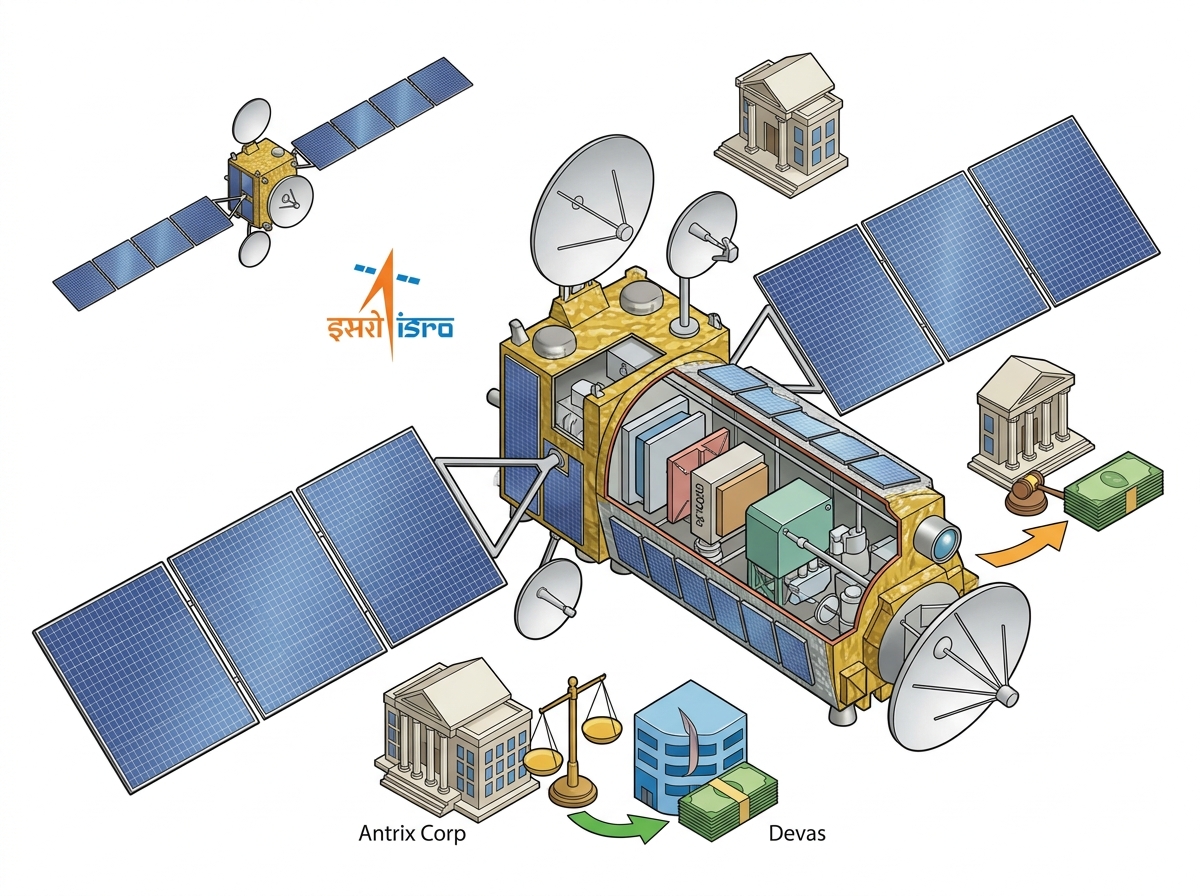
20 Aug US Court Upholds $565M Award Against ISRO’s Antrix Corp: Key Implications for UPSC Aspirants
Arbitration awardForeign courtCommercial arm✎ The Foreign Sovereign Immunities Act (FSIA) of the United States does not shield foreign sovereign entities from arbitration-related jurisdiction if the dispute falls under the arbitration exception, as clarified by the US Court…
Subject Relevance — Where This Topic Fits
- GS Paper II — International Relations: International Arbitration and Dispute Resolution | GS Paper II — International Relations: Bilateral and Multilateral Treaties | GS Paper III — Economy: Foreign Direct Investment and Commercial Arbitration
- Prelims: Foreign Sovereign Immunities Act (FSIA), 1976, New York Convention on the Recognition and Enforcement of Foreign Arbitral Awards, 1958, International Chamber of Commerce (ICC) Arbitration, Antrix Corporation Limited, Devas Multimedia Private Limited, Commercial Arbitration, Sovereign Immunity, Arbitration Immunity, Jurisdictional Challenges in Arbitration
- Essay: The Role of International Arbitration in Resolving Commercial Disputes Involving Sovereign Entities, Challenges in Enforcing Arbitration Awards Across Jurisdictions: A Case Study of Devas-Antrix
Quick Revision: The Foreign Sovereign Immunities Act (FSIA) of the United States does not shield foreign sovereign entities from arbitration-related jurisdiction if the dispute falls under the arbitration exception, as clarified by the US Court of Appeals for the Ninth Circuit in the Devas-Antrix dispute.
Why is this in the news?
The United States Court of Appeals for the Ninth Circuit, in a landmark ruling dated August 12, 2026, upheld a $565.2 million arbitration award in favour of the Indian startup Devas Multimedia against Antrix Corporation Limited, the commercial arm of the Indian Space Research Organisation (ISRO). The decision underscores the global enforceability of arbitral awards under the New York Convention and raises critical questions about the jurisdiction of foreign courts in disputes involving sovereign entities, particularly under the Foreign Sovereign Immunities Act (FSIA) of the United States.
Background
- The dispute originated from a 2005 satellite lease agreement between Antrix Corporation and Devas Multimedia, under which Antrix was to lease two communication satellites to Devas for a period of 12 years.
- The agreement included an arbitration clause providing for resolution of disputes through the International Chamber of Commerce (ICC).
- In 2011, Antrix terminated the agreement unilaterally, citing national security concerns, leading Devas to initiate arbitration proceedings under the ICC.
- An ICC tribunal awarded Devas $565.2 million in compensation in September 2015, which was later confirmed by the United States District Court for the Western District of Washington in October 2020.
- Antrix challenged the enforcement of the award in US courts, arguing that it enjoyed sovereign immunity under the Foreign Sovereign Immunities Act (FSIA) and that the dispute should have been adjudicated in India.
- The matter has seen multiple rounds of litigation in both Indian and US courts, including a 2023 ruling by the Delhi High Court, which was later challenged in the US courts.
What is the Devas-Antrix Dispute?
- The dispute arose from a 2005 commercial agreement between Antrix Corporation Limited (a Government of India-owned entity) and Devas Multimedia Private Limited, an Indian startup, for the lease of two communication satellites.
- The agreement included an arbitration clause under the rules of the International Chamber of Commerce (ICC).
- In 2011, Antrix terminated the agreement, citing national security concerns, prompting Devas to initiate arbitration proceedings under the ICC.
- The ICC tribunal, in a final award dated September 15, 2015, ruled in favour of Devas and awarded compensation of $565.2 million, later increased to over $1.2 billion with interest.
- Devas sought enforcement of the ICC award in the United States, leading to a series of legal battles in US courts regarding jurisdiction and sovereign immunity.
- The US Court of Appeals for the Ninth Circuit, in its ruling of August 12, 2026, upheld the enforceability of the ICC award in the US, dismissing Antrix’s claims of sovereign immunity under the FSIA.
- The case highlights the complexities of enforcing foreign arbitral awards against sovereign entities and the interplay between domestic laws and international treaties.
Key Features
| Feature | Significance |
|---|---|
| International Chamber of Commerce (ICC) Arbitration Award | Establishes a binding international arbitral award under the ICC rules, enforceable in multiple jurisdictions, including the US, under the New York Convention. |
| Foreign Sovereign Immunities Act (FSIA) Arbitration Exception | Removes sovereign immunity for Antrix Corp in matters governed by treaties to which the US is a party, enabling US courts to adjudicate disputes involving foreign state-owned entities. |
| Jurisdictional Override by US Courts | Demonstrates that foreign courts may assert jurisdiction over disputes involving sovereign entities when the underlying agreement permits enforcement in multiple jurisdictions. |
| Enforcement of Arbitral Awards in the US | Highlights the procedural mechanism for enforcing foreign arbitral awards in US courts, including the role of the New York Convention in facilitating cross-border recognition. |
| Legal Precedent on Alter Ego Doctrine | Clarifies the conditions under which a foreign state-owned entity may be treated as an ‘alter ego’ of the state, subjecting it to US jurisdiction under the FSIA. |
Why it Matters
Economic Implications
- The award underscores the financial liabilities faced by state-owned enterprises (SOEs) in cross-border commercial disputes, impacting budgetary allocations for public sector entities like ISRO.
- Demonstrates the enforceability of international arbitration awards against sovereign-backed entities, potentially influencing future contract negotiations and risk assessments by Indian SOEs.
- The compounding interest on the award (over $1.2 billion) highlights the long-term fiscal consequences of prolonged legal disputes for public sector corporations.
Strategic and Diplomatic Dimensions
- The ruling reaffirms the primacy of international arbitration mechanisms in resolving commercial disputes involving state entities, aligning with India’s commitments under treaties like the New York Convention.
- Potential strain on India-US bilateral relations, particularly in the context of space cooperation, where ISRO and NASA have historically collaborated.
- The case serves as a cautionary tale for India’s space diplomacy, emphasizing the need for robust legal safeguards in international commercial agreements.
Legal and Institutional Lessons
- The judgment reinforces the global enforceability of arbitral awards, setting a precedent for similar disputes involving Indian SOEs in foreign jurisdictions.
- The case highlights the importance of clear jurisdictional clauses in international contracts to preempt disputes over forum selection.
- The ruling underscores the necessity for Indian SOEs to adopt proactive legal strategies to mitigate exposure to foreign court jurisdictions.
Policy and Governance Reforms
- The dispute exposes gaps in the legal framework governing SOEs, necessitating a review of sovereign immunity protections and arbitration clauses in commercial agreements.
- The case may prompt the Indian government to strengthen domestic legal mechanisms for enforcing arbitral awards, reducing reliance on foreign courts.
- The ruling could influence India’s approach to international arbitration, particularly in sectors like space and defence where SOEs play a dominant role.
Challenges
1. Sovereign Immunity and Jurisdictional Conflicts
- The case illustrates the tension between sovereign immunity protections and the enforceability of international arbitral awards against state-owned entities.
- Antrix Corp’s argument that the dispute should have been resolved in India reflects broader concerns about forum shopping and the extraterritorial reach of foreign courts.
- The ruling may embolden foreign courts to assert jurisdiction over disputes involving Indian SOEs, leading to potential conflicts with domestic legal frameworks.
UPSC Link: Constitutional Law: Sovereign Immunity (Article 300)
2. Enforcement of Arbitral Awards Across Jurisdictions
- The dispute highlights the complexities of enforcing arbitral awards in multiple jurisdictions, particularly when domestic courts set aside awards.
- The referral back to the district court on the enforceability of the ICC award in the US, despite its annulment in India, underscores the challenges of cross-border legal consistency.
- The case may deter foreign investors from engaging with Indian SOEs due to uncertainty over the enforceability of arbitral awards.
UPSC Link: Arbitration and Conciliation Act, 1996 (Part II)
3. Financial and Fiscal Burden on SOEs
- The award and its compounding interest impose a significant financial burden on Antrix Corp, diverting resources from its core space-related activities.
- The case raises questions about the accountability of SOEs in managing commercial risks, particularly in high-stakes international ventures.
- The fiscal strain may impact ISRO’s budget allocations, potentially affecting its strategic missions and collaborations.
UPSC Link: Public Sector Undertakings: Financial Governance
4. Reputation Risks for Indian Space Sector
- The dispute tarnishes the reputation of India’s space sector, particularly ISRO, which is widely regarded for its technological prowess and cost-effective missions.
- The case may deter foreign partners from collaborating with Indian entities due to perceived legal and financial risks.
- The ruling could undermine India’s position as a preferred destination for space-related commercial ventures.
UPSC Link: India’s Space Diplomacy and International Collaborations
5. Legal and Contractual Vulnerabilities
- The dispute exposes vulnerabilities in the contractual frameworks governing international commercial agreements, particularly in sectors like space and defence.
- The lack of clarity in jurisdictional clauses in the original 2005 agreement contributed to the prolonged legal battle.
- The case underscores the need for Indian SOEs to adopt robust legal and contractual safeguards in international ventures.
UPSC Link: Commercial Law: Contractual Obligations
Challenges — UPSC Perspective
| Issue | Concern |
|---|---|
| Sovereign Immunity vs. Arbitral Enforceability | Potential erosion of sovereign immunity protections for state-owned entities in foreign jurisdictions. |
| Cross-Border Enforcement of Arbitral Awards | Uncertainty over the enforceability of awards annulled in one jurisdiction but upheld in another. |
| Financial Strain on SOEs | Long-term fiscal burden on public sector entities due to compounding interest and legal costs. |
| Reputation Risks for India’s Space Sector | Adverse impact on India’s global standing in space exploration and commercial ventures. |
| Contractual Ambiguities in International Agreements | Lack of clear jurisdictional clauses leading to prolonged legal disputes. |
| Jurisdictional Overreach by Foreign Courts | Risk of foreign courts asserting jurisdiction over disputes involving Indian SOEs. |
Way Forward
- Conduct a comprehensive review of arbitration clauses in all international commercial agreements involving Indian SOEs to ensure clarity on jurisdiction and enforceability.
- Strengthen domestic legal mechanisms for enforcing arbitral awards to reduce reliance on foreign courts and mitigate reputational risks.
- Establish a dedicated legal cell within ISRO and Antrix Corp to proactively manage commercial disputes and international arbitration cases.
- Enhance financial risk assessment and contingency planning for SOEs engaged in high-stakes international ventures.
- Promote awareness among Indian SOEs about the legal and financial implications of sovereign immunity and jurisdictional clauses in contracts.
- Collaborate with international bodies like the ICC and UNCITRAL to advocate for harmonized arbitration frameworks that protect sovereign entities.
- Develop a standardized template for international commercial agreements involving SOEs, incorporating robust legal safeguards.
- Monitor and analyze the implications of this ruling for India’s space diplomacy and international collaborations, adjusting policies as necessary.
UPSC Value Addition
Keywords for Mains Answer-Writing
International Commercial Arbitration · Foreign Sovereign Immunities Act (FSIA) 1976 · New York Convention on the Recognition and Enforcement of Foreign Arbitral Awards · International Chamber of Commerce (ICC) Arbitration · Antrix Corporation Limited · ISRO commercial arm · Devas Multimedia case · Jurisdictional immunity of foreign state entities · Enforcement of foreign arbitral awards in US courts · Comity of nations in arbitration · Sovereign immunity doctrine · Bilateral Investment Treaties (BITs) · Enforcement of arbitral awards under Indian law · Delhi High Court orders on Devas case · Supreme Court of India and arbitration law
Concept Flow
2005: Antrix Corp and Devas Multimedia enter into a satellite lease agreement for 12 years, governed by ICC arbitration. → 2015: ICC awards $565.2 million compensation to Devas Multimedia for breach of contract. → 2016-2020: Antrix Corp challenges the award in Indian courts, which annul it in 2022-2023. → 2020: Devas Multimedia seeks enforcement of the ICC award in US courts under the New York Convention. → 2023: US Supreme Court rejects Devas Multimedia’s pleas against Indian court orders annulling the award, but US courts assert jurisdiction under the FSIA arbitration exception. → 2025: US Court of Appeals for the Ninth Circuit upholds the enforceability of the ICC award in the US, despite its annulment in India. → 2026: US appeals court dismisses Antrix Corp’s jurisdictional arguments, confirming the $565.2 million award with compounding interest.
Prelims Practice Questions
Q1. Consider the following statements regarding the Foreign Sovereign Immunities Act (FSIA), 1976 of the United States:
1. FSIA grants immunity to foreign sovereign entities from the jurisdiction of US courts in all matters.
2. The arbitration exception under FSIA withdraws immunity if the dispute arises from an agreement that provides for arbitration.
3. The FSIA applies to all foreign state-owned entities, including commercial arms of foreign governments.
How many of the above statements are correct?
- Only one
- Only two
- All three
- None
Answer: All three — Statements 2 and 3 are correct. Statement 1 is incorrect because FSIA provides exceptions, including the arbitration exception, where immunity is withdrawn for certain disputes. Statement 2 correctly states the arbitration exception under FSIA. Statement 3 is correct as FSIA applies to foreign state-owned entities, including commercial arms like Antrix Corporation.
Q2. Assertion (A): The New York Convention, 1958, facilitates the recognition and enforcement of foreign arbitral awards in the courts of contracting states.
Reason (R): The convention requires that the award must be final and binding under the law of the country where it was made.
- Both A and R are true, and R is the correct explanation of A
- Both A and R are true, but R is not the correct explanation of A
- A is true, but R is false
- A is false, but R is true
Answer: Both A and R are true, but R is not the correct explanation of A — Both the assertion and reason are true. The New York Convention indeed facilitates the recognition and enforcement of foreign arbitral awards. The reason correctly explains that the award must be final and binding under the law of the country where it was made, which is a condition for enforcement under the convention.
Q3. Match the following international legal instruments with their primary purpose:
Column I
A. New York Convention, 1958
B. Foreign Sovereign Immunities Act (FSIA), 1976
C. International Chamber of Commerce (ICC) Arbitration Rules
D. Bilateral Investment Treaty (BIT)
Column II
1. Provides a framework for the recognition and enforcement of foreign arbitral awards
2. Grants immunity to foreign sovereign entities with specific exceptions
3. Establishes procedural rules for international commercial arbitration
4. Protects and promotes foreign investment between two countries
- A-1, B-2, C-3, D-4
- A-2, B-1, C-4, D-3
- A-3, B-2, C-1, D-4
- A-1, B-4, C-3, D-2
Answer: A-1, B-2, C-3, D-4 — The correct matching is: A-1 (New York Convention facilitates enforcement of foreign arbitral awards), B-2 (FSIA grants immunity to foreign sovereign entities with exceptions), C-3 (ICC Arbitration Rules establish procedural rules for international commercial arbitration), and D-4 (BITs protect and promote foreign investment between countries).
Mains Practice Question
✍ The enforcement of foreign arbitral awards against state-owned commercial entities in foreign jurisdictions poses complex challenges to the doctrine of sovereign immunity. Critically examine the legal and policy dimensions of this issue with reference to the Devas-Antrix case and the role of the Foreign Sovereign Immunities Act (FSIA), 1976. Also answer what implications this case holds for the enforcement of arbitral awards under the New York Convention in India. (15 Marks)
Approach: MODEL-ANSWER SKELETON:
1. Introduction: Briefly define sovereign immunity and its exceptions under international law, citing the FSIA (1976) and the New York Convention (1958).
2. The Devas-Antrix case: Outline the facts, the ICC arbitration award (2015), the US court’s jurisdiction, and the US appeals court’s ruling (2026). Highlight the FSIA’s arbitration exception and the court’s reasoning.
3. Legal dimensions:
a. Sovereign immunity doctrine: Absolute vs. restrictive immunity; the FSIA’s framework.
b. Arbitration exception under FSIA: Conditions and scope (treaty-based disputes, commercial activity).
c. Comity of nations: Respect for foreign judgments and the principle of reciprocity.
4. Policy dimensions:
a. Attractiveness of India as an arbitration hub: Need for clarity in the law and predictability in enforcement.
b. Impact on foreign investment: Perception of India as an arbitration-friendly jurisdiction.
c. Role of BITs: How BITs can provide additional layers of protection and enforcement mechanisms.
5. Implications for enforcement under the New York Convention in India:
a. Domestic legal framework: Sections 44-60 of the Arbitration and Conciliation Act, 1996, and the 2015 amendments.
b. Judicial approach: Landmark judgments (e.g., Bharat Aluminium Co. v. Kaiser Aluminium Technical Services Inc., 2012) and their relevance.
c. Challenges: Enforcement of foreign awards set aside by Indian courts; the principle of reciprocity.
6. Conclusion: Balanced view on the need for India to align its arbitration law with international standards while safeguarding sovereign interests. Suggest policy reforms or legislative clarity.
Source: The Indian Express
Generated by AanyaAi for educational purpose.

- मद्रास उच्च न्यायालय में ‘वेट्ट्री पयणम’ योजना को असंवैधानिक घोषित करने की मांग - October 4, 2026
- Gurugram’s groundwater extraction exceeds limit by 212%; HC seeks ban - October 4, 2026
- स्वतंत्रता सेनानी श्यामजी कृष्ण वर्मा की जन्म जयंती पर पीएम का श्रद्धांजलि - October 4, 2026

No Comments