


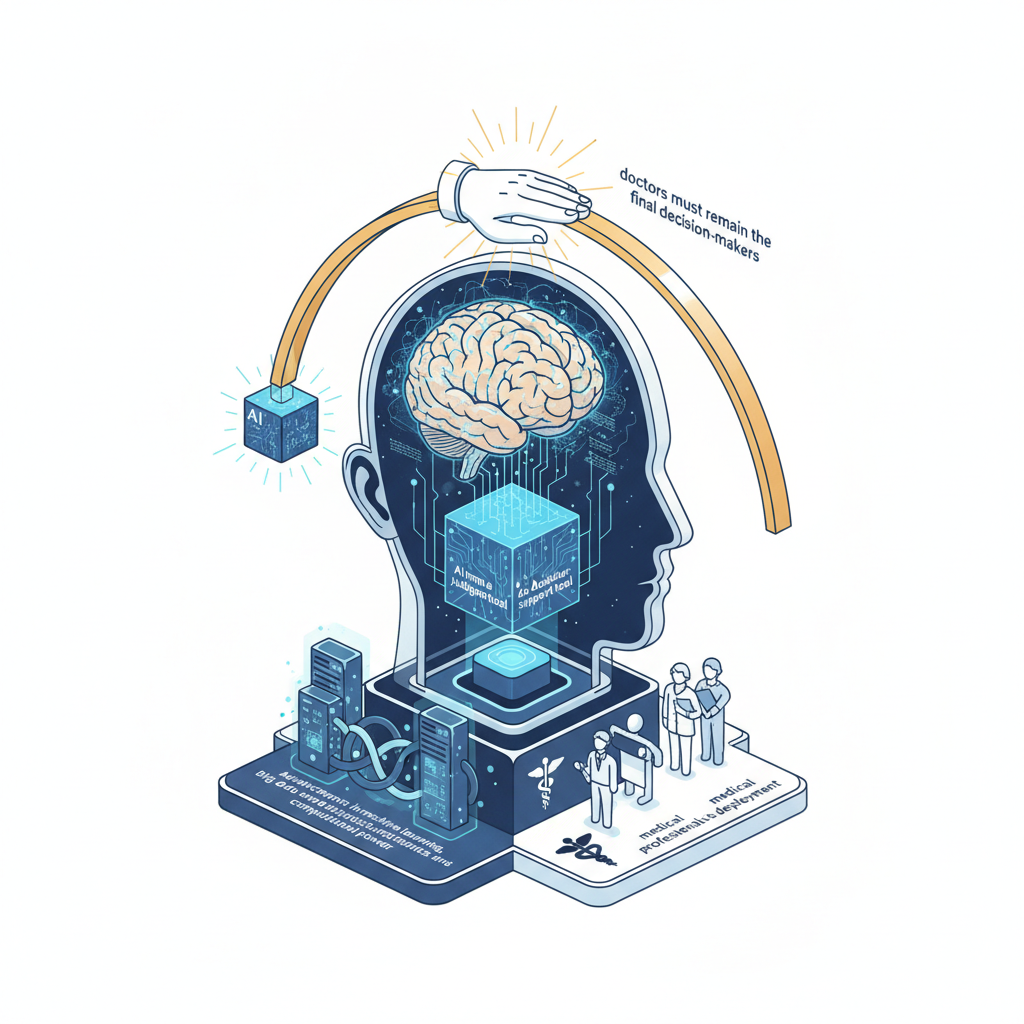
30 Aug Why AI in Healthcare Needs Doctors as Final Decision-Makers: Experts Insight
✎ AI in healthcare must function as a decision-support tool under the ultimate oversight of qualified medical professionals, ensuring patient safety, ethical compliance, and evidence-based practice.
Subject Relevance — Where This Topic Fits
- GS Paper II — Governance, Transparency and Accountability | GS Paper III — Science and Technology — Developments and their Applications and Effects in Everyday Life
- Prelims: Artificial Intelligence (AI), Machine Learning (ML), Clinical Decision Support Systems (CDSS), Medical Ethics, Patient Safety, Digital Health, National Digital Health Mission (NDHM), AI literacy, Bias in AI, Empathy in Medicine
- Essay: The Intersection of Technology and Human Judgement: Balancing Innovation with Ethical Responsibility in Healthcare, The Role of AI in Public Health: Opportunities, Risks, and the Need for Regulatory Frameworks
Quick Revision: AI in healthcare must function as a decision-support tool under the ultimate oversight of qualified medical professionals, ensuring patient safety, ethical compliance, and evidence-based practice.
Why is this in the news?
A recent webinar titled ‘The Future Doctor: Balancing Clinical Experience with Technology’, organised by SRM Institute of Science and Technology in association with *The Hindu*, highlighted the evolving role of Artificial Intelligence (AI) in healthcare. The panellists, comprising medical professionals, AI experts, and academicians, underscored the necessity of integrating AI as a decision-support tool while reaffirming the primacy of human clinical judgement in patient care. This discourse is significant in the context of India’s expanding digital health ecosystem and the global emphasis on ethical AI deployment in sensitive domains such as healthcare.
Background
- The integration of AI into healthcare has accelerated globally, driven by advancements in machine learning, big data analytics, and computational power. In India, initiatives such as the National Digital Health Mission (NDHM) and Ayushman Bharat Digital Mission (ABDM) aim to create a unified digital health infrastructure, facilitating the adoption of AI-driven tools for diagnostics, treatment planning, and public health management.
- AI applications in healthcare include medical imaging analysis (e.g., radiology, pathology), predictive analytics for disease outbreaks, drug discovery, personalised treatment recommendations, and administrative automation (e.g., electronic health records management).
- The COVID-19 pandemic accelerated the adoption of telemedicine and AI-based tools for triage, contact tracing, and vaccine distribution, demonstrating AI’s potential to enhance healthcare accessibility and efficiency, particularly in resource-constrained settings.
- Ethical concerns surrounding AI in healthcare include algorithmic bias, data privacy, accountability in case of errors, and the risk of over-reliance on technology at the expense of human judgement. Regulatory bodies such as the World Health Organization (WHO) and the Ministry of Health and Family Welfare (MoHFW), Government of India, have issued guidelines to address these challenges.
- India’s healthcare system faces a significant shortage of specialists, with a doctor-patient ratio of approximately 1:1,500 against the WHO-recommended 1:1,000. AI is viewed as a potential solution to bridge this gap by augmenting diagnostic capabilities and improving healthcare delivery in rural and underserved areas.
What is Artificial Intelligence in Healthcare?
- Artificial Intelligence (AI) in healthcare refers to the application of machine learning algorithms, natural language processing, and data analytics to analyse complex medical data, assist in clinical decision-making, and improve patient outcomes. It encompasses tools such as Clinical Decision Support Systems (CDSS), robotic process automation (RPA), and predictive analytics models.
- AI systems in healthcare operate by processing large datasets—including electronic health records (EHRs), medical imaging, genomic data, and wearable device outputs—to identify patterns, predict risks, and recommend interventions. Examples include AI-driven radiology tools that detect anomalies in X-rays or MRIs with high accuracy.
- The primary objectives of AI in healthcare are to enhance diagnostic precision, reduce human error, optimise treatment plans, streamline administrative workflows, and improve access to care, particularly in remote or underserved regions.
- AI tools are categorised into narrow AI (designed for specific tasks such as image recognition) and general AI (hypothetical systems capable of performing any intellectual task). Most current healthcare applications utilise narrow AI due to its reliability and domain-specific optimisation.
- Ethical frameworks for AI in healthcare emphasise principles such as beneficence, non-maleficence, autonomy, justice, and explicability. These principles guide the development, deployment, and oversight of AI systems to ensure they align with patient welfare and societal values.
- AI in healthcare is not a replacement for healthcare professionals but a complementary tool that augments their capabilities. The final responsibility for clinical decisions remains with qualified medical practitioners, who must validate AI outputs, assess contextual relevance, and ensure patient safety.
- Challenges in AI deployment include data quality and interoperability, algorithmic bias (e.g., underrepresentation of certain demographics in training datasets), cybersecurity risks, and the need for continuous validation and updating of AI models to reflect evolving medical knowledge.
Key Features
| Feature | Significance |
|---|---|
| AI literacy in medical education | Ensures future doctors can critically evaluate AI outputs and integrate technology without compromising clinical reasoning. |
| Verification reflex in AI-assisted diagnosis | Mandates cross-referencing AI-generated data with trusted medical sources to prevent diagnostic errors. |
| AI as a decision-support tool in dentistry | Automates routine diagnostics while retaining dentist accountability for final clinical decisions. |
| AI for public health screening in underserved areas | Acts as a force multiplier to address specialist shortages and improve early detection in rural settings. |
| Ethical oversight mechanisms for AI deployment | Requires institutions to establish protocols for bias mitigation, accuracy validation, and clinical accountability. |
Why it Matters
Healthcare Delivery
- Enhances diagnostic accuracy and efficiency through AI-assisted imaging, predictive analytics, and automated screening in resource-constrained settings.
- Reduces clinician workload by handling repetitive tasks (e.g., radiology triage, pathology slide analysis), allowing doctors to focus on complex cases.
- Improves patient outcomes by enabling early intervention in chronic disease management and outbreak prediction.
Medical Education & Workforce
- Demands integration of AI literacy into medical curricula to prepare practitioners for a technology-driven healthcare ecosystem.
- Requires continuous professional development to ensure clinicians can interpret AI outputs and maintain clinical autonomy.
- Bridges gaps in specialist availability by augmenting non-specialist practitioners with AI tools for preliminary assessments.
Public Health Governance
- Facilitates equitable healthcare access by deploying AI in telemedicine and remote diagnostics, particularly in tribal and rural regions.
- Supports national health programs (e.g., Ayushman Bharat) by optimizing resource allocation and prioritizing high-risk patient cohorts.
- Strengthens surveillance systems for infectious diseases and non-communicable diseases through real-time data analytics.
Challenges
1. Ethical and Legal Accountability
- Unclear liability frameworks in cases of AI-induced diagnostic errors, complicating malpractice litigation and insurance claims.
- Risk of over-reliance on AI leading to deskilling of medical professionals, particularly in junior doctors and medical students.
- Need for standardized protocols to define the scope of AI decision-support versus human oversight in clinical settings.
UPSC Link: GS2: Health, GS3: Science Tech
2. Data Privacy and Security
- Vulnerability of patient data to breaches or misuse when integrated with AI systems, especially in cloud-based platforms.
- Informed consent challenges arise when AI models are trained on anonymized patient data without explicit patient awareness.
- Cross-border data flows in global AI healthcare solutions may conflict with domestic data protection laws (e.g., DPDP Act 2023).
UPSC Link: GS2: Governance, GS3: Security
3. Bias and Fairness in AI Algorithms
- Historical biases in training datasets (e.g., underrepresentation of certain ethnic groups) may lead to skewed diagnostic outcomes.
- Regional disparities in healthcare data quality can exacerbate urban-rural divides in AI performance.
- Lack of diversity in AI development teams may perpetuate systemic biases in algorithm design.
UPSC Link: GS2: Social Justice, GS3: Technology
4. Regulatory and Standardization Gaps
- Absence of uniform certification standards for AI medical devices, leading to inconsistent quality across jurisdictions.
- Delayed adaptation of medical education frameworks to incorporate AI competencies, creating a skill deficit.
- Need for national guidelines on AI validation, transparency, and post-market surveillance in healthcare.
UPSC Link: GS2: Health, GS3: Governance
5. Infrastructure and Digital Divide
- Limited digital literacy among healthcare workers and patients in rural areas hinders effective AI adoption.
- High costs of AI infrastructure (e.g., high-performance computing, cloud storage) may widen disparities between public and private healthcare sectors.
- Unreliable internet connectivity in remote regions disrupts real-time AI-assisted diagnostics.
UPSC Link: GS2: Welfare, GS3: Infrastructure
Challenges — UPSC Perspective
| Issue | Concern |
|---|---|
| AI-induced diagnostic errors | Unclear liability and malpractice frameworks complicate accountability. |
| Data privacy breaches | Patient data vulnerability in AI systems conflicts with DPDP Act 2023. |
| Algorithmic bias | Underrepresentation in training datasets skews diagnostic accuracy for minority groups. |
| Regulatory gaps | Lack of standardized certification for AI medical devices delays adoption. |
| Digital divide | Poor infrastructure in rural areas limits equitable AI deployment. |
Way Forward
- Integrate AI literacy modules into undergraduate and postgraduate medical curricula, emphasizing critical evaluation of AI outputs.
- Establish national certification standards for AI healthcare tools, including validation protocols and bias audits.
- Develop clear legal frameworks to delineate liability in cases of AI-assisted diagnostic errors.
- Strengthen data governance policies to ensure compliance with DPDP Act 2023 while enabling AI training.
- Invest in digital infrastructure in rural and tribal areas to bridge the AI adoption divide.
- Promote interdisciplinary collaboration between clinicians, AI developers, and ethicists to design context-aware healthcare solutions.
- Create public-private partnerships to subsidize AI tools for public health institutions.
- Conduct regular audits of AI systems in healthcare to monitor performance, bias, and patient outcomes.
UPSC Value Addition
Keywords for Mains Answer-Writing
Artificial Intelligence in healthcare · AI-driven diagnostics · medical ethics and AI · doctor-patient relationship in AI era · AI literacy in medical education · clinical decision-making and AI · AI bias in healthcare · AI as decision-support tool · public health workforce augmentation through AI · ethical frameworks for AI deployment in medicine · medical jurisprudence and AI accountability · AI in rural healthcare delivery
Concept Flow
Rise of AI in healthcare → Integration into diagnostics and treatment → Need for human oversight → Emphasis on clinical autonomy → Development of AI literacy in medical education → Establishment of regulatory standards → Addressing ethical and infrastructure challenges → Equitable and accountable AI deployment.
Prelims Practice Questions
Q1. Consider the following statements regarding the role of Artificial Intelligence (AI) in healthcare:
1. AI systems are designed to replace human doctors in making final clinical decisions.
2. AI can act as a force multiplier in healthcare by automating routine diagnostic tasks.
3. The use of AI in healthcare is strictly regulated under the Medical Council of India Act, 1956.
4. AI literacy is being integrated into medical education curricula to ensure responsible use.
How many of the above statements are correct?
- Only one
- Only two
- Only three
- All four
Answer: Only three — Statements 2 and 4 are correct. AI is positioned as a decision-support tool rather than a replacement for doctors (Statement 1 is incorrect). While AI is transforming healthcare, it is not regulated under the MCI Act, 1956; instead, ethical and regulatory frameworks are still evolving (Statement 3 is incorrect).
Q2. Assertion (A): Artificial Intelligence in healthcare enhances diagnostic accuracy by reducing human error.
Reason (R): AI systems rely on large datasets and machine learning algorithms to identify patterns that may elude human clinicians.
Options:
A. Both A and R are true, and R is the correct explanation of A.
B. Both A and R are true, but R is NOT the correct explanation of A.
C. A is true, but R is false.
D. A is false, but R is true.
Answer: ? — Both the assertion and reason are true. AI systems can improve diagnostic accuracy by processing vast datasets, but this does not eliminate the need for human oversight, as emphasized in contemporary medical discourse.
Q3. Match the following AI applications in healthcare with their primary functions:
Column I (AI Application)
A. Deep learning-based radiology
B. Natural language processing for EHRs
C. Predictive analytics for patient deterioration
D. AI-driven robotic surgery
Column II (Primary Function)
1. Automating documentation and clinical note-taking
2. Enhancing precision in surgical procedures
3. Detecting anomalies in medical imaging
4. Forecasting critical care needs
Select the correct match:
- A-3, B-1, C-4, D-2
- A-1, B-3, C-2, D-4
- A-4, B-2, C-1, D-3
- A-2, B-4, C-3, D-1
Answer: A-3, B-1, C-4, D-2 — The correct pairing is: A-3 (Deep learning-based radiology detects anomalies in medical imaging), B-1 (NLP for EHRs automates documentation), C-4 (Predictive analytics forecasts patient deterioration), and D-2 (AI-driven robotic surgery enhances precision).
Mains Practice Question
✍ Artificial Intelligence is increasingly being integrated into healthcare systems as a decision-support tool. Critically examine the ethical, legal, and professional implications of this integration, with particular reference to the primacy of clinical judgement. (15 Marks)
Approach: MODEL-ANSWER SKELETON:
1. **Introduction (2 marks)**
– Define AI in healthcare: AI as a decision-support tool (not replacement) for diagnostics, treatment planning, and administrative tasks.
– Contextualise with recent developments (e.g., AI-driven radiology, predictive analytics, robotic surgery) and the emphasis on human oversight by experts like Dr. Jayanthi and Dr. Ganapathy.
2. **Ethical Implications (4 marks)**
– **Beneficence and Non-Maleficence**: AI improves accuracy but may introduce biases (e.g., dataset underrepresentation of certain demographics) or errors in rare cases.
– **Autonomy and Informed Consent**: Patients must be informed about AI’s role in their care; transparency in AI-driven decisions is critical.
– **Accountability**: Who is responsible for AI-driven errors? Clinicians, developers, or institutions? Reference the principle of ‘verification reflex’ (Dr. Jayanthi).
– **Equity**: AI can exacerbate disparities if access is limited to urban or well-funded facilities.
3. **Legal and Professional Implications (5 marks)**
– **Medical Jurisprudence**: Current legal frameworks (e.g., Medical Council of India Regulations, 2002) do not explicitly address AI. Need for guidelines on liability, data privacy (e.g., Digital Information Security in Healthcare Act, DISHA), and AI-generated recommendations.
– **Professional Standards**: Medical councils must mandate AI literacy in curricula (e.g., MBBS, MD) and continuing medical education (CME). Reference the call for ‘AI literacy’ and ‘verification reflex’ in medical education.
– **Regulatory Gaps**: Lack of standardised certification for AI tools in healthcare; role of bodies like the National Medical Commission (NMC) and the Ministry of Health and Family Welfare (MoHFW).
4. **Primacy of Clinical Judgement (3 marks)**
– **Human-AI Collaboration**: AI as a ‘force multiplier’ (Mr. Gautham) in underserved areas but must not replace clinical reasoning. Reference the webinar’s emphasis on doctors as final decision-makers.
– **Judgement and Empathy**: AI lacks contextual understanding and empathy; clinical decisions require holistic patient assessment.
– **Case Example**: AI-driven misdiagnosis in dermatology (e.g., melanoma detection) highlights the need for human oversight.
5. **Conclusion (1 mark)**
– Summarise the need for a balanced approach: AI as an enabler, not a replacement, with robust ethical, legal, and professional safeguards.
– Call for multi-stakeholder collaboration (government, medical councils, tech developers, patient groups) to frame policies.
Source: The Hindu
Generated by AanyaAi for educational purpose.
Related guides on our sites
- How to prepare for GS paper 1 for UPSC CSE mains exam
- Best UPSC coaching for IFOS exam
- Best mentorship programme for upsc
- UPSC+BA degree

- मोदी ने सेमीकॉन इंडिया में 7.8% विकास और सेमीकंडक्टर क्रांति का ऐलान किया - September 17, 2026
- PM Modi highlights India’s 7.8% growth & semiconductor push at SEMICON India 2026 - September 17, 2026
- गृहमंत्रालय ने ठुकराया दारा सिंह का रिहाई निवेदन, जानिए पूरा मामला - September 17, 2026

No Comments