


31 Aug Super El Niño 2026: Impact on India’s Monsoon & Global Climate for UPSC
✎ El Niño-Southern Oscillation (ENSO) is a coupled ocean-atmosphere phenomenon in the tropical Pacific, with El Niño phases characterized by weakened trade winds, elevated sea surface temperatures (anomalies expected to exceed the…
Subject Relevance — Where This Topic Fits
- GS Paper I — Geography (Climate and Weather Systems) | GS Paper III — Environment and Disaster Management
- Prelims: El Niño-Southern Oscillation (ENSO), Walker Circulation, Monsoon Variability, Permafrost Thaw, Global Warming, Climate Anomalies, Trade Winds, Ocean-Atmosphere Interaction, Drought Conditions, Food Security Risks
- Essay: Climate Change and Extreme Weather Events: A Global Challenge, The Interplay of Natural and Anthropogenic Factors in Shaping Monsoon Patterns
Quick Revision: El Niño-Southern Oscillation (ENSO) is a coupled ocean-atmosphere phenomenon in the tropical Pacific, with El Niño phases characterized by weakened trade winds, elevated sea surface temperatures (anomalies expected to exceed the 2°C threshold), and global climatic disruptions, including deficient monsoon rainfall over India.
Why is this in the news?
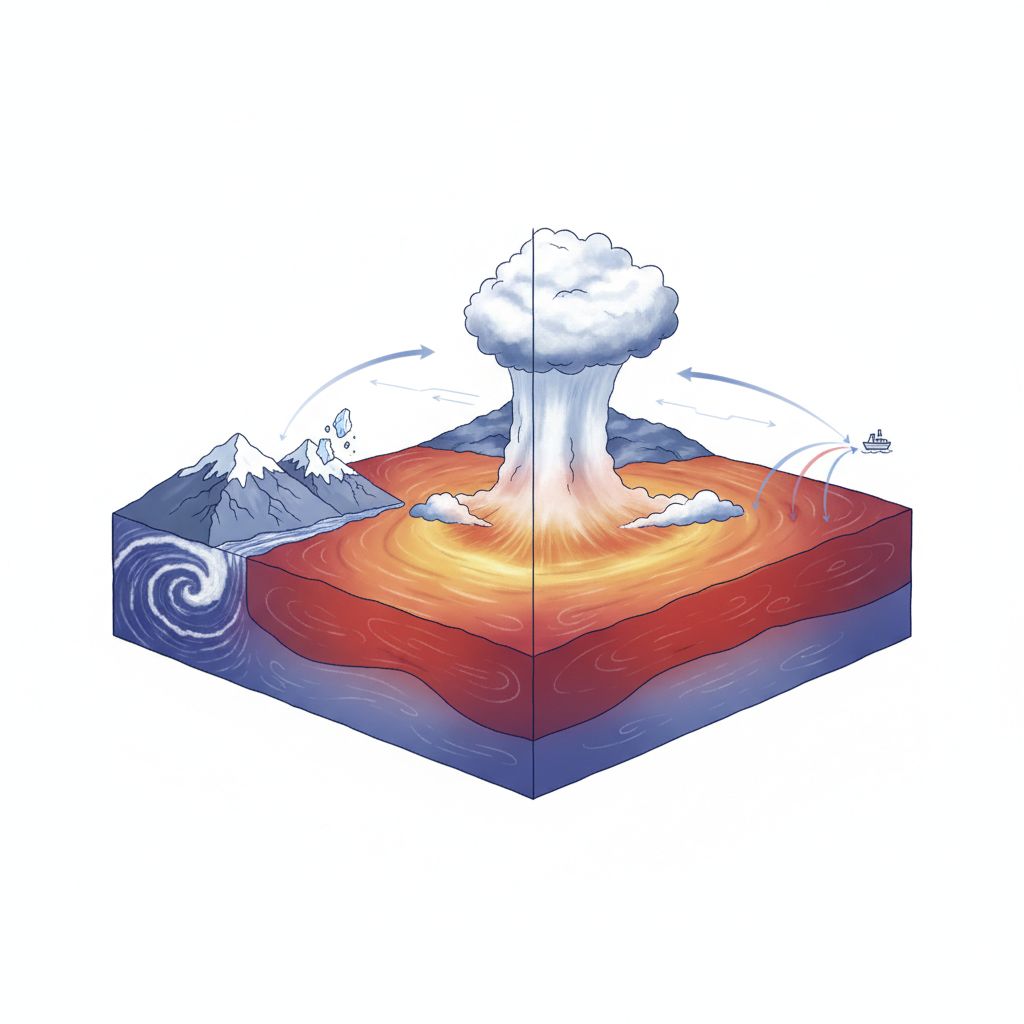
A Super El Niño event of unprecedented intensity is projected to peak in late 2026, with sea surface temperature anomalies exceeding 2°C. This phenomenon, compounded by the existing baseline warming due to climate change, is expected to exacerbate global heat extremes and trigger severe climatic disruptions, including altered monsoon patterns over India, extreme weather events worldwide, and heightened risks to food security and trade routes. The event has already been linked to recent glacial collapses and flash floods in the Himalayan region, underscoring the compounded risks of natural and anthropogenic climate drivers.
Background
- El Niño-Southern Oscillation (ENSO) is a naturally occurring climate phenomenon characterized by periodic warming (El Niño) and cooling (La Niña) of sea surface temperatures in the equatorial Pacific Ocean, with global teleconnections.
- Global warming has elevated the baseline temperature of the Earth’s climate system, amplifying the intensity and impacts of ENSO events, including El Niño.
- Historical records indicate that strong El Niño events (e.g., 1982–83, 1997–98, 2015–16) have been associated with severe droughts, heatwaves, and disruptions in global weather patterns.
- India’s southwest monsoon, which contributes ~75% of annual rainfall, is highly sensitive to ENSO variability, with El Niño phases often correlating with deficient rainfall and drought conditions.
What is a Super El Niño?
- A Super El Niño is an extreme phase of the El Niño-Southern Oscillation (ENSO) characterized by sea surface temperature (SST) anomalies in the equatorial Pacific exceeding 2°C, significantly higher than the 0.5°C threshold for a standard El Niño event.
- El Niño events arise from the weakening or reversal of trade winds, which reduces upwelling of cold water in the eastern Pacific and allows warm water to accumulate near the South American coast, disrupting global weather patterns.
- The Southern Oscillation Index (SOI), a measure of the atmospheric component of ENSO, typically turns negative during El Niño phases, indicating a weakening of the Walker Circulation—a large-scale atmospheric circulation cell in the tropical Pacific.
- Super El Niño events are rare but have occurred historically, such as in 1982–83, 1997–98, and 2015–16, and are associated with extreme climatic disruptions globally.
- The current event is projected to peak in late 2026, with conditions persisting into early 2027, amplifying the risks of extreme weather events, including heatwaves, droughts, and floods.
- The interaction between El Niño and anthropogenic climate change is critical: elevated baseline temperatures enhance the intensity and duration of El Niño events, leading to unprecedented climatic anomalies.
- El Niño’s impact on India is primarily through the weakening of the southwest monsoon winds, which reduces atmospheric moisture and heat transport, leading to deficient rainfall and drought conditions.
- The phenomenon also influences global trade routes, such as the Panama Canal, by altering precipitation patterns and water levels, thereby affecting shipping and agricultural trade.
Key Features
| Feature | Significance |
|---|---|
| Sea Surface Temperature Anomalies | Exceeding 2°C threshold in equatorial Pacific, indicating a Super El Niño event of unprecedented intensity. |
| Temporal Progression | Peak intensification expected in autumn 2026, with lingering effects into early 2027, exacerbating global climate sensitivity. |
| Thermal Spike Amplification | Superimposes temporary heat extremes on an already elevated global temperature baseline, amplifying extreme weather risks. |
| Permafrost Degradation | Accelerated thawing of permafrost in mountainous regions, contributing to glacial collapse and heightened disaster risks. |
| Monsoon Disruption | Weakening of southwest monsoon winds due to altered trade wind patterns, reducing atmospheric moisture over the Indian subcontinent. |
Why it Matters
Climate Science & Global Systems
- The Super El Niño event represents a critical perturbation in the El Niño-Southern Oscillation (ENSO) cycle, a key driver of interannual climate variability.
- Ocean-atmosphere interactions during such events release vast amounts of stored heat, altering global weather patterns and temperature distributions.
- The event underscores the compounding effects of anthropogenic climate change on natural climate variability, intensifying baseline warming trends.
Economic & Agricultural Impact
- Disruptions to monsoon patterns threaten India’s agricultural sector, with 50-60% of the population dependent on rain-fed agriculture for livelihoods.
- Reduced rainfall and erratic precipitation patterns elevate the risk of drought, famine, and crop failures, particularly in vulnerable districts.
- Global food security is at risk due to potential disruptions in major agricultural producing regions, including Australia, South America, and South Asia.
Hydrological & Infrastructure Risks
- Depletion of reservoir levels in states like Maharashtra, Karnataka, and Tamil Nadu poses severe challenges to water supply and hydroelectric power generation.
- Flash floods and mudslides, exacerbated by glacial collapse and permafrost degradation, threaten critical infrastructure and human settlements.
- Disruptions to global trade routes, such as the Panama Canal, could lead to supply chain bottlenecks and economic losses.
Disaster Management & Governance
- The event highlights the need for adaptive disaster preparedness strategies to mitigate the impacts of extreme weather events on vulnerable populations.
- Integrated climate monitoring and early warning systems are essential to forecast and respond to cascading climate-related disasters.
- Cross-sectoral coordination between meteorological agencies, agricultural bodies, and disaster management authorities is critical for effective response.
Challenges
1. Monsoon Variability & Agricultural Stress
- Erratic monsoon patterns disrupt sowing cycles, leading to suboptimal crop yields and threatening food security.
- Prolonged dry spells in key agricultural regions exacerbate soil moisture deficits, increasing the risk of drought-induced crop failure.
- Vulnerable districts, particularly in rain-shadow regions, face heightened exposure to climate-induced agricultural losses.
UPSC Link: Geography – Climate Change and Monsoon Variability
2. Water Resource Scarcity
- Depletion of reservoir levels in peninsular India threatens drinking water supply, irrigation, and industrial water usage.
- Groundwater depletion, exacerbated by reduced recharge during dry spells, further strains water availability.
- Competition for water resources between agriculture, industry, and urban sectors intensifies during periods of scarcity.
UPSC Link: Geography – Water Resources and Drought Management
3. Extreme Weather Events & Disaster Risk
- Super El Niño events increase the frequency and intensity of extreme weather phenomena, including floods, droughts, and heatwaves.
- Glacial collapse and permafrost degradation in mountainous regions elevate the risk of landslides and flash floods.
- Urban infrastructure, particularly in vulnerable cities, faces heightened exposure to climate-related disasters.
UPSC Link: Disaster Management – Climate-Induced Hazards
4. Global Trade & Economic Disruptions
- Disruptions to major agricultural producing regions can trigger global food price volatility and supply chain bottlenecks.
- Trade route closures, such as the Panama Canal, exacerbate logistical challenges and increase transportation costs.
- Economic losses from climate-induced disruptions disproportionately affect developing economies reliant on agricultural exports.
UPSC Link: Economy – Global Supply Chains and Climate Risks
5. Permafrost Degradation & Ecological Impact
- Thawing permafrost releases stored carbon and methane, accelerating climate change and further destabilizing ecosystems.
- Loss of permafrost undermines the structural integrity of mountainous slopes, increasing the risk of landslides and glacial collapse.
- Biodiversity loss in fragile ecosystems, such as the Himalayas, threatens ecological balance and ecosystem services.
UPSC Link: Environment – Climate Change and Ecosystem Stability
Challenges — UPSC Perspective
| Issue | Concern |
|---|---|
| Monsoon Variability | Erratic rainfall patterns threaten agricultural productivity and food security. |
| Water Scarcity | Depletion of reservoirs and groundwater levels exacerbates water stress in peninsular India. |
| Extreme Weather Events | Increased frequency of floods, droughts, and heatwaves poses risks to infrastructure and livelihoods. |
| Permafrost Degradation | Thawing permafrost in mountainous regions increases the risk of landslides and glacial collapse. |
| Global Trade Disruptions | Climate-induced disruptions to trade routes and agricultural regions threaten economic stability. |
Way Forward
- Enhance climate monitoring and early warning systems to improve the accuracy of monsoon and extreme weather forecasts.
- Strengthen adaptive agricultural practices, including drought-resistant crop varieties and efficient water management techniques.
- Implement integrated water resource management strategies to optimize reservoir operations and groundwater recharge.
- Develop climate-resilient infrastructure in vulnerable regions to mitigate the impact of extreme weather events.
- Promote cross-sectoral coordination between meteorological agencies, agricultural bodies, and disaster management authorities.
- Invest in research on permafrost dynamics and glacial stability to better understand and mitigate associated risks.
- Enhance global cooperation on climate adaptation and disaster risk reduction to address transboundary climate impacts.
UPSC Value Addition
Keywords for Mains Answer-Writing
El Niño-Southern Oscillation (ENSO) · Southwest Monsoon variability · Global climate teleconnections · Extreme weather events · Indian agriculture and droughts · Climate change and permafrost thaw · Global food security risks · India Meteorological Department (IMD) · World Meteorological Organization (WMO) · Climate resilience and adaptation · Panama Canal trade disruptions · Glacial lake outburst floods (GLOFs)
Concept Flow
Equatorial Pacific warming triggers El Niño conditions → Trade winds weaken, reducing atmospheric moisture over the Indian subcontinent → Southwest monsoon rainfall declines, leading to agricultural stress → Reservoir levels deplete, exacerbating water scarcity → Extreme weather events intensify, increasing disaster risks → Permafrost degradation and glacial collapse amplify environmental hazards → Global food security and trade routes face disruptions
Prelims Practice Questions
Q1. Consider the following statements regarding El Niño-Southern Oscillation (ENSO):
1. El Niño is characterized by the abnormal warming of sea surface temperatures in the equatorial Pacific Ocean.
2. El Niño events typically lead to increased rainfall in India during the southwest monsoon season.
3. The Southern Oscillation Index (SOI) is a measure of the atmospheric component of ENSO.
4. The 2026 El Niño event is projected to be a ‘Super El Niño’ with sea surface temperature anomalies exceeding 2°C.
How many of the above statements are correct?
- Only one
- Only two
- Only three
- All
Answer: All — Statements 1, 3, and 4 are correct. Statement 2 is incorrect as El Niño typically weakens the southwest monsoon, leading to reduced rainfall in India.
Q2. Assertion (A): The weakening of trade winds during El Niño events reduces atmospheric moisture and heat, resulting in diminished rainfall over the Indian subcontinent.
Reason (R): El Niño causes the equatorial Pacific to release vast amounts of oceanic heat into the atmosphere, altering global weather patterns.
Options:
A. Both A and R are true, and R is the correct explanation of A.
B. Both A and R are true, but R is not the correct explanation of A.
C. A is true, but R is false.
D. A is false, but R is true.
Answer: ? — Both A and R are true, and R correctly explains A. The weakening of trade winds during El Niño reduces moisture transport to India, leading to diminished rainfall.
Q3. Match the following climatic phenomena with their associated impacts on India:
Column I (Phenomenon)
1. El Niño
2. La Niña
3. Indian Ocean Dipole (IOD) positive phase
4. Indian Ocean Dipole (IOD) negative phase
Column II (Impact on India)
A. Enhanced southwest monsoon rainfall
B. Drought conditions and reduced monsoon rainfall
C. Increased cyclonic activity in the Bay of Bengal
D. Normal to above-normal monsoon rainfall in central and peninsular India
- 1-B, 2-D, 3-A, 4-C
- 1-B, 2-A, 3-D, 4-C
- 1-A, 2-B, 3-C, 4-D
- 1-D, 2-B, 3-A, 4-C
Answer: 1-B, 2-A, 3-D, 4-C — El Niño (1) is associated with drought conditions (B). La Niña (2) enhances monsoon rainfall (A). Positive IOD (3) leads to normal to above-normal rainfall in central and peninsular India (D). Negative IOD (4) increases cyclonic activity in the Bay of Bengal (C).
Mains Practice Question
✍ El Niño-Southern Oscillation (ENSO) events, particularly ‘Super El Niño’ phases, significantly disrupt global and regional climate systems. Critically examine the implications of the 2026 Super El Niño event for India’s monsoon dynamics, agricultural productivity, and water resource management. (15 Marks)
Approach: MODEL-ANSWER SKELETON:
1. **Introduction (2 Marks)**
– Define ENSO and its phases (El Niño, La Niña, Neutral).
– Explain the 2026 Super El Niño projection (WMO data, sea surface temperature anomalies >2°C).
2. **Impact on Indian Monsoon (4 Marks)**
– Mechanism: Weakening of trade winds and reduced moisture transport during El Niño.
– Historical correlation: 90% of El Niño years with below-normal rainfall; 65% with severe droughts (e.g., 2002, 2009).
– 2026 monsoon disruption: Early deficits (40% shortfall in June-July), partial recovery via Bay of Bengal depressions.
– Role of IMD and WMO in forecasting and early warnings.
3. **Agricultural and Economic Implications (4 Marks)**
– Drought and famine risks: 111 high-priority districts tagged by Ministry of Agriculture.
– Crop-specific impacts: Kharif sowing delays, water stress in Maharashtra, Karnataka, Tamil Nadu.
– Food security: Global and domestic supply chain disruptions (e.g., wheat, rice).
– Economic losses: GDP contraction, rural distress, and inflationary pressures.
4. **Water Resource Challenges (3 Marks)**
– Reservoir depletion: Mumbai lakes at 9% capacity; power cuts and water rationing.
– Groundwater over-exploitation: Long-term sustainability concerns.
– Adaptation strategies: Rainwater harvesting, drought-resistant crop varieties, and inter-state water sharing agreements.
5. **Conclusion and Way Forward (2 Marks)**
– Need for climate-resilient agriculture (e.g., National Mission for Sustainable Agriculture).
– Strengthening of early warning systems and disaster management protocols.
– International cooperation for climate adaptation and mitigation (e.g., Paris Agreement).
Source: orissapost.com
Generated by AanyaAi for educational purpose.
Related guides on our sites
- Current affairs for upsc 2026
- UPSC EPFO syllabus
- Gs Paper 1 Syllabus
- How to prepare for GS paper 1 for UPSC CSE mains exam

- विशेष अभियान 6: कपड़ा आयुक्त कार्यालय ने सफाई और दक्षता में बढ़ाया योगदान - October 24, 2026
- Inter-Caste Marriage Scheme: UPSC Exam Polity & Governance Insight - October 24, 2026
- मध्य प्रदेश में 118 किमी रेल नेटवर्क का उद्घाटन: विंध्य क्षेत्र में पहली बार सीधी जुड़ा, जानिए पूरा विवरण - October 24, 2026

No Comments