


31 Aug Andhra Pradesh Judiciary Adopts eSummons: UPSC & State PCS Exam Insights
✎ eSummons, under the eCourts Project Phase III, is the electronic issuance and service of summons through digital platforms, replacing traditional paper-based methods to enhance efficiency, transparency, and compliance in the…
Subject Relevance — Where This Topic Fits
- GS Paper II — Governance, Constitution, Polity, Social Justice and International Relations (Judicial Reforms, E-Governance) | GS Paper III — Science and Technology (Digital Infrastructure, Cyber Security)
- Prelims: eCourts Project, eSummons, Judicial Information Management System (JIMS), National Judicial Data Grid (NJDG), Digital India Mission, Service of Summons, Information Technology Act, 2000, Section 66D of IT Act (cheating by impersonation), Section 66E (violation of privacy), Cyber Security Policy of India
- Essay: The role of technology in transforming governance: Challenges and opportunities, Judicial reforms and access to justice in the digital age
Quick Revision: eSummons, under the eCourts Project Phase III, is the electronic issuance and service of summons through digital platforms, replacing traditional paper-based methods to enhance efficiency, transparency, and compliance in the judicial process.
Why is this in the news?
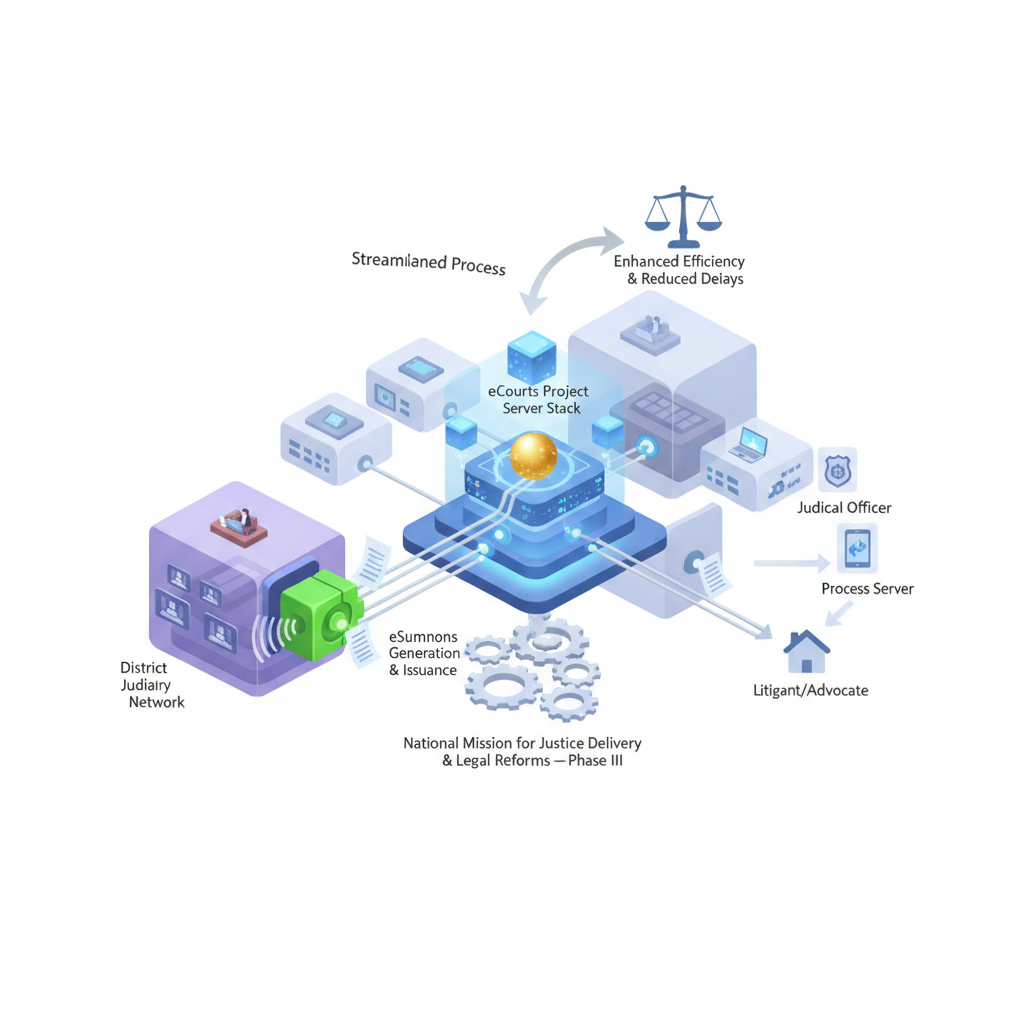
The High Court of Andhra Pradesh has achieved a significant milestone under the eCourts Project Phase III by implementing the generation and issuance of eSummons across all courts in the state’s district judiciary. This initiative aligns with the broader national effort to digitise judicial processes, enhance efficiency, and reduce delays in the delivery of justice. The move is expected to streamline the service of summons, reduce pendency, and improve compliance with legal timelines, thereby contributing to the overarching goal of judicial reform in India.
Background
- The eCourts Project is a pan-India initiative launched in 2007 under the National Mission for Justice Delivery and Legal Reforms, with the objective of transforming the Indian judiciary through digitalisation.
- Phase I (2007–2015) focused on computerisation of district and subordinate courts, while Phase II (2015–2023) expanded digital infrastructure, including the launch of the National Judicial Data Grid (NJDG) and the Judicial Information Management System (JIMS).
- Phase III (2023–2027) aims to further integrate technology, including AI-driven case management, virtual courts, and electronic service of legal documents such as summons and notices.
- The service of summons is a critical procedural step in the judicial process, governed by the Code of Civil Procedure, 1908, and the Code of Criminal Procedure, 1973, which mandate timely and effective service to ensure fair trial and due process.
- Digital service of summons via eSummons is designed to overcome challenges such as delays, non-delivery, and procedural inefficiencies associated with traditional physical summons.
- The implementation of eSummons in Andhra Pradesh follows successful pilot projects in other states, including Tamil Nadu and Karnataka, which demonstrated improvements in service efficiency and reduction in case pendency.
What is the eCourts Project and eSummons?
- The **eCourts Project** is a centrally sponsored scheme implemented by the Department of Justice, Ministry of Law and Justice, in collaboration with the e-Governance Division of the Ministry of Electronics and Information Technology (MeitY). Its primary objective is to digitise the judiciary by leveraging Information and Communication Technology (ICT) to enhance efficiency, transparency, and access to justice.
- The project is structured in three phases: Phase I (computerisation), Phase II (digital infrastructure), and Phase III (advanced technological integration, including AI, machine learning, and blockchain for judicial processes).
- eSummons refers to the electronic issuance and service of summons—legal documents requiring a party to appear in court—through digital platforms, replacing traditional paper-based methods.
- The **Judicial Information Management System (JIMS)** is a core component of the eCourts Project, enabling case management, tracking, and monitoring across the judiciary. It integrates with the **National Judicial Data Grid (NJDG)**, a nationwide repository of case data accessible to judges, lawyers, and litigants.
- eSummons is facilitated through the **eCourts Services Portal** and mobile applications, allowing for real-time tracking, acknowledgment, and compliance reporting. It is governed by the **Information Technology Act, 2000**, and the **Rules on Electronic Service of Summons** framed under it.
- The system employs **Aadhaar-based authentication** and **OTP verification** to ensure secure and verifiable service of summons, reducing the risk of fraud or impersonation.
- eSummons is part of a broader shift towards **paperless courts**, which includes electronic filing (eFiling), virtual hearings, and digital evidence management, all aimed at reducing pendency and improving judicial efficiency.
- The implementation of eSummons in Andhra Pradesh’s district judiciary marks a significant step towards achieving the **Digital India Mission’s** vision of a technologically empowered judiciary.
Key Features
| Feature | Significance |
|---|---|
| Digital issuance of summons | Eliminates physical dispatch, reducing time-lag and administrative costs in the judicial process. |
| Automated generation of summons | Ensures uniformity in format and content, minimising errors and enhancing judicial efficiency. |
| Integration with eCourts Services | Facilitates seamless tracking of summons status and reduces pendency in district judiciary. |
| Real-time delivery confirmation | Provides instantaneous feedback to courts, enabling proactive case management and monitoring. |
| Secure digital signature authentication | Validates the authenticity of summons, preventing fraud and ensuring legal compliance. |
Why it Matters
Judicial Efficiency
- Reduces procedural delays by automating summons issuance and delivery, accelerating case disposal in the district judiciary.
- Enhances transparency in judicial processes through digital tracking and audit trails of summons.
- Improves access to justice by streamlining summons-related workflows, particularly in remote and underserved districts.
Administrative Governance
- Lowers operational costs for the judiciary by reducing reliance on physical infrastructure and manual processes.
- Enhances data-driven decision-making through analytics on summons delivery rates and pendency trends.
- Strengthens inter-departmental coordination between the judiciary and law enforcement agencies for effective service.
Legal Compliance
- Ensures adherence to the Code of Civil Procedure, 1908, and the Supreme Court’s eCourts Project directives on digital service of summons.
- Facilitates compliance with the Right to Information Act, 2005, through digital record-keeping and accessibility.
Challenges
1. Digital Divide and Accessibility
- Limited digital literacy among litigants and lawyers in rural areas may hinder effective utilisation of eSummons.
- Inadequate internet connectivity in remote districts could delay or prevent timely delivery of summons.
UPSC Link: GS-II: Judiciary – Challenges
2. Cybersecurity and Data Privacy
- Risk of unauthorised access or tampering with summons documents during digital transmission.
- Compliance with the Personal Data Protection Bill, 2023, and ensuring data localisation for judicial records.
UPSC Link: GS-III: Cybersecurity
3. Technical Infrastructure Gaps
- Insufficient IT infrastructure in district courts to support seamless eSummons integration.
- Need for continuous capacity-building of judicial staff on digital tools and cyber hygiene.
UPSC Link: GS-II: Governance – Digital Infrastructure
4. Legal Recognition and Adoption
- Ensuring universal acceptance of digitally issued summons by all stakeholders, including opposing parties and witnesses.
- Addressing potential resistance to change among traditional practitioners accustomed to physical summons.
UPSC Link: GS-II: Judiciary – Reforms
Challenges — UPSC Perspective
| Issue | Concern |
|---|---|
| Digital literacy | Low awareness among litigants and lawyers may impede adoption of eSummons. |
| Connectivity gaps | Poor internet access in rural areas could delay summons delivery. |
| Cyber threats | Risk of data breaches or tampering with summons documents. |
| Infrastructure deficit | Inadequate IT systems in district courts may hinder implementation. |
| Legal scepticism | Reluctance to accept digital summons due to unfamiliarity or lack of precedent. |
| Capacity constraints | Judicial staff may lack training to manage eSummons systems effectively. |
Way Forward
- Conduct targeted digital literacy programmes for litigants, lawyers, and judicial staff in rural districts.
- Upgrade IT infrastructure in district courts, prioritising high-speed connectivity and secure servers.
- Establish a robust cybersecurity framework to protect summons data and ensure compliance with data protection norms.
- Introduce pilot monitoring mechanisms to track eSummons delivery rates and pendency trends.
- Facilitate stakeholder consultations to address concerns and build consensus on digital summons adoption.
- Develop standard operating procedures (SOPs) for handling disputes arising from digital summons service.
- Ensure periodic audits of the eSummons system to identify gaps and implement corrective measures.
- Promote inter-state coordination to harmonise digital summons processes across jurisdictions.
UPSC Value Addition
Keywords for Mains Answer-Writing
Digital India Mission · eCourts Project Phase III · eSummons · Judicial Process Modernisation · Information and Communication Technology in Judiciary · Service of Summons · Judicial Efficiency · Legal Reforms · Digital Governance · Constitutional Courts · Judicial Infrastructure · Processual Justice · Legal Technology · Access to Justice
Constitutional & Policy Linkages
- Article 39A – Equal justice and legal aid.
- Article 21 – Right to speedy trial.
- Article 51A(h) – Duty to develop scientific temper.
Concept Flow
Physical summons issuance → Digital transformation of summons process → Automated generation and issuance → Real-time tracking and confirmation → Reduced pendency and enhanced judicial efficiency → Strengthened access to justice.
Prelims Practice Questions
Q1. Consider the following statements regarding the eCourts Project in India: 1. The eCourts Project is a pan-India initiative under the Digital India Mission. 2. Phase III of the eCourts Project focuses on the integration of Artificial Intelligence and Machine Learning in judicial processes. 3. The High Court of Andhra Pradesh has implemented eSummons across all its district courts. 4. eSummons are issued electronically under the provisions of the Code of Civil Procedure, 1908. How many of the above statements are correct?
- Only one
- Only two
- Only three
- All four
Answer: All four — Statements 1, 3, and 4 are correct. Statement 2 is incorrect as Phase III of the eCourts Project primarily focuses on digital infrastructure, e-filing, and e-payments, with AI/ML integration being a future aspiration rather than a current focus.
Q2. Assertion (A): The issuance of eSummons under the eCourts Project reduces delays in the judicial process. Reason (R): eSummons ensure instantaneous delivery of summons to the concerned parties, thereby expediting the adjudication process.
- Both A and R are true, and R is the correct explanation of A.
- Both A and R are true, but R is NOT the correct explanation of A.
- A is true, but R is false.
- A is false, but R is true.
Answer: Both A and R are true, but R is NOT the correct explanation of A. — Both the assertion and reason are correct. eSummons significantly reduce delays by ensuring faster and more reliable delivery of summons compared to traditional methods, thereby expediting judicial processes.
Mains Practice Question
✍ The integration of Information and Communication Technology (ICT) in the judicial system is transforming access to justice in India. In this context, critically examine the significance of the eCourts Project and its Phase III initiatives, with particular reference to the implementation of eSummons in the High Court of Andhra Pradesh. Also, analyse the potential challenges in the widespread adoption of such digital reforms in the judiciary. (15 Marks)
Approach: MODEL-ANSWER SKELETON:
1. **Introduction (2 marks)**
– Briefly define the eCourts Project and its phases under the Digital India Mission.
– Mention the objective of Phase III: digital infrastructure, e-filing, e-payments, and processual efficiency.
2. **Significance of ICT in Judiciary (3 marks)**
– Reduces delays and backlogs in judicial processes.
– Enhances transparency, accountability, and accessibility of justice.
– Aligns with constitutional guarantees under Article 14 (equality before law) and Article 21 (right to life and liberty).
– Supports the Supreme Court’s directives in the case of *State of Maharashtra v. Praful B. Desai* (2003) on virtual court proceedings.
3. **eSummons and Judicial Efficiency (4 marks)**
– Explain the mechanism of eSummons: electronic issuance, delivery, and acknowledgment under the Code of Civil Procedure, 1908, and the Information Technology Act, 2000.
– Highlight the Andhra Pradesh High Court’s initiative: full implementation across district judiciary.
– Cite data (if available) on reduction in summons service time and improvement in case disposal rates.
– Reference the *National Policy and Action Plan for Implementation of Information and Communication Technology in the Indian Judiciary (2005)* and the *eCourts Project Phase III Vision Document*.
4. **Challenges in Digital Reforms (4 marks)**
– **Digital Divide**: Unequal access to technology among litigants, especially in rural and marginalised communities.
– **Cybersecurity Risks**: Data breaches, identity theft, and misuse of electronic records.
– **Legal and Procedural Hurdles**: Resistance from stakeholders, lack of standardised protocols, and ambiguity in legal provisions.
– **Infrastructure Deficits**: Inadequate digital infrastructure in lower courts and district judiciary.
– **Training and Capacity Building**: Need for continuous training of judicial officers, staff, and stakeholders.
5. **Way Forward (2 marks)**
– Strengthening public-private partnerships for digital infrastructure.
– Ensuring inclusive design through multi-stakeholder consultations.
– Leveraging AI for predictive analytics and case management.
– Continuous monitoring and evaluation through the *eCommittee of the Supreme Court*.
Source: aphc.gov.in
Andhra Pradesh PCS (APPSC) — State PCS Practice
Prelims: Under the eCourts Project, the High Court of Andhra Pradesh has implemented eSummons in all courts of the state to enhance judicial efficiency. Which of the following is the PRIMARY objective of introducing eSummons in the district judiciary?
- To reduce the physical movement of court summons and improve service delivery
- To increase the workload of court staff by digitizing all processes
- To replace the need for physical court hearings entirely
- To allow judges to issue summons without any legal framework
Answer: To reduce the physical movement of court summons and improve service delivery — The primary objective of eSummons is to digitize the process of serving court notices, reducing delays and improving efficiency in the judicial system.
Mains: Discuss the significance of the implementation of eSummons in the district judiciary of Andhra Pradesh under the eCourts Project. How does this initiative contribute to the broader goals of judicial reform and access to justice in the state?
Generated by AanyaAi for educational purpose.
Related guides on our sites
- Current affairs for upsc 2026
- Best PSIR optional coaching for upsc
- Best PSIR optional teacher for upsc
- Best teacher of PSIR optional for upsc

- एससीओ बैठक में भारत का आतंकवाद विरोध: क्षेत्रीय सहयोग पर जोर - October 22, 2026
- SEC Directs Strict SC Order Compliance for Andhra ULB Polls - October 22, 2026
- आंध्र प्रदेश: 100 नगर निकाय चुनाव प्रक्रिया पर रोक, सर्वोच्च न्यायालय के आदेश के बाद SEC ने रोकी प्रक्रिया - October 22, 2026

No Comments