


31 Aug RBI Survey: Mutual Funds’ Foreign Assets & Liabilities in 2025-26
✎ The net foreign liabilities of Indian mutual funds declined to US$ 21.3 billion in 2025-26 from US$ 22.3 billion in 2024-25, reflecting a 23.9% increase in overseas assets (US$ 10.2 billion) outpacing a 3.3% rise in foreign…
Subject Relevance — Where This Topic Fits
- GS Paper III — Indian Economy: Issues relating to Planning, Mobilisation of Resources, Growth, Development and Employment | GS Paper III — Liberalisation of Capital Account: Foreign Portfolio Investment (FPI) and Foreign Direct Investment (FDI) | GS Paper III — Balance of Payments: Components and Trends | GS Paper III — Role of RBI in Regulation and Supervision of Financial Markets
- Prelims: Mutual Funds (MFs), Asset Management Companies (AMCs), Foreign Liabilities and Assets (FLA) Survey, Foreign Portfolio Investment (FPI), Foreign Direct Investment (FDI), Balance of Payments (BoP), RBI reference rate, Net Foreign Liabilities, Market Value vs Face Value, Non-Resident Holdings, Capital Account Liberalisation
- Essay: Globalisation and Financial Integration: Balancing Growth with Stability, Role of Regulatory Institutions in Safeguarding Economic Sovereignty
Quick Revision: The net foreign liabilities of Indian mutual funds declined to US$ 21.3 billion in 2025-26 from US$ 22.3 billion in 2024-25, reflecting a 23.9% increase in overseas assets (US$ 10.2 billion) outpacing a 3.3% rise in foreign liabilities (US$ 31.5 billion), primarily driven by higher holdings of foreign equity securities.
Why is this in the news?
The Reserve Bank of India (RBI) released the results of the 2025-26 Survey of Foreign Liabilities and Assets (FLA) of Mutual Funds (MFs) and their Asset Management Companies (AMCs), highlighting trends in foreign investments by Indian mutual funds, changes in liabilities to non-residents, and shifts in overseas asset holdings. The data provides critical insights into the evolving structure of India’s capital account, the composition of foreign investments, and the geographical distribution of mutual fund exposures, which are essential for understanding macroeconomic stability and policy calibration.
Background
- The Survey of Foreign Liabilities and Assets (FLA) is conducted annually by the RBI under the Foreign Exchange Management Act (FEMA), 1999, to assess the external financial exposure of Indian entities, including mutual funds and AMCs.
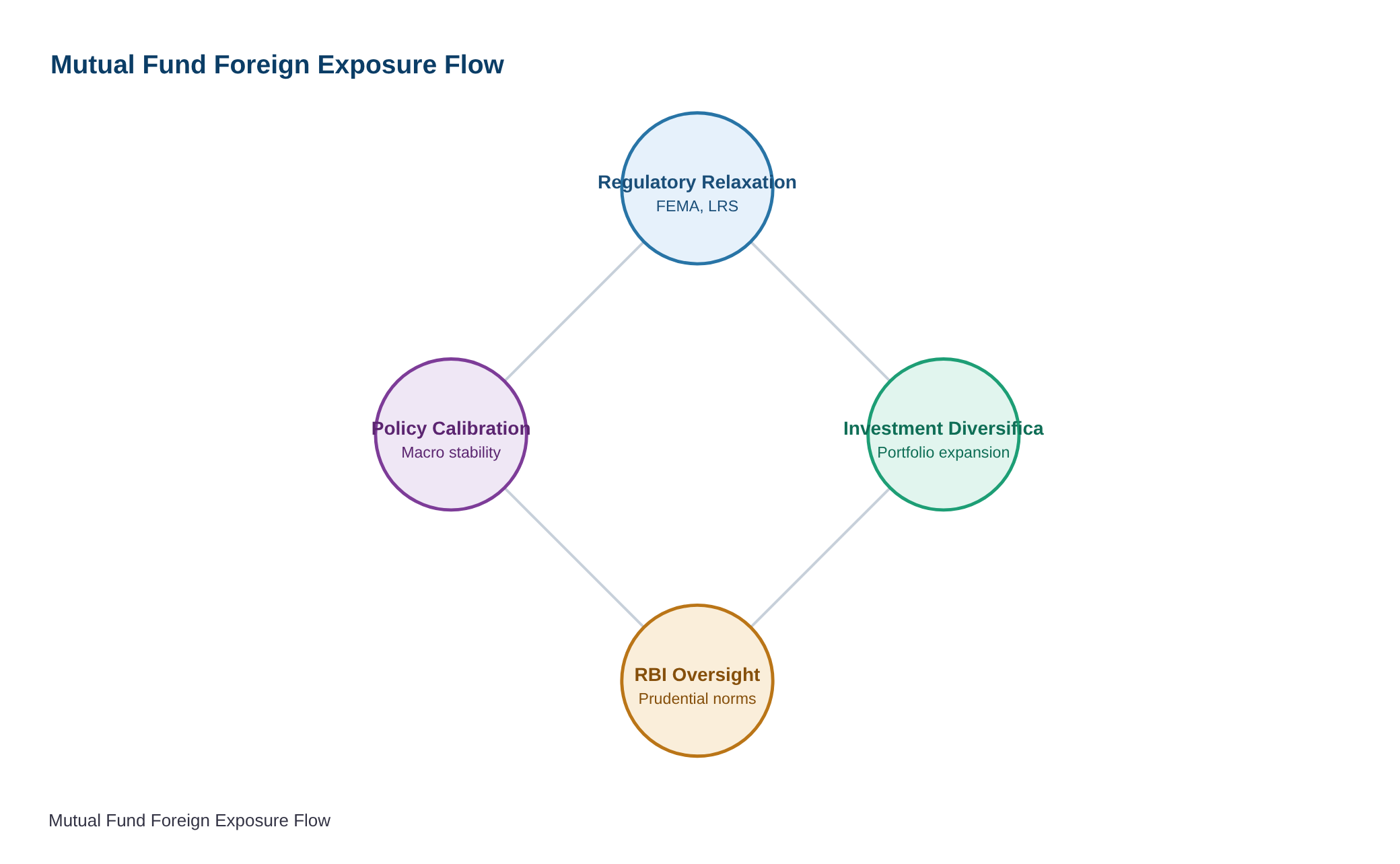
- Mutual funds in India have progressively expanded their foreign investments, driven by regulatory relaxations under the Foreign Exchange Management (Non-Debt Instruments) Rules, 2019, and the Liberalised Remittance Scheme (LRS), enabling greater outward portfolio diversification.
- The global financial landscape post-2020 has been characterised by volatile capital flows, rising geopolitical risks, and divergent monetary policies across major economies, influencing investment decisions of Indian mutual funds.
- India’s balance of payments (BoP) framework distinguishes between current account transactions (trade in goods/services) and capital account transactions (investments and borrowings), with mutual funds playing a pivotal role in the latter through foreign portfolio investments.
- The RBI’s regulatory oversight over mutual funds’ foreign exposures ensures compliance with prudential norms, limits on leverage, and adherence to foreign exchange regulations to mitigate systemic risks.
- The survey data is utilised by policymakers to assess the impact of foreign investments on rupee stability, foreign exchange reserves, and overall financial sector resilience.
What is the Survey of Foreign Liabilities and Assets (FLA) of Mutual Funds?
- The FLA survey is a statutory exercise mandated under FEMA, 1999, to collect data on the foreign assets and liabilities of Indian mutual funds and their AMCs as of the end of each financial year.
- It captures quantitative details such as the face value and market value of units held by non-residents, unit premium reserves, and other foreign liabilities and assets, including overseas equity and debt securities.
- The survey covers all Indian mutual funds that have acquired or held foreign assets/liabilities during the reference year or in preceding years, ensuring comprehensive coverage of the sector’s external exposure.
- Data is collected in both Indian Rupees (₹) and US Dollars ($) using the RBI reference rate prevailing at the end of March, enabling cross-year comparability and international benchmarking.
- The survey distinguishes between foreign liabilities (e.g., units issued to non-residents) and foreign assets (e.g., holdings of foreign securities), providing a net position that reflects the sector’s external financial obligations and claims.
- Findings from the survey inform the RBI’s macro-prudential policies, including adjustments to investment limits, risk weights, and liquidity norms for mutual funds engaging in cross-border investments.
- The survey also aids in assessing the geographical concentration of risks, such as exposure to specific jurisdictions, and the potential impact of geopolitical or economic shocks on India’s financial stability.
Key Features
| Feature | Significance |
|---|---|
| Foreign Liabilities of Mutual Funds (MFs) | Increased by 3.3% (y-o-y) to US$ 31.5 billion, primarily due to rise in market value of units issued to non-residents, reflecting growing foreign investor participation in Indian MFs. |
| Overseas Assets of MFs | Surged by 23.9% to US$ 10.2 billion, driven by increased holdings in foreign equity securities, indicating enhanced global diversification by Indian MFs. |
| Net Foreign Liabilities of MFs | Declined to US$ 21.3 billion from US$ 22.3 billion, suggesting improved balance between foreign liabilities and assets held by MFs. |
| Top Investment Destinations | United Arab Emirates, United States, United Kingdom, and Singapore accounted for ~50% of MF units held by non-residents, highlighting key geographies for foreign investments in Indian MFs. |
| Foreign Liabilities of Asset Management Companies (AMCs) | Rose by 18.1% to US$ 8.7 billion, driven by inward direct investments and portfolio investments, reflecting growing foreign interest in Indian asset management sector. |
| Geographical Distribution of FDI in AMCs | Japan and Canada together accounted for ~80% of total FDI in AMCs, indicating concentrated foreign direct investment sources in the sector. |
Why it Matters
Macroeconomic Implications
- Demonstrates India’s increasing integration with global capital markets, with MFs and AMCs acting as conduits for foreign portfolio and direct investments.
- Reflects growing confidence of foreign investors in Indian financial markets, particularly in equity securities and MF units.
- Enhances India’s foreign exchange reserves indirectly by attracting foreign capital into domestic financial instruments.
- Supports the development of a robust and globally connected asset management industry in India.
Financial Sector Development
- Signals maturation of India’s mutual fund industry, with greater foreign participation and global asset allocation capabilities.
- AMCs’ increasing foreign liabilities indicate deeper financial integration, potentially improving liquidity and investment opportunities.
- Diversification of foreign investments by MFs reduces concentration risk and enhances portfolio resilience.
- Promotes adoption of global best practices in fund management and risk assessment within Indian MFs.
Policy and Regulatory Insights
- Provides data for the Reserve Bank of India (RBI) to monitor and regulate cross-border financial flows associated with MFs and AMCs.
- Helps assess the impact of foreign investments on domestic financial stability and systemic risk.
- Informs policy decisions on capital account convertibility and foreign investment limits in the financial sector.
- Supports macro-prudential supervision by tracking the build-up of foreign liabilities and assets in the mutual fund ecosystem.
Challenges
1. Capital Flight Risk
- Sudden reversal of foreign investments in MF units could lead to capital outflows, impacting liquidity and market stability.
- Dependence on specific geographies (e.g., UAE, US) for foreign investments increases vulnerability to regional economic shocks.
UPSC Link: GS3: Capital Flight and Financial Stability
2. Regulatory Arbitrage
- Complexity in monitoring and regulating cross-border investments by MFs and AMCs may create loopholes for regulatory arbitrage.
- Differences in regulatory frameworks across jurisdictions could lead to inconsistent oversight of foreign-held assets.
UPSC Link: GS3: Regulatory Framework for Financial Markets
3. Exchange Rate Volatility
- Fluctuations in exchange rates can significantly impact the valuation of foreign assets and liabilities of MFs and AMCs.
- Sudden depreciation of the rupee could increase the burden of foreign liabilities in rupee terms.
UPSC Link: GS3: Exchange Rate Management
4. Systemic Risk in Asset Management
- Concentration of foreign investments in a few geographies or asset classes may amplify systemic risks in the event of a market downturn.
- Over-reliance on foreign capital could expose the financial sector to global financial cycles and contagion risks.
UPSC Link: GS3: Financial Sector Stability
5. Data Gaps and Surveillance
- Ensuring accuracy and timeliness of data on foreign liabilities and assets remains a challenge for regulators.
- Lack of granular data on the nature of foreign investments (e.g., sectoral distribution) may hinder effective policy formulation.
UPSC Link: GS3: Financial Data Surveillance
Challenges — UPSC Perspective
| Issue | Concern |
|---|---|
| Concentration Risk in Geographies | Overdependence on UAE, US, UK, and Singapore for foreign investments increases vulnerability to regional economic or geopolitical shocks. |
| Valuation Volatility in Foreign Assets | Market value fluctuations in foreign equity securities can lead to sudden changes in the net liabilities of MFs, affecting financial stability. |
| Regulatory Oversight Gaps | Complex cross-border financial flows may outpace the regulatory framework, creating gaps in monitoring and enforcement. |
| Exchange Rate Exposure | Rupee depreciation could inflate the burden of foreign liabilities, impacting the profitability and solvency of MFs and AMCs. |
| Liquidity Risks in Foreign Investments | Sudden withdrawal of foreign investments could strain the liquidity of MFs, particularly if assets are illiquid or market conditions are adverse. |
| Data Accuracy and Timeliness | Delays or inaccuracies in reporting foreign liabilities and assets may hinder the RBI’s ability to assess systemic risks promptly. |
Way Forward
- Strengthen macro-prudential surveillance by the RBI to monitor cross-border financial flows associated with MFs and AMCs, including stress testing for sudden capital reversals.
- Enhance data collection and reporting mechanisms to ensure real-time tracking of foreign liabilities and assets, with granular sectoral and geographical breakdowns.
- Review and rationalise regulatory frameworks to address gaps in oversight of foreign investments in the mutual fund sector, ensuring consistency with global standards.
- Promote diversification of foreign investment sources beyond concentrated geographies to mitigate regional risks and enhance resilience.
- Develop contingency plans for managing capital flight scenarios, including liquidity support mechanisms and communication strategies to maintain investor confidence.
- Encourage AMCs to adopt robust risk management frameworks to hedge against exchange rate volatility and market risks in foreign assets.
- Facilitate capacity-building in regulatory agencies to keep pace with the evolving complexity of cross-border financial transactions.
- Collaborate with international financial institutions (e.g., IMF, BIS) to align regulatory practices and enhance global financial stability.
UPSC Value Addition
Keywords for Mains Answer-Writing
Capital Account Convertibility · Foreign Portfolio Investment (FPI) · Mutual Funds (MFs) regulations · Foreign Liabilities and Assets Survey · RBI’s regulatory oversight on MFs · Net Foreign Liabilities of Mutual Funds · Overseas Investment by Indian Mutual Funds · Non-Resident Investment in Indian MFs · Liberalised Remittance Scheme (LRS) · Foreign Exchange Management Act (FEMA), 1999 · Asset Management Companies (AMCs) foreign exposure · Top destinations for Indian MF investments · Market value vs face value of MF units · Foreign equity securities holdings by MFs
Concept Flow
Foreign investments in Indian MFs and AMCs → Increase in foreign liabilities and assets → Growth in overseas equity holdings by MFs → Diversification of investor base and asset portfolios → Enhanced integration with global capital markets → Need for robust regulatory oversight and risk management → Potential systemic risks from capital reversals or exchange rate fluctuations → Policy responses to ensure financial stability and investor protection.
Prelims Practice Questions
Q1. Consider the following statements regarding the Survey of Foreign Liabilities and Assets of Mutual Funds (MFs) – 2025-26:
1. The foreign liabilities of Mutual Funds increased by 3.3 per cent (y-o-y) to US$ 31.5 billion as on end-March 2026.
2. The overseas assets of Mutual Funds increased by 23.9 per cent and stood at US$ 10.2 billion as on end-March 2026.
3. The United Arab Emirates, the United States of America, the United Kingdom, and Singapore together accounted for around 50 per cent share in MF units held by non-residents.
4. The foreign liabilities of Asset Management Companies (AMCs) decreased by 18.1 per cent (y-o-y) to US$ 8.7 billion as of end-March 2026.
How many of the above statements are correct?
- Only one
- Only two
- Only three
- All four
Answer: Only three — Statements 1, 2, and 3 are correct. Statement 4 is incorrect as the foreign liabilities of AMCs increased by 18.1 per cent (y-o-y) to US$ 8.7 billion.
Q2. Assertion (A): The Reserve Bank of India conducts the Survey of Foreign Liabilities and Assets of Mutual Funds annually to assess their exposure to foreign markets.
Reason (R): The survey is mandated under the Foreign Exchange Management Act (FEMA), 1999, to monitor capital flows and ensure compliance with regulatory norms.
Options:
A. Both A and R are true, and R is the correct explanation of A.
B. Both A and R are true, but R is not the correct explanation of A.
C. A is true, but R is false.
D. A is false, but R is true.
Answer: ? — Both Assertion (A) and Reason (R) are true. The RBI conducts the survey to assess foreign exposure of MFs, and FEMA, 1999, provides the legal framework for monitoring capital flows.
Mains Practice Question
✍ Critically examine the significance of the Survey of Foreign Liabilities and Assets of Mutual Funds (MFs) in the context of India’s capital account management and foreign investment regime. Also, analyse the implications of the observed trends in foreign liabilities and assets of MFs for macroeconomic stability and financial sector regulation. (15 Marks)
Approach: MODEL-ANSWER SKELETON:
1. **Introduction to the Survey and its Regulatory Framework**
– Define the Survey of Foreign Liabilities and Assets of MFs and its purpose under RBI’s oversight.
– Cite the legal basis: Foreign Exchange Management Act (FEMA), 1999, and RBI’s regulatory powers.
– Mention the scope: Coverage of 53 MFs and their AMCs, valuation at market value, and inclusion of non-resident holdings.
2. **Key Trends and Data (2025-26)**
– Foreign liabilities of MFs: Increase of 3.3% (y-o-y) to US$ 31.5 billion, driven by market value of units issued to non-residents.
– Overseas assets of MFs: Increase of 23.9% to US$ 10.2 billion, primarily due to holdings in foreign equity securities.
– Net foreign liabilities declined to US$ 21.3 billion from US$ 22.3 billion.
– Top destinations for MF units held by non-residents: UAE, USA, UK, and Singapore (50% share).
– Investment in overseas equity securities by MFs increased by 37.5%, concentrated in USA, Luxembourg, and Ireland.
3. **Significance for Capital Account Management**
– **Capital Account Convertibility (CAC)**: The survey reflects India’s gradual liberalisation of capital flows, allowing MFs to invest overseas while managing risks.
– **Foreign Portfolio Investment (FPI)**: Non-resident holdings in MF units indicate India’s attractiveness as an investment destination.
– **Macroeconomic Stability**: Trends in net foreign liabilities (decline) suggest reduced external vulnerability, but rising overseas assets indicate diversification.
4. **Regulatory and Supervisory Implications**
– RBI’s role in monitoring systemic risks arising from MFs’ foreign exposure.
– Need for prudential norms to limit excessive leverage or concentration risks.
– Alignment with global standards (e.g., IMF’s Institutional View on Capital Flows) for managing volatile capital flows.
5. **Challenges and Risks**
– **Exchange Rate Volatility**: Impact of currency fluctuations on the valuation of foreign assets/liabilities.
– **Global Economic Shocks**: Sensitivity of MFs’ overseas investments to geopolitical or financial crises.
– **Regulatory Arbitrage**: Ensuring compliance with FEMA and other norms while allowing operational flexibility.
6. **Conclusion**
– Reiterate the survey’s role in providing data-driven insights for policy formulation.
– Emphasise the need for a balanced approach: Liberalisation to attract FPI while maintaining financial stability.
– Suggest further measures: Enhancing transparency, strengthening risk management frameworks, and promoting investor education.
Source: RBI
Generated by AanyaAi for educational purpose.
Related guides on our sites
- Best PSIR optional coaching for upsc
- Best economics optional coaching for upsc
- Best PSIR optional teacher for upsc
- Best teacher of PSIR optional for upsc


No Comments