


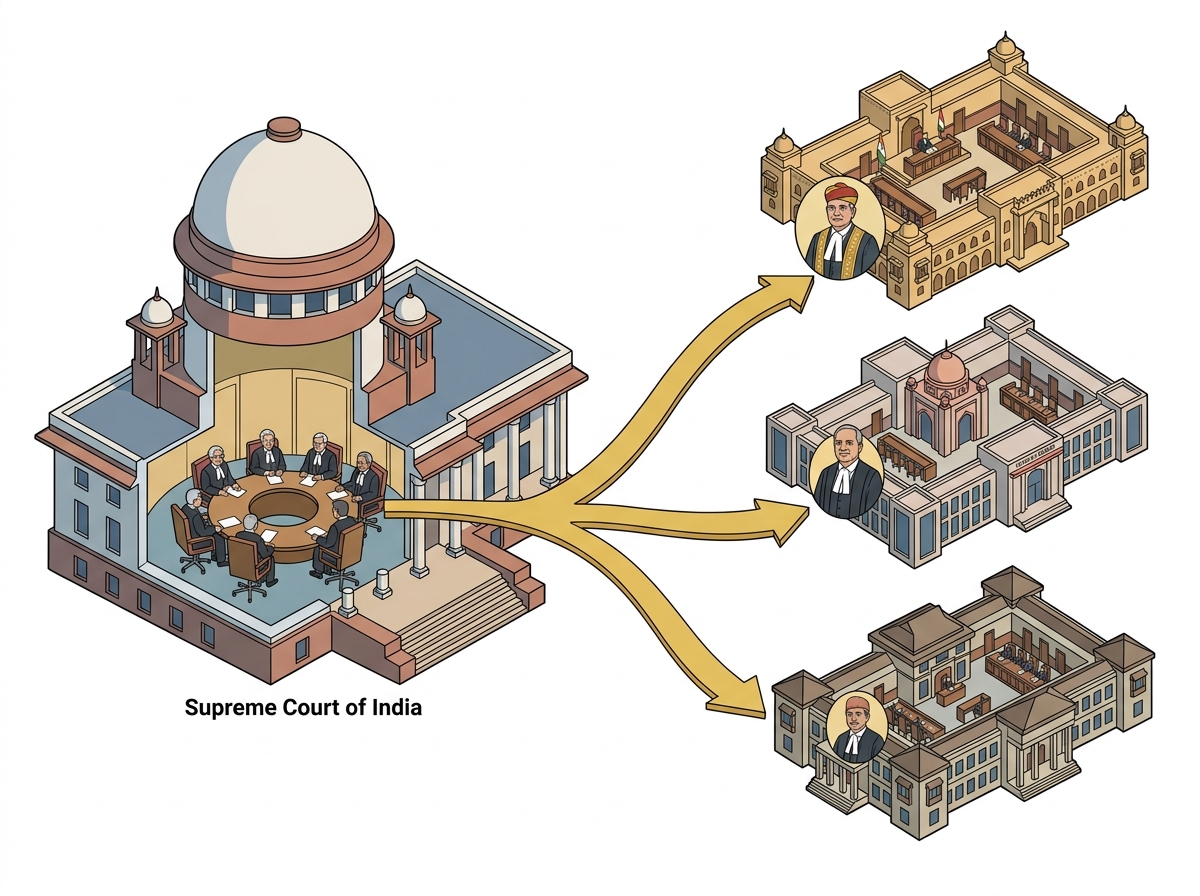
01 Sep Supreme Court Collegium Recommends New Chief Justices for Three High Courts
✎ The Supreme Court Collegium, as per judicial precedents, holds primacy in recommending judicial appointments to the higher judiciary, ensuring constitutional governance and judicial independence.
Subject Relevance — Where This Topic Fits
- GS Paper II — Polity and Governance (Constitutional Bodies) | GS Paper IV — Ethics and Governance (Appointment Processes)
- Prelims: Collegium System, High Court Chief Justice, Article 217, Judicial Appointments, Supreme Court Collegium
- Essay: Judicial Independence and Constitutional Governance, Role of Constitutional Institutions in Upholding Rule of Law
Quick Revision: The Supreme Court Collegium, as per judicial precedents, holds primacy in recommending judicial appointments to the higher judiciary, ensuring constitutional governance and judicial independence.
Why is this in the news?
The Supreme Court Collegium has recommended the appointment of new Chief Justices for three High Courts—Rajasthan, Madhya Pradesh, and Jammu & Kashmir and Ladakh—following its meeting on Monday, September 1, 2026. These recommendations are significant as they reflect the Collegium’s role in judicial appointments under the Constitution, particularly in ensuring judicial continuity and institutional integrity. The process involves constitutional scrutiny by the government before formal appointments are made.
Background
- The Supreme Court Collegium is a body of senior Supreme Court judges responsible for recommending judicial appointments to the higher judiciary, including High Court Chief Justices and judges, as per the Supreme Court’s judgment in the Second and Third Judges Cases (1993, 1998).
- Judicial appointments in India are governed by Articles 217 and 224 of the Constitution, which mandate consultation with the Chief Justice of India and other senior judges before appointments are made.
- The Collegium system evolved as a judicial interpretation to ensure judicial independence, reducing executive interference in judicial appointments.
- High Court Chief Justices play a pivotal role in the administration of justice, overseeing judicial functions, and ensuring the timely disposal of cases in their respective jurisdictions.
- Recent recommendations follow a structured process of evaluation based on seniority, merit, and administrative efficiency, as per judicial conventions.
- The recommendations are subject to constitutional scrutiny and final approval by the President of India, acting on the advice of the Union Government.
What is the Supreme Court Collegium and its Role in Judicial Appointments?
- The Supreme Court Collegium is a body of the five senior-most judges of the Supreme Court, including the Chief Justice of India, responsible for recommending appointments to the higher judiciary.
- It was established through judicial pronouncements in the Second Judges Case (1993) and Third Judges Case (1998), which interpreted Articles 124(2) and 217 of the Constitution to assert judicial primacy in appointments.
- The Collegium system aims to insulate judicial appointments from political interference, ensuring independence and impartiality in the judiciary.
- The Collegium recommends appointments for Chief Justices of High Courts, Additional Judges elevated to permanent positions, and transfers of High Court judges across states.
- The process involves consultations among Collegium members, evaluation of seniority, merit, and past performance, and consensus-building before recommendations are finalised.
- Once recommendations are made, they are forwarded to the Union Government for scrutiny and approval, followed by formal appointments by the President of India.
- The Collegium’s recommendations are not subject to judicial review, but the government may seek clarifications or raise objections before granting approval.
- This system has been a subject of debate, with critics arguing for greater transparency and executive involvement, while proponents highlight its role in safeguarding judicial autonomy.
Key Features
| Feature | Significance |
|---|---|
| Appointment of Chief Justices by Supreme Court Collegium | Ensures judicial independence by insulating appointments from executive interference, as per the Third Judges Case (1998) interpretation of Article 124(2) of the Constitution. |
| Recommendation of Justices for Rajasthan High Court | Addresses concerns of judicial governance in a state with significant pendency and constitutional importance, particularly after allegations regarding the functioning of the acting Chief Justice. |
| Appointment of Justices for Madhya Pradesh High Court | Strengthens judicial capacity in a High Court with substantial litigation load, ensuring continuity in leadership during a period of high judicial activity. |
| Appointment of Chief Justice for Jammu & Kashmir and Ladakh High Court | Supports judicial administration in a Union Territory with unique constitutional status under Article 370 (now repealed) and Article 371, ensuring stability in a region of strategic importance. |
| Collegium System’s Decision-Making Process | Demonstrates the collegial and consensus-driven approach of the Supreme Court Collegium in judicial appointments, balancing seniority, merit, and regional representation. |
Why it Matters
Judicial Governance
- Maintains the integrity and independence of the judiciary by ensuring that Chief Justices are appointed based on merit and seniority, free from executive influence.
- Facilitates continuity in judicial administration, particularly in High Courts with high pendency rates, such as Rajasthan and Madhya Pradesh.
- Supports the rule of law in Union Territories like Jammu & Kashmir and Ladakh, where judicial stability is crucial for governance and public confidence.
Constitutional Framework
- Reinforces the constitutional scheme of judicial appointments under Article 217, which vests the power of appointment in the President after consultation with the Chief Justice of India.
- Aligns with the principle of judicial independence, as enunciated in the landmark judgment of the Supreme Court in the Second and Third Judges Cases (1993, 1998).
- Ensures that the judiciary remains a check on arbitrary executive actions, particularly in matters of governance and constitutional interpretation.
Institutional Stability
- Provides stability in judicial leadership during periods of transition, such as the retirement of a Chief Justice, thereby avoiding governance gaps in the judiciary.
- Supports the efficient disposal of cases by ensuring that High Courts are led by experienced judicial officers who can manage administrative and judicial functions effectively.
Challenges
1. Judicial Pendency and Backlog
- High pendency rates in High Courts like Rajasthan and Madhya Pradesh necessitate timely appointments to ensure efficient case disposal.
- Delays in judicial appointments can exacerbate the backlog of cases, undermining public trust in the judiciary.
UPSC Link: Judicial Pendency (Article 217, 227)
2. Allegations of Judicial Misconduct
- Allegations of impropriety against acting Chief Justices, as reported in the Rajasthan High Court, highlight the need for transparent and merit-based appointments to maintain public confidence.
- Such allegations can erode trust in the judiciary and necessitate corrective measures to uphold its credibility.
UPSC Link: Judicial Accountability (Article 124)
3. Regional Representation and Balance
- Ensuring equitable representation of judges from different regions and High Courts in the appointment process is a persistent challenge to maintain diversity and inclusivity.
- Balancing seniority with regional representation requires careful deliberation to avoid perceptions of bias.
UPSC Link: Judicial Appointments (Article 217)
4. Constitutional Status of Union Territories
- The unique constitutional status of Jammu & Kashmir and Ladakh, particularly post-repeal of Article 370, necessitates judicial appointments that are sensitive to local governance needs.
- Ensuring continuity in judicial leadership in these regions is critical for maintaining stability and public order.
UPSC Link: Article 370, Article 371
Challenges — UPSC Perspective
| Issue | Concern |
|---|---|
| Judicial Pendency | High case backlog in High Courts like Rajasthan and Madhya Pradesh necessitates timely appointments to ensure efficient judicial administration. |
| Allegations of Misconduct | Public allegations against acting Chief Justices can undermine trust in the judiciary and require transparent appointment processes. |
| Regional Representation | Balancing seniority with regional representation in judicial appointments is essential to maintain diversity and inclusivity. |
| Constitutional Status of Union Territories | The unique governance framework of Jammu & Kashmir and Ladakh requires judicial appointments that are sensitive to local needs and stability. |
| Executive-Judiciary Balance | Ensuring that judicial appointments remain insulated from executive interference is critical to uphold judicial independence. |
| Administrative Continuity | Delays in appointing Chief Justices can lead to governance gaps, particularly during the retirement of incumbent Chief Justices. |
Way Forward
- The Union Government must expeditiously process the Collegium’s recommendations to avoid delays in judicial appointments and ensure continuity in judicial governance.
- The Rajasthan High Court should address allegations of judicial misconduct through established mechanisms to maintain public trust in the judiciary.
- The Collegium should continue to prioritize merit, seniority, and regional representation in judicial appointments to uphold the principles of fairness and transparency.
- Judicial training programs should be strengthened to prepare senior judges for leadership roles, ensuring they are equipped to manage administrative and judicial functions effectively.
- Public awareness campaigns should be conducted to educate citizens about the judicial appointment process and the constitutional safeguards in place to ensure independence.
- The judiciary should explore technological solutions to reduce pendency, such as digital case management systems, to complement leadership continuity.
- Judicial accountability mechanisms should be reviewed and strengthened to address concerns of misconduct and ensure the integrity of the judiciary.
UPSC Value Addition
Keywords for Mains Answer-Writing
Supreme Court Collegium System · Appointment of High Court Chief Justices · Article 217 of the Constitution of India · Judicial Appointments Commission (JAC) · Constitutional provisions governing judicial appointments · Role of the President in judicial appointments · Judicial independence and accountability · High Court Chief Justice appointments process · Judicial reforms and transparency · Constitutional functionaries in India
Constitutional & Policy Linkages
- Article 124(2) — Appointment of Judges to the Supreme Court
- Article 217 — Appointment of High Court Judges
- Article 227 — Power of Superintendence over Subordinate Courts
- Third Judges Case (1998) — Collegium System Interpretation
Concept Flow
Supreme Court Collegium identifies vacancies in High Courts → → Collegium evaluates seniority, merit, and regional representation for appointments → → Recommendations forwarded to the Union Government for approval → → Union Government processes recommendations under constitutional provisions → → President appoints Chief Justices after due consultation → → New Chief Justices assume office, ensuring judicial continuity and governance → → Judicial administration improves with stable leadership, reducing pendency and enhancing public trust.
Prelims Practice Questions
Q1. Consider the following statements regarding the appointment of High Court Chief Justices in India:
1. The Supreme Court Collegium recommends names for appointment as High Court Chief Justices.
2. The President of India appoints High Court Chief Justices based on the Collegium’s recommendations.
3. The appointment is governed by Article 217 of the Constitution of India.
4. The Governor of the respective state has a decisive role in the appointment process.
How many of the above statements are correct?
- Only one
- Only two
- Only three
- All
Answer: All — Statements 1, 2, and 3 are correct. The Supreme Court Collegium recommends names for appointment as High Court Chief Justices under Article 217, and the President appoints them. The Governor does not have a decisive role in the appointment process.
Q2. Assertion (A): The Supreme Court Collegium system has been criticized for its lack of transparency and accountability.
Reason (R): The Collegium system vests the power of judicial appointments solely with a group of senior judges, bypassing executive and legislative oversight.
Codes:
A. Both A and R are true, and R is the correct explanation of A.
B. Both A and R are true, but R is not the correct explanation of A.
C. A is true, but R is false.
D. A is false, but R is true.
- A
- B
- C
- D
Answer: A — Both the Assertion (A) and Reason (R) are true, and R correctly explains A. The Collegium system’s lack of transparency and accountability stems from its exclusive reliance on senior judges for appointments.
Mains Practice Question
✍ The Supreme Court Collegium has recommended the appointment of new Chief Justices for three High Courts. Examine the constitutional and institutional framework governing the appointment of High Court Chief Justices in India. Also, discuss the challenges associated with the Collegium system and suggest measures to enhance transparency and accountability. (15 Marks)
Approach: MODEL-ANSWER SKELETON:
1. **Constitutional Framework (5 Marks)**
– Article 217: Appointment of High Court judges and Chief Justices.
– Role of the President (Article 74) and the Governor (Article 153) in the appointment process.
– The Collegium system: Evolution from the First Judges Case (1981) to the Third Judges Case (1998).
2. **Institutional Process (5 Marks)**
– Composition of the Supreme Court Collegium: Senior-most judges.
– Consultation with High Court Chief Justices and the Executive.
– Transparency in the process: Public disclosure of reasons for recommendations.
3. **Challenges and Criticisms (3 Marks)**
– Lack of transparency and accountability in the Collegium system.
– Allegations of nepotism, favoritism, and lack of diversity.
– Absence of legislative or executive oversight.
4. **Measures for Reform (2 Marks)**
– Introduction of a Judicial Appointments Commission (JAC) as recommended by the Law Commission of India.
– Greater transparency in the selection process, including public consultations.
– Strengthening the role of the Executive in the appointment process while maintaining judicial independence.
Source: amarujala.com
Generated by AanyaAi for educational purpose.
Related guides on our sites
- Anthropology VS PSIR
- Best PSIR optional coaching
- Best PSIR optional coaching online
- Best PSIR optional teacher


No Comments